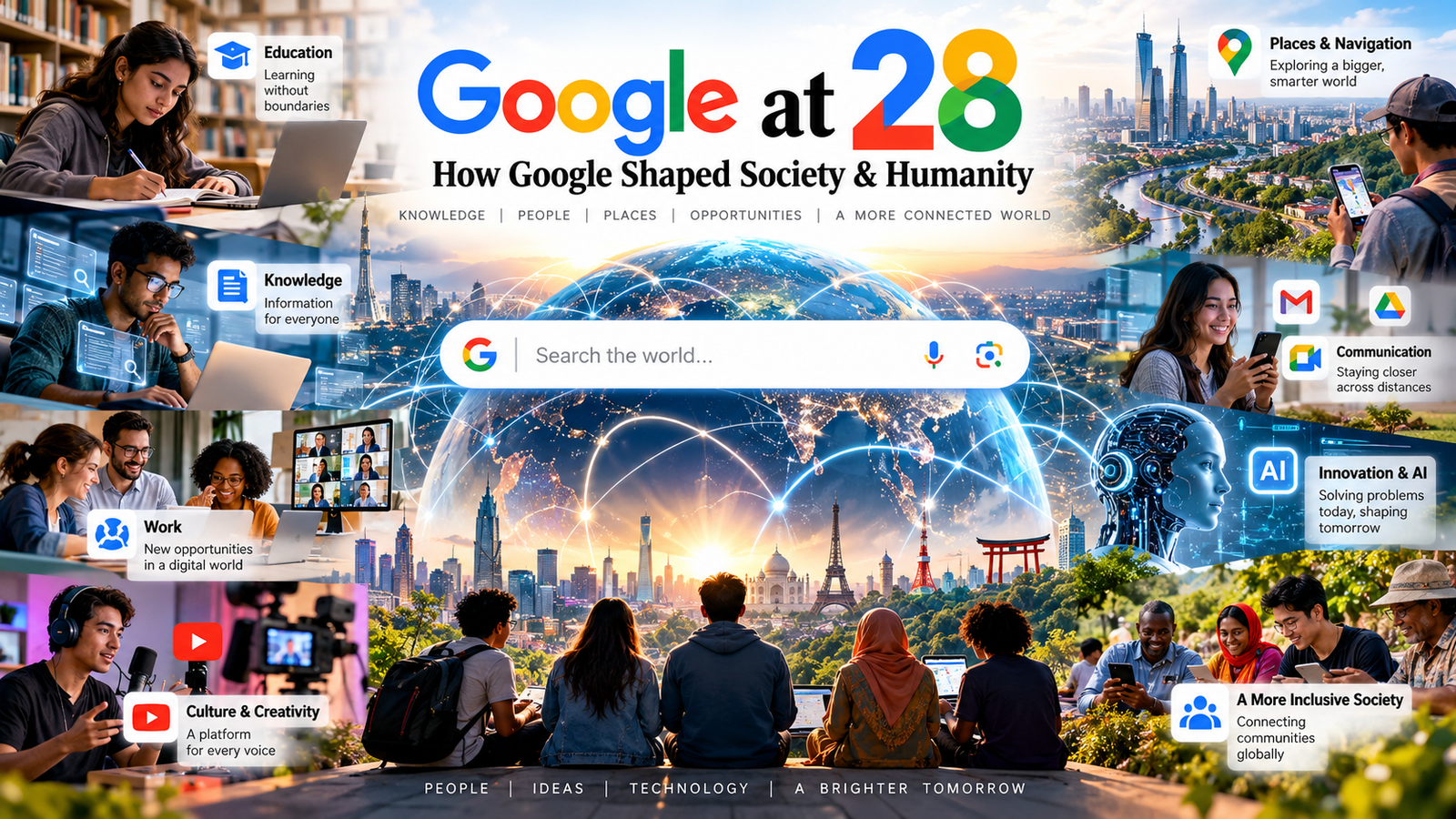
On September 27, 2026, Google celebrates its 28th birthday. For many people, the occasion may appear to be simply another anniversary of a technology company. From a sociological perspective, however, Google’s 28-year journey represents something much larger: the transformation of human society through information technology.
Google was incorporated in September 1998, although the company itself has explained that the exact date of its founding is complicated; September 27 became the date associated with its birthday celebration.
What began as a search engine created by Larry Page and Sergey Brin eventually became a vast digital ecosystem involving Search, Maps, YouTube, Android, Chrome, Gmail, Google Drive, advertising, cloud computing, artificial intelligence and many other services. Google describes its mission as organizing the world’s information and making it accessible and useful.
But what happens when one digital ecosystem becomes deeply integrated into everyday social life?
The answer is sociologically fascinating.
Google has influenced not only technology but also knowledge, education, culture, communication, work, consumption, social relationships, individual thoughts, geography, identity and power.

Google and the Transformation of Knowledge
Before the rise of search engines, access to information depended heavily on physical institutions and human intermediaries.
People went to libraries, consulted teachers, purchased encyclopaedias or books , asked experts or relied on newspapers and television.
Google changed this relationship.
The question gradually shifted from:
“Who knows the answer?”
to:
“Can I Google it?”
Google’s own 28th-birthday reflection noted how ordinary questions that once required books, friends or other sources could increasingly be answered through Search.
From a sociological perspective, this represents a transformation in the social organization of knowledge.
Knowledge became:
- faster to access,
- more searchable,
- more decentralized,
- increasingly digital,
- continuously updated,
- and available across geographical boundaries.
A student in a small Indian town can potentially access information produced by universities, governments, researchers and organizations around the world.
This has reduced some traditional barriers between people and information.
However, it has also created a new question:
Who controls the visibility of knowledge?
Search engines do not simply provide an infinite library. They organize and rank information.
Therefore, algorithms increasingly participate in determining what people see, what they read and what they consider relevant.
This creates an important sociological issue: the power to organize information can become a form of social power.
From Information Society to Algorithmic Society
Sociologists have long discussed the transition from industrial society to information society.
Google provides a powerful example of this transformation.
In an industrial society, economic power was strongly connected with factories, machines, land and physical infrastructure.
In the digital economy, another resource has become extremely important:
information and data.
Search queries, browsing behavior, locations, interactions and preferences can contribute to digital profiles and personalized experiences.
Google’s own documentation explains that information such as age can be used for personalization and advertising, while users have controls related to personalized advertising.
This illustrates a broader sociological transition toward an algorithmic society, in which software systems increasingly participate in decisions about what information individuals encounter.
The algorithm has therefore become a new kind of social actor—not a human actor, but a technological system capable of influencing social experiences.
Google and Education
Education is one of the areas most dramatically affected by search technology.
For students, Google can function as:
library + encyclopedia + map + tutorial platform + language assistant + research starting point.
A student studying sociology, history, economics or science can discover articles, videos, books, research papers and educational resources within seconds.
This has changed the role of teachers as well.
The teacher is no longer necessarily the primary gatekeeper of information.
Instead, the teacher increasingly becomes a:
guide, interpreter, evaluator and mentor.
The challenge is that information availability does not automatically produce knowledge.
Students must learn how to distinguish:
- reliable information from misinformation,
- evidence from opinion,
- academic research from low-quality content,
- original sources from copied material,
- and expertise from popularity.
Thus, Google’s existence has increased the importance of digital literacy.
Google and the Democratization of Information
One of Google’s most significant social effects has been the reduction of geographical barriers to information.
A person living in a major metropolitan city and a person living in a rural village may both have access to the same search engine.
This creates possibilities for what can be described as democratization of information.
Small businesses can find customers.
Students can discover scholarships.
Job seekers can search for opportunities.
Researchers can locate academic material.
Ordinary citizens can learn about events occurring thousands of kilometres away.
Entrepreneurs can learn skills without attending expensive institutions.
In this sense, Google has contributed to the expansion of what sociologists call social access to resources.
But democratization is not the same as equality.
The Digital Divide
Google cannot eliminate the digital divide by itself.
People differ in:
- internet access,
- smartphone ownership,
- digital literacy,
- language skills,
- educational background,
- income,
- technological infrastructure,
- and ability to evaluate information.
Therefore, two people may technically have access to Google while possessing very different abilities to benefit from it.
This demonstrates an important sociological principle:
Equal access to technology does not necessarily produce equal outcomes.
Digital inequality can reproduce existing social inequalities.
A highly educated person may use search technology to access academic research, develop professional skills and build a business.
Someone with limited digital literacy may use exactly the same technology primarily for entertainment or may become more vulnerable to misinformation.
Technology therefore interacts with existing structures of class, education and social capital.
Google and Globalization
Google also represents globalization.
Information can cross national borders almost instantly.
A student in Africa can read a university publication from the United States.
A Japanese anime fan can follow developments from Japan.
A small Chinese business can learn about international markets.
A researcher in Europe can access information produced in Asia.
This creates what sociologists describe as increasing global interconnectedness.
Google therefore contributes to the shrinking of informational distance between societies.
However, globalization also raises questions about cultural dominance.
Which languages receive the greatest amount of online content?
Which cultures are most visible?
Which sources receive higher visibility?
Which knowledge traditions remain underrepresented?
The digital world can connect cultures, but it can also reproduce existing global inequalities.
Google Maps and the Social Construction of Space
Google’s influence is not limited to information.
Google Maps changed how humans experience geographical space.
People can search for restaurants, schools, hospitals, roads, businesses and unfamiliar locations.
Navigation has become increasingly digital.
From a sociological perspective, this changes the relationship between people and place.
Previously, geographical knowledge depended heavily on physical maps, local knowledge and personal experience.
Today, digital maps increasingly mediate our understanding of space.
The city is no longer simply a physical environment.
It is also a digital representation.
A restaurant, school or business can now possess a digital identity through its location, reviews, photographs and ratings.
This creates a new layer of social reality: digital geography.
Google and the Transformation of Everyday Language
Few technologies demonstrate cultural influence as clearly as language.
The expression:
“Google it.”
became a common part of everyday communication.
A company’s name became a verb associated with searching for information.
This illustrates how technology can move from being an external tool to becoming part of everyday culture.
Sociologically, this is an example of technological normalization.
People eventually stop thinking of the technology as something extraordinary.
Searching becomes routine.
Navigation becomes routine.
Online video becomes routine.
Email becomes routine.
Cloud storage becomes routine.
The technology disappears into everyday life precisely because it becomes so deeply integrated into social practices.
Google, Identity and the Digital Self
The modern individual increasingly possesses both a physical identity and a digital identity.
Google accounts, search histories, YouTube activity, locations, online documents and digital interactions can form parts of a person’s digital environment.
This raises important questions about the digital self.
Who are we online?
How are our interests represented through data?
How much of our identity is constructed through algorithms?
How do personalized recommendations influence what we consume?
Google’s systems can personalize aspects of digital experiences. Google’s account documentation, for example, explains that some personal information can be used for personalization and advertising.
The sociological issue is therefore not simply privacy.
It is also identity formation.
Digital systems increasingly participate in constructing the environment in which individuals make choices and express themselves.
Google and the Attention Economy
Another major transformation concerns human attention.
The internet created an enormous competition for attention.
Search results, advertisements, videos, recommendations and notifications compete for limited human attention.
This creates what can be called an attention economy.
Attention becomes an economic resource.
The longer people remain engaged with digital platforms, the greater the potential value for advertising and other digital businesses.
This changes patterns of everyday behavior.
People increasingly move between:
search → website → video → recommendation → advertisement → another search.
The result is a social environment in which human attention itself becomes economically significant.
Google and the Changing Nature of Work
Google’s ecosystem has also changed professional life.
Email transformed workplace communication.
Google Drive enabled collaborative documents.
Google Meet facilitated remote communication.
Google Search became a basic research tool.
Google Maps supports logistics and location-based businesses.
Google Ads created new opportunities for digital marketing.
YouTube created entirely new occupations around content creation.
The rise of digital platforms therefore contributed to the emergence of new forms of employment and entrepreneurship.
A person can now create a website, publish educational material, operate an online store, produce videos or provide digital services from a relatively small physical location.
This represents an important shift from the traditional workplace toward networked and platform-based work.
Google and the Creator Economy
YouTube, owned by Google, is particularly important in understanding the transformation of cultural production.
Previously, television networks, film studios, newspapers and publishers controlled much of mass cultural distribution.
Digital platforms lowered some barriers to becoming a content creator.
An individual with a smartphone can potentially become:
- educator,
- journalist,
- entertainer,
- commentator,
- musician,
- filmmaker,
- entrepreneur,
- or influencer.
This represents a partial shift from mass communication to networked communication.
The audience is no longer merely a passive consumer.
The audience can also become a producer.
The Problem of Misinformation
The same technology that makes reliable information easier to find can also make unreliable information easier to distribute.
This creates a major sociological contradiction.
More information does not automatically mean more truth.
Search engines can expose people to scientific research and educational resources, but the broader internet also contains conspiracy theories, misleading claims, manipulated content and misinformation.
Therefore, modern society requires a new form of social competence:
information literacy.
Citizens increasingly need the ability to ask:
Who produced this information?
What evidence supports it?
Is the source credible?
Is the information current?
Are alternative explanations available?
This makes critical thinking increasingly important in digital society.
Google and Social Stratification
Technology does not exist outside society.
It interacts with social class.
People with greater economic resources often have better devices, faster internet, stronger education and greater digital literacy.
People with fewer resources may experience limited access.
Therefore, digital technologies can simultaneously:
reduce some inequalities while reproducing others.
This is an important lesson from the sociology of technology.
Technological progress should not automatically be interpreted as social equality.
The social consequences depend on how technology is distributed, regulated and used.
Google and the New Forms of Social Power
Perhaps the most important sociological question is the question of power.
Who has the ability to organize information?
Who determines visibility?
Who owns the infrastructure?
Who controls data?
Who creates the algorithms?
Who benefits economically?
These questions take us beyond the simple idea of Google as a search engine.
Google represents a form of institutional power within digital society.
Its services can influence how information is discovered, how businesses reach consumers, how people navigate cities and how individuals interact with digital content.
This does not mean that Google controls society by itself. Rather, Google operates within a larger technological, economic, political and cultural system involving governments, users, advertisers, competitors, creators and other institutions.
Google and Humanity: The Larger Sociological Question
After 28 years, the most interesting question is not:
“How successful has Google become?”
The deeper question is:
“What kind of society has Google helped create?”
Google contributed to a world in which information is increasingly immediate.
It helped normalize searching rather than remembering.
It changed how people learn.
It changed how businesses advertise.
It changed how people navigate cities.
It contributed to new forms of work.
It connected cultures.
It created opportunities for individual creators.
It also introduced new challenges involving privacy, misinformation, digital inequality, algorithmic influence and dependence on technological infrastructures.
Google’s story is therefore also a story about social transformation.
From Google Search to Artificial Intelligence
The next stage may be even more significant.
Google’s technological ecosystem is increasingly moving from traditional search toward artificial intelligence.
Google’s current technology ecosystem includes Search, Ads, Maps, Android, Chrome, Pixel, Play, Cloud and AI-related technologies.
In India, Google’s 2026 initiatives have also emphasized AI, multilingual tools, education, healthcare, cybersecurity and support for developers and startups.
This raises a new sociological possibility.
The first era of Google largely asked:
“What information are you looking for?”
The emerging AI era increasingly asks:
“What do you want to accomplish?”
That could fundamentally change the relationship between humans and information systems.
Instead of searching through information ourselves, people may increasingly interact with AI systems that summarize, interpret, generate and organize information.
This could create enormous opportunities—but it also makes questions about knowledge, authority, employment, education, privacy and human autonomy even more important.
Conclusion: Google as a Sociological Phenomenon
Google’s 28th birthday is therefore more than a corporate anniversary.
It provides an opportunity to examine one of the most important technological transformations of contemporary society.
From a sociological perspective, Google’s influence can be understood through several major processes:
knowledge democratization, globalization, digitalization, social stratification, algorithmic mediation, cultural change, identity formation, the attention economy and the transformation of work.
Google did not create all these changes alone. Many emerged from the broader development of the internet, smartphones, social media, artificial intelligence and the digital economy.
But Google became one of the most important institutions through which people experienced these transformations.
Twenty-eight years after its emergence, the word “Google” represents much more than a search engine.
It represents a social transformation.
And perhaps the most important question for the next 28 years is not how much technology can know about humanity, but how humanity will choose to live with technologies that increasingly participate in the production of knowledge, culture and everyday social life.
Final Thought
Google changed the question from “Where can I find information?” to “How quickly can I access it?”
The next technological revolution may change the question again:
“If machines can find, organize and generate information for us, what new role will human beings play in the production of knowledge?”
That is not merely a technological question.
It is a sociological question about the future of humanity.
FAQs
1. How has Google changed society?
Google has transformed how people search for information, communicate, learn, work, navigate places and interact with digital technology.
2. Why is Google important from a sociological perspective?
Google is sociologically significant because it influences knowledge production, social interaction, culture, inequality, globalization and the distribution of information.
3. How has Google changed education?
Google has made educational information much more accessible and has changed students’ and teachers’ approaches to research, learning and information verification.
4. Has Google democratized information?
Google has reduced some barriers to accessing information, but unequal internet access, education and digital literacy mean that information access does not automatically create social equality.
5. What is the relationship between Google and globalization?
Google allows information to cross geographical and cultural boundaries rapidly, contributing to global interconnectedness.
6. How does Google influence culture?
Google influences culture by affecting what people search for, watch, read and discover, while services such as YouTube also allow individuals to produce and distribute cultural content.
7. How does Google contribute to the digital divide?
Google can provide access to information, but people with different levels of income, connectivity, education and digital literacy may benefit from that access differently.
8. What is algorithmic society?
An algorithmic society is one in which algorithms increasingly influence how information is organized, recommended, filtered and presented to individuals and groups.
9. How has Google changed work?
Google services have contributed to remote collaboration, digital communication, online advertising, cloud-based work, content creation and new forms of entrepreneurship.
10. What could Google’s AI development mean for society?
AI may change how people search for information, learn, work and make decisions, while raising important questions about employment, privacy, knowledge, inequality and human autonomy.