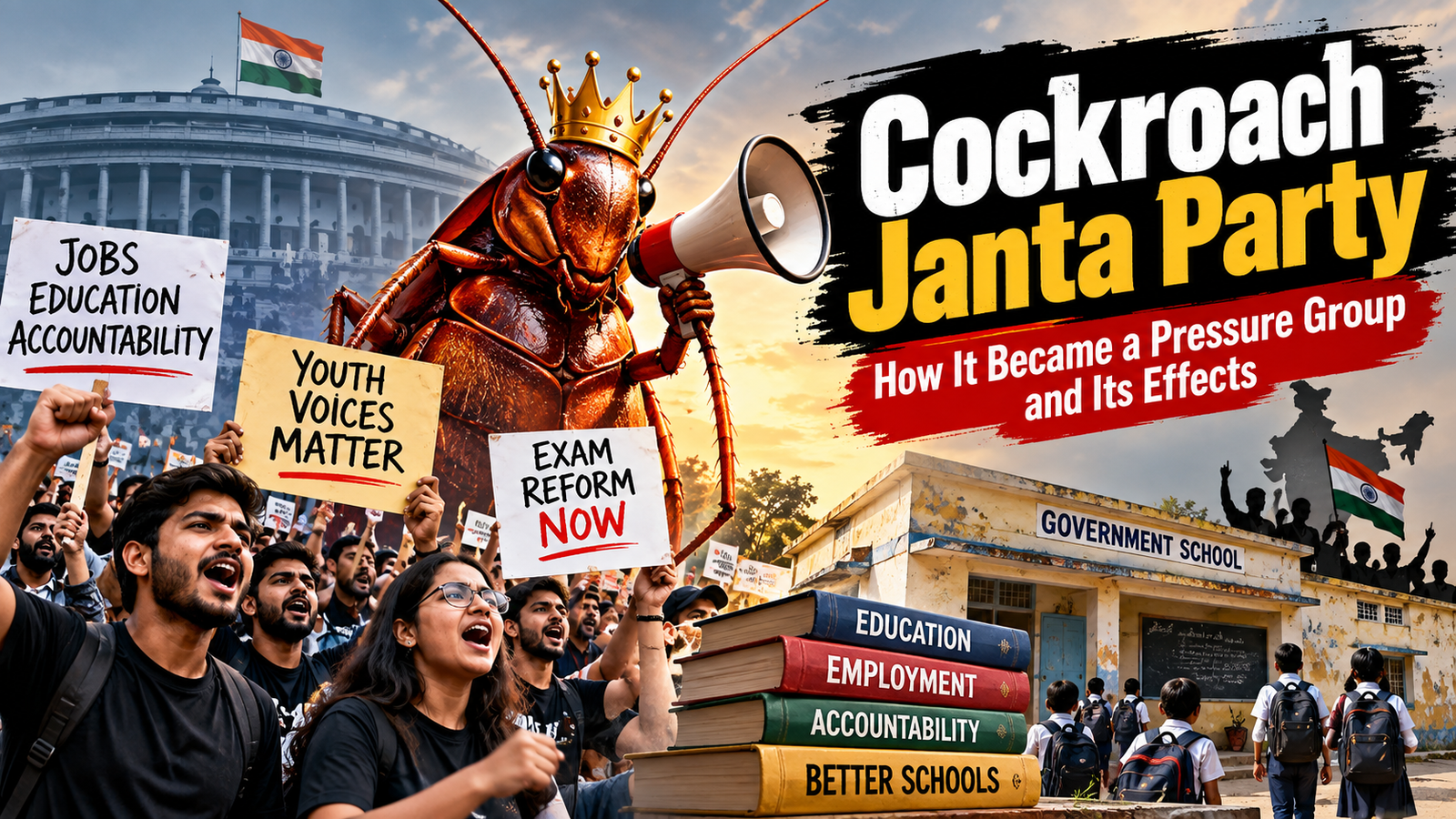
The Cockroach Janta Party has emerged as one of the most unusual political phenomena in India in 2026. What began as a satirical response to a controversial courtroom remark developed within weeks into a youth mobilisation centred on examination reform, unemployment, institutional accountability and education. By August, its founder Abhijeet Dipke stated that the organisation would not immediately enter electoral politics but would instead function as a pressure group.
The transformation of the Cockroach Janta Party is sociologically important because it illustrates how digital political identities can move from social media into street protest and then into grassroots civic campaigns. Its journey also demonstrates how a pressure group can operate differently from a conventional political party: rather than seeking votes and governmental office, it can attempt to influence public institutions by mobilising citizens around specific issues.
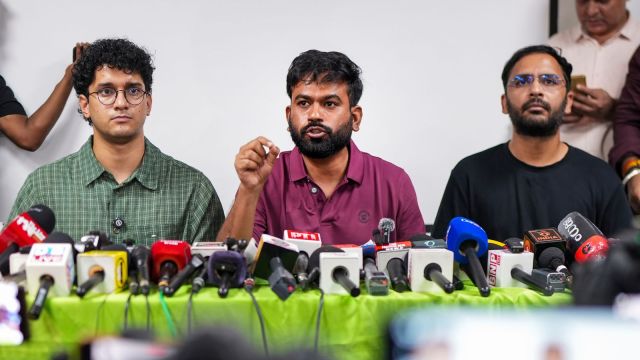
From a Satirical Post to a Political Movement
The origin of the Cockroach Janta Party is associated with a May 2026 controversy involving a remark by Chief Justice of India Surya Kant during a hearing. In the context of discussion around criticism of the judiciary and bogus degrees, a reference to unemployed youth as “cockroaches” attracted significant attention. Abhijeet Dipke responded on social media with the question of what would happen if all the “cockroaches” came together. The phrase subsequently became the symbolic foundation of CJP.
The significance of this moment lies in the transformation of language into collective identity. A term used in a derogatory context was appropriated as a symbol of resilience and political solidarity. Instead of responding through a conventional organisation, Dipke and supporters used humour, memes, social-media communication and a deliberately unconventional political identity.
This was characteristic of an increasingly digital form of political mobilisation. The movement did not begin with a traditional party office, large cadre network or election manifesto. It began with an idea that could circulate rapidly online.
From Online Movement to Street Politics
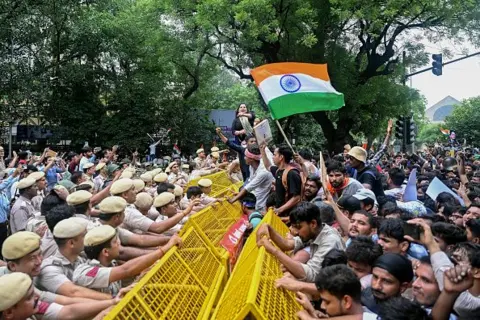
The next major stage came in June. After returning to India, Dipke joined supporters at Delhi’s Jantar Mantar, where CJP organised protests related to examination irregularities and demands concerning Union Education Minister Dharmendra Pradhan. Delhi Police granted permission for the protest, and hundreds of supporters gathered at the site. Reports described participation by students, young professionals and parents, with the distinctive cockroach symbolism becoming part of the demonstrations.
This transition was crucial. Digital visibility alone does not constitute sustained political pressure. To become a pressure movement, an organisation must convert attention into participation, formulate demands and communicate those demands to institutions.
CJP increasingly focused on examination-related problems, including allegations surrounding paper leaks and irregularities in competitive examinations. The issue had broad social relevance because examinations such as NEET, JEE and recruitment tests affect educational opportunities, employment prospects and expectations of social mobility.
The Cockroach Janta Party, therefore, found an issue that connected personal frustration with broader structural concerns.
The Jantar Mantar Phase
The movement intensified during June and July and became centred on a prolonged agitation at Jantar Mantar. CJP representatives presented a five-point charter concerning examination reform, compensation for families of students who had died by suicide, and protection from legal action for protesters, among other demands. During negotiations, Union ministers J. P. Nadda and Jitendra Singh met representatives of the movement.

The protest eventually lasted 36 days, according to reporting, and became one of the major youth-led political mobilisations of the period.
On July 25, Dharmendra Pradhan resigned as Union Education Minister amid the continuing controversy and political pressure surrounding the examination issue. His resignation fulfilled one of the principal demands being raised at the CJP protest site.
However, analytically it is important not to reduce the resignation to a simple one-to-one causal relationship. The examination controversy, student protests, opposition pressure, parliamentary politics, government responses and the broader public reaction were all part of the situation. CJP was a prominent actor within that larger political environment. Reuters and other media reports nevertheless identified the movement as a major force in the protests and highlighted the resignation as the movement’s most visible political outcome.
Why CJP Chose to Become a Pressure Group
After the July agitation, the Cockroach Janta Party faced a strategic choice: should it become a conventional political party and contest elections, or should it remain outside electoral politics?
In early August, Dipke publicly chose the second route, saying that CJP would function as a pressure group and had no immediate plans to enter electoral politics. He argued that the organisation could bring together people with different ideological backgrounds around common public issues.
This distinction is fundamental.
A political party normally seeks political office through elections. A pressure group seeks to influence those who exercise political power. Its resources may include public campaigns, demonstrations, petitions, media attention, research, citizen mobilisation and direct engagement with government institutions.
The emerging CJP model therefore became:
Identify an issue → mobilise citizens → document the problem → create public pressure → approach authorities → demand institutional action.
That model can operate without putting candidates on election ballots.
Expansion Beyond Examination Reform
After the resignation of the Education Minister, CJP did not disappear. Instead, it broadened its agenda.
In August, Dipke announced the “Kya Bolti Public” campaign, intended as a nationwide public outreach programme covering issues such as unemployment, education reform and social justice.
CJP also indicated that it would support student protests outside Maharashtra and continue raising questions about institutional accountability. Its stated concerns expanded to subjects including unemployment, institutional trust and some government policies.
This represents an important shift from single-issue protest to multi-issue pressure politics.
School Thik Karo: From Protest to Social Audit
Perhaps the most significant post-Jantar Mantar development was the “School Thik Karo” campaign.
On Independence Day, August 15, CJP launched a social-audit initiative focusing on government schools, beginning with a school in Santuk Pimpri in Hingoli district, Maharashtra. The campaign encouraged citizens, parents and village representatives to inspect school facilities and document deficiencies.
The first audit reported problems including inadequate drinking water, insufficient benches, dirty washrooms, broken windows and other infrastructure deficiencies. Hindustan Times reported that Dipke also discussed the issues with the local sarpanch, who reportedly assured that the panchayat would address them.
This campaign is sociologically significant because it changes the role of citizens.
In a traditional protest, citizens primarily express dissatisfaction.
In a social-audit model, citizens are encouraged to observe, document, verify and report.
The distinction is important. CJP is attempting to turn political participation into a routine form of civic monitoring.
Expansion Across Indian States
The school campaign subsequently spread beyond its original Maharashtra setting. India Today reported that CJP’s School Thik Karo activity had reached more than half a dozen states and involved government schools under administrations controlled by both the BJP and Opposition parties.
This geographic expansion matters because it allows the organisation to present itself as a national accountability movement rather than one confined to a single state or political constituency.
The campaign also created a different relationship between CJP and government authorities. Instead of simply demanding the resignation of a minister, the organisation could approach local administrators, education ministers and elected representatives with specific complaints concerning schools.
In Karnataka, for example, reporting described CJP inspections of government schools and subsequent engagement with the state’s education minister.
Whether every reported deficiency is independently verified is a separate question. Nevertheless, the organisational method—field inspection followed by public advocacy—represents a significant evolution in CJP’s activities.
Adivasi School Thik Karo
In September, the Cockroach Janta Party expanded the education campaign into tribal regions through “Adivasi School Thik Karo.” The initiative began in Maharashtra’s Gadchiroli region and focused on infrastructure, student safety and educational access in tribal schools.
This development gave the campaign a more specific social focus. Tribal education involves questions not only of buildings and classrooms but also of geographical isolation, teacher availability, accessibility and the distribution of public resources.
From a sociological perspective, CJP was therefore moving from a general claim about educational failure toward the investigation of unequal access to state educational institutions.
Effects on Political Communication
One of the clearest effects of the Cockroach Janta Party has been on political communication.
Its language is informal, humorous and highly adapted to social media. The movement illustrates how political mobilisation can emerge through memes and symbolic identities rather than through traditional speeches and ideological literature.
This does not mean conventional politics has disappeared. Rather, digital political expression can operate alongside parties, student organisations, civil-society groups and mainstream media.
The CJP example demonstrates the political potential of what may be called attention-based mobilisation. A movement first gains attention; attention produces participation; participation creates public visibility; visibility can then generate institutional responses.
Effects on Youth Political Participation
CJP has also placed young people’s concerns at the centre of political discussion.
Its original mobilisation connected unemployment, competitive examinations and educational insecurity. Reuters described the organisation as a rallying point for wider frustrations among younger Indians facing unemployment and pressure within India’s education system.
The sociological importance here is that youth problems can shift from being understood as individual difficulties to being interpreted as collective political issues.
An unemployed graduate may initially experience unemployment as a personal problem. When thousands of young people organise around the same issue, it becomes a public question involving education policy, labour markets, recruitment systems and state capacity.
In this sense, CJP demonstrates how private troubles can become public issues through collective mobilisation.
Effects on Accountability
The pressure-group model also has implications for institutional accountability.
CJP’s school campaigns ask citizens to inspect public institutions that they directly depend upon. This creates an informal layer of public scrutiny outside the formal administrative hierarchy.
Its later Election Commission Thik Karo campaign further illustrates the organisation’s attempt to broaden accountability politics from education to electoral institutions. The campaign, announced on September 24, included demands concerning the Chief Election Commissioner and the Special Intensive Revision of electoral rolls. These are organisational demands and should be distinguished from independently established findings about the issues involved.
CJP’s evolution consequently raises a broader question: can citizen pressure groups remain issue-focused while engaging with increasingly contentious national institutions?
The Limits of the Pressure-Group Model
The rise of the Cockroach Janta Party should not automatically be interpreted as evidence that it has permanently transformed Indian politics.
A pressure group’s effectiveness depends on several factors: organisational sustainability, credible evidence, volunteers, financial resources, media attention, government responsiveness and the ability to maintain public participation after the initial excitement has faded.
There is also a difference between agenda-setting and policy implementation.
A protest can place an issue in national conversation. A social audit can expose a problem. A government can announce reforms. But the eventual implementation of those reforms requires administrative capacity and institutional follow-through.
CJP’s future therefore depends partly on whether it can convert mobilisation into sustained monitoring and measurable outcomes.
Cockroach Janta Party and the New Politics of Civic Pressure
The story of the Cockroach Janta Party in 2026 can be understood as a sequence of transformations:
Satire → digital identity → youth mobilisation → street protest → negotiation → pressure group → social audit → grassroots accountability.
Its most significant feature may not be the possibility of becoming an electoral party. In fact, its leadership has explicitly said that it does not currently intend to do so.
Instead, its significance lies in experimenting with a different relationship between citizens and political institutions.
The movement demonstrates how a digitally created identity can be translated into physical protest, how a protest can become an organised pressure campaign, and how pressure politics can subsequently take the form of school inspections, public documentation and institutional demands.
For sociology and political science, the Cockroach Janta Party provides a useful contemporary case study of new social movements, digital political participation, youth mobilisation and participatory accountability.
Its long-term impact remains uncertain. But its rapid transformation during 2026 already provides an important example of how political pressure can be organised outside the conventional electoral-party structure.
The central sociological lesson is therefore not simply that a new organisation appeared. It is that the boundaries between meme culture, social movements, civic activism and political pressure are becoming increasingly fluid in India’s digital society.
The future of the Cockroach Janta Party will depend on whether it can maintain public participation, verify the issues it raises, work across political jurisdictions and demonstrate sustained institutional outcomes. Whatever its eventual trajectory, its 2026 journey offers a distinctive case for understanding how a digitally born movement can attempt to convert public frustration into organised civic pressure.
FAQs
1. What is the Cockroach Janta Party?
The Cockroach Janta Party is a youth-led political pressure movement that emerged in India in 2026 and focuses on issues including education, examinations, unemployment and institutional accountability.
2. When did the Cockroach Janta Party start?
The Cockroach Janta Party emerged in May 2026 following controversy surrounding a remark about unemployed youth. Abhijeet Dipke subsequently turned the phrase “cockroach” into a political identity.
3. Who founded the Cockroach Janta Party?
The Cockroach Janta Party was founded by Abhijeet Dipke, who became the movement’s principal public figure during its 2026 mobilisation.
4. Why is it called the Cockroach Janta Party?
The name Cockroach Janta Party originated from the “cockroach” remark that became associated with the movement. Supporters subsequently reappropriated the term as a symbol of resilience and collective identity.
5. Is the Cockroach Janta Party a political party?
The Cockroach Janta Party has described itself as a pressure group, rather than immediately functioning as a conventional electoral political party.
6. What does the Cockroach Janta Party demand?
The Cockroach Janta Party has raised demands concerning examination reform, unemployment, education, institutional accountability and other public-interest issues.
7. What was the major protest of the Cockroach Janta Party?
One of the Cockroach Janta Party’s major campaigns was the prolonged Jantar Mantar agitation concerning examination-related issues and demands for accountability in India’s education system.
8. What is School Thik Karo by the Cockroach Janta Party?
School Thik Karo is a Cockroach Janta Party campaign that involves inspecting government schools, documenting infrastructure and educational deficiencies, and bringing those issues to public and government attention.
9. What is Adivasi School Thik Karo?
Adivasi School Thik Karo is an extension of the Cockroach Janta Party’s school-accountability campaign focusing particularly on educational infrastructure and access in tribal areas.
10. How does the Cockroach Janta Party use social media?
The Cockroach Janta Party uses social media for political communication, mobilisation, campaign promotion, public documentation and coordination with supporters.
11. How did the Cockroach Janta Party attract young people?
The Cockroach Janta Party connected issues such as unemployment, examination problems and educational opportunities with a humorous digital communication style that appealed particularly to sections of India’s youth.
12. What is the role of the Cockroach Janta Party as a pressure group?
As a pressure group, the Cockroach Janta Party seeks to influence government institutions through public campaigns, protests, citizen participation, social audits and demands for accountability rather than primarily through electoral competition.
13. Has the Cockroach Janta Party influenced government policy?
The Cockroach Janta Party has participated in negotiations with government representatives and raised demands concerning examination reform. Government responses and reforms should, however, be assessed individually because political outcomes generally involve multiple actors and factors.
14. Why is the Cockroach Janta Party important for sociology?
The Cockroach Janta Party provides a contemporary case study of digital mobilisation, collective identity, youth politics, new social movements, political participation and citizen-led institutional accountability.
15. What is the future of the Cockroach Janta Party?
The future of the Cockroach Janta Party will depend on its ability to sustain its organisation, mobilise citizens, document public issues credibly and influence institutions while maintaining its stated pressure-group approach.