Introduction on Student Protests
Across societies, education is widely regarded as a pathway to social mobility, economic security, and personal development. Families invest their savings in schooling and higher education because they expect qualifications to create opportunities for a better life. However, when educational institutions struggle to provide adequate learning conditions and graduates face uncertain employment prospects, the promise of education can become a source of frustration rather than hope.
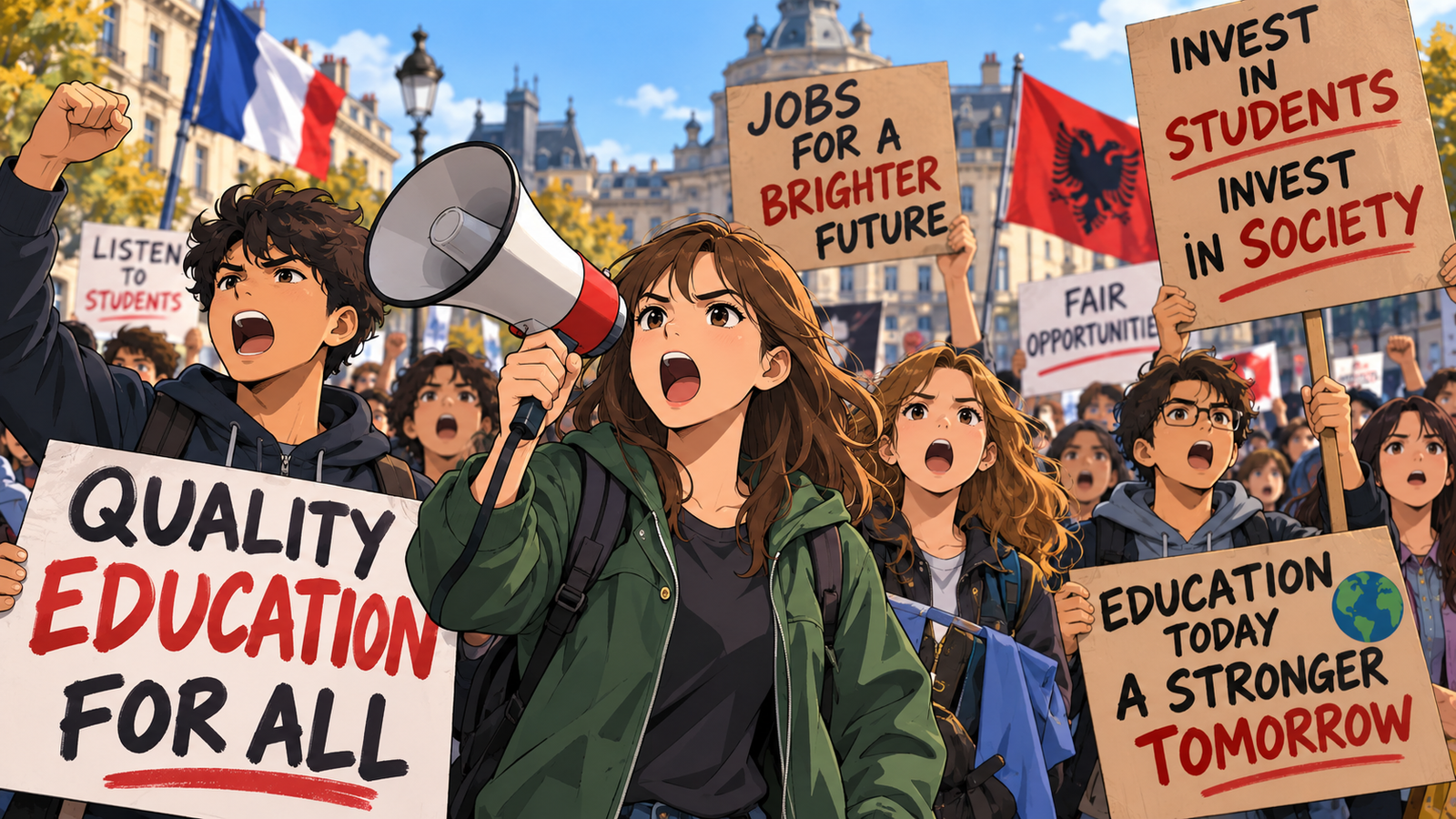
Recent student protests in France and Albania illustrate different dimensions of this problem. In France, high school students have demonstrated against teacher shortages, overcrowded classrooms, and deteriorating school facilities. In Albania, student demonstrations in October 2026 have raised concerns about university conditions, education costs, financial assistance, inequality, and employment opportunities after graduation. The Albanian demonstrations also became connected with broader anti-government protests, and some confrontations involved violence and police intervention. Associated Press reporting on France and Reuters reporting on Albania provide context for these developments.
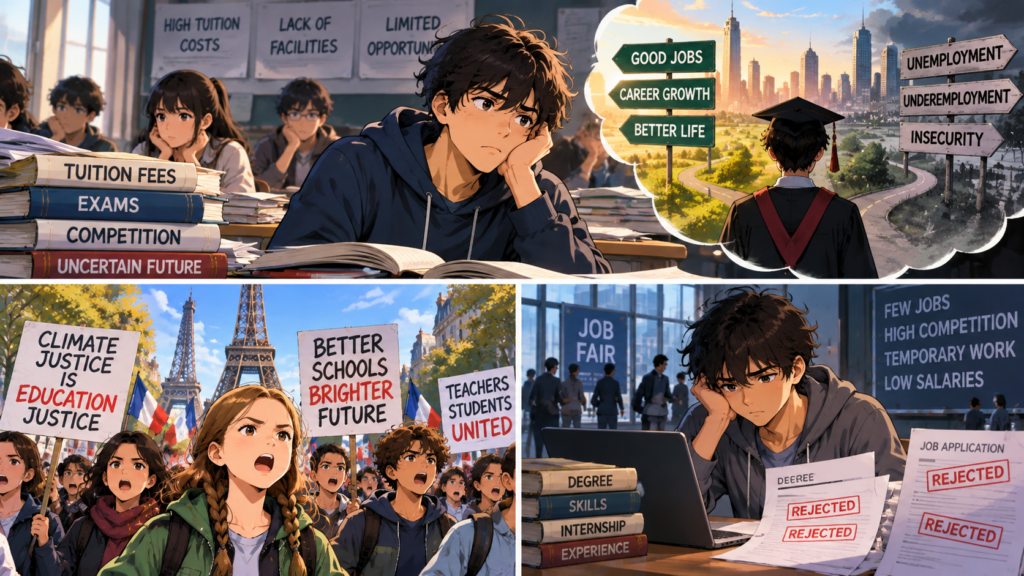
Although the two countries have different political and educational systems, their protests invite an important sociological question: What happens when young people are encouraged to pursue education as the route to success but become uncertain about whether that education can deliver a secure future?
From a sociological perspective, student protests should be understood not merely as isolated expressions of anger but as potential indicators of structural problems involving inequality, institutional performance, employment, and the relationship between younger generations and the state.
Student Protests and the Crisis of Educational Expectations
Education performs several important functions in society. It transmits knowledge, develops skills, prepares individuals for employment, and introduces young people to social norms and civic responsibilities. Educational institutions also influence how individuals understand their position within the social hierarchy.
However, these functions depend on the quality, accessibility, and relevance of education. When classrooms lack teachers, university facilities deteriorate, or students cannot afford educational expenses, the formal promise of equal opportunity becomes more difficult to realise.
The French demonstrations illustrate concerns about the everyday conditions under which students learn. Reports of staff shortages, overcrowded classrooms, and inadequate school facilities suggest that educational opportunity depends not only on a student’s motivation but also on the resources available within the institution.
In Albania, the concerns raised by student organisers extend to higher education costs, financial support, university conditions, and employment prospects. These issues reflect a broader concern about the value of investing time and money in education when the eventual economic returns remain uncertain.
The two situations should not be treated as identical. Protests in France have focused prominently on school conditions, while Albanian demonstrations have combined educational grievances with wider social and political demands. Nevertheless, both highlight the importance of examining education in relation to young people’s expectations for the future.
When institutions fail to meet reasonable expectations, students may begin to question whether established systems are responsive to their needs. Protests can then become a mechanism through which dissatisfaction is communicated to authorities and the wider public.
Education and Social Mobility: The Promise and the Reality
Social mobility refers to movement between different social and economic positions. Education is commonly considered one of the principal mechanisms through which individuals can improve their circumstances.
A student from a low-income family may view a university degree as an opportunity to obtain stable employment, support their family, and escape economic insecurity. This expectation is particularly important in societies where professional qualifications are associated with higher income, social prestige, and greater independence.
However, educational attainment does not automatically guarantee upward mobility. Employment opportunities also depend on economic growth, labour-market demand, professional networks, regional inequalities, discrimination, and the availability of suitable jobs.
This creates a potential contradiction. Educational systems may encourage increasing numbers of young people to obtain qualifications, while labour markets may not generate enough secure, appropriately paid positions for all graduates.
The resulting frustration is not necessarily evidence that education has become worthless. Rather, it suggests that the relationship between qualifications and employment is more complicated than the promise that studying hard will inevitably lead to success.
Sociologist Pierre Bourdieu‘s work on cultural capital and social reproduction offers a useful framework for understanding this contradiction. Students enter educational institutions with unequal access to financial resources, family support, cultural knowledge, and influential social networks. These differences can shape educational achievement and subsequent employment opportunities.
For example, two students may earn similar qualifications but have very different access to internships, professional contacts, relocation opportunities, and postgraduate education. The student with greater financial support may be able to accept unpaid experience or move to a city with more employment opportunities. A student from a disadvantaged household may need to begin earning immediately.
Consequently, equal access to examinations does not necessarily produce equal opportunities after graduation. Student protests can draw attention to the gap between the formal promise of meritocracy and the unequal resources that influence people’s actual outcomes.
Youth Unemployment and the Anxiety of an Uncertain Future
Employment is not simply a source of income. It also provides social recognition, independence, routine, and a sense of belonging. For many young adults, entering the workforce represents an important transition from dependence on family to greater economic and personal autonomy.
When this transition becomes difficult, its consequences extend beyond financial hardship.
Young people who spend years studying may experience disappointment if they cannot find employment corresponding to their qualifications. Some may accept insecure work, low-paid positions, or jobs unrelated to their fields of study. Others may postpone marriage, independent living, or other long-term decisions because their economic circumstances remain uncertain.
This situation can be examined through the concept of blocked mobility. Young people may believe that education is the legitimate route to advancement but find that the available opportunities do not match their expectations or qualifications.
The problem becomes especially significant when families have made substantial sacrifices to finance education. A degree that fails to produce an expected improvement in living standards can become a source of tension between generations, educational institutions, employers, and governments.
It is important, however, to distinguish between unemployment, underemployment, and dissatisfaction with job quality. These are related but different problems. A country may have relatively low overall unemployment while young graduates still struggle to secure permanent contracts, adequate wages, or employment relevant to their qualifications.
The Albanian student protests demonstrate how employment concerns can become part of a broader debate about the responsibilities of educational institutions and the state. When students question what opportunities await them after graduation, they are also questioning the relationship between public investment in education and the economic prospects available to citizens.
Educational Inequality and the Reproduction of Class Differences
Educational inequality refers to differences in access to educational resources, learning conditions, qualifications, and subsequent opportunities. These differences often reflect wider inequalities in income, social class, geography, and family circumstances.
In France, concerns about overcrowded classrooms and inadequate facilities raise questions about whether students across different communities receive comparable educational support. Where schools have difficulty attracting or retaining teachers, students may experience unequal access to instruction and academic guidance.

In Albania, concerns about the costs of higher education and financial assistance highlight another dimension of inequality: the ability to enter, continue, and complete education without excessive financial pressure.
Students from wealthier households may be better positioned to afford accommodation, transport, digital resources, private tutoring, and postgraduate study. Students from lower-income backgrounds may face difficult choices between continuing their education and meeting immediate household needs.
These disadvantages can accumulate over time. A student who lacks adequate academic support may struggle to enter a competitive university. Limited financial resources may then restrict internship opportunities or professional training. The eventual employment gap may reinforce the original social inequality.
From a conflict-theory perspective, education cannot be understood entirely as a neutral system that rewards individual effort. It also operates within societies characterised by unequal access to economic and social resources.
This does not mean that educational institutions necessarily reproduce inequality in every circumstance. Public education, scholarships, financial aid, and inclusive policies can improve social mobility. The central sociological issue is whether these mechanisms are sufficiently effective to prevent family background from determining life chances.
Student protests bring these questions into public debate by demanding that educational opportunity be supported by adequate institutional resources and financial arrangements.
Social Strain, Relative Deprivation, and Collective Frustration
The intensity of social dissatisfaction cannot always be explained by material hardship alone. People’s perceptions of fairness, comparison with others, and expectations about the future also matter.
The concept of relative deprivation helps explain why individuals may become dissatisfied even when their living conditions have improved in absolute terms. Frustration can emerge when people believe that their opportunities are substantially worse than those available to others or that the rewards they were promised remain out of reach.
Students may compare their qualifications and aspirations with the professional success of other groups. They may also compare the opportunities available to them with those enjoyed by earlier generations or by young people in other countries.
Social media can make these comparisons more visible, although it does not affect all students in the same way. Digital platforms also allow students to share information, organise demonstrations, circulate evidence of institutional problems, and connect local grievances with wider public discussions.
Émile Durkheim’s concept of anomie provides another useful perspective. Anomie refers broadly to a condition in which established social norms and expectations become weakened or lose their ability to guide behaviour effectively.
When societies strongly encourage young people to pursue qualifications and professional success but provide uncertain routes towards those goals, expectations and opportunities may become disconnected. This can contribute to feelings of uncertainty and dissatisfaction.
These concepts do not prove that every student protest is caused by relative deprivation or anomie. Rather, they offer analytical tools for understanding why educational grievances may become collective demands for broader social change.
Why Student Protests Can Expand Beyond Education
Student movements sometimes begin with specific demands but gradually develop into wider campaigns involving political accountability, corruption, inequality, or public services.
The Albanian demonstrations provide an example of this process. According to Reuters, student organisers raised concerns about university conditions, education costs, financial assistance, and employment after graduation. The demonstrations also became connected with wider opposition to the government, while some confrontations involved attacks on property and clashes with police.
This development illustrates how educational grievances can become linked with broader questions about the distribution of power and public resources. When students believe that their difficulties reflect larger institutional failures, they may seek support from other social groups.
Sociologically, this can be understood through the concept of political opportunity: collective action may expand when people perceive that public institutions are vulnerable to pressure, that existing channels of representation are insufficient, or that other groups share their concerns.
Collective identity is also important. Students who individually experience financial pressure, inadequate facilities, or uncertain career prospects may begin to see these experiences as shared problems rather than personal failures.
However, the expansion of a protest does not mean that all participants have identical motives. Some may prioritise educational reform, while others focus on employment, corruption, or political change.
Nor should all demonstrators be held responsible for the actions of individuals who engage in violence. Peaceful assembly and political expression are distinct from assaults, intimidation, and the destruction of property. A balanced sociological analysis must acknowledge both the grievances motivating collective action and the consequences of violent conduct.
The Role of Governments and Educational Institutions
Student protests can serve as an important source of information about institutional performance. Governments and educational authorities may receive feedback through formal surveys, consultations, student unions, and administrative reports, but protests can make grievances more visible when students believe existing channels have failed.
A meaningful response requires more than temporary announcements or short-term changes introduced to reduce public pressure.
First, governments need to examine the quality of educational infrastructure. School buildings, classroom capacity, teacher recruitment, and the availability of learning materials influence students’ everyday experiences and educational outcomes.
Second, higher education financing requires attention. Scholarships, transparent financial assistance, affordable accommodation, and accessible support services can reduce the risk that students abandon education because of economic difficulties.
Third, educational planning must be connected with labour-market realities. Institutions should regularly examine graduate employment outcomes, emerging skill requirements, and the relationship between academic programmes and available work. This does not mean that universities should serve only the immediate needs of employers; education also has intellectual, cultural, and civic purposes.
Fourth, governments and institutions should strengthen opportunities for students to participate in decisions affecting their education. Student representation, accessible complaint mechanisms, public reporting, and genuine consultation can help resolve disputes before they escalate.
Finally, responses to demonstrations should distinguish peaceful protest from violence. Authorities have responsibilities to maintain public safety while respecting lawful expression and ensuring that any enforcement measures are proportionate and accountable.
Education Reform Must Address the Future of Work
The relationship between education and employment is changing as economies undergo technological transformation, the expansion of digital services, demographic shifts, and changes in the organisation of work.
Traditional qualifications remain important, but students increasingly need opportunities to develop adaptable skills, practical experience, and professional networks. The challenge for educational systems is to prepare students for changing labour markets without reducing education to a narrow instrument of economic production.
Employers also have responsibilities. If organisations demand extensive experience for entry-level positions but provide few opportunities for beginners to gain that experience, graduates may encounter barriers even after completing relevant education.
Governments can help address these problems through apprenticeships, paid internships, career guidance, vocational education, employment services, and policies that encourage the creation of productive jobs.
Such measures must be evaluated against actual outcomes. Announcing a training programme is not the same as demonstrating that it improves employment prospects, and increasing university enrolment does not automatically ensure that graduates obtain secure work.
The broader goal should be to establish a more credible connection between educational investment and opportunities for meaningful participation in economic and social life.
What Student Protests Reveal About the Social Contract
A social contract can be understood as the expectations connecting citizens, public institutions, and the state. In education, families and students contribute time, effort, taxes, and financial resources while expecting institutions to provide learning opportunities and help prepare young people for adult life.
The state, in turn, has an interest in an educated population capable of contributing to economic development, civic life, and social cooperation.

When students believe that institutions are not fulfilling their responsibilities, confidence in this relationship may weaken. Their dissatisfaction may concern immediate conditions, such as teacher shortages or university fees, but it can also reflect broader uncertainty about whether society offers fair opportunities to the next generation.
This interpretation should not be confused with the claim that every protest represents a complete rejection of the social system. In many cases, demonstrations may express a demand for institutions to fulfil their stated commitments more effectively.
The French protests highlight the importance of adequate educational provision, while the Albanian demonstrations connect educational concerns with financial insecurity, employment prospects, and wider political dissatisfaction.
Together, these cases show why education should be examined as both a public service and a mechanism through which societies distribute opportunities.
Conclusion on Student Protests
Student protests highlighting frustration with education and employment prospects reveal a central challenge facing contemporary societies: the gap between the promise of opportunity and the experience of young people attempting to achieve it.
The French demonstrations have drawn attention to school conditions, teacher shortages, and inadequate facilities. In Albania, students have raised concerns about university conditions, education costs, financial support, and employment after graduation, while the demonstrations have also intersected with wider political unrest.
These events have different immediate causes, and they should not be reduced to a single explanation. Nevertheless, a sociological perspective reveals several connected themes: educational inequality, blocked social mobility, relative deprivation, uncertainty about employment, and questions about institutional accountability.
Young people do not necessarily protest because they reject education. They may protest precisely because they believe education should provide better opportunities than they currently experience. Their demands can therefore be understood as questions about fairness, institutional responsibility, and the future of social mobility.
The long-term significance of these protests will depend partly on how governments, universities, schools, and employers respond. Better educational facilities, accessible financing, meaningful student participation, and credible routes into employment can help address some of the underlying concerns.
Ultimately, the value of education cannot be measured only by enrolment figures or the number of degrees awarded. It must also be considered in relation to the quality of learning, equality of opportunity, and the possibilities available to people after they leave the classroom.
When the promise of education becomes disconnected from the realities of employment and social mobility, student protests can become a powerful reminder that young people’s expectations are an important test of the institutions shaping their future.
FAQs on Student Protests
1. What are student protests?
Student protests are collective actions organised by students to express dissatisfaction with educational policies, tuition fees, inadequate facilities, unemployment, inequality, or government decisions. They may involve demonstrations, marches, strikes, and peaceful sit-ins.
2. Why do students participate in protests?
Students participate in protests when they believe their educational rights, economic opportunities, or social interests are being neglected. Common reasons include rising education costs, poor institutional facilities, limited employment opportunities, and demands for greater accountability.
3. How do student protests highlight educational inequality?
Student protests can expose differences in access to qualified teachers, educational resources, scholarships, technology, and quality institutions. They highlight how family income, social class, and geographical location influence students’ educational experiences and future opportunities.
4. What is the relationship between student protests and youth unemployment?
Youth unemployment can increase frustration among students who expect educational qualifications to lead to secure employment. When graduates struggle to find suitable jobs, protests may emerge as a way to demand employment opportunities, economic reforms, and better career support.
5. How do student protests reflect social mobility?
Student protests may reveal difficulties in achieving upward social mobility through education. When qualifications fail to provide expected economic and social advantages, students may question whether educational institutions and labour markets offer equal opportunities.
6. What is the sociological significance of student protests?
From a sociological perspective, student protests reveal tensions involving social inequality, institutional authority, collective identity, and political participation. They help researchers understand how individual grievances can develop into collective demands for social change.
7. How does Pierre Bourdieu’s theory explain student protests?
Pierre Bourdieu’s concepts of cultural capital and social reproduction explain how unequal family resources and social networks influence educational achievement. Student protests may highlight frustration when formal educational opportunities do not eliminate deeper social inequalities.
8. How does relative deprivation explain student protests?
Relative deprivation occurs when people perceive a gap between what they believe they deserve and what they actually receive, particularly compared with others. Students may protest when they believe their qualifications, efforts, or expectations are not matched by fair opportunities.
9. What role does social media play in student protests?
Social media helps students share information, organise demonstrations, publicise grievances, and connect with supporters. However, online information can also spread misinformation, so claims about protests should be checked against reliable reporting.
10. Why are student protests sometimes linked to political movements?
Student grievances may become connected with wider political movements when participants associate educational problems with government policies, corruption, inequality, or inadequate public services. However, not every student protest has a political objective.
11. What do student protests in France reveal about education?
The French student demonstrations discussed in recent reporting highlight concerns about school conditions, including teacher shortages, overcrowded classrooms, and inadequate facilities. Sociologically, these issues raise questions about educational quality and equal access to learning resources.
12. What do student protests in Albania reveal about employment prospects?
The Albanian student demonstrations reported in October 2026 have raised concerns about university conditions, education costs, financial assistance, and employment after graduation. They illustrate how educational grievances can intersect with wider economic and political dissatisfaction.
13. Are student protests always peaceful?
No. Many student protests are peaceful, while some involve confrontations, property damage, or violence. It is important to distinguish peaceful collective action from unlawful conduct and to examine the circumstances of each protest using reliable evidence.
14. How can governments address the causes of student protests?
Governments can address student concerns by improving educational infrastructure, recruiting qualified teachers, providing financial assistance, strengthening career guidance, expanding employment opportunities, and creating effective channels for student representation and dialogue.
15. What do student protests tell us about the future of education and employment?
Student protests indicate that young people expect education to provide meaningful learning, fair opportunities, and preparation for working life. Their demands highlight the need to connect educational quality with social inclusion, labour-market realities, and long-term economic security.