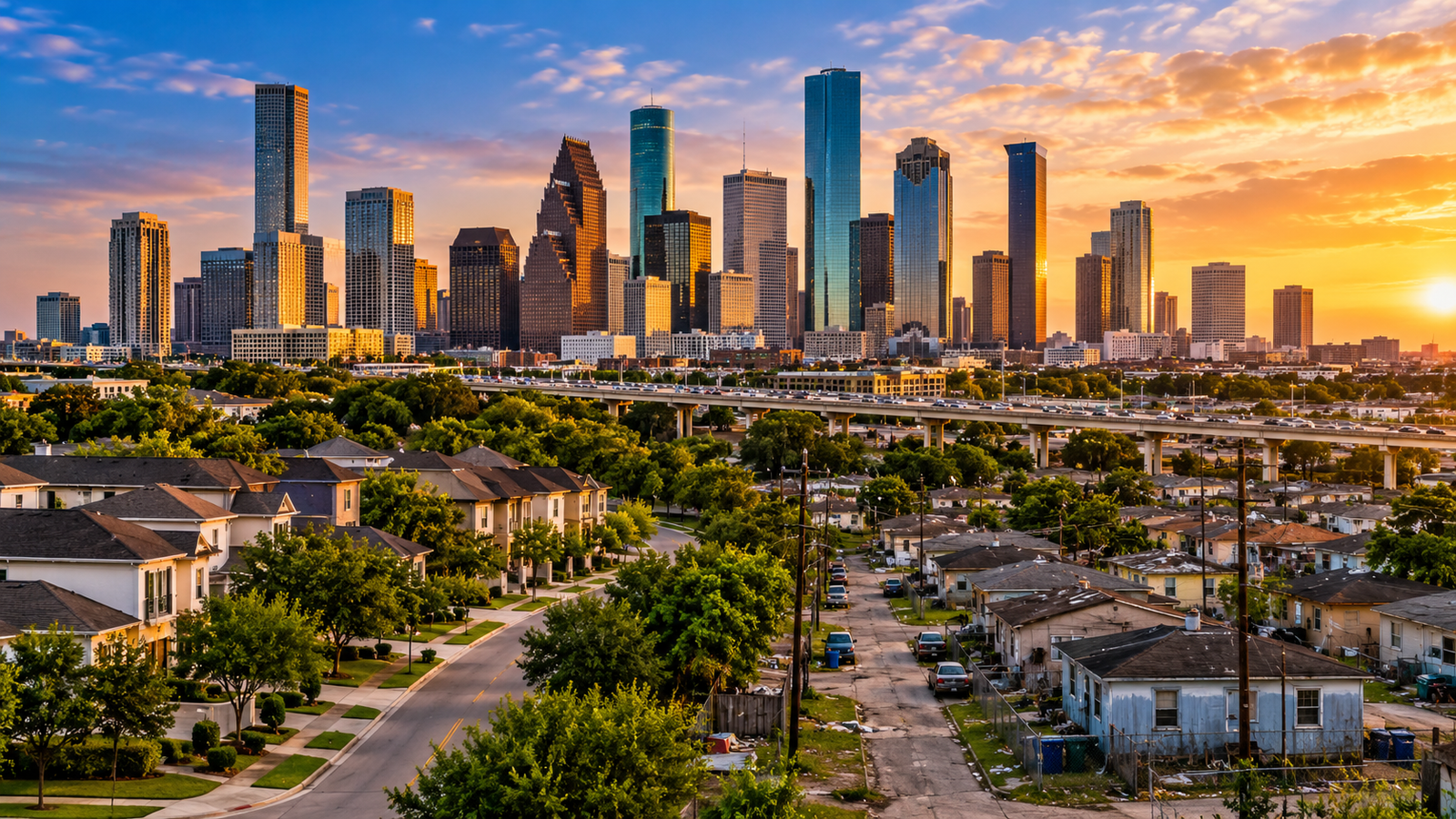
American cities are often presented as centres of economic opportunity, innovation, cultural diversity, and social mobility. Yet beneath this image of prosperity lies a complex pattern of unequal access to housing, education, employment, transportation, healthcare, and political influence. In Texas, the rapidly growing metropolitan areas of Houston, Dallas, and Austin provide important examples of how economic development can coexist with deep social inequalities.
Urban inequality in Houston is particularly significant because the city combines a large and diverse population, a powerful energy economy, extensive suburban development, and substantial differences in income and living conditions between neighbourhoods. Dallas and Austin demonstrate similar patterns, although the sources and geographical expressions of inequality differ.
From a sociological perspective, urban inequality is not simply a difference between rich and poor individuals. It is a structural phenomenon shaped by institutions, historical development, housing markets, labor markets, race and ethnicity, migration, education, transportation, and government policy. The spatial organization of cities often determines who receives access to opportunities and who remains concentrated in areas with fewer resources.

Understanding Urban Inequality
Urban inequality refers to the unequal distribution of economic resources, social opportunities, public services, political power, and quality of life within cities and metropolitan regions. Sociologists examine inequality not only through income but also through the relationship between social class and urban space.
A wealthy household may live in a neighborhood with high-quality schools, safe streets, parks, reliable transportation, and better healthcare facilities. A low-income household may live only a few miles away but experience overcrowded housing, longer commuting times, weaker public infrastructure, environmental risks, and limited access to social services.
This spatial dimension is central to understanding modern cities. Inequality becomes visible on the urban landscape itself.
Houston, Dallas, and Austin are useful case studies because all three cities have experienced significant population growth and economic transformation. However, growth does not automatically produce equal benefits. Instead, economic expansion can increase housing costs, accelerate neighborhood redevelopment, attract higher-income residents, and create new divisions between social groups.
Urban Inequality in Houston
Urban inequality in Houston is shaped by the city’s economic structure, housing market, racial and ethnic diversity, suburbanization, and historical patterns of residential segregation.
Houston is one of the largest metropolitan economies in the United States, with major industries including energy, healthcare, aerospace, manufacturing, logistics, and professional services. These sectors create employment opportunities and attract migrants from across the United States and around the world. However, employment opportunities are distributed unevenly, and workers do not necessarily benefit equally from economic growth.
One important characteristic of Houston is its relatively decentralized urban structure. Unlike cities dominated by a single traditional downtown, Houston has multiple employment centers and extensive suburban development. This spatial arrangement can create significant differences in accessibility.
For professionals with automobiles, higher incomes, and flexible employment, living farther from the central city may not represent a major disadvantage. For low-income workers who depend on public transportation, however, distance between home and employment can become a serious barrier.
The relationship between transportation and employment illustrates how urban inequality is reproduced. A worker may technically have access to a job market but still struggle to reach available employment because of transportation costs, limited transit coverage, or long commuting times.
Housing and Class Inequality in Houston
Housing is one of the most visible dimensions of urban inequality in Houston. The city has historically had a different housing regulatory environment from many other large American cities, but this does not mean that housing inequality is absent.
Houston contains neighborhoods with expensive homes, high property values, and significant private investment alongside communities where residents face lower incomes, aging housing infrastructure, environmental risks, or housing insecurity.
Gentrification can further complicate this picture. When investment enters previously disinvested neighborhoods, property values and rents can increase. New businesses and infrastructure may improve the physical environment, but existing residents can face increasing financial pressure.
This creates a sociological contradiction: neighborhood improvement can simultaneously produce displacement.
The issue is therefore not simply whether an area is developing. Sociologists ask who benefits from development and who bears its costs.
Race, Ethnicity, and Urban Inequality in Houston
Houston’s racial and ethnic diversity makes it particularly important for studying the relationship between race and urban inequality.

African American, Hispanic or Latino, Asian American, immigrant, and other communities contribute significantly to the social and economic life of the metropolitan region. However, historical patterns of segregation, unequal wealth accumulation, housing discrimination, and differences in employment opportunities can continue to influence present-day inequalities.
Race and class frequently overlap. A household’s economic position may influence where it can afford to live, while neighborhood characteristics influence educational opportunities, social networks, exposure to environmental hazards, and access to employment.
From a sociological perspective, this demonstrates that inequality is multidimensional. Economic inequality cannot always be separated from racial and spatial inequality.
Environmental Inequality in Houston
Environmental inequality is another important element of urban inequality in Houston.
Houston’s industrial economy has generated enormous economic value, but industrial facilities, transportation infrastructure, and other environmental risks are not distributed randomly across the metropolitan region. Lower-income communities and historically marginalized populations can experience greater exposure to pollution, flooding risks, or inadequate environmental protection.
Flooding provides another example of how environmental vulnerability can intersect with social inequality. Extreme weather events affect entire metropolitan areas, but households differ considerably in their capacity to prepare, evacuate, recover, and rebuild.
A wealthy household may have insurance, savings, transportation, and alternative housing options. A low-income household may have fewer resources and may experience prolonged financial consequences after a disaster.
Thus, environmental disasters can transform existing economic inequalities into deeper social inequalities.
Urban Inequality in Dallas
Dallas provides another important example of the relationship between economic growth and social inequality. The Dallas–Fort Worth metropolitan area has developed into a major economic center with strong finance, technology, healthcare, logistics, telecommunications, and business-service sectors.
Like Houston, Dallas has experienced rapid metropolitan expansion. However, prosperity is unevenly distributed.
Dallas contains affluent neighborhoods with expensive housing, highly rated schools, and extensive amenities while other communities experience poverty, lower household wealth, housing insecurity, and limited access to resources.
Residential segregation has historically played an important role in shaping these differences. The consequences of historical segregation can persist even after discriminatory laws have changed because housing markets, accumulated wealth, neighborhood institutions, and educational systems reproduce social differences over time.
Suburbanization and Inequality
The growth of the Dallas–Fort Worth metropolitan region also illustrates the sociological importance of suburbanization.
Suburban expansion can provide households with larger homes and access to new infrastructure, but it can also increase dependence on automobiles. For workers without reliable vehicles, employment opportunities may become geographically inaccessible.
Urban sprawl can therefore create a paradox. A metropolitan region may contain thousands of jobs while some residents still struggle to reach those jobs efficiently.
This demonstrates that urban inequality is not simply about whether opportunities exist. It is also about whether different social groups can realistically access those opportunities.
Urban Inequality in Austin
Austin has developed a somewhat different form of urban inequality. Known for technology, government, education, entrepreneurship, and a strong creative economy, Austin has experienced considerable population and economic growth.
However, rapid growth has contributed to significant housing pressures.
Austin’s economic transformation has attracted technology companies, highly skilled professionals, entrepreneurs, and investors. While this has strengthened the city’s economic position, it has also contributed to rising housing demand.
For lower-income residents, teachers, service workers, hospitality employees, retail workers, and other workers whose wages have not increased as rapidly as housing costs, remaining in the city can become increasingly difficult.
The result is a growing distinction between people who benefit from the new economy and people who provide essential services but struggle to afford the city in which they work.
Gentrification and Displacement in Austin
Austin illustrates how gentrification can reshape urban communities.
Gentrification generally involves the transformation of neighborhoods following an increase in investment and the arrival of higher-income residents. This process can produce new businesses, improved infrastructure, rising property values, and increased tax revenues.
Yet these benefits can come with costs.
Long-term residents may face rising rents, property taxes, or redevelopment pressures. Cultural institutions and local businesses can also disappear as neighborhood demographics change.
Sociologically, gentrification raises a fundamental question about the meaning of urban development: Should successful urban development be measured only by increasing property values and investment, or should it also be measured by the ability of existing residents to remain and participate in the benefits?
Comparing Houston, Dallas, and Austin
Although Houston, Dallas, and Austin have different economic identities, they share several major characteristics.
All three metropolitan areas have experienced substantial population growth. All have attracted highly educated professionals and investment. All contain significant differences in household income and wealth. And all demonstrate how housing, transportation, education, employment, and neighborhood conditions interact to reproduce inequality.
However, the pattern differs between cities.
Houston’s inequality is strongly connected with its industrial economy, environmental risks, transportation geography, racial and ethnic diversity, and decentralized urban structure.
Dallas demonstrates the relationship between economic growth, suburbanization, racial segregation, housing, and transportation access across a vast metropolitan area.
Austin provides a particularly strong example of how technology-driven growth and housing pressures can transform an urban social structure and create tensions between economic success and affordability.
These differences demonstrate that there is no single model of urban inequality. Urban inequality is produced through the interaction of local history, economic institutions, government policy, housing markets, and demographic change.
Education and the Reproduction of Inequality
Education is another major mechanism through which urban inequality is reproduced.
Neighborhoods and schools are closely connected in many American metropolitan areas. Families with higher incomes can often choose from a wider range of housing options and educational environments. Lower-income families may have fewer choices.
This creates a cycle in which economic inequality influences residential location, residential location influences educational opportunities, and educational opportunities influence future employment and income.
Sociologist Pierre Bourdieu’s concept of social and cultural capital is useful here. Children from advantaged households may inherit not only financial resources but also networks, knowledge, expectations, and cultural practices that help them navigate educational institutions.
Therefore, inequality can persist across generations even when formal educational opportunities are technically available to everyone.
Labor Markets and the Urban Class Structure
Houston, Dallas, and Austin also demonstrate the changing nature of the urban working class.
Modern metropolitan economies contain highly paid professionals alongside low-wage service workers. Technology companies, hospitals, universities, restaurants, warehouses, hotels, construction companies, and retail businesses depend on different categories of workers.

The problem arises when the wages of essential workers do not correspond to the cost of living in the metropolitan area.
A city can therefore experience economic growth while many workers remain financially insecure.
This phenomenon challenges the traditional assumption that economic growth automatically reduces inequality. Economic growth can create jobs without ensuring equal access to wealth, security, or social mobility.
Social Mobility and the American City
Urban areas are often described as engines of social mobility. Cities bring together educational institutions, businesses, cultural organizations, and professional networks.
However, the ability to take advantage of these resources varies by social class.
A middle- or upper-income household may have savings, reliable transportation, higher education, professional networks, and access to credit. A low-income household may lack these resources.
Consequently, two people living in the same metropolitan area may experience completely different economic realities.
This is why sociologists distinguish between formal opportunity and substantive opportunity. Formal opportunity means that an institution is theoretically available to everyone. Substantive opportunity asks whether people actually possess the resources necessary to use that opportunity.
The Future of Urban Inequality in Texas
The future of Houston, Dallas, and Austin will depend partly on how policymakers respond to housing affordability, transportation, environmental vulnerability, education, and labor-market inequality.
Simply attracting businesses and increasing investment may not be sufficient. Cities also need policies that allow different social groups to participate in economic growth.
Affordable housing, accessible public transportation, stronger public education, environmental protection, worker protections, and inclusive urban planning can potentially reduce some dimensions of inequality.
However, solving urban inequality requires more than individual policies. It requires recognition that economic, racial, spatial, environmental, and political inequalities are interconnected.
Conclusion
Urban inequality in Houston, Dallas, and Austin demonstrates an important sociological reality: economic growth and social equality are not the same thing.
Houston, Dallas, and Austin have become powerful centers of economic activity, attracting businesses, migrants, professionals, and investment. Yet prosperity exists alongside housing insecurity, income inequality, unequal educational opportunities, transportation barriers, environmental risks, and differences in access to political and social resources.
Urban inequality in Houston is particularly important because the city shows how economic opportunity can coexist with strong spatial and social divisions. Dallas demonstrates how suburbanization and metropolitan expansion can produce unequal access to jobs and services, while Austin shows how rapid technology-driven growth can intensify housing pressures and displacement.
Ultimately, urban inequality should not be understood simply as a problem of individual poverty. It is a structural issue created through the interaction of institutions, markets, historical processes, public policies, and social relationships.
The central sociological question is therefore not simply “How wealthy is a city?” but “Who benefits from the city’s wealth, who has access to its opportunities, and who is excluded from them?”
Answering that question is essential for understanding the future of Houston, Dallas, Austin, and the broader American urban experience.
Frequently Asked Questions About Urban Inequality in Houston
1. What is Urban Inequality in Houston?
Urban Inequality in Houston refers to unequal access to income, housing, education, healthcare, employment, transportation, public services, and political resources among different social groups and neighborhoods. From a sociological perspective, it reflects differences in class, race, ethnicity, geography, and institutional opportunities.
2. What are the main causes of Urban Inequality in Houston?
The major causes of Urban Inequality in Houston include income and wealth disparities, historical residential segregation, unequal access to education, housing affordability problems, differences in transportation access, labor-market inequality, and uneven investment between neighborhoods.
3. How does income inequality contribute to Urban Inequality in Houston?
Income inequality affects where people can afford to live, the quality of housing they can access, educational opportunities, transportation choices, healthcare, and exposure to environmental risks. Higher-income households generally have greater access to resources that can improve long-term social mobility.
4. How does housing affect Urban Inequality in Houston?
Housing is a central factor in Urban Inequality in Houston because neighborhood location influences access to schools, employment, transportation, healthcare, parks, and other public resources. Rising housing costs can also place low-income households under financial pressure and contribute to displacement.
5. Is race connected to Urban Inequality in Houston?
Yes. Race and ethnicity are important dimensions of Urban Inequality in Houston. Historical patterns of segregation, differences in household wealth, housing discrimination, and unequal access to institutions can continue to influence where different racial and ethnic groups live and the opportunities available to them.
6. How does transportation contribute to Urban Inequality in Houston?
Transportation can create significant differences in access to employment and services. Residents with private vehicles generally have greater mobility, while households dependent on public transportation may face longer travel times and fewer employment options, particularly when jobs and affordable housing are geographically separated.
7. What is the relationship between gentrification and Urban Inequality in Houston?
Gentrification can bring investment, new businesses, and improvements to neighborhoods, but it can also increase property values and rents. When existing low-income residents cannot afford these changes, they may experience displacement. Therefore, gentrification can simultaneously produce neighborhood improvement and social inequality.
8. How does education influence Urban Inequality in Houston?
Education can either reduce or reproduce inequality. Differences in school resources, neighborhood conditions, family income, and access to educational support can influence academic outcomes. These differences may subsequently affect college attendance, employment opportunities, income, and social mobility.
9. Does environmental pollution contribute to Urban Inequality in Houston?
Yes. Environmental risks can be distributed unevenly across urban communities. Industrial facilities, transportation infrastructure, flooding risks, and pollution can disproportionately affect some lower-income or historically marginalized neighborhoods, making environmental inequality an important component of Urban Inequality in Houston.
10. How does flooding affect Urban Inequality in Houston?
Flooding can deepen existing inequalities because households have different levels of financial savings, insurance coverage, transportation, and access to temporary housing. Wealthier households may recover more quickly, while economically vulnerable families can experience prolonged financial and housing difficulties after major flooding events.
11. How does Urban Inequality in Houston compare with Dallas?
Both cities experience significant differences in income, housing, education, transportation, and neighborhood resources. However, Urban Inequality in Houston is strongly connected with its energy-based economy, environmental risks, extensive metropolitan geography, and diverse population, while Dallas also demonstrates strong connections between suburbanization, transportation, housing, and historical segregation.
12. How does Urban Inequality in Houston compare with Austin?
Houston and Austin both face housing affordability and income disparities, but their economic structures differ. Austin’s rapid technology-sector growth and increasing housing demand have contributed to affordability pressures, while Urban Inequality in Houston is more strongly shaped by its industrial economy, environmental issues, transportation geography, and large-scale metropolitan structure.
13. Who is most affected by Urban Inequality in Houston?
Low-income households, renters, some racial and ethnic minority communities, workers in low-wage occupations, people with limited transportation options, and households with fewer financial resources can be particularly vulnerable to the effects of urban inequality. However, the experience varies significantly between individuals and neighborhoods.
14. Can government policies reduce Urban Inequality in Houston?
Government policies can potentially reduce inequality through affordable housing initiatives, improved public transportation, investment in education, environmental protections, infrastructure improvements, worker protections, and inclusive urban planning. Effective policy requires attention to both economic inequality and its spatial consequences.
15. Why is Urban Inequality in Houston important to sociology?
Urban Inequality in Houston is an important sociological issue because it demonstrates how social class, race, institutions, economic structures, housing, and geography interact to shape people’s everyday lives. Studying Houston helps sociologists understand how urban development can create economic opportunities while simultaneously reproducing social inequalities.