Introduction: When Classrooms Become Political Arenas
The French Protest of October 2026 represents more than a series of demonstrations against government policies. It reveals a deeper conflict involving economic insecurity, educational inequality, generational frustration, public services, and the relationship between citizens and political institutions. What began with student grievances about school conditions expanded into a broader movement involving workers, trade unions, supporters of the Yellow Vest movement, and citizens dissatisfied with the cost of living.
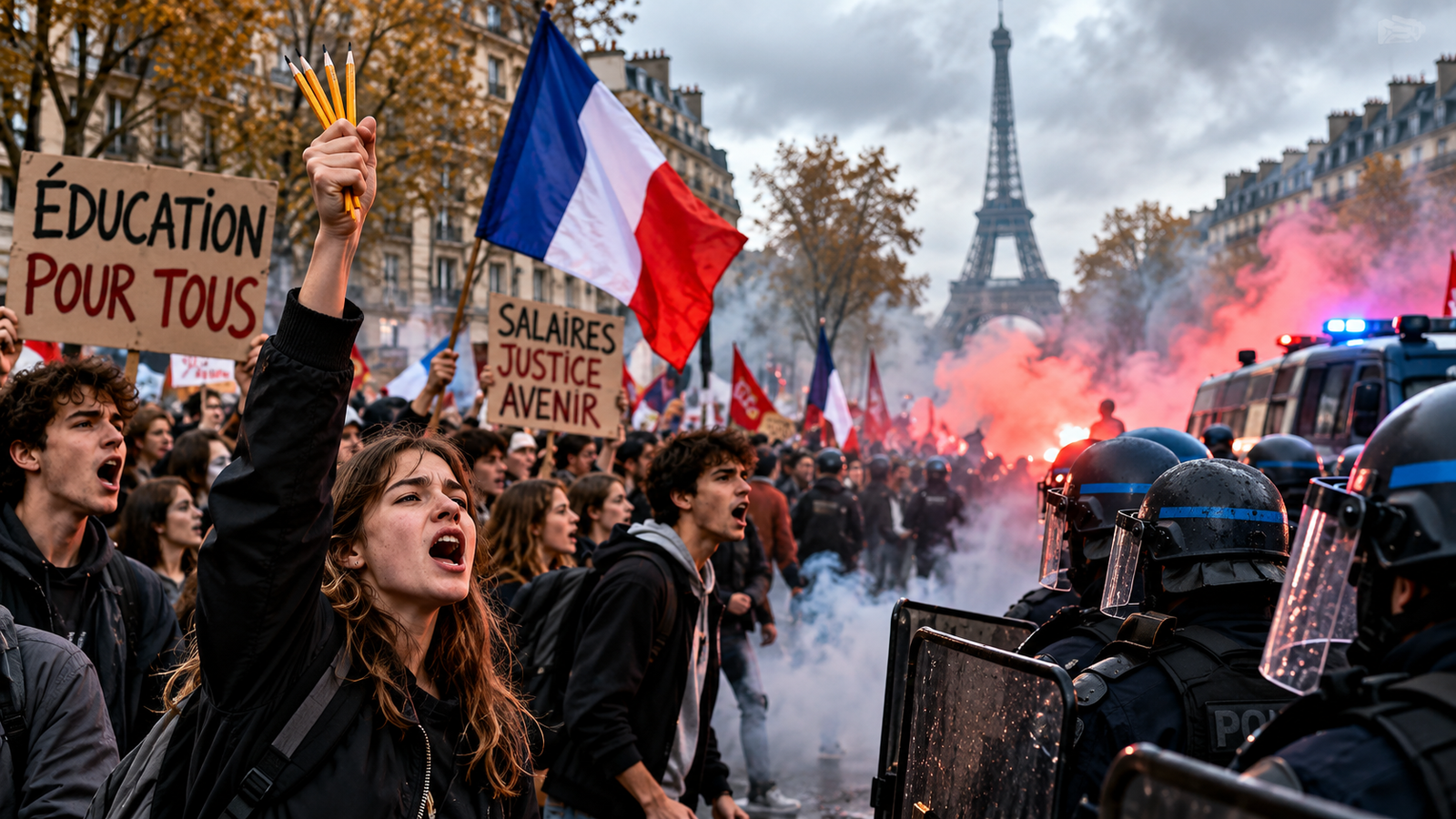
The image of students putting down their pencils while police sirens fill the streets captures the central contradiction of the French Protest of October 2026: institutions designed to prepare young people for the future have become spaces where dissatisfaction with that future is being expressed.
According to reporting by Al Jazeera on October 18, demonstrations brought together students, trade unions, and Yellow Vest supporters, connecting educational concerns with rising living costs and deteriorating public services. The mobilization followed earlier student demonstrations and public-sector strikes in September. Source: Al Jazeera, October 18, 2026.
From a sociological perspective, the French Protest of October 2026 can be understood through collective behaviour, class conflict, social movement theory, political legitimacy, and the sociology of education. It also raises an important question: why do seemingly separate grievances sometimes converge into a national crisis?
1. The Immediate Triggers: Schools, Wages, and the Cost of Living
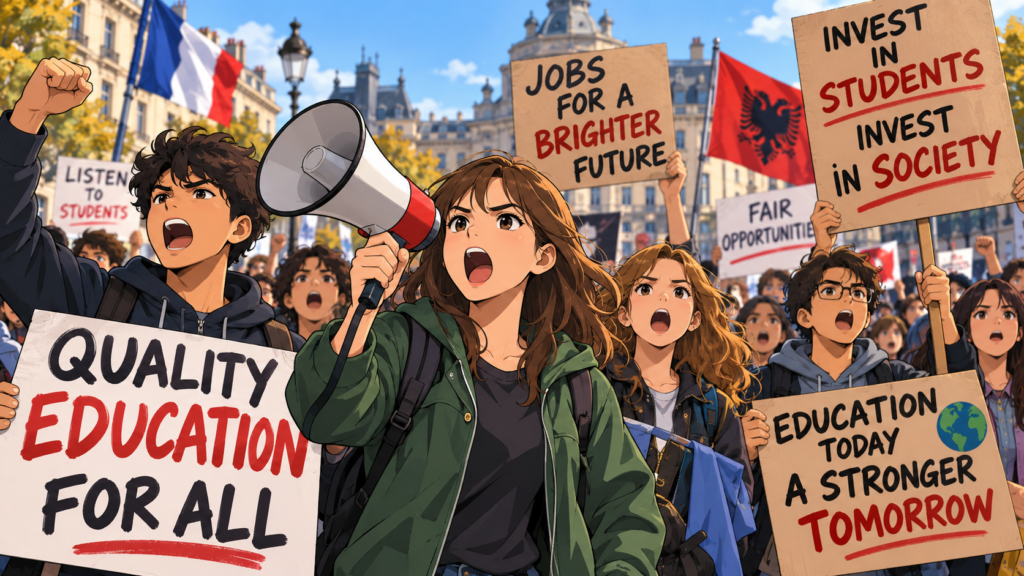
The French Protest of October 2026 developed from several interconnected grievances rather than a single political demand. School conditions became a major point of mobilization, with students raising concerns about crowded classrooms, teacher shortages, inadequate resources, and the quality of education.
These concerns reflect the sociology of education, which examines how schools reproduce or challenge social inequalities. Education is commonly presented as a route to social mobility, allowing individuals to improve their economic position through qualifications and skills. However, when students experience overcrowded classrooms or insufficient educational support, they may question whether the system offers genuinely equal opportunities.
The French Protest of October 2026 also intersected with economic dissatisfaction. Public-sector workers had demonstrated on September 29 against proposed budget measures and a freeze in public-sector salaries. Al Jazeera reported that unions estimated approximately 300,000 participants in that nationwide action, while police figures for Paris were considerably lower. Source: Al Jazeera, September 30, 2026.
These developments illustrate the sociological concept of relative deprivation. People become dissatisfied not only because they lack material resources, but because they perceive a gap between what they believe they deserve and what they actually receive.
For students, that gap may involve educational opportunities and future employment. For workers, it may involve wages, purchasing power, and working conditions. For families, it may involve the rising cost of maintaining an acceptable standard of living.
The French Protest of October 2026 therefore connects immediate material pressures with broader expectations of fairness. When different groups interpret their difficulties as consequences of the same political or economic arrangements, separate complaints can develop into collective action.
2. From Student Demonstrations to a Wider Social Movement
One of the most significant features of the French Protest of October 2026 is its expansion beyond educational grievances.
Student demonstrations can initially appear to be limited campaigns concerning school facilities, teacher availability, or admissions policies. Yet schools are embedded within wider social structures. Families, teachers, public employees, and students all depend on public institutions, while many also face the pressures of housing costs, insecure employment, and reduced purchasing power.
The convergence of these groups can be examined through social movement theory. Movements become more influential when they develop shared identities, organizational networks, recognizable demands, and opportunities to mobilize supporters.
The October 17 demonstrations illustrate this process. The Connexion reported that the French Interior Ministry estimated approximately 550,000 participants across 110 demonstrations, while organizers claimed 800,000. The mobilization brought together students, trade unions, and former Yellow Vest participants, although turnout estimates differed significantly. Source: The Connexion, October 18, 2026.
The French Protest of October 2026 demonstrates what activists often describe as a convergence of struggles. However, sociologically, convergence does not necessarily mean complete agreement. Students may prioritize educational reform, workers may focus on wages, and other demonstrators may oppose government austerity or express broader anti-establishment sentiments.
Their participation in a common demonstration creates a temporary coalition, but maintaining that coalition requires more than shared anger. It requires agreement about objectives, acceptable methods, leadership, and the political changes being demanded.
This distinction helps explain why large demonstrations can generate enormous public attention without automatically producing a unified reform programme.
3. The Yellow Vest Legacy and Collective Memory
The French Protest of October 2026 cannot be understood independently of France’s earlier protest movements. The Yellow Vest movement, which emerged in 2018, challenged rising living costs, fuel taxation, and perceived economic inequality. It became associated with the frustrations of people who believed that political decision-makers were disconnected from ordinary citizens.
The Yellow Vest legacy provides a symbolic and organizational resource for contemporary mobilization. Protesters can draw upon familiar slogans, memories of earlier demonstrations, and a shared interpretation of political neglect.
Sociologist Émile Durkheim’s concept of collective consciousness helps explain why such memories matter. Collective consciousness refers to shared beliefs, values, and understandings that bind members of a society. In protest movements, however, shared understandings can also unite people against institutions they believe have failed them.
The French Protest of October 2026 shows how an earlier movement can influence the language through which new grievances are expressed. Rising fuel prices, household expenses, wages, and public services may appear to be different issues, but participants can interpret them as evidence of a common problem: the perceived unfair distribution of economic burdens.
Nevertheless, the Yellow Vest tradition does not make every participant part of one ideological camp. The French Protest of October 2026 includes people with different social backgrounds, political commitments, and expectations. Some may demand practical reforms, while others seek a more fundamental transformation of political and economic institutions.
Collective memory supplies a framework for mobilization, but it does not eliminate internal differences.
4. Class Conflict and the Sociology of Economic Inequality
Karl Marx’s theory of class conflict offers another useful perspective on the French Protest of October 2026. Marx argued that social relations are shaped partly by conflicts over resources, ownership, and control of economic life.
The contemporary French demonstrations should not be reduced to a simple confrontation between two economic classes. Nevertheless, the protest movement raises questions about who bears the costs of economic adjustment and whose interests receive priority in public policy.
When workers fear declining purchasing power while students worry about educational opportunities, both groups may interpret their experiences as signs that existing institutions distribute opportunities and risks unfairly.
The French Protest of October 2026 also highlights the importance of social reproduction: the processes through which social advantages and disadvantages pass from one generation to the next. Families with greater financial resources can often compensate for weaknesses in public education through tutoring, private schooling, or access to additional learning opportunities. Families with fewer resources may have less flexibility.
Consequently, unequal school conditions can reinforce broader economic inequalities. Students who already experience disadvantage may perceive educational shortcomings as evidence that the promise of equal opportunity is not being fulfilled.
The same pattern appears in employment. Workers facing stagnant wages or insecure working conditions may struggle to afford housing, transportation, and essential services.
The French Protest of October 2026 thus illustrates how economic grievances can become moral and political grievances. Participants are not necessarily demanding identical outcomes; they may instead be demanding a system they consider more just, accountable, and responsive.
From a sociological standpoint, the crucial issue is not simply the presence of economic hardship. It is how hardship becomes collectively interpreted, attributed to particular causes, and transformed into organized demands.
5. The Sociology of Youth: Why Students Take to the Streets
Young people occupy a distinctive position in society. They are expected to prepare for adulthood through education, yet they often have limited influence over the decisions that shape their schools, employment prospects, housing opportunities, and political future.
The French Protest of October 2026 highlights this tension between social expectations and actual power.
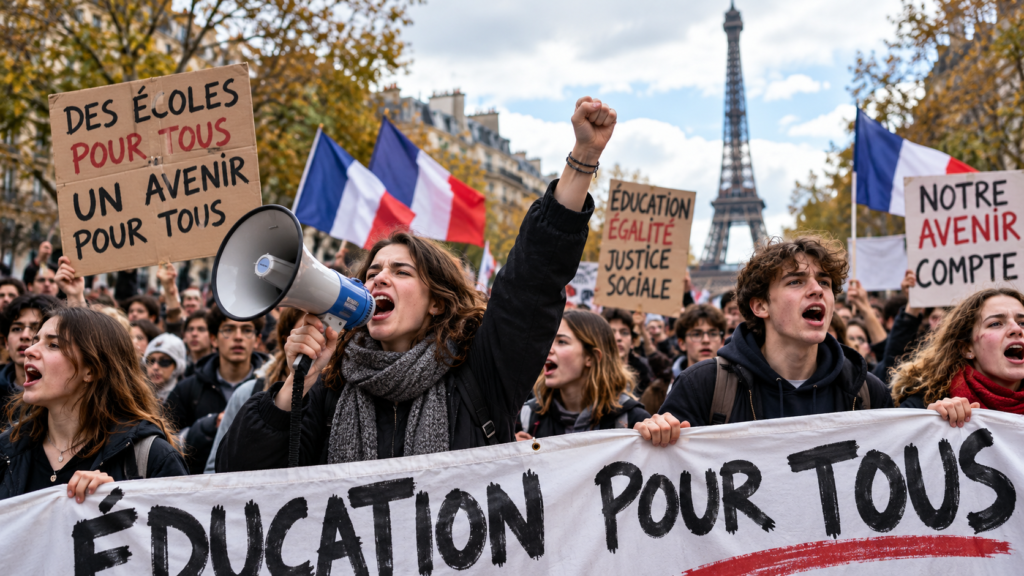
Students are not merely passive recipients of education. Through demonstrations, school blockades, public speeches, and collective organizing, they can challenge institutional authority and demand recognition as political actors.
The sociology of generations is useful here. Different generations experience economic and political conditions at different stages of life. Older citizens may evaluate public policy through employment, pensions, and accumulated assets, while younger people may be especially concerned about qualifications, future employment, affordable housing, and the long-term consequences of present decisions.
These differences do not mean that young and older people must be politically opposed. Indeed, the French Protest of October 2026 illustrates how students and workers can find common ground when their concerns overlap.
However, youth participation also presents a dilemma. Students may gain political visibility through disruption, but prolonged school closures and confrontations can interfere with learning. The challenge is to understand student protest as a form of political participation without overlooking the educational costs and safety risks that can accompany it.
The French Protest of October 2026 therefore invites a broader question about democracy: do young citizens have meaningful opportunities to influence decisions before frustration develops into street mobilization?
6. October 17: When Mass Mobilization Turned Violent
The events of October 17 became a critical moment in the French Protest of October 2026. A large nationwide mobilization was accompanied by serious clashes, looting, fires, and attacks on public and commercial property in several cities.
Reporting by Le Monde described a fragmented protest environment in Paris, where large peaceful marches occurred alongside smaller groups that sought confrontations with police or engaged in property destruction. The report also documented disturbances in cities including Marseille, Lyon, Bordeaux, and Limoges. Source: Le Monde, October 18, 2026.
The Connexion reported that the Interior Ministry estimated 1,800 arrests and more than 500 injured police officers by the following morning. These were reported official figures, and the full consequences of the unrest required further assessment.
Sociologically, it is essential to distinguish between a protest movement and every action committed during a demonstration. A peaceful march, a student blockade, a confrontation with police, and opportunistic looting are different behaviours, even when they occur in the same urban space.
Collective behaviour theories help explain how large gatherings can become unpredictable. Crowds bring together individuals with different motivations, levels of commitment, and attitudes toward violence. The presence of a crowd does not automatically make people violent, nor does participation in a protest imply approval of property destruction.
The French Protest of October 2026 therefore raises a problem of collective attribution. When violence dominates media coverage, the actions of a minority can become the defining image of a much larger mobilization. This may obscure the original demands of peaceful participants while strengthening public support for restrictive policing.
A careful sociological analysis must condemn violence against people and recognize the rights of peaceful demonstrators without treating every participant as responsible for every incident.
7. Police, State Authority, and Political Legitimacy
The response of the state is central to understanding the French Protest of October 2026. Governments have a responsibility to protect people, maintain public order, and investigate criminal acts. At the same time, citizens have rights to peaceful assembly, political expression, and public criticism.
Max Weber’s concept of legitimate authority offers a framework for examining this relationship. Weber distinguished between the possession of power and the belief that authority is legitimate. A government may have the legal capacity to enforce public order, but its long-term legitimacy also depends on public perceptions of fairness, competence, and accountability.
The French Protest of October 2026 places these principles under pressure. Reports of tear gas, arrests, protest restrictions, and serious confrontations raise questions about the proportionality of enforcement and the protection of peaceful assembly.
On October 24, the Associated Press reported renewed demonstrations involving students and workers, with police deploying tear gas in Lyon and Clermont-Ferrand. Authorities had also restricted demonstrations in Paris and banned rallies in several cities. The report described continuing demands for educational investment, higher wages, pension improvements, and relief from living costs. Source: Associated Press, October 24, 2026.
These developments illustrate the difficult balance between public safety and civil liberties. Excessive or indiscriminate force can deepen distrust, while ineffective responses to serious violence can undermine confidence in the state’s ability to protect the public.
The French Protest of October 2026 demonstrates that policing is not merely a technical exercise in crowd management. It is also a social relationship involving authority, rights, public trust, and competing interpretations of legitimate action.
8. Social Media, Digital Mobilization, and Protest Narratives

Digital communication has changed how protest movements develop. Social media platforms allow organizers to circulate meeting information, share videos, publicize grievances, and connect people who may never have met in person.
The French Protest of October 2026 reflects the importance of rapid communication in large-scale mobilization. Digital networks can help separate groups recognize shared concerns and coordinate action without depending entirely on centralized organizations.
From the perspective of network sociology, movements can spread through loosely connected communities as well as formal unions and student organizations. These networks may increase participation and allow new voices to enter public debate.
However, digital mobilization also creates difficulties. Online messages can circulate without reliable verification, isolated incidents can be presented as representative of an entire movement, and competing groups can use the same footage to construct contradictory political narratives.
The French Protest of October 2026 consequently involves a struggle over meaning as well as physical space. Protesters may frame demonstrations as demands for justice and democratic accountability, while officials may emphasize disorder and public safety. Media organizations can influence which aspects receive the greatest attention.
This does not mean that every interpretation is equally accurate. Claims about arrests, injuries, attendance, and responsibility for violence must be checked against reliable reporting. Digital visibility should not be confused with proof, and a widely shared video cannot establish the motives of an entire crowd.
9. Gender, Social Background, and Unequal Experiences of Protest
The French Protest of October 2026 also needs to be examined through the intersections of gender, class, age, and social background.
Students from financially secure families may experience educational disruption differently from those who depend on school facilities, subsidized meals, or reliable access to public transport. Workers with limited savings may find it difficult to participate in prolonged strikes even when they support the demands.
Gender can shape experiences of public space, care responsibilities, political participation, and exposure to violence. Women and men may participate in the same demonstration while facing different social expectations or practical barriers. However, these differences should be investigated through evidence rather than assumed from the presence of particular groups.
An intersectional approach, associated with the work of Kimberlé Crenshaw, examines how multiple forms of disadvantage can interact. It helps explain why a common slogan about economic justice may carry different meanings for a university student, a low-paid public employee, a single parent, or a worker living far from major urban centres.
The French Protest of October 2026 is therefore not simply a story about a unified public. It is a coalition whose members experience social problems differently and may disagree about the best solutions.
Understanding these differences can help policymakers design reforms that address the needs of diverse groups rather than assuming that one measure will resolve every grievance.
10. Political Consequences and the Future of French Democracy
Large protests can influence public policy, political debate, electoral competition, and the relationship between citizens and institutions. Yet the scale of a demonstration does not guarantee that its demands will be adopted.
The French Protest of October 2026 creates political pressure because it links everyday experiences to questions about government priorities. School conditions, public-sector pay, living costs, and access to essential services can become symbols of whether political institutions are responsive to ordinary citizens.
The movement may encourage parties and policymakers to reconsider budget priorities, strengthen public services, or establish new channels for consultation. It may also intensify political polarization if different groups interpret the unrest as evidence of either legitimate social resistance or unacceptable disorder.
Sociologically, the outcome will depend partly on whether the movement develops stable organizations, negotiable demands, and mechanisms for holding leaders accountable. Movements that unite around dissatisfaction can mobilize quickly, but sustaining cooperation requires a credible programme for change.
The French Protest of October 2026 also tests the quality of democratic representation. Elections provide one mechanism for expressing political preferences, but citizens also use demonstrations, strikes, petitions, and public debate to influence decisions between elections.
The challenge for democratic institutions is to respond to legitimate grievances while protecting the rights of people who disagree with the movement. Equally, protest organizations must consider how their strategies affect students, workers, local communities, and the wider public.
The long-term significance of the French Protest of October 2026 will therefore depend not only on the number of people who participate, but on whether the mobilization produces meaningful dialogue, institutional reform, and renewed public confidence.
Conclusion: Beyond the Sirens
The French Protest of October 2026 illustrates how educational dissatisfaction, economic insecurity, generational frustration, and distrust of political institutions can converge into a national movement. Its development from school-related grievances to broader demonstrations reveals the connections between public services, material living conditions, and the perceived fairness of social institutions.
Sociological theories help explain different dimensions of this process. Relative deprivation illuminates dissatisfaction with unmet expectations; Marxist analysis highlights conflicts over resources and economic priorities; social movement theory explains coalition-building; and Weber’s concept of legitimacy clarifies why state responses matter for public trust.
The events of October 17 also demonstrate why careful distinctions are necessary. Peaceful collective action and violent acts should not be treated as interchangeable. Protecting public safety and safeguarding democratic freedoms are both essential to understanding the crisis.
Ultimately, the French Protest of October 2026 is a reminder that social stability cannot be measured solely by the absence of demonstrations. It also depends on whether people believe their institutions listen to them, distribute opportunities fairly, and offer credible solutions to their everyday problems.
When students leave classrooms to demand change, the sociological question is not simply why they are protesting. It is what their actions reveal about the society in which they are growing up—and whether political institutions can respond before frustration becomes a more enduring crisis.