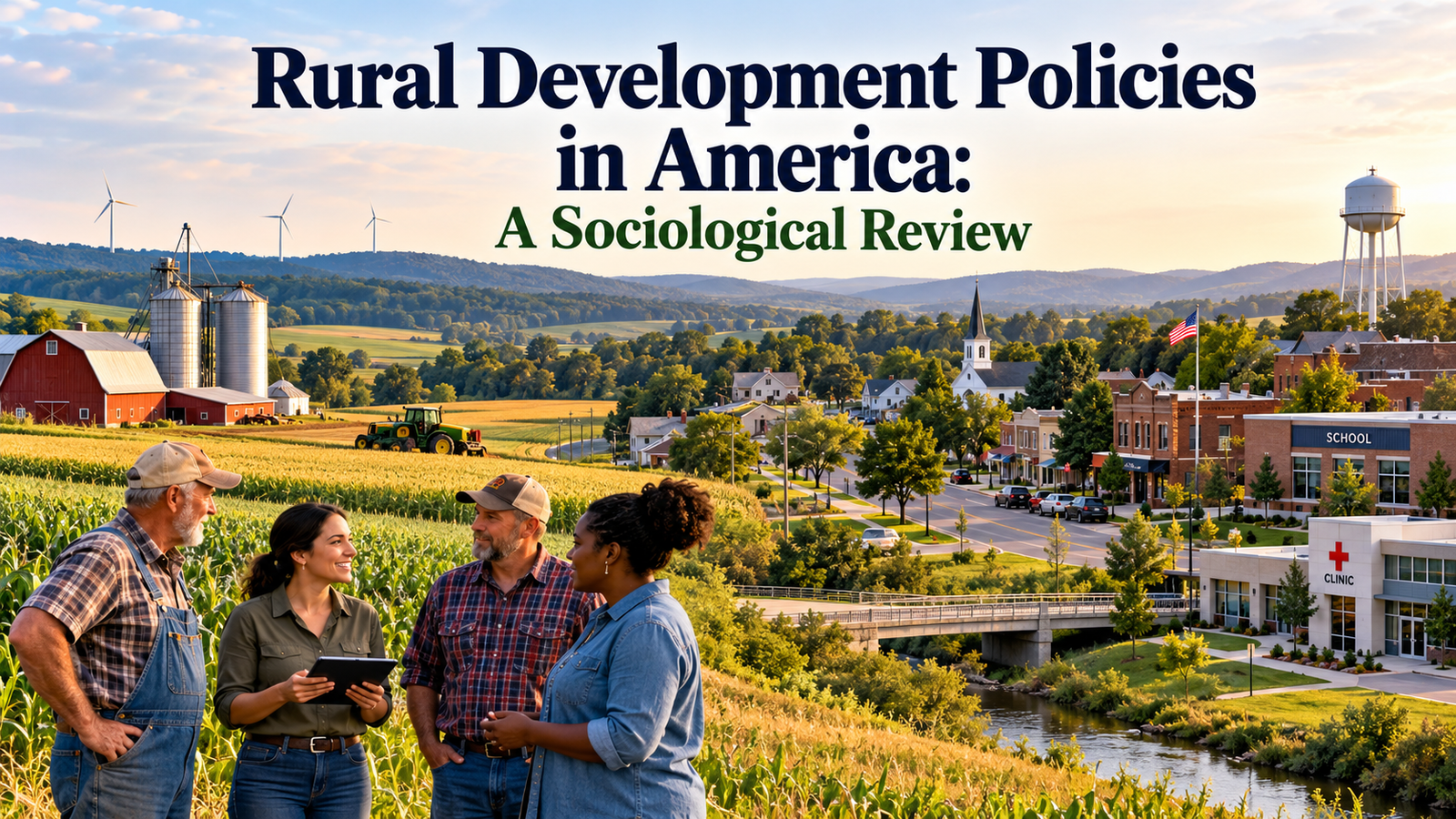
Introduction on Rural Development Policies in America
Rural development is an important area of sociological research because it examines the relationship between economic change, social inequality, community life, and government intervention. In the United States, rural communities play a significant role in agriculture, natural resource management, manufacturing, energy production, and the preservation of cultural traditions. However, many rural areas experience persistent poverty, limited employment opportunities, inadequate healthcare facilities, and unequal access to education and modern infrastructure. These challenges make Rural Development Policies in America an essential subject for understanding contemporary American society.
From a sociological perspective, rural development is not simply a process of increasing agricultural productivity or expanding local businesses. It also involves transforming social institutions, improving people’s quality of life, reducing structural inequalities, and strengthening community participation. Rural Development Policies in America seek to address these interconnected challenges through public investment, economic assistance, infrastructure development, and social welfare initiatives.

The effectiveness of these policies depends on how well they respond to the diverse needs of rural populations. Rural America is not a single, uniform social environment. Farming communities in the Midwest, Indigenous communities, Appalachian towns, agricultural settlements in the South, and remote communities in the West experience different economic and social conditions. Therefore, Rural Development Policies in America must be evaluated through the sociological concepts of social stratification, power, community organization, social mobility, and regional inequality.
Historical Development of Rural Policies in America
The historical development of Rural Development Policies in America reflects changing ideas about agriculture, poverty, economic growth, and the responsibilities of government. During the early stages of American development, rural policy primarily focused on agricultural expansion, land settlement, farming productivity, and the development of transportation networks.
Agriculture remained central to rural economic life for much of American history. Government initiatives supporting agricultural education, research, credit, and infrastructure helped farmers increase productivity. Nevertheless, the benefits of agricultural modernization were not distributed equally. Differences in land ownership, access to capital, race, and political influence shaped the opportunities available to rural households.
The New Deal era of the 1930s introduced significant government intervention in response to the Great Depression and the agricultural crisis. Agricultural assistance, conservation programs, and rural electrification contributed to improvements in living conditions. These initiatives demonstrated that rural poverty could not be addressed solely through individual effort; broader economic structures and public institutions also mattered.
During the 1960s and 1970s, poverty reduction, education, community services, and regional development became more prominent policy concerns. The Rural Development Act of 1972 represented an important step toward a broader approach to rural development. Later legislation, including the Rural Development Policy Act of 1980, further established rural development as a federal policy concern.
Today, Rural Development Policies in America extend beyond farming and agricultural subsidies. They address housing, broadband connectivity, healthcare facilities, renewable energy, small-business development, drinking water, and community infrastructure. This evolution reflects the recognition that rural societies require coordinated economic and social investment rather than agricultural assistance alone.
The Sociological Perspective on Rural Development
Sociology provides a framework for examining the social consequences of Rural Development Policies in America. It focuses on how policies influence social relationships, access to resources, institutional power, and opportunities for different population groups.
Structural functionalism emphasizes the importance of institutions such as families, schools, local governments, healthcare systems, and economic organizations. From this perspective, successful rural development strengthens the relationships between these institutions. Better schools can improve employment prospects, improved transportation can expand access to hospitals, and stronger local businesses can support community stability.
Conflict theory offers a different interpretation. It argues that economic and political power influence how resources are distributed. Under this approach, Rural Development Policies in America must be assessed by examining who receives public investment, who controls local economic resources, and whether disadvantaged populations benefit from development projects. A policy that increases total regional income may still deepen inequality if its benefits primarily reach large landowners, major corporations, or politically influential groups.
Modernization theory emphasizes technological development, education, infrastructure, and economic diversification. It helps explain why digital connectivity, advanced agricultural practices, and vocational training can transform rural economies. However, modernization should not be treated as a process in which rural communities must abandon their traditions or imitate urban lifestyles.
Consequently, a comprehensive sociological analysis of Rural Development Policies in America must combine economic development with social justice, institutional accountability, cultural understanding, and community participation.
Major Rural Development Policies and Programs
The United States Department of Agriculture (USDA) Rural Development agency is one of the principal federal institutions supporting rural communities. Its programs provide loans, grants, loan guarantees, and technical assistance for housing, business development, essential facilities, and infrastructure.
According to the USDA’s official rural development information, its programs support broadband expansion, water and wastewater systems, community facilities, and rural businesses. These initiatives demonstrate the broad scope of Rural Development Policies in America beyond conventional agricultural support.
Housing programs help eligible rural households obtain affordable homes, finance improvements, and repair unsafe living conditions. Community Facilities programs support essential services such as schools, healthcare institutions, emergency services, and public facilities. Rural business initiatives provide financial and technical assistance to businesses and cooperatives seeking to establish or expand operations.
The Farm Bill is another important policy mechanism. Its rural development provisions have supported infrastructure, rural enterprises, water systems, energy services, and broadband expansion. These provisions connect agricultural policy with the broader economic and social needs of rural communities.
Nevertheless, the existence of multiple programs does not automatically guarantee equitable development. Eligibility requirements, administrative complexity, limited local capacity, and difficulties obtaining matching funds can prevent some communities from accessing assistance. Therefore, the success of Rural Development Policies in America depends not only on the availability of funding but also on the accessibility and distribution of public resources.
Rural Poverty and Social Inequality
Rural poverty remains one of the most important concerns in the sociological assessment of Rural Development Policies in America. Although rural communities differ considerably, some experience low wages, unstable employment, declining industries, limited public services, and persistent economic insecurity.
Rural poverty is often connected to structural disadvantages rather than individual shortcomings. The closure of factories, consolidation of agricultural operations, declining local employment, and population loss can weaken entire communities. When businesses close, residents may lose not only their income but also access to local shops, social networks, and community institutions.
Sociologists also examine how poverty intersects with race, gender, age, disability, and geographic isolation. Some African American communities in the rural South, Indigenous communities, and economically disadvantaged Appalachian communities have experienced long-standing barriers to land ownership, investment, healthcare, and quality education.
Effective Rural Development Policies in America should therefore consider both income inequality and the distribution of opportunities. Employment programs, affordable housing, accessible healthcare, quality education, and support for local enterprises can reduce the structural barriers that reproduce poverty across generations.
A sociological approach also recognizes that economic growth alone may not eliminate poverty. If newly created jobs offer low wages, lack security, or require skills unavailable to local residents, disadvantaged households may experience little improvement. Development policies must consequently prioritize the quality of employment and the social mobility of residents.
Employment and Economic Diversification
Employment is central to rural development because it influences income, family stability, migration, and community participation. Historically, farming was a major source of rural employment. However, technological change, agricultural consolidation, and the expansion of non-agricultural industries have transformed rural labor markets.
Many rural communities now depend on manufacturing, tourism, healthcare, education, logistics, energy production, and small businesses. Rural Development Policies in America increasingly recognize that economic diversification can reduce dependence on a single industry and make communities more resilient to economic shocks.
Small businesses are particularly important because they create local employment and retain some economic activity within the community. Cooperatives, local food-processing enterprises, agricultural innovation, and tourism-related businesses can connect local resources with wider markets.
However, economic diversification also raises sociological questions. Who has the financial resources to establish businesses? Are women and minority entrepreneurs able to access credit? Do workers receive adequate wages and benefits? Can young people find skilled employment without leaving their communities?
Successful Rural Development Policies in America should support entrepreneurship while also investing in vocational education, worker training, labor protections, and access to affordable credit. Economic growth becomes more socially meaningful when it expands opportunities for residents across different social classes.
Education, Digital Connectivity, and Social Mobility
Education is one of the strongest mechanisms through which individuals can improve their social and economic position. Yet rural schools and colleges may face challenges involving funding, transportation, teacher recruitment, specialized courses, and access to advanced educational resources.
Educational inequality can contribute to intergenerational poverty. Students who cannot access high-quality education or professional training may have fewer opportunities to enter higher-paying occupations. This situation can encourage migration among young adults, weakening the demographic and economic foundations of rural communities.
For this reason, Rural Development Policies in America should prioritize school infrastructure, vocational training, community colleges, affordable higher education, and partnerships between educational institutions and local employers.
Digital connectivity is equally important. Broadband internet supports online learning, remote employment, telemedicine, digital entrepreneurship, and access to government services. The USDA identifies telecommunications programs as a means of expanding reliable high-speed internet access in rural areas.
However, access to broadband does not automatically eliminate the digital divide. Affordability, digital literacy, device availability, and the reliability of local networks also influence whether households can benefit from connectivity.
From a sociological perspective, Rural Development Policies in America should treat digital infrastructure as a foundation for social inclusion. Broadband investment should be accompanied by training and affordable access so that low-income households, older residents, students, and small businesses can participate in the digital economy.
Healthcare and Social Well-Being
Healthcare inequality is another major challenge facing rural communities. Some rural residents live far from hospitals, specialist services, pharmacies, and mental health professionals. Long travel distances, transportation difficulties, insurance limitations, and shortages of healthcare workers can delay treatment and increase household costs.
These problems demonstrate how geographic location can influence access to essential social resources. In sociology, this relationship is often examined through the concept of spatial inequality: people’s opportunities and well-being are partly shaped by where they live.
Rural Development Policies in America can address these challenges by supporting rural hospitals, community health centers, emergency services, telemedicine, and healthcare workforce development. Reliable broadband can help patients consult healthcare professionals remotely, although it cannot replace every form of in-person care.
Healthcare is also connected to employment, family life, and community stability. When local hospitals close, residents may face longer journeys for treatment, while communities can lose important jobs and services.
Therefore, effective Rural Development Policies in America must view healthcare as both a social service and an essential component of community development. Rural residents should not face systematically greater barriers to healthcare simply because they live far from metropolitan centers.
Gender, Family, and Community Life
Gender relations are an important dimension of rural development. Women contribute significantly to agriculture, household management, education, healthcare, small businesses, and community organizations. However, unpaid care responsibilities, limited employment choices, unequal access to credit, and traditional gender expectations can restrict their opportunities.

Rural Development Policies in America should promote women’s entrepreneurship, professional training, childcare access, leadership opportunities, and fair employment. These measures can strengthen household income while also expanding women’s participation in local decision-making.
Family structures are also affected by economic change. When local employment declines, younger adults may migrate to urban areas, leaving older relatives behind. Migration can separate family members, reduce informal caregiving networks, and weaken community institutions.
At the same time, rural communities often possess strong social networks, shared traditions, voluntary organizations, and informal systems of mutual assistance. These relationships can support residents during economic crises and provide a foundation for collective action.
Sociologically informed Rural Development Policies in America should strengthen these existing community resources without assuming that all rural residents have the same family arrangements, cultural values, or social experiences.
Race, Indigenous Communities, and Historical Inequality
Rural America contains diverse racial, ethnic, and Indigenous populations whose experiences of development are shaped by distinct historical circumstances. Land dispossession, discriminatory institutions, unequal access to finance, and underinvestment have affected opportunities in some communities over generations.
Indigenous communities may face additional challenges involving infrastructure, healthcare, housing, economic sovereignty, and the protection of cultural resources. Development initiatives that overlook tribal authority or local priorities can undermine community autonomy.
Similarly, rural minority communities may encounter barriers to property ownership, business financing, and political representation. Such disadvantages demonstrate why universal policies sometimes produce unequal outcomes.
Rural Development Policies in America should therefore incorporate historical awareness, culturally appropriate services, fair access to public investment, and meaningful participation by affected communities. Tribal governments and community organizations should be involved in designing projects that influence their land, resources, and livelihoods.
An equitable approach does not assume that every community needs the same development model. Instead, it recognizes different histories, social structures, and aspirations while ensuring that all communities have opportunities to improve their living conditions.
Environmental Sustainability and Climate Resilience
Environmental conditions influence rural employment, public health, agricultural productivity, and long-term economic stability. Droughts, floods, wildfires, severe storms, and changing temperatures can threaten livelihoods and damage infrastructure.
Rural Development Policies in America increasingly need to connect economic development with environmental sustainability. Renewable energy projects, water conservation, soil protection, energy efficiency, and climate-resilient infrastructure can create opportunities while reducing environmental risks.
Nevertheless, environmental development may generate social conflicts. Renewable energy projects can create jobs and public revenue, but disputes may emerge over land use, local control, environmental impacts, and the distribution of benefits.
A sociological approach asks whether residents participate in decisions, whether affected households receive fair treatment, and whether environmental costs are imposed disproportionately on disadvantaged groups.
Sustainable Rural Development Policies in America should protect natural resources while supporting secure employment and community well-being. Long-term development must balance economic needs, environmental responsibility, and the rights of local populations.
Challenges and Limitations of Rural Development Policies
Despite their importance, Rural Development Policies in America face several persistent limitations. One major problem is fragmentation. Different federal and state agencies may operate separate programs with different eligibility criteria, application processes, and reporting requirements. Small communities often lack the administrative staff needed to coordinate these opportunities.
Another challenge is unequal access to political influence and financial resources. Communities with experienced grant writers, established institutions, and stronger tax bases may be better positioned to secure public investment. More disadvantaged areas can struggle to compete, even when their needs are greater.
Population decline also creates difficulties. When residents leave, local governments may experience shrinking tax revenues while the cost of maintaining roads, schools, water systems, and emergency services remains high. This can create a cycle in which weak services encourage further migration.
Furthermore, development projects may prioritize measurable economic outcomes while neglecting social relationships, cultural identity, and residents’ perceptions of well-being. A new industrial facility may increase regional output without necessarily improving working conditions or reducing household insecurity.
To address these limitations, Rural Development Policies in America should include transparent funding criteria, technical assistance for underserved communities, coordination among agencies, and meaningful public participation. Evaluation should measure not only money spent or jobs created but also changes in inequality, service accessibility, employment quality, and community resilience.
Recommendations for More Inclusive Rural Development
A stronger approach to Rural Development Policies in America requires an integrated strategy that connects economic growth with social equity.
First, policymakers should expand investment in essential services, including healthcare, education, public transportation, affordable housing, clean water, and broadband. These services establish the foundation for economic participation and a better quality of life.
Second, governments should support locally rooted economic development. Small businesses, cooperatives, agricultural enterprises, and community-owned projects can retain more benefits within rural areas. Assistance should be accessible to low-income entrepreneurs, women, minority-owned businesses, and Indigenous communities.
Third, rural residents should participate directly in planning and evaluation. Community meetings, local surveys, participatory budgeting, and partnerships with universities can help identify priorities that may otherwise be overlooked.
Fourth, policymakers should recognize regional differences. A farming community facing water shortages requires different interventions from a former manufacturing town experiencing unemployment or a remote Indigenous community lacking essential infrastructure.
Finally, Rural Development Policies in America should be evaluated through long-term social indicators. These should include poverty reduction, educational attainment, health outcomes, income distribution, job security, housing affordability, and residents’ ability to influence local decisions.
This approach would move rural policy beyond short-term financial assistance toward a more comprehensive understanding of development as a social process.
Conclusion
Rural Development Policies in America are essential for understanding how government intervention can influence economic opportunity, social inequality, and the future of rural communities. Their historical development demonstrates a gradual shift from agricultural support toward a broader approach that includes infrastructure, housing, education, healthcare, business development, and digital connectivity.
From a sociological perspective, rural development must be evaluated by examining who benefits from public investment, how social inequalities are reproduced, and whether communities gain greater control over their futures. Economic growth alone is insufficient if poverty, unequal access to services, and exclusion from decision-making remain unchanged.
The future of Rural Development Policies in America depends on inclusive institutions, locally responsive planning, sustainable investment, and stronger coordination between government agencies and community organizations. Policies that recognize racial and gender inequalities, regional differences, environmental challenges, and the importance of social networks are more likely to produce lasting improvements.
Ultimately, Rural Development Policies in America should aim not merely to make rural economies more productive but also to create communities in which residents have equitable access to resources, meaningful employment, essential services, and opportunities for social mobility. Such a sociological approach places people, communities, and social justice at the center of rural development.
References
- United States Department of Agriculture (USDA). Rural Development: Programs and Services.
- USDA Economic Research Service. Rural Development and the Farm Bill.
- Organisation for Economic Co-operation and Development (OECD). Enhancing Rural Innovation in the United States.
- Wilkinson, K. P. (2019). Community Development in Rural America: Sociological Issues in National Policy. Journal of Rural Social Sciences.
- Tickamyer, A. R., & Duncan, C. M. (1990). Poverty and Opportunity Structure in Rural America. Annual Review of Sociology, 16, 67–86. https://doi.org/10.1146/annurev.so.16.080190.000435.
- Hill, S. A., Low, S., & Taylor, K. (2026). The Economics of Rural Development in the United States. Annual Review of Resource Economics. https://doi.org/10.1146/annurev-resource-120324-050230.