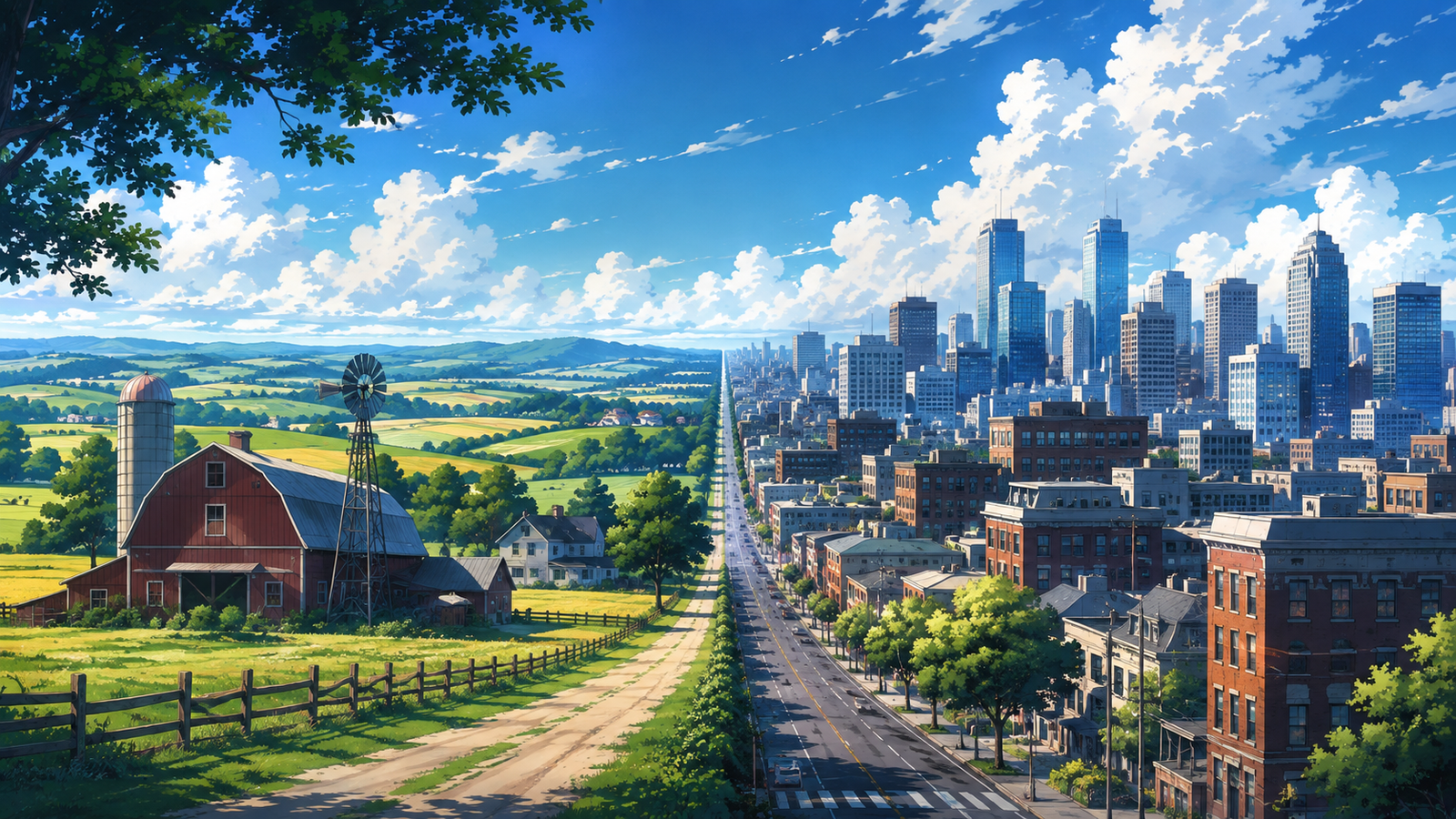
The Rural–Urban Divide in America is one of the most significant social and geographical inequalities shaping contemporary American society. The United States is often portrayed as a highly urbanized nation characterized by metropolitan growth, technological development, and expanding service economies. Yet millions of Americans continue to live in rural communities where social relationships, economic opportunities, political attitudes, access to institutions, and cultural traditions differ substantially from those found in large cities. The divide between rural and urban America is therefore not simply a difference in population density or geographical location. It represents a complex sociological relationship involving class, education, occupation, race, political identity, social networks, cultural values, and access to resources.
From a sociological perspective, rural and urban communities should not be understood as completely separate worlds. They are interconnected through migration, markets, communication technologies, education, transportation, and national institutions. However, unequal access to economic and social resources has produced different experiences of American life. Rural communities may face population decline, limited employment opportunities, healthcare shortages, and infrastructure problems, while urban communities often confront housing costs, overcrowding, inequality, homelessness, crime, and social fragmentation. Thus, the Rural–Urban Divide in America involves different forms of advantage and disadvantage rather than a simple opposition between “rural” and “urban.”
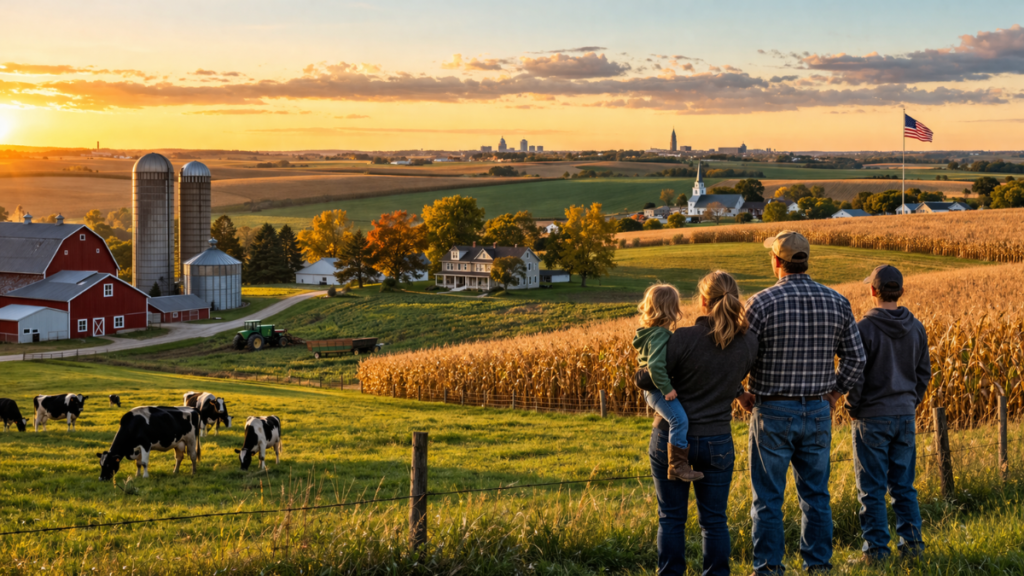
Understanding the Rural–Urban Divide in America
The rural–urban divide refers broadly to differences between people and communities living in rural areas and those living in metropolitan or urban areas. These differences can involve income, employment, education, healthcare, transportation, political participation, social values, technology, and cultural identity.
Classical sociologists recognized that social organization changes with the scale and density of human settlements. Ferdinand Tönnies’ distinction between Gemeinschaft and Gesellschaft provides a useful framework. Gemeinschaft refers to community relationships characterized by familiarity, tradition, kinship, and emotional bonds, while Gesellschaft describes more formal, impersonal, and contractual relationships associated with modern urban societies.
Rural America cannot simply be equated with Gemeinschaft, nor can cities be completely identified with Gesellschaft. Nevertheless, the distinction helps sociologists examine differences in patterns of social interaction. Rural communities frequently possess dense networks of family, neighbors, churches, schools, voluntary organizations, and local associations. Urban communities generally contain more diverse populations and a larger number of specialized institutions, occupations, and social networks.
Émile Durkheim’s concept of mechanical and organic solidarity is also relevant. Rural communities may display stronger similarities in social life and collective traditions, whereas urban societies depend increasingly on occupational specialization and interdependence. Modern American society, however, combines both forms of solidarity.
Economic Inequality and Employment
One of the strongest dimensions of the Rural–Urban Divide is economic inequality. The transformation of the American economy from agriculture and manufacturing toward services, finance, technology, healthcare, and knowledge-based industries has created significant geographical differences.
Large metropolitan areas have attracted technology companies, universities, financial institutions, hospitals, professional services, and creative industries. These sectors generate employment for highly educated workers and contribute to economic growth. Rural areas, by contrast, have historically depended more heavily on agriculture, natural-resource industries, manufacturing, small businesses, and public-sector employment.
The decline of traditional manufacturing and extractive industries has affected many rural communities. When a major factory, mine, mill, or processing facility closes, the consequences extend beyond individual workers. Local restaurants, shops, transportation providers, schools, and other businesses may also lose customers. Sociologically, economic decline can therefore produce community-wide social disorganization.
Employment opportunities also influence migration. Young adults from rural communities frequently move toward metropolitan areas in search of higher education, professional employment, and greater economic mobility. This can create a demographic cycle in which rural communities lose younger and highly educated residents while becoming increasingly older.
Economic inequality is therefore not only about individual income. It is also about the geographical distribution of opportunities.
Education and Social Mobility
Education is another major dimension of the Rural–Urban Divide in America. Urban areas tend to contain large numbers of colleges, universities, specialized schools, training centers, libraries, and educational organizations. Rural communities may have fewer educational institutions, particularly at the postsecondary level.
Educational inequality can influence social mobility. A rural student who wants to pursue a specialized profession may have to travel considerable distances or move to a metropolitan area. The cost of transportation, housing, tuition, and relocation can create additional barriers.

The issue is not simply whether rural schools are inherently inferior. Many rural schools play important social and cultural roles within their communities and may provide strong relationships between teachers, students, and families. However, rural schools can face challenges associated with limited tax bases, teacher recruitment, declining enrollment, transportation difficulties, and restricted access to specialized courses.
Education also has a cultural dimension. Higher education may expose individuals to diverse social environments and political perspectives. Consequently, educational differences can contribute to differences in social attitudes and political identities between rural and urban populations.
Healthcare Inequality
Healthcare access demonstrates how geography becomes a social determinant of inequality. Rural communities often have fewer hospitals, specialist physicians, mental-health professionals, and other healthcare resources than major metropolitan regions.
Long travel distances can make routine medical treatment difficult. For elderly people, low-income households, and individuals without reliable transportation, geographical distance can become a serious barrier.
The closure or reduction of services at rural hospitals can have consequences beyond healthcare. Hospitals often function as major employers and economic institutions within rural communities. Their decline may weaken both the healthcare system and the local economy.
Mental healthcare presents another challenge. Social stigma, shortages of professionals, and limited availability of specialized services can make treatment difficult in some rural communities. Sociologists therefore examine rural healthcare inequality not merely as a medical issue but as a question of social structure, institutional access, and spatial inequality.
The Digital Divide
Technology has transformed the relationship between rural and urban America, but it has also created new forms of inequality. Internet access is essential for education, employment, telemedicine, banking, government services, communication, and entrepreneurship.
Urban residents generally benefit from dense telecommunications infrastructure, while some rural communities have historically faced limited broadband availability, higher costs, or lower-quality service.
The digital divide is increasingly important because physical distance can sometimes be overcome through digital technology. A rural student can potentially attend online courses, a worker can participate in remote employment, and a patient can consult a medical professional through telehealth. But these possibilities depend on reliable internet infrastructure and digital literacy.
Thus, technology can reduce geographical inequality, but unequal access to technology can simultaneously reproduce existing social inequalities.
Political Polarization
The Rural–Urban Divide has become highly visible in American political life. Rural and urban populations often differ in voting patterns, political priorities, and attitudes toward government, taxation, immigration, environmental regulation, social policy, and cultural issues.
However, sociologists caution against treating all rural residents as politically conservative or all urban residents as politically progressive. Rural communities contain considerable political diversity, while cities contain many ideological differences.
Political divisions are partly connected to economic and cultural experiences. Rural residents may perceive national political institutions as distant from their everyday concerns. Urban residents may have different experiences because of greater racial, ethnic, occupational, and cultural diversity.
Political identity can also become a form of social identity. Individuals may increasingly understand themselves through categories such as “rural America,” “urban America,” “small-town America,” or “metropolitan America.” These identities can create symbolic boundaries between groups.
Culture, Values, and Social Identity

Culture represents another important sociological dimension of the Rural–Urban Divide. Rural communities often place strong emphasis on family relationships, local traditions, religious organizations, community events, land, and attachment to place. Urban environments are generally characterized by greater demographic diversity and a wider variety of lifestyles and cultural institutions.
This does not mean that rural Americans are uniformly traditional or that urban Americans are uniformly modern. Instead, the social environment influences the types of relationships and cultural experiences available to individuals.
Robert Putnam’s work on social capital is particularly useful here. Rural communities can possess strong forms of bonding social capital, involving close relationships among people who share similar backgrounds. These networks can generate trust, mutual assistance, and community solidarity. At the same time, strong internal networks may sometimes provide fewer connections to institutions and opportunities outside the community.
Urban environments may provide greater opportunities for bridging social capital because people encounter individuals from different racial, ethnic, occupational, and cultural backgrounds. However, urban social networks can also be fragmented and unequal.
Race and the Rural–Urban Divide
Race adds another layer of complexity to rural–urban inequality. Rural America is not racially homogeneous. African American, Native American, Latino, Asian American, and other communities live in rural regions across the United States.
Some rural minority communities experience overlapping forms of disadvantage involving poverty, limited employment opportunities, inadequate infrastructure, environmental risks, and restricted access to healthcare and education.
Native American communities provide an especially important example of how geography, historical inequality, and political institutions intersect. Many tribal communities face distinctive challenges related to infrastructure, economic development, healthcare, and educational opportunities.
At the same time, metropolitan areas also contain substantial racial and economic inequality. Therefore, race cannot be separated from the broader analysis of class, geography, and institutional power.
Housing and the Cost of Living
Housing represents an important contrast between rural and urban America. Large metropolitan areas in the United States have experienced substantial housing-cost pressures. High demand, limited housing supply, and expensive land can make homeownership increasingly difficult for working- and middle-class households.
Rural areas often have lower housing costs, but affordability does not automatically mean economic security. Rural households may face lower wages, limited employment opportunities, older housing stock, inadequate infrastructure, and fewer rental options.
The sociological concept of spatial inequality helps explain this contradiction. A household’s quality of life depends not only on how much it pays for housing but also on the availability of employment, schools, healthcare, transportation, and public services in the surrounding area.
Transportation and Geographic Isolation
Transportation strongly influences access to social opportunities. Urban residents can often choose among public transportation, private vehicles, ride-sharing services, cycling, and walking. Rural residents are generally more dependent on private automobiles because services and workplaces may be widely dispersed.
For people who cannot drive—such as some elderly, disabled, or low-income residents—transportation limitations can create social isolation.
Geographical isolation can also affect young people. Limited public transportation may restrict access to colleges, jobs, cultural institutions, recreational activities, and social networks outside the immediate community.
Thus, transportation is not merely an infrastructure issue. It affects social mobility, participation, independence, and quality of life.
Social Isolation and Community Change
Rural depopulation can produce significant changes in community life. When young people leave, the remaining population may become older. Schools may consolidate because of declining enrollment, businesses may close, and community organizations may lose members.
These processes can weaken what sociologists call community social infrastructure—the institutions and spaces that enable people to interact.
However, rural communities are not simply disappearing. Many have demonstrated resilience through local organizations, cooperatives, community development initiatives, tourism, entrepreneurship, agricultural innovation, and new forms of remote work.
The COVID-19 pandemic also altered perceptions of rural living. Remote work allowed some professionals to relocate away from major cities. Yet the benefits of this transformation were uneven because they depended on employment type, internet connectivity, housing availability, and financial resources.
Rural–Urban Divide and Social Stratification
From a broader sociological perspective, the Rural–Urban Divide illustrates how social stratification operates through geography.
Social class, race, education, occupation, age, and geographical location interact to produce different life chances. A wealthy rural resident and a poor rural resident do not experience rural America in the same way. Similarly, the experiences of a high-income urban professional and a low-income urban worker may be dramatically different.
Therefore, rurality and urbanity should be treated as social locations rather than fixed social categories.
Pierre Bourdieu’s concept of different forms of capital is useful here. Economic capital includes income and wealth; cultural capital includes education and knowledge; social capital involves networks and relationships. Access to these resources varies across geographical settings.
A person’s geographical location can therefore influence the amount and type of capital available to them.
Globalization and the Transformation of Rural America
Globalization has reshaped the rural economy. Agricultural production has become increasingly mechanized and integrated into global markets. Manufacturing jobs have moved between regions and countries. Natural-resource industries have experienced technological and market changes.
These transformations have created winners and losers.
Large-scale agricultural enterprises and technologically advanced rural businesses may benefit from global markets, while smaller producers can face increasing competition. Communities dependent on a single industry can become vulnerable to external economic decisions.
This demonstrates that the Rural–Urban Divide is not isolated from globalization. Rural communities are deeply connected to national and international markets.
Sociological Theories and the Rural–Urban Divide
Several sociological perspectives help explain the divide.
The conflict perspective emphasizes unequal access to economic and political power. From this perspective, rural decline may reflect broader processes in which capital and investment become concentrated in economically profitable metropolitan regions.
The functional perspective examines how rural and urban communities perform different but interconnected functions within society. Rural regions contribute food, energy, natural resources, and land, while urban regions concentrate administration, finance, education, technology, and specialized services.
The symbolic interactionist perspective focuses on how people construct meanings around rural and urban identities. Terms such as “small-town values,” “city people,” “rural America,” or “urban elites” can become powerful symbols through which groups define themselves and others.
A political economy approach emphasizes the relationship between geography, markets, government policy, and institutional power. It asks why some regions receive greater investment, infrastructure, employment, and political attention than others.
Together, these perspectives demonstrate that the Rural–Urban Divide is a multidimensional social phenomenon.
Bridging the Rural–Urban Divide
Reducing the Rural–Urban Divide requires more than transferring resources from cities to rural communities. Policies must address the structural causes of geographical inequality.
Investment in broadband, transportation, healthcare, education, vocational training, and rural entrepreneurship can strengthen local opportunities. At the same time, urban communities require policies addressing housing affordability, inequality, transportation, homelessness, and social exclusion.
Greater interaction between rural and urban populations can also challenge stereotypes. Educational exchanges, regional economic partnerships, cultural programs, and collaborative political initiatives can create stronger social connections.
The goal should not be to make rural America identical to urban America. Sociologically, diversity between communities is not necessarily a problem. The central issue is whether geographical differences translate into unequal life chances.
Conclusion on Rural–Urban Divide in America
The Rural–Urban Divide in America represents a complex form of social inequality shaped by geography, economic transformation, education, healthcare, technology, political identity, race, class, and culture. Rural and urban communities have different institutional structures and social experiences, but they remain deeply interconnected.
The most important sociological insight is that rural and urban differences should not be reduced to stereotypes. Rural America is not simply economically backward or culturally conservative, just as urban America is not uniformly prosperous or socially progressive. Both contain significant internal inequalities and diverse populations.
The divide becomes socially problematic when geographic location determines access to education, employment, healthcare, technology, political influence, and social mobility. In this sense, the Rural–Urban Divide is fundamentally a question of social justice and unequal life chances.
Understanding this divide requires moving beyond the simplistic image of “city versus countryside.” America is a geographically interconnected society in which rural and urban communities depend upon one another. The future of American social cohesion will depend partly on whether policymakers and citizens can recognize these interdependencies and create institutions that provide meaningful opportunities across different geographical settings.
Ultimately, bridging the Rural–Urban Divide does not require eliminating differences between rural and urban communities. Instead, it requires creating a society in which a person’s place of residence does not determine their ability to obtain quality education, healthcare, meaningful employment, political representation, and a secure standard of living.
FAQs on Rural–Urban Divide in America
1. What is the Rural–Urban Divide in America?
The Rural–Urban Divide in America refers to social, economic, cultural, political, and geographical differences between people living in rural communities and those living in urban and metropolitan areas. It includes differences in employment, education, healthcare, infrastructure, political attitudes, technology, and access to social opportunities.
2. Why is the Rural–Urban Divide in America important sociologically?
The Rural–Urban Divide in America is important because geography influences people’s life chances. Where people live can affect their access to education, healthcare, employment, transportation, technology, and political institutions. Sociology examines how these geographical differences interact with class, race, age, gender, and social status.
3. What are the major causes of the Rural–Urban Divide in America?
Major causes of the Rural–Urban Divide in America include economic restructuring, declining agricultural and manufacturing employment, urbanization, population migration, unequal infrastructure investment, differences in educational opportunities, healthcare access, broadband connectivity, and variations in political and cultural experiences.
4. How does education contribute to the Rural–Urban Divide in America?
Education contributes to the Rural–Urban Divide in America because urban areas generally have greater access to colleges, universities, specialized courses, training programs, libraries, and educational resources. Rural students may face transportation challenges, fewer specialized courses, and greater distances from higher-education institutions.
5. How does healthcare reflect the Rural–Urban Divide in America?
Healthcare is a major dimension of the Rural–Urban Divide in America. Rural communities may have fewer hospitals, specialist physicians, mental-health professionals, and healthcare facilities. Long travel distances and limited transportation can make healthcare less accessible for some rural residents.
6. Does the Rural–Urban Divide in America affect employment opportunities?
Yes. The Rural–Urban Divide in America is strongly connected to employment. Metropolitan areas often concentrate technology, finance, professional services, education, and healthcare jobs, while rural economies may depend more heavily on agriculture, manufacturing, natural resources, small businesses, and public-sector employment.
7. How does migration influence the Rural–Urban Divide in America?
Migration is an important factor in the Rural–Urban Divide in America. Young adults may move from rural communities to metropolitan areas for higher education and employment. This can contribute to population aging and declining enrollment in rural communities while increasing the concentration of younger workers in urban areas.
8. Is the Rural–Urban Divide in America only an economic issue?
No. The Rural–Urban Divide in America is both an economic and sociocultural phenomenon. It involves differences in political attitudes, cultural identities, social networks, community relationships, religious participation, education, technology, and perceptions of national institutions.
9. How does politics relate to the Rural–Urban Divide in America?
Politics is one of the most visible aspects of the Rural–Urban Divide in America. Rural and urban populations often show different voting patterns and political priorities. However, it is important not to assume that every rural resident shares one political ideology or that urban residents are politically homogeneous.
10. What role does technology play in the Rural–Urban Divide in America?
Technology can both reduce and reinforce the Rural–Urban Divide in America. Reliable broadband can provide rural residents with access to online education, telemedicine, remote employment, and digital businesses. However, inadequate connectivity or high costs can create a digital divide and reinforce existing inequalities.
11. How does social class influence the Rural–Urban Divide in America?
Social class strongly shapes the Rural–Urban Divide in America. Wealthier people generally have greater access to transportation, education, healthcare, technology, and housing regardless of where they live. Therefore, rurality and urbanity interact with income, occupation, and wealth rather than determining people’s experiences independently.
12. How does race intersect with the Rural–Urban Divide in America?
Race adds another dimension to the Rural–Urban Divide in America. Rural communities include African American, Native American, Latino, Asian American, and other populations that may experience different forms of economic and institutional inequality. Race, class, geography, and historical disadvantage can overlap to produce unequal life chances.
13. Does the Rural–Urban Divide in America contribute to political polarization?
The Rural–Urban Divide in America can contribute to political polarization because geographical communities may develop different economic experiences, cultural identities, and perceptions of government. These differences can reinforce political identities and create social boundaries between rural and metropolitan populations.
14. Can the Rural–Urban Divide in America be reduced?
Yes, although eliminating all geographical differences is neither realistic nor necessary. The Rural–Urban Divide in America can be reduced through investment in broadband, healthcare, transportation, education, vocational training, local businesses, infrastructure, and rural economic development. Stronger rural–urban cooperation can also reduce stereotypes and social distance.
15. What is the future of the Rural–Urban Divide in America?
The future of the Rural–Urban Divide in America will depend on technological change, migration, economic restructuring, remote work, infrastructure investment, demographic trends, and government policy. Greater digital connectivity may reduce some differences, but economic and social inequalities could persist unless underlying disparities in resources and opportunities are addressed.