Introduction: Understanding the Hidden Diversity of Rural America
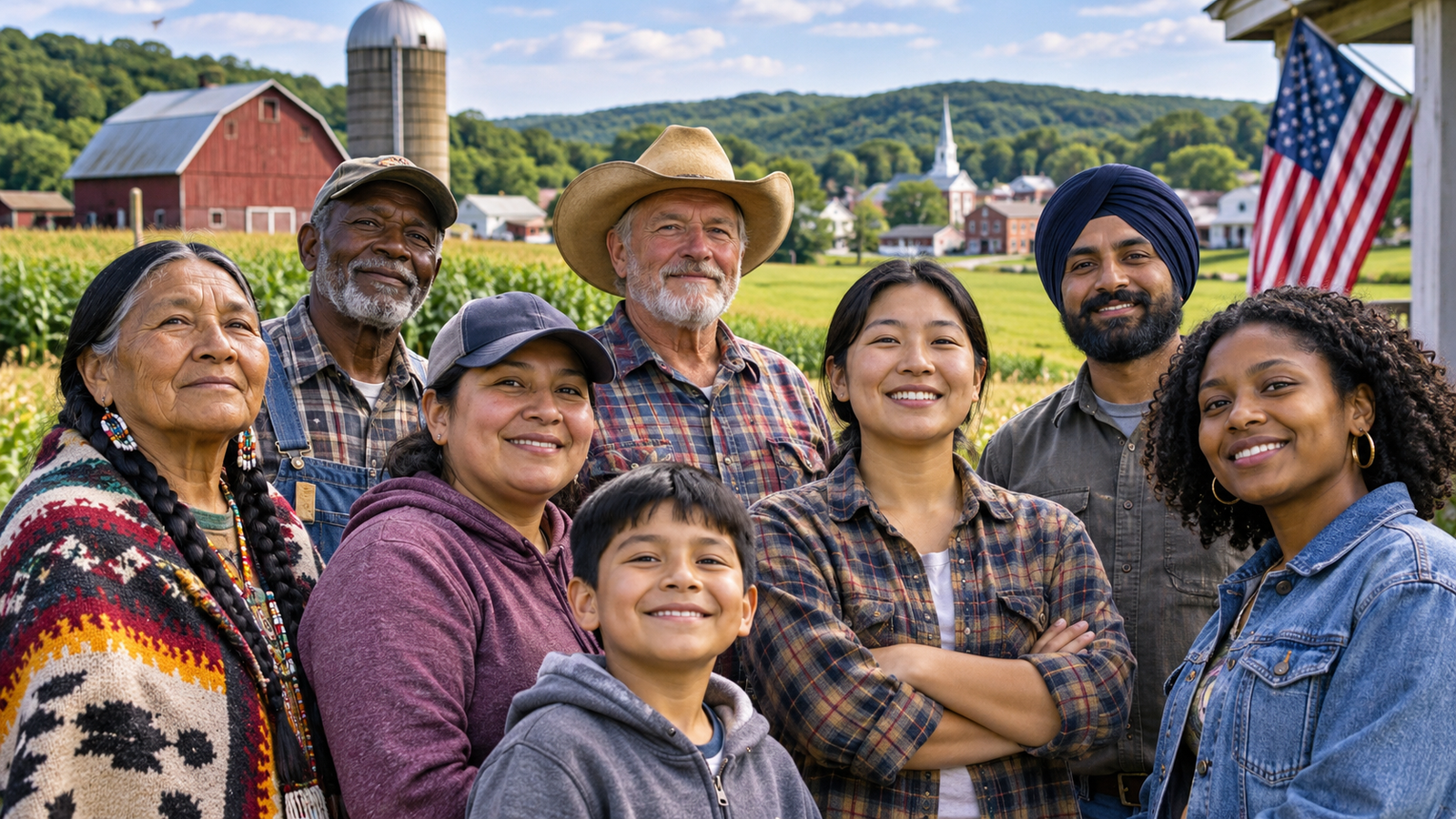
When people imagine rural America, they often picture small towns, agricultural landscapes, farming communities and predominantly White populations. This image has become deeply embedded in American popular culture, political discussions and sociological narratives. However, the reality of rural society is considerably more complex. Behind this conventional image exists a diverse population consisting of African Americans, Hispanic and Latino communities, Native Americans, Asian Americans, immigrants and people from numerous ethnic and cultural backgrounds.
Ethnicity in Rural America is an important subject in contemporary sociology because it challenges the assumption that rural communities are culturally and racially homogeneous. Rural areas are not simply isolated agricultural settlements; they are dynamic social spaces shaped by migration, historical inequalities, economic transformations and cultural interactions.
According to a Brookings Institution analysis of the 2020 Census, approximately 24% of rural Americans were people of colour. Furthermore, two-thirds of rural counties had populations that were at least 10% people of colour. These figures demonstrate that racial and ethnic diversity is an established feature of rural American society rather than an exclusively urban phenomenon. Source: Brookings Institution.
The study of Ethnicity in Rural America therefore requires an understanding of historical experiences, racial relations, economic structures, migration patterns and unequal access to social resources. It also reveals how race and ethnicity influence employment, education, political participation, healthcare and community relationships.
1. Historical Background of Race and Ethnicity in Rural America
The ethnic composition of rural America has been shaped by centuries of migration, colonisation, slavery and economic development.
Indigenous populations were the original inhabitants of North America. However, European colonisation resulted in the displacement of Native American communities, the loss of ancestral territories and the disruption of traditional social institutions. Many Indigenous populations continue to live in rural areas and reservations, where questions of land ownership, cultural preservation and political sovereignty remain significant.
African Americans also have a long history in rural America. During slavery, millions of African Americans were forced to work on plantations, particularly in the southern United States. Following emancipation, many continued to live in rural agricultural communities under conditions of racial discrimination, economic dependency and segregation.
The Great Migration, which began in the early twentieth century, transformed the geographical distribution of African Americans. Millions moved from the rural South to industrial cities in the North and West in search of employment and freedom from racial oppression. Nevertheless, substantial African American populations remained in rural southern counties.
European immigration also contributed to rural ethnic diversity. German, Irish, Italian, Scandinavian and other European immigrant communities settled in agricultural regions and established distinctive cultural institutions.
During the late twentieth century, immigration from Latin America and Asia further transformed rural communities. Agricultural expansion, meatpacking industries and changing labour markets attracted workers from Mexico, Central America, Southeast Asia and other regions.
Thus, Ethnicity in Rural America is historically connected to colonialism, slavery, migration, labour exploitation and changing patterns of settlement.
2. Major Racial and Ethnic Groups in Rural America
Contemporary rural America consists of several major racial and ethnic communities, each with distinct historical experiences and social characteristics.
African American Communities
African Americans constitute an important part of rural society, particularly in the southern United States. States such as Mississippi, Alabama, Georgia, Louisiana and South Carolina contain rural counties with substantial Black populations.
These communities have historically faced racial segregation, unequal land ownership, limited educational opportunities and economic exclusion. Even after the abolition of slavery and the introduction of civil rights legislation, structural inequalities have continued to influence their socioeconomic position.

In many rural southern communities, African Americans participate actively in churches, educational institutions, local politics and community organisations. Churches, in particular, have historically functioned as centres of social support, collective identity and political mobilisation.
The sociological study of Ethnicity in Rural America must therefore recognise the continuing significance of historical racial inequality and the role of community institutions in promoting social solidarity.
Hispanic and Latino Communities
Hispanic and Latino populations represent one of the most rapidly transforming dimensions of rural American society.
Many Latino families have settled in agricultural regions, particularly in California, Texas, Arizona, New Mexico and parts of the Midwest. Their presence is strongly associated with agricultural labour, food processing, construction and other industries.
In some rural communities, Latino populations have become central to local economic development. They contribute to farming, establish businesses, participate in schools and introduce new cultural traditions.
However, Latino workers frequently experience low wages, occupational insecurity, language barriers and limited access to healthcare. Undocumented workers may also experience additional vulnerabilities because of their immigration status.
The growth of Latino communities demonstrates how Ethnicity in Rural America is increasingly connected with international migration and the restructuring of rural labour markets.
Native American and Indigenous Communities
Native American populations are another essential part of rural ethnic diversity.
Many Indigenous communities live in rural reservations and tribal territories, particularly in states such as Alaska, New Mexico, Arizona, Oklahoma, Montana and South Dakota.
Their experiences cannot be understood only through conventional categories of minority status. Indigenous identity is also connected with historical sovereignty, territorial rights, tribal governance and cultural preservation.
Issues such as inadequate infrastructure, poverty, limited healthcare facilities and unequal educational opportunities remain important challenges in many Indigenous communities.
At the same time, Indigenous organisations continue to protect traditional knowledge, languages, cultural practices and environmental resources.
From a sociological perspective, Ethnicity in Rural America includes the relationship between ethnic identity, historical dispossession and struggles for self-determination.
Asian American Communities
Asian American populations also contribute to the diversity of rural America. Immigrants from countries such as Vietnam, Laos, Cambodia, India and other Asian nations have established communities in several agricultural and industrial regions.
Some Southeast Asian refugee communities settled in rural areas following conflicts in their home countries. Others migrated for employment and educational opportunities.
Asian Americans participate in agriculture, small businesses, manufacturing, education and healthcare. Nevertheless, they may encounter cultural isolation, language difficulties and limited access to culturally appropriate public services.
Their experiences further challenge the assumption that rural communities are culturally uniform.
3. Immigration and the Transformation of Rural Communities
Immigration is one of the most important factors influencing contemporary Ethnicity in Rural America.
Historically, rural population growth depended heavily on agriculture and natural population increase. However, declining birth rates, ageing populations and the migration of younger residents to cities have created labour shortages in many rural regions.
Immigrants have helped address these shortages, particularly in agriculture, meatpacking, poultry processing and food manufacturing.
An important example is the development of meatpacking towns in Kansas, Nebraska, Iowa and Missouri. These communities have attracted immigrant workers from Latin America, Africa and Asia.
The town of Milan, Missouri, provides an interesting example. Investigate Midwest reported in April 2026 that approximately 46% of its residents identified as Latino and more than 28% were born outside the United States. The town’s demographic transformation is closely connected with the meatpacking and food-processing industries. Source: Investigate Midwest, 2026.
This transformation illustrates an important sociological concept: economic restructuring produces demographic restructuring.
As industries relocate to rural areas, they attract workers from different ethnic and national backgrounds. These workers establish families, develop cultural institutions and transform local social relationships.
Consequently, Ethnicity in Rural America is increasingly shaped by the relationship between global migration and local economic development.
4. Race, Social Stratification and Economic Inequality
Social stratification refers to the unequal distribution of wealth, income, power, status and opportunities within society.
In rural America, racial and ethnic identity frequently intersects with class position. Many ethnic minority populations are concentrated in low-wage agricultural and industrial occupations.

For example, Latino farmworkers often perform physically demanding agricultural work under difficult environmental conditions. Some experience seasonal employment, inadequate housing and limited access to healthcare.
African American rural communities may face the long-term consequences of unequal land ownership, historical discrimination and limited investment in public infrastructure.
Indigenous populations may experience economic disadvantages associated with historical land dispossession and inadequate public services.
These inequalities demonstrate that racial and ethnic differences cannot be understood separately from economic structures.
The concept of intersectionality, developed by legal scholar Kimberlé Crenshaw, helps explain how race, class, gender and other social positions interact to produce different experiences of disadvantage.
For example, a low-income Latina farmworker may experience economic exploitation, gender discrimination, language barriers and immigration-related insecurity simultaneously.
Therefore, the sociological analysis of Ethnicity in Rural America must examine not only cultural differences but also the unequal distribution of resources and opportunities.
5. Recent Incidents: Immigration Enforcement and Rural Ethnic Relations
Recent developments provide important examples of how racial and ethnic relations are changing in rural America.
Immigration Raids in Agricultural Communities
In 2025 and 2026, immigration enforcement operations in agricultural regions attracted considerable public attention.
In June 2025, immigration authorities conducted enforcement activities in California’s agricultural heartland, including areas around Tulare, Fresno and Ventura counties. Farmworkers and community organisations reported fear and disruption as enforcement agents appeared near agricultural fields and packing facilities. The incidents raised questions about workers’ rights, racial profiling and the economic dependence of agricultural communities on immigrant labour. Source: Los Angeles Times, June 2025.
In February 2026, an investigation discussed by Oregon Public Broadcasting examined arrests of farmworkers in rural Oregon and other agricultural states. The investigation described enforcement actions involving workers in Oregon, Wisconsin, Vermont and Nebraska. It also highlighted the challenges faced by detained workers and the labour shortages experienced by agricultural employers. Source: OPB, February 2026.
From a sociological perspective, these incidents reveal the contradiction between economic dependence on immigrant labour and political debates surrounding immigration.
Rural communities may rely heavily on immigrant workers while simultaneously experiencing political tensions over immigration policies. This contradiction is central to understanding contemporary Ethnicity in Rural America.
Immigration Enforcement in Milan, Missouri
Another important development occurred in Milan, Missouri, in February 2026. Investigate Midwest reported that federal immigration agents arrested three people, including two men from Senegal and one from Guatemala.
The incident created anxiety among immigrant residents because enforcement activities extended beyond workplaces into residential areas and public streets.
The report also described concerns about racial and ethnic profiling, particularly among people who speak languages associated with immigrant communities.
Sociologically, this incident illustrates how immigration enforcement can influence everyday social relationships. When people begin to associate language, appearance or occupation with possible immigration scrutiny, social trust and feelings of belonging may weaken.
The experience demonstrates that Ethnicity in Rural America is not simply a matter of demographic diversity; it also concerns citizenship, social recognition and the boundaries of community membership.
The 2026 Kansas Immigration Raids
A particularly significant development occurred in southwest Kansas in September 2026.
According to Reuters, immigration authorities detained 104 people in an operation affecting communities including Dodge City, Garden City and Liberal. The operation reportedly caused family separations and disruptions to meatpacking and livestock businesses.
The November 2026 election subsequently saw significant political changes in the affected region. Reuters reported that Democrat Adam Hamilton defeated Republican Senator Roger Marshall, while the three counties most affected by the raids shifted substantially towards Hamilton compared with their 2024 presidential voting patterns. Source: Reuters, November 13, 2026.
This development is sociologically important because it demonstrates how immigration enforcement can influence political participation and collective mobilisation.
Immigrant families, local organisations and community supporters may respond to perceived insecurity through mutual assistance, political engagement and demands for institutional accountability.
Thus, Ethnicity in Rural America is increasingly connected with electoral politics, citizenship debates and local democratic participation.
6. Environmental Racism and Rural Ethnic Communities
Environmental racism refers to the unequal exposure of racial and ethnic minority populations to environmental hazards and pollution.
This phenomenon is particularly relevant in rural America, where agricultural processing plants, industrial facilities and waste-management operations are sometimes located near economically disadvantaged communities.
An important example comes from Postville, Iowa. In March 2024, officials shut down the city’s water treatment facility for two days after a meatpacking plant discharged more than 250,000 gallons of untreated food-processing waste into the wastewater system.
Investigate Midwest’s October 2024 investigation found that meatpacking facilities across the Midwest frequently operated near low-income communities and communities of colour. The investigation also identified disproportionate environmental burdens around several facilities. Source: Investigate Midwest, October 17, 2024.
This situation illustrates environmental inequality as a structural problem.
Ethnic minority workers may depend economically on industries that create environmental risks in their residential surroundings. Consequently, employment opportunities and environmental protection become interconnected social concerns.
The sociological importance of Ethnicity in Rural America therefore extends beyond employment and cultural identity to include environmental justice, public health and the unequal distribution of environmental risks.
7. Education, Language and Cultural Integration
Education is an important institution through which ethnic diversity influences rural social life.
Children from immigrant and minority families may face language barriers, cultural adjustment difficulties and unequal educational resources.
In some rural schools, teachers must support students who speak Spanish, Vietnamese, Mam and other languages at home. However, smaller school districts may have limited funding for bilingual teachers, translators and specialised educational programmes.
Language differences can also influence communication between parents and schools. When educational institutions fail to provide adequate language support, minority families may become less involved in school activities and decision-making.
However, schools can also become important institutions of social integration. Multicultural education, language programmes and inclusive curricula can encourage mutual understanding among students from different backgrounds.
In this context, Ethnicity in Rural America is closely associated with educational equality and the development of intercultural relationships.
8. Political Participation and Representation
Race and ethnicity also influence political participation in rural America.
Historically, African Americans in the rural South experienced voter suppression through discriminatory registration requirements, intimidation and segregation.
Although civil rights legislation expanded democratic participation, barriers to political representation and institutional access remain concerns in some communities.
Immigrant populations may encounter additional challenges, particularly when they lack citizenship or adequate access to translated information.
A 2026 Axios analysis found that 403 US counties, approximately 12.8% of all counties, were already majority-minority. Of these, 221 were non-metropolitan counties. The analysis highlighted the growing importance of ethnic minority populations in rural political and administrative systems.
It also identified challenges involving bilingual election services, court interpreters and translated public information. Source: Axios, August 14, 2026.
This suggests that Ethnicity in Rural America is transforming local political institutions and creating new demands for inclusive governance.
9. Social Integration, Identity and Community Relationships
Social integration refers to the process through which individuals and groups participate in common social institutions and develop relationships within a society.
In rural America, ethnic diversity can produce both opportunities and challenges for social integration.
Immigrant communities often establish churches, cultural associations, local businesses and community organisations. These institutions provide social support and help preserve cultural traditions.
At the same time, differences in language, religion, food habits and cultural practices may create misunderstandings between established residents and newcomers.
The sociological concept of social capital is useful for understanding these relationships. Strong connections within ethnic communities create bonding social capital, while relationships between different ethnic groups generate bridging social capital.
Both are important for community development.
For example, cooperation between established farmers, immigrant workers, schools and local government can improve economic opportunities and social trust.
Therefore, Ethnicity in Rural America should be examined through both social conflict and social cooperation. Diversity does not automatically produce either integration or division; the outcome depends on institutions, economic conditions and everyday interactions.
10. The Future of Ethnic Diversity in Rural America
The future of Ethnicity in Rural America will be shaped by demographic change, immigration policies, economic restructuring, technological development and political institutions.
Many rural communities are experiencing population ageing and declining birth rates. Immigration and minority population growth can help maintain local economies, support schools and sustain community institutions.
However, demographic diversity alone cannot solve rural inequality. Communities also require investment in education, healthcare, housing, transportation and employment protections.
Local governments must develop inclusive policies that recognise linguistic and cultural differences. Schools need resources for multicultural education, while healthcare institutions require appropriate communication services.
Equally important is the need to address structural racism, occupational discrimination and unequal access to political representation.
The future of Ethnicity in Rural America will therefore depend on whether rural institutions can adapt to changing demographic realities while ensuring equal opportunities for all residents.
Conclusion
Rural America is far more diverse than conventional stereotypes suggest. African Americans, Hispanic and Latino populations, Native Americans, Asian Americans and immigrant communities have played important roles in shaping its history, economy and culture.
The study of Ethnicity in Rural America reveals the relationship between race, class, migration, social stratification, environmental inequality and political participation.
Recent immigration enforcement incidents in California, Missouri and Kansas demonstrate that ethnic identity remains closely connected with questions of labour rights, citizenship, social security and community belonging. Environmental problems in meatpacking towns further reveal how economic and racial inequalities can overlap.
From a sociological perspective, rural society should not be understood as a homogeneous cultural space. Instead, it is a changing social environment in which different ethnic groups interact, compete, cooperate and negotiate their identities.
Ultimately, recognising Ethnicity in Rural America is essential for understanding contemporary American society. Rural diversity is not hidden because it is absent; it is hidden because dominant narratives have often failed to recognise the experiences and contributions of minority communities.
Frequently Asked Questions (FAQs)
1. What does ethnicity in rural America mean?
Ethnicity in Rural America refers to the cultural, racial and national diversity of people living in non-metropolitan communities across the United States. It includes African American, Hispanic, Native American, Asian American and immigrant populations.
2. Is rural America ethnically diverse?
Yes. According to the 2020 Census analysis published by Brookings, approximately 24% of rural Americans were people of colour. Many rural counties have substantial minority populations.
3. Which ethnic groups live in rural America?
Major groups include African Americans, Hispanic and Latino Americans, Native Americans, Asian Americans and immigrants from different parts of the world.
4. How does immigration influence rural America?
Immigration contributes to agricultural and industrial labour, population growth, cultural diversity, business development and the transformation of rural communities.
5. What are the major challenges faced by ethnic minorities in rural America?
Major challenges include racial discrimination, low wages, language barriers, limited healthcare access, environmental inequality, educational disadvantages and political underrepresentation.
6. Why is ethnicity important in rural sociology?
Ethnicity is important because it helps sociologists understand social stratification, migration, cultural identity, inequality, community relationships and changing patterns of rural development.