
Introduction
Youth unemployment in India is more than an economic indicator. It is a social condition that shapes family life, education, migration, marriage, mental health, and the confidence young people place in the future. In 2026, the issue is especially important because India continues to produce a large number of educated young people, while the quality of school learning, the pace of job creation, and the stability of entry-level employment are not keeping pace with expectations. From a sociological perspective, this gap between aspiration and opportunity is one of the most important pressures on Indian society today.
The Current Picture of Youth Unemployment in India
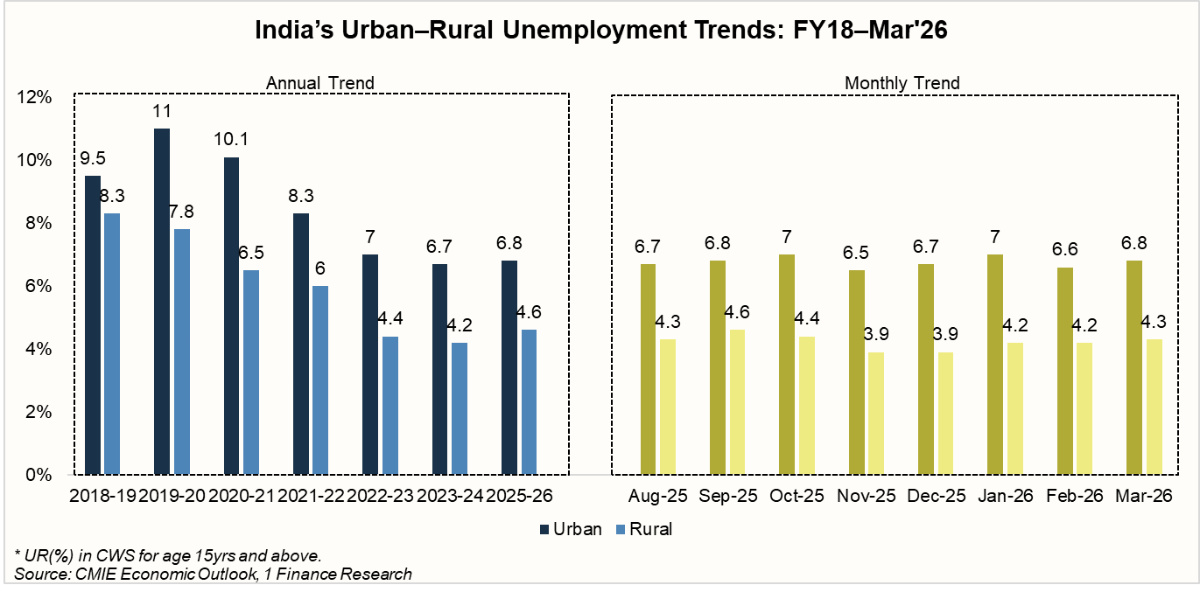
The latest official labour-force data show that the overall unemployment rate among persons aged 15 years and above was 3.1% in the PLFS Annual Report 2025, released in March 2026. But the youth unemployment rate for ages 15 to 29 was 9.9%, which is far higher than the general rate. The gap becomes more visible in urban India, where youth unemployment stood at 13.6%, compared with 8.3% in rural areas. This tells us that the job crisis is concentrated among young people, especially those searching for salaried and white-collar work in towns and cities.
The monthly labour-market data for April 2026 also show continuing stress. According to the government’s PLFS monthly bulletin, the unemployment rate for persons aged 15 years and above was 5.2% in April 2026. Urban unemployment was 6.6%, while rural unemployment was 4.6%. These monthly numbers are useful because they show that even when the labour market appears relatively stable, urban workers and job-seeking youth continue to face more pressure than the country as a whole.
Another important fact is that education does not automatically protect young people from unemployment. The PLFS Annual Report 2025 says that unemployment among persons with secondary education and above was 6.5%. That is significant because it means that the problem is not simply lack of schooling; it is also the mismatch between educational credentials and labour-market demand. India is producing more educated youth, but not enough suitable jobs that match their qualifications.
Education Quality and the Employability Gap
The quality of education is one of the strongest sociological explanations for youth unemployment in India. The ASER 2024 findings show that learning outcomes remain weak at the foundation level. Among children in Std III, only 23.4% in government schools could read a Std II-level text. Among Std V children, only 30.7% could do a division problem, and among Std VIII students, arithmetic performance reached only 45.8% nationally. These figures matter because weak foundational learning reduces the ability of students to acquire advanced academic and vocational skills later.
ASER 2024 also shows that digital access is not the same as digital learning. Among adolescents aged 14 to 16, 82.2% reported knowing how to use a smartphone, and 57% said they had used a smartphone for an educational activity in the previous week. At the same time, 76% said they had used it for social media. This is sociologically important because it shows that young people may have access to devices, but not necessarily to productive digital learning that improves employability.
The same report also notes that 7.9% of 15 to 16-year-olds were not enrolled in school, with the figure slightly higher for girls at 8.1%. This matters because early school exit, weak attendance, and poor learning outcomes all feed into later labour-market vulnerability. When education does not build confidence, skills, and practical competence, it can become a waiting room rather than a ladder of mobility.
The PLFS Annual Report 2025 strengthens this picture by showing that 67.8% of persons aged 15 years and above had at least secondary education, while only 5.0% of youth aged 15 to 29 reported formal vocational or technical training. That gap is very important. It means India has a large educational pipeline, but relatively weak vocational preparation. In sociological terms, the country is not only facing unemployment; it is facing a transition crisis between school, college, and work.
Mass Layoffs and the Changing Nature of Work
Youth unemployment in 2026 is not caused only by weak entry-level hiring. It is also affected by restructuring, automation, and mass layoffs in sectors that were once considered secure. Reuters reported in July 2025 that Tata Consultancy Services would cut about 2% of its workforce, affecting more than 12,000 jobs, mainly in middle and senior management. For many Indian families, the IT sector had long symbolized stability, upward mobility, and middle-class success. Large-scale layoffs in such a sector send a strong social signal that even “safe” jobs are no longer fully secure.
Reuters also reported in 2026 that AI-driven changes are disrupting India’s outsourcing and back-office economy. That matters because many young people have built their career expectations around coding, support services, testing, operations, and other office-based entry jobs. When firms begin to automate these roles or reduce hiring, the social impact goes beyond the individuals who lose work. It changes the entire expectation structure of the youth labour market.
This creates a new kind of insecurity. Earlier, young people feared not finding a job. Now they also fear that a job may disappear after they get it. That uncertainty weakens the promise of long-term planning, such as saving money, renting a house, supporting parents, or delaying marriage until financial stability is achieved. Sociologically, mass layoffs intensify the feeling that the labour market is unstable and unpredictable.
Social Consequences of Youth Unemployment
1. Delayed adulthood
One of the strongest social effects of youth unemployment is the delay of adulthood. In many Indian households, adulthood is not only a matter of age; it is a matter of earning capacity. A young person becomes socially recognized as independent when he or she can contribute economically to the family, support personal expenses, and take part in major decisions. When employment is delayed, adulthood is also delayed. This often creates frustration, dependence, and a sense of suspended life. The high youth unemployment rate of 9.9% in 2025 shows why this problem remains serious in 2026.
2. Family stress and intergenerational tension
Unemployment is rarely experienced by the young person alone. In India, the family usually invests heavily in education and coaching, expecting employment as the return. When that return does not come, pressure spreads across the household. Parents may become anxious, siblings may compare outcomes, and young adults may feel guilt or shame. This tension is especially sharp in families that have spent money on degrees, entrance exams, or private coaching but still cannot secure a stable job. The mismatch between educational expansion and labour-market absorption makes this family stress more common.
3. Mental health and emotional distress
Youth unemployment also affects mental health. Repeated job rejection, exam failure, and financial dependence can produce anxiety, low self-esteem, and social withdrawal. The burden becomes heavier when society treats employment as proof of personal worth. In such a culture, being unemployed may feel like personal failure even when the real cause is structural. The official figures on youth unemployment and urban stress help explain why many young people feel trapped between hope and disappointment.
4. Gender inequality
Youth unemployment does not affect men and women in exactly the same way. The April 2026 bulletin shows an unemployment rate of 5.4% among females aged 15 years and above, compared with 5.1% among males. Urban female unemployment was especially high at 8.5%. This suggests that women continue to face additional barriers in accessing work, especially in cities where jobs are often advertised as “open,” but remain socially and institutionally harder for women to enter.
Girls and young women also face a second problem: weaker labour-market entry can reinforce older gender norms. In many families, if work is difficult to find, investment may shift toward sons, while daughters are encouraged to stay at home, marry earlier, or accept restricted forms of work. In this way, unemployment is not only economic exclusion; it can also become a mechanism for reproducing gender inequality.
5. Migration and urban insecurity
When local labour markets fail to absorb educated youth, migration becomes a common response. Young people move toward cities, industrial clusters, and service hubs in search of work. But migration does not always solve unemployment; often it simply relocates insecurity. Many migrants end up in informal housing, unstable work, or temporary contracts. Since urban youth unemployment remains much higher than rural youth unemployment, the city is not automatically the answer many families imagine it to be.
6. Growth of informal and precarious work
The Indian labour market remains dominated by insecure forms of work. The PLFS Annual Report 2025 says self-employment accounted for 56.2% of workers, while regular wage and salaried employment stood at 23.6%. This means that even when people are working, many are not in stable, protected, or high-quality jobs. For youth, this often leads to a cycle of short-term work, gig labour, underpaid service jobs, and repeated job searching. In sociological terms, unemployment and precarious employment are becoming part of the same continuum.
7. Weak social mobility
Youth unemployment also reduces social mobility. Education is supposed to provide a path out of poverty and into a better class position. But when school learning is weak and jobs are scarce, education can become expensive waiting rather than upward movement. Families with more money can afford coaching, digital tools, and long search periods. Poorer families cannot. As a result, unemployment reproduces class inequality instead of reducing it. The learning deficits shown in ASER 2024 and the high youth unemployment rate in PLFS 2025 together explain why this mobility gap persists.
A Sociological Interpretation
Sociology helps us see that unemployment is not just a personal failure or a statistical rate. It is a breakdown in the connection between education, work, status, and future expectation. When young people study hard but cannot find work, the social promise of education weakens. When even secure sectors announce layoffs, trust in the labour market weakens further. When digital access does not become learning, and learning does not become employability, the result is frustration, uncertainty, and social strain.

The Indian case is especially significant because the country is in a demographic phase where a large youth population can become a source of strength only if it is productively absorbed into work. If that does not happen, the same demographic advantage can turn into a social burden. The data from PLFS, ASER, and Reuters all point in the same direction: India needs not only more jobs, but better learning, stronger skill formation, and more stable labour-market transitions.
Conclusion
Youth unemployment in India in 2026 is a serious social issue because it affects much more than income. It affects dignity, family relationships, gender equality, migration, mental health, and social mobility. The latest data show that overall unemployment may appear moderate, but youth unemployment remains much higher, especially in urban areas. At the same time, education quality remains uneven, vocational preparation is limited, and mass layoffs in major sectors are creating fresh anxiety.
A sociological response must therefore go beyond job counts. India needs stronger school learning, better vocational training, more employer-linked skills, and a labour market that gives youth a realistic path from education to secure work. Until that happens, youth unemployment will continue to shape the social future of the country.
15 FAQs on Youth Unemployment in India
1. What is Youth Unemployment in India?
Youth Unemployment in India refers to the condition where young people, especially those aged between 15 and 29 years, are willing to work but cannot find suitable employment opportunities.
2. Why is Youth Unemployment in India increasing in 2026?
Youth Unemployment in India is increasing because of slow job creation, poor education quality, skill mismatch, automation, AI-driven layoffs, and growing competition among educated youth.
3. What is the current youth unemployment rate in India?
According to recent PLFS data, the youth unemployment rate in India for the 15–29 age group remains significantly higher than the national unemployment average, especially in urban areas.
4. How does education affect Youth Unemployment in India?
Weak educational quality and lack of practical skill training contribute greatly to Youth Unemployment in India because many graduates are not industry-ready.
5. What role does technology play in Youth Unemployment in India?
Automation, artificial intelligence, and digital transformation are reducing demand for some traditional entry-level jobs, increasing Youth Unemployment in India.
6. How does Youth Unemployment in India affect society?
Youth Unemployment in India affects family stability, mental health, social mobility, crime rates, migration, and social inequality.
7. Why are educated youth unemployed in India?
Many educated youth remain unemployed because degrees often do not match labour-market requirements, creating a gap between education and employability.
8. Is Youth Unemployment in India higher in urban areas?
Yes, Youth Unemployment in India is generally higher in urban areas because more educated youth compete for limited salaried and white-collar jobs.
9. How does Youth Unemployment in India impact mental health?
Long-term unemployment creates stress, anxiety, depression, low self-esteem, and frustration among young people.
10. What is the relationship between skill development and Youth Unemployment in India?
Lack of vocational and technical skills is one of the major reasons behind Youth Unemployment in India, making skill development programs highly important.
11. How does Youth Unemployment in India affect women?
Young women face additional barriers such as gender discrimination, social restrictions, and fewer employment opportunities, increasing female unemployment.
12. What are the major causes of Youth Unemployment in India?
Major causes include population growth, poor education quality, lack of industrial growth, automation, inadequate vocational training, and economic inequality.
13. Can entrepreneurship reduce Youth Unemployment in India?
Yes, entrepreneurship and startups can help reduce Youth Unemployment in India by creating self-employment and new job opportunities.
14. How does migration relate to Youth Unemployment in India?
Many unemployed youth migrate from rural areas to cities in search of better opportunities, but urban unemployment often creates new insecurities.
15. What are the solutions to Youth Unemployment in India?
Improving education quality, expanding vocational training, supporting startups, increasing industrial investment, and creating stable employment policies can reduce Youth Unemployment in India.