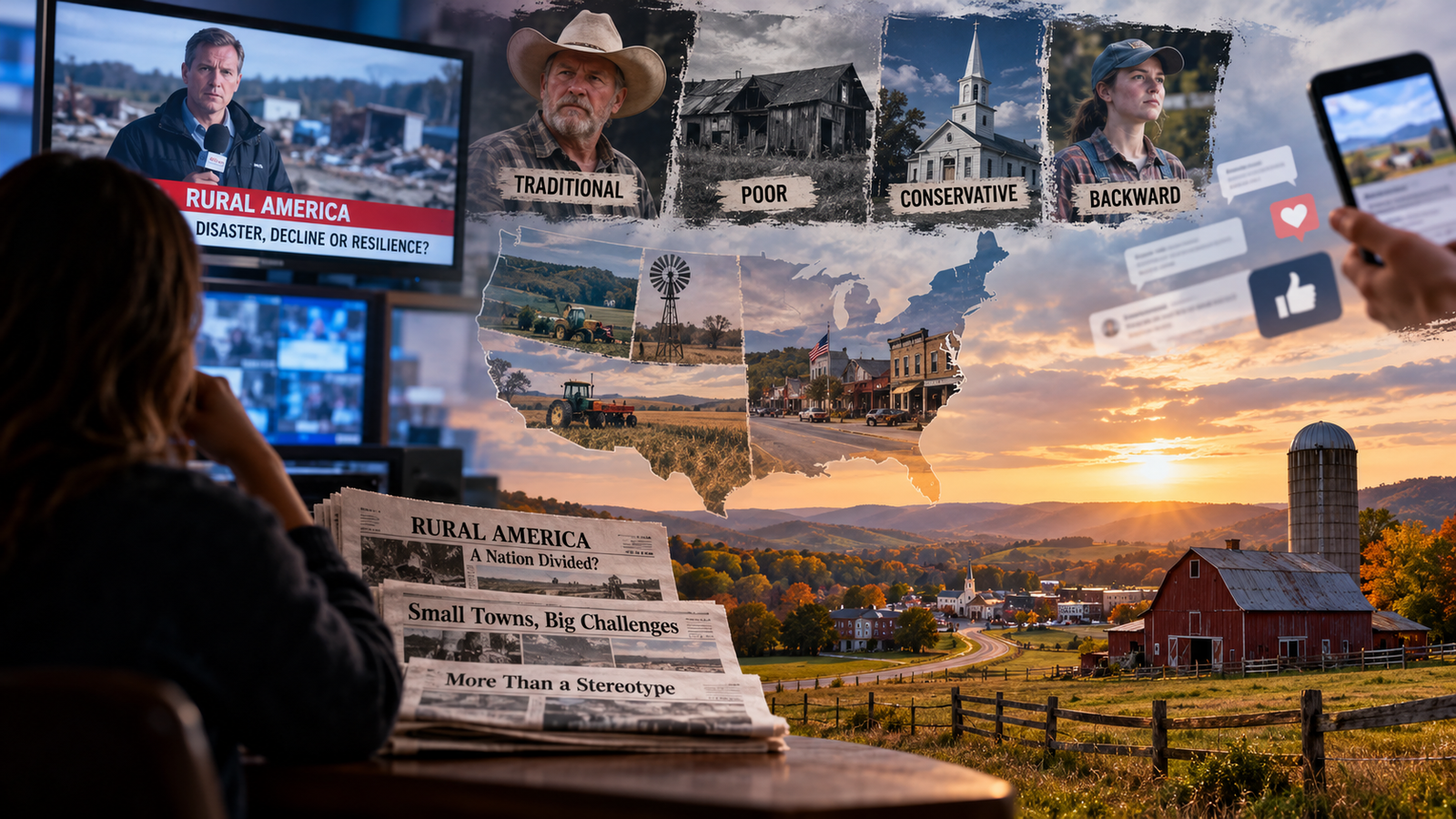
Introduction: Understanding Rural America Through Media
The Media Representation of Rural America plays a significant role in shaping how the American public understands rural communities, their cultures, political beliefs, economic conditions, and everyday experiences. Newspapers, television, films, documentaries, and social media do more than report events; they construct narratives that influence public opinion and social relationships. Rural America is frequently portrayed as a landscape of traditional values, economic hardship, political conservatism, and cultural isolation. Although some of these characteristics reflect genuine experiences in particular places, treating them as universal descriptions creates an incomplete picture of rural society.
From a sociological perspective, the Media Representation of Rural America raises important questions about power, identity, inequality, and cultural authority. Who determines which rural stories receive national attention? Why do some communities become visible primarily during elections, disasters, or social conflicts? How do media narratives influence public policies and the relationship between rural and urban populations?
These questions demonstrate that the Media Representation of Rural America is not simply a matter of journalistic accuracy. It is also a question of social representation: whose experiences are recognized, whose voices are excluded, and whose interpretations become accepted as common sense.

A sociological critique therefore examines both the content of media narratives and the institutional conditions under which those narratives are produced. It seeks to understand how the Media Representation of Rural America can reinforce stereotypes while also providing opportunities to challenge inequality and promote a more diverse understanding of American society.
1. The Historical Construction of Rural Identity
The Media Representation of Rural America has developed through a long history of cultural distinctions between rural and urban life. American popular culture has often associated rural communities with agriculture, family traditions, religious institutions, local customs, and a close relationship with nature. In contrast, cities have frequently been represented as centres of innovation, modernity, diversity, and social change.
These distinctions are not entirely imaginary, but they become problematic when they are transformed into rigid oppositions. Rural communities are not necessarily traditional, just as urban communities are not automatically progressive. Both contain diverse social groups, conflicting interests, and changing cultural practices.
Historically, popular entertainment has frequently presented rural characters as comic figures, unsophisticated outsiders, or symbols of an idealised past. Other narratives romanticise rural life as peaceful, morally pure, and free from the problems associated with modern urban society. Although these portrayals appear different, both can reduce complex communities to simplified cultural images.
The Media Representation of Rural America consequently produces a symbolic geography in which rural places are associated with particular moral and political characteristics. Such representations influence how people interpret rural residents before they encounter them directly.
The Society of Environmental Journalists has highlighted the problem of rural stereotyping, arguing that national coverage often relies on clichés and concentrates on hardship rather than the full range of rural experiences. Its discussion of rural reporting recommends greater attention to community context and everyday life. (Society of Environmental Journalists)
From a sociological standpoint, these representations reveal how cultural meanings become attached to geographical spaces. Rurality is not merely a physical location; it is also a social identity constructed through historical narratives, institutional practices, and media discourse.
2. Media Stereotypes and the Problem of Rural Othering
One of the central problems in the Media Representation of Rural America is the process of othering. Othering occurs when a group is represented as fundamentally different from the dominant social group. These differences may be exaggerated, simplified, or presented as evidence of inferiority.
Rural Americans have often been portrayed through stereotypes of ignorance, intolerance, backwardness, poverty, or resistance to change. Such images can encourage audiences to interpret rural residents as a homogeneous population rather than as individuals with different experiences and opinions.
Sociologists can analyse this process through the concept of symbolic boundaries. Symbolic boundaries are distinctions through which people classify themselves and others into categories such as modern and traditional, educated and uneducated, or progressive and conservative. Media narratives can strengthen these boundaries by repeatedly associating particular groups with negative characteristics.
A 2026 study published in the Journal of Criminal Justice and Popular Culture examined anti-idyllic representations of rural communities in horror cinema. The researchers argued that some films portray rural people and places as deviant or threatening outsiders, a process that can contribute to social harm. (Baker et al., 2026)
This research illustrates how entertainment media can shape cultural perceptions beyond the immediate experience of watching a film. When rural characters repeatedly appear as dangerous, primitive, or socially abnormal, audiences may begin to associate rural environments with those characteristics.
However, a sociological critique must also recognise that not every negative representation is necessarily a stereotype. Rural communities, like urban communities, experience violence, discrimination, poverty, and social conflict. The problem arises when such issues are presented as defining characteristics of rural identity rather than as specific social conditions requiring explanation.
The Media Representation of Rural America should therefore be evaluated according to whether it provides context, acknowledges diversity, and distinguishes individual actions from generalisations about entire populations.
3. Political Polarisation and the Rural-Urban Divide
Political coverage is another major influence on the Media Representation of Rural America. During election campaigns, rural communities often become symbols of national political divisions. Rural voters may be portrayed as a unified conservative bloc, while urban residents are associated with liberal politics and cultural diversity.
These generalisations obscure the complexity of political behaviour. Rural voting patterns are influenced by class, religion, race, education, occupation, age, regional history, economic change, and party organisation. No single factor adequately explains the political preferences of every rural resident.
The problem is not that journalism reports differences between rural and urban voting patterns. Rather, it is that political differences can become cultural stereotypes. When rural voters are described as uniformly resistant to social change, their economic concerns, community identities, and individual motivations may receive insufficient attention.
The Media Representation of Rural America can consequently contribute to political polarisation by encouraging urban audiences to view rural citizens as an opposing cultural group. At the same time, rural residents may interpret dismissive national coverage as evidence that mainstream institutions neither understand nor respect them.
Sociologist Pierre Bourdieu’s concept of symbolic power helps explain this process. Symbolic power is the capacity to establish particular classifications and interpretations as legitimate or authoritative. Media organisations possess considerable influence over which political explanations receive visibility and credibility.
A 2025 analysis published by the Washington Post challenged several common assumptions about rural America, including the idea that rural workers are primarily farmers and that rural populations are uniformly white. It also highlighted the historical development of rural voting patterns rather than treating them as a recent or universal phenomenon. (Washington Post, December 2025)
This kind of reporting demonstrates the value of evidence-based analysis. A more balanced Media Representation of Rural America must explain political behaviour through social structures and historical processes rather than reducing it to cultural caricatures.
4. Economic Hardship, Deindustrialisation, and Media Narratives

Economic decline is a recurring theme in the Media Representation of Rural America. News reports frequently focus on declining employment, factory closures, hospital shortages, agricultural pressures, population loss, and the deterioration of public infrastructure.
These issues deserve serious attention. Rural communities can face limited access to healthcare, fewer employment opportunities, inadequate transport, and reduced public services. However, an exclusive focus on crisis can make rural communities appear permanently disadvantaged and incapable of renewal.
A sociological analysis distinguishes between structural inequality and narratives that portray inequality as an inherent feature of rural life. The closure of a factory, for example, cannot be adequately explained by claiming that a town has failed to modernise. It may require an examination of corporate restructuring, trade, labour markets, investment decisions, public policy, and the changing geography of employment.
Similarly, the decline of agricultural employment does not mean that rural economies consist only of struggling farmers. Manufacturing, healthcare, education, retail, tourism, logistics, and professional services are also important sources of rural employment.
The Media Representation of Rural America becomes misleading when a limited set of economic indicators is used to define the whole social identity of a place.
Another important issue is the relationship between economic hardship and cultural stigma. Communities repeatedly portrayed as declining may be perceived by investors, policymakers, and prospective residents as places without future opportunities. Although media narratives are not the only cause of these perceptions, they can reinforce existing disadvantages.
A more sociologically informed approach would examine how local residents adapt to economic change, develop businesses, organise cooperatives, maintain social networks, and advocate for public investment. Such reporting would acknowledge hardship without reducing communities to their problems.
5. News Deserts and the Decline of Local Journalism
One of the most significant contemporary challenges affecting the Media Representation of Rural America is the disappearance of local news organisations.
Local newspapers and radio stations provide information about school boards, local government, public spending, community disputes, sporting events, cultural activities, and local businesses. Their work allows residents to understand decisions that directly affect their lives.
When local news outlets close, communities lose more than a source of information. They also lose an institution that documents collective experiences and holds local authorities accountable.
The 2026 State of Local News report from Northwestern University’s Medill Local News Initiative documented 170 newspaper closures or mergers over the preceding year. It identified 238 counties as news deserts, meaning they lacked a reliable local news source based within the community. The report also found that nearly 47 million Americans lived in counties with limited or no access to local news. (Medill Local News Initiative, 2026)
These findings demonstrate that the Media Representation of Rural America is shaped not only by what journalists choose to report but also by whether local reporting institutions survive.
The closure of newspapers can create a situation in which national media organisations become the principal interpreters of rural experiences. Yet national outlets may have limited resources for covering everyday local developments, and their attention is often directed towards events with wider political significance.
Research published online in May 2026 in Journalism & Mass Communication Quarterly examined community journalism across a large rural region of the American South. Based on surveys, interviews with residents, and interviews with editors and publishers, the study identified financial and staffing constraints, reliance on social media and word of mouth, and concerns about misinformation. (Sternadori et al., 2026)
These findings reveal an important contradiction. Communities may become more dependent on media for interpreting complicated events while simultaneously losing access to reliable local reporting.
The Media Representation of Rural America therefore requires attention to media ownership, newsroom resources, advertising markets, broadband access, and the economic sustainability of journalism.
6. Recent Incidents: When Rural Communities Become National Stories
Recent events illustrate how media attention can make rural communities visible while also narrowing the way audiences understand them.
East Palestine, Ohio: Disaster and Community Identity
The February 2023 train derailment in East Palestine, Ohio, and the associated hazardous chemical release brought intense national attention to a small community. News coverage examined environmental risks, public health concerns, emergency response, corporate responsibility, and the experiences of residents.
The incident demonstrated the essential role of investigative journalism in exposing potential failures and demanding accountability. At the same time, rural reporting commentators observed that communities can become nationally recognisable primarily through disaster coverage.
The Society of Environmental Journalists used East Palestine as an example of how a town can become defined in the public imagination by a single traumatic event, despite having a longer and more complex history. (SEJ analysis)
From a sociological perspective, this illustrates event-centred representation. A community’s public identity becomes organised around a crisis, while its everyday relationships, institutions, occupations, and cultural practices receive less attention.
A comprehensive Media Representation of Rural America would continue covering the consequences of a disaster while also examining the community’s longer-term recovery and social life.
The 2026 Crisis in Local News
The newspaper closures documented by the Medill Local News Initiative provide another recent example. As local news organisations disappear, rural communities may receive less reporting about local government and public services, even when national political debates about rural America remain highly visible.
This produces a form of representational inequality: rural populations can be discussed extensively by national commentators while having fewer opportunities to document their own experiences through locally rooted journalism.
The issue is therefore not simply a shortage of news. It is a question of who has the resources to produce information, define local problems, and influence public discussion.
Rural Identity in Popular Culture
Popular culture also demonstrates that rural identity is more diverse than conventional stereotypes suggest. Media discussions surrounding Beyoncé’s 2024 album Cowboy Carter, for example, challenged narrow associations between country music, rural identity, and whiteness.
A 2026 discussion of rodeo journalism by Texas Christian University researchers examined how media coverage can frame rural life through nostalgia, tradition, and conflict. The discussion highlighted how artists and performers can complicate assumptions about who belongs to rural and Western cultural traditions. (TCU journalism analysis)
These examples show that cultural representation can reproduce stereotypes, but it can also challenge them. The Media Representation of Rural America becomes more accurate when it recognises racial diversity, changing cultural practices, and the multiple meanings of rural identity.
7. Race, Class, Gender, and Diversity in Rural Representation
Another limitation of the Media Representation of Rural America is its tendency to present rural residents as a socially homogeneous population.
In reality, rural America includes Black communities, Indigenous peoples, Latino populations, immigrant workers, wealthy landowners, low-income families, young professionals, older residents, and people with different political and religious beliefs. Their experiences of rural life vary considerably.
Intersectionality, a concept associated with Kimberlé Crenshaw, provides a useful framework for understanding how social identities interact with structures of inequality. Race, class, gender, disability, and geographical location can combine to shape people’s access to resources and their visibility in public narratives.
For example, reporting on agricultural labour may overlook the experiences of migrant workers if it focuses exclusively on farm owners. Stories about rural economic hardship may neglect gender inequalities in employment or the unpaid care work performed within households. Representations of rural political culture may also overlook Black rural voters and Indigenous communities.
The Media Representation of Rural America should not assume that a single spokesperson can represent the interests of an entire region. A local business owner, teacher, farmer, healthcare worker, and unemployed young adult may experience the same community in very different ways.
A sociological critique therefore calls for diverse sources, locally grounded interviews, and careful attention to inequalities within rural populations. Representational diversity is not merely a matter of including more faces in a news report; it requires examining how different groups experience power, opportunity, and exclusion.
8. Social Media, Digital Culture, and Rural Voices

Digital platforms have created new opportunities for rural residents to challenge conventional media narratives. Local Facebook groups, independent newsletters, podcasts, YouTube channels, and community websites allow residents to share information and communicate directly with broader audiences.
These platforms can strengthen community ties, circulate emergency information, promote local businesses, and document experiences that larger news organisations overlook.
However, digital visibility does not automatically produce reliable information. The absence of professional verification, combined with algorithmic incentives for emotionally engaging content, can facilitate rumours and misinformation.
Research on rural community journalism published in 2026 found that residents relied heavily on social media and word of mouth for local information, while journalists reported limited resources for producing coverage and addressing misinformation. (Sternadori et al., 2026)
This creates a paradox in the Media Representation of Rural America. Digital communication can democratise storytelling, yet it can also intensify divisions and circulate inaccurate generalisations.
The concept of the digital divide is especially relevant. Broadband availability, affordability, digital literacy, and access to suitable devices influence who can participate in online communication. Consequently, rural communities with weaker digital infrastructure may face additional barriers to challenging inaccurate narratives.
A balanced approach must recognise both the potential of citizen journalism and the importance of sustainable, accountable local news organisations.
9. Sociological Theories for Critiquing Rural Media
Several sociological perspectives help explain the Media Representation of Rural America.
The social construction of reality: Peter L. Berger and Thomas Luckmann argued that people develop shared understandings of reality through social interaction and institutional processes. Media narratives contribute to these shared understandings by selecting events, organising explanations, and repeating familiar categories. When rural America is repeatedly described through a narrow set of images, those images can become accepted as reality.
Conflict theory: A conflict perspective examines how economic and political power influence media production. Ownership concentration, advertising pressures, unequal access to communication resources, and the commercial demand for sensational stories can affect which rural experiences receive attention. The resulting representation may reflect institutional priorities rather than the full range of community concerns.
Framing theory: Media framing concerns how journalists and other communicators select and emphasise particular aspects of an issue. A story about a rural hospital closure can frame the event as a local tragedy, a consequence of national healthcare policy, or a result of regional economic inequality. Each frame highlights different causes and possible solutions.
Symbolic interactionism: This perspective examines how people develop meanings and identities through interaction. Repeated media images can influence how rural residents believe outsiders perceive them. They can also shape how urban audiences interpret rural behaviour, creating stereotypes that affect everyday encounters.
Together, these perspectives demonstrate that the Media Representation of Rural America is a social process involving institutions, cultural meanings, power relationships, and individual experiences.
10. Towards a More Balanced Representation of Rural America
Improving the Media Representation of Rural America requires more than eliminating offensive language or including occasional positive stories. It requires changes in reporting practices and the institutional conditions that shape journalism.
First, journalists should move beyond crisis-driven coverage. Disasters, elections, economic closures, and public controversies are important, but they should not constitute the entire public record of rural communities. Reporting should also examine education, entrepreneurship, scientific research, cultural production, civic participation, and community innovation.
Second, journalists should avoid treating rural America as a single social category. Regional differences, racial diversity, occupational structures, and variations in economic conditions should be incorporated into analysis. Rural Appalachia, the Great Plains, the Mississippi Delta, and agricultural communities in California do not share identical histories or social challenges.
Third, local voices should be treated as sources of knowledge rather than merely as interview subjects. Teachers, healthcare professionals, local organisers, young people, workers, and community leaders can explain how policies operate in everyday life. Their testimony should be combined with credible data and independent verification.
Fourth, media organisations and policymakers should recognise the democratic importance of local journalism. Supporting financially sustainable reporting, public-interest journalism, community news initiatives, and accessible digital infrastructure can help communities maintain a stronger presence in public debate.
Finally, audiences must develop critical media literacy. Readers should ask whether a report distinguishes between evidence and opinion, whether it provides historical context, whose voices are missing, and whether the headline exaggerates the findings.
These measures can help transform the Media Representation of Rural America from a system of simplified cultural labels into a more nuanced account of social life.
Conclusion on Media Representation of Rural America
The Media Representation of Rural America is a significant sociological issue because media narratives influence how communities are understood, classified, and treated within wider society. Stereotypes of rural ignorance, political uniformity, cultural backwardness, or permanent decline obscure the diversity of rural experiences and the structural forces that shape them.
Recent developments, including the continuing contraction of local journalism, research on rural othering in popular culture, and debates about rural political identity, demonstrate the importance of examining representation critically. Rural communities need journalism that investigates inequality and holds powerful institutions accountable, but they also need coverage that recognises ordinary life, cultural diversity, social innovation, and local agency.
A sociological critique does not require romanticising rural America or ignoring its challenges. Instead, it demands that those challenges be explained through evidence, context, and attention to social structures.
Ultimately, the Media Representation of Rural America should be judged not only by how frequently rural people appear in the news, but also by whether they are represented accurately, whether their voices influence public discussion, and whether their communities are portrayed as complex social worlds rather than simplified symbols of American political and cultural conflict.
A more inclusive Media Representation of Rural America would strengthen public understanding, encourage meaningful rural-urban dialogue, and support a more democratic media environment in which rural communities can participate in defining their own identities and futures.
Frequently Asked Questions (FAQs) on Media Representation of Rural America
1. What is the Media Representation of Rural America?
The Media Representation of Rural America refers to how newspapers, television, films, digital platforms, and other media portray rural communities, their residents, cultures, economic conditions, and political identities.
2. Why is the Media Representation of Rural America important?
It influences public opinion, political debate, cultural identity, and perceptions of rural communities. It can also affect how rural problems and policy priorities are understood.
3. What are common stereotypes about rural Americans on Media Representation of Rural America?
Common stereotypes portray rural residents as uniformly conservative, economically disadvantaged, socially isolated, or resistant to change. These generalisations overlook substantial differences among rural communities.
4. How does media coverage influence rural identity?
Media Representation of Rural America can shape how rural residents understand their own communities and how people from other places perceive them.
5. How can journalists improve the Media Representation of Rural America?
Journalists can improve coverage by consulting diverse local sources, providing historical and economic context, avoiding sweeping generalisations, and reporting on both challenges and achievements.
Research sources on Media Representation of Rural America
The article incorporates recent reporting and research from the following sources:
- Medill Local News Initiative (2026) — The State of Local News: 2026 Report.
- Baker et al. (2026) — Revisiting the Rural Folk Devil: Rural ‘Othering’ and the Connections Between Media Stereotypes and Rural Issues.
- Sternadori et al. (2026) — Disappearing Community Journalism in a Rural Region of the U.S. South.
- Society of Environmental Journalists — Rethinking Rural Reporting: How to Get Past the Clichés.
- Texas Christian University — Gone Country: Sports Media Frame Perception of Rural America.