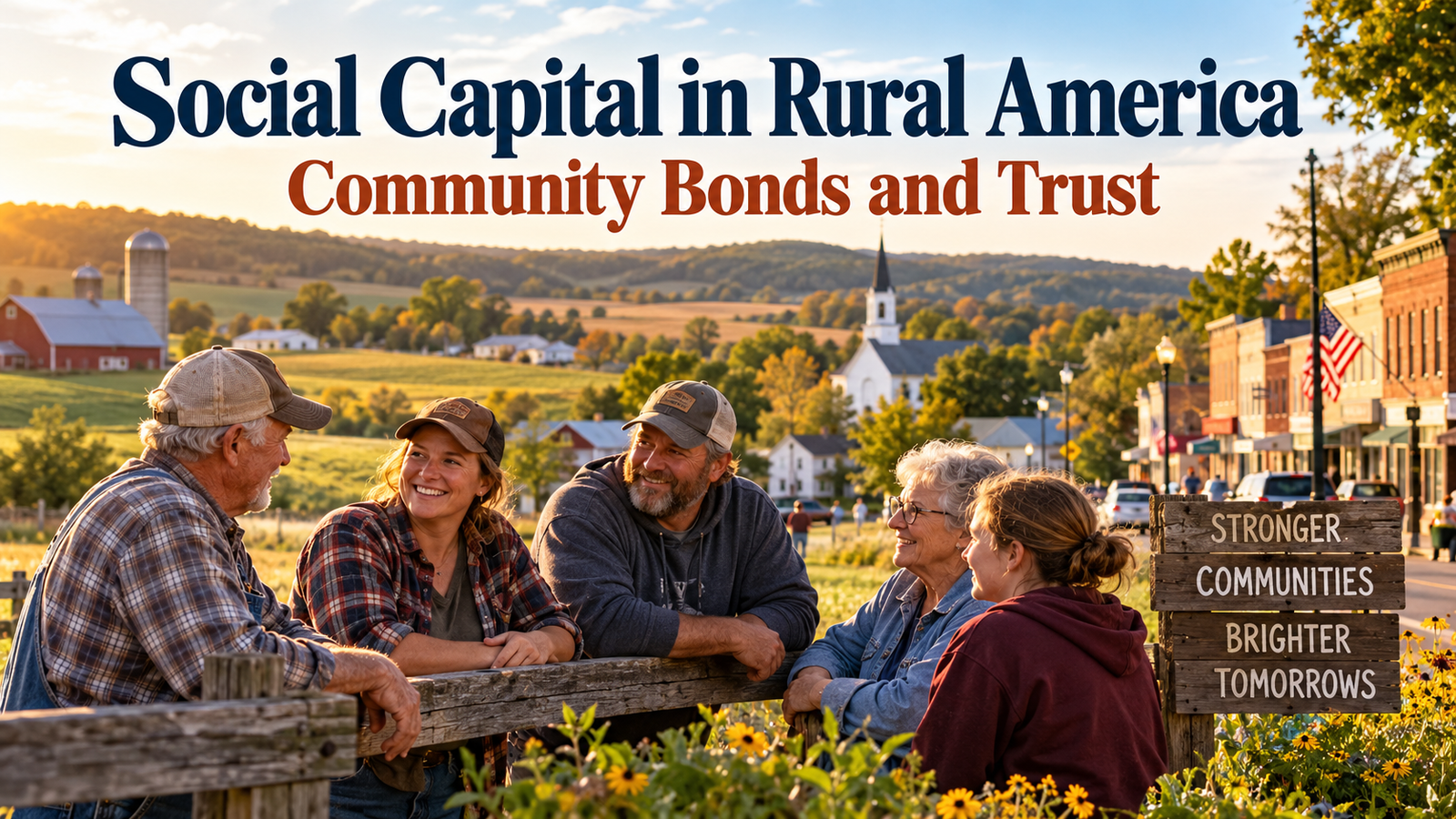
Introduction on Social Capital in Rural America
Social relationships are among the most valuable resources available to any society. People depend on one another for emotional support, practical assistance, information, cooperation, and a sense of belonging. In rural communities, where residents may know their neighbors personally and share long-standing local traditions, these relationships often play a particularly important role. Sociologists use the concept of social capital to understand how trust, shared norms, networks, and cooperation help people work together.
Social Capital in Rural America is an important sociological topic because it reveals how local relationships influence community development, civic participation, disaster recovery, and everyday life. From volunteer fire departments and churches to agricultural associations, school committees, libraries, and neighborhood groups, rural Americans build networks that can help communities respond to common problems.
However, strong community bonds do not automatically produce equality or social harmony. Rural communities may also experience political polarization, social exclusion, declining institutions, economic insecurity, and generational differences. Therefore, understanding Social Capital in Rural America requires examining both the benefits of close relationships and the limitations of community solidarity.

Recent research published in 2026 reinforces the importance of this subject. A Trust for Civic Life survey found that rural residents continued to report stronger confidence in local institutions than in national political institutions, while many remained confident in their ability to solve community problems together. Trust for Civic Life These findings suggest that community relationships remain an important resource even when trust in wider political systems becomes uncertain.
This article examines Social Capital in Rural America from a sociological perspective, focusing on community bonds, social trust, volunteering, local institutions, inequality, and the changing character of rural society.
Table of Contents
What Is Social Capital in Rural America?
Social capital refers to the resources that individuals and groups obtain through relationships, social networks, mutual trust, and shared expectations of cooperation. Unlike economic capital, which involves money and material assets, or human capital, which includes education and skills, social capital is embedded in relationships between people.
The concept is associated with several influential sociologists and social theorists. Pierre Bourdieu examined how social networks provide access to resources and reproduce social advantage. James Coleman emphasized how social relationships facilitate cooperation and support individual and collective action. Robert Putnam popularized the concept through his research on civic participation, voluntary associations, and declining involvement in traditional community organizations.
Social Capital in Rural America can be understood through these perspectives. A farmer who receives assistance from neighboring farmers during a difficult harvest, a volunteer who helps organize a local food distribution program, or parents who cooperate to improve a rural school are all examples of social relationships producing practical benefits.
These networks can reduce isolation, spread information, and help people overcome resource shortages. In places where public services are distant or difficult to access, informal cooperation may become especially important.
Nevertheless, Social Capital in Rural America is not distributed equally. Established families, influential landowners, business owners, and community leaders may possess stronger networks than newcomers, low-income households, or socially marginalized residents. Sociological analysis must therefore examine not only the existence of community relationships but also who benefits from them and who remains excluded.
Types of Social Capital in Rural America
Sociologists commonly distinguish between bonding, bridging, and linking social capital. These categories help explain how relationships operate within rural communities and how local networks influence opportunities and social development.
Bonding Social Capital: Strong Community Bonds
Bonding social capital refers to close relationships among people who share similar identities, backgrounds, experiences, or social positions. In rural America, these relationships often develop among relatives, lifelong friends, neighbors, members of religious congregations, and people involved in the same local organizations.
Social Capital in Rural America frequently takes the form of bonding relationships. Neighbors may help one another repair storm damage, care for older residents, transport children, or provide food to a family experiencing financial difficulties. These actions strengthen solidarity and establish expectations of reciprocity.
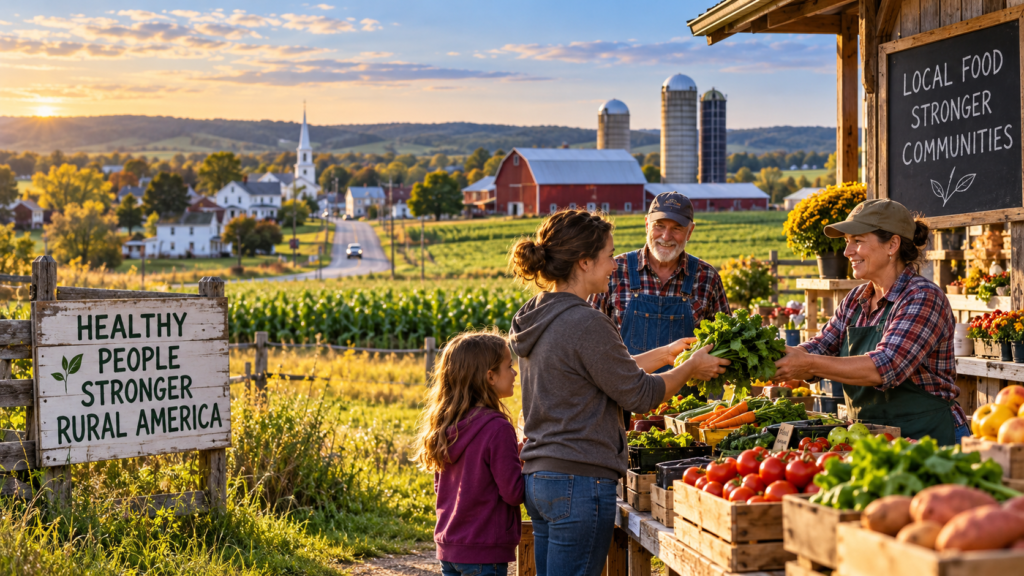
From a sociological perspective, bonding social capital provides emotional security and practical support. It can reduce loneliness, especially among older residents, and help families manage economic uncertainty. However, strong internal networks may also exclude newcomers, racial minorities, religious minorities, or residents who do not conform to established community expectations.
Therefore, bonding social capital is valuable but insufficient on its own. A community also needs relationships that extend beyond familiar social circles.
Bridging Social Capital: Connecting Different Groups
Bridging social capital connects people from different social, economic, political, racial, religious, or generational backgrounds. It develops when residents cooperate despite their differences.
For example, a rural development association might bring together farmers, small-business owners, teachers, young adults, and local government representatives to improve public transport. Although these participants have different interests, their shared objective creates opportunities for cooperation.
Social Capital in Rural America becomes more inclusive when local organizations encourage people to interact across social boundaries. Such relationships can introduce residents to new information, professional opportunities, alternative perspectives, and broader sources of assistance.
Bridging social capital is particularly important in politically divided communities. Rather than requiring residents to agree on national political questions, community projects allow them to cooperate on practical issues such as school facilities, road maintenance, flood preparation, and local employment.
Linking Social Capital: Relationships with Institutions
Linking social capital describes relationships between ordinary residents and people or institutions possessing formal authority, funding, or organizational power.
In rural communities, these connections may involve county officials, state agencies, healthcare providers, philanthropic foundations, universities, and federal programs.
Social Capital in Rural America becomes more effective when local residents can communicate their needs to decision-makers and obtain resources for community projects. A neighborhood association may identify a shortage of childcare facilities, but its ability to address the problem could depend on securing funding, planning assistance, or government cooperation.
These three forms of social capital are interconnected. Bonding relationships provide immediate support, bridging relationships widen cooperation, and linking relationships help communities access resources beyond their immediate networks.
Community Trust and Everyday Cooperation
Trust is one of the central foundations of social capital. It develops when people believe that others will behave reliably, respect commitments, and provide assistance when needed.
In rural America, repeated interaction often makes trust easier to establish. Residents may meet regularly at schools, religious gatherings, agricultural markets, local businesses, sporting events, and community celebrations. Over time, these encounters create familiarity and expectations of mutual responsibility.
Social Capital in Rural America depends partly on these repeated social interactions. When residents trust one another, they may find it easier to organize fundraisers, share equipment, support local businesses, or respond collectively to emergencies.
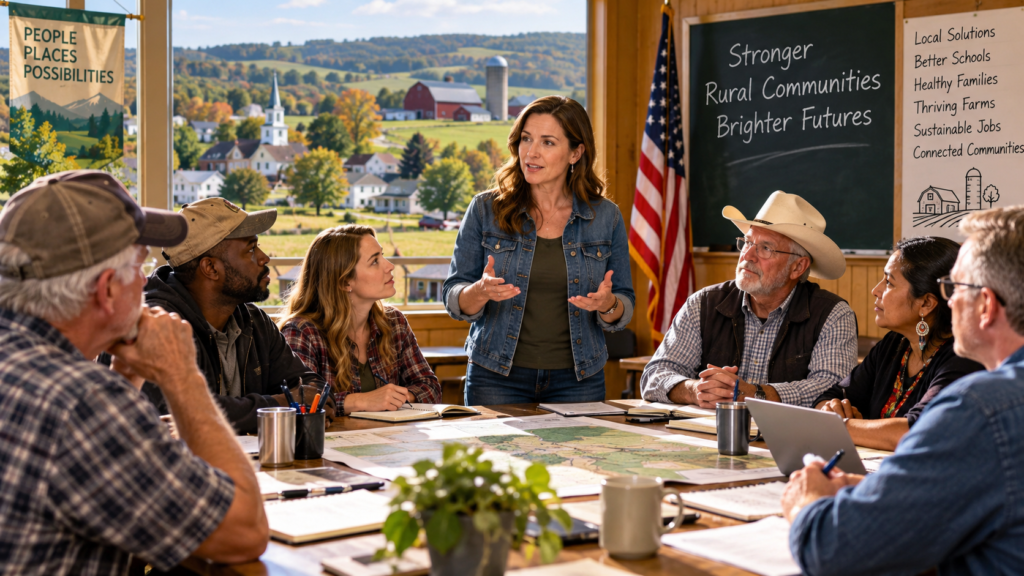
However, trust should not be confused with complete agreement or the absence of conflict. Rural communities contain competing interests, inequalities, and disagreements over land use, public spending, religion, education, and politics. The sociological question is whether residents possess the relationships and institutions needed to manage these differences constructively.
Trust also varies according to social position. A prominent landowner may experience a community as supportive, while a low-income renter or newcomer may feel excluded from important networks. Consequently, Social Capital in Rural America must be assessed through the experiences of different groups rather than through a general assumption that all residents enjoy equal belonging.
Recent Developments: What Rural America Is Teaching Sociologists in 2026
Recent research and community initiatives provide useful evidence about the changing nature of rural relationships. Three developments are particularly important: renewed investment in local civic organizations, the role of libraries as trusted community spaces, and the relationship between community cohesion and disaster resilience.
1. Rural Civic Hubs and the Rebuilding of Trust
In July 2026, the Trust for Civic Life announced $7.6 million in grants for 20 additional Civic Hub organizations working in rural America. These organizations aim to strengthen local connections, encourage participation, and help residents work together across differences. The initiative forms part of a broader investment intended to support locally led civic activity.
This development illustrates an important sociological argument: community trust is not simply an inherited cultural characteristic. It can also be cultivated through institutions that create opportunities for collective action.
For example, a community organization that brings residents together to restore a public building or organize a cultural festival provides more than a service. It creates opportunities for people to develop relationships, demonstrate reliability, negotiate disagreements, and experience shared accomplishment.
Social Capital in Rural America can therefore be strengthened when residents participate in meaningful activities rather than remaining passive recipients of external assistance.
The initiative also reveals a structural problem. Rural organizations often have limited access to funding and professional support, even when they possess extensive local knowledge. According to the Trust for Civic Life, rural regions receive a relatively small share of national philanthropic funding. Its grantmaking seeks to direct more resources toward community-led efforts.
From a sociological perspective, this represents an attempt to connect local social networks with wider institutional resources. Strong relationships matter, but they cannot replace adequate funding, public infrastructure, and sustained investment.
2. Public Libraries as Centers of Social Capital
Public libraries provide another example of how community institutions generate trust.
In an October 14, 2026, publication, the Trust for Civic Life reported that 87% of respondents in its recent rural community survey expressed high trust in their local libraries. The organization also highlighted the role of libraries in providing spaces for programs, social interaction, and civic participation.
This finding is significant because libraries are not merely places for borrowing books. In rural communities, they can function as accessible meeting places where residents encounter people outside their immediate family or friendship circles.
Library activities may include educational workshops, children’s reading programs, digital literacy sessions, cultural events, and public discussions. These activities create opportunities for informal interaction and cooperation.
Social Capital in Rural America can grow through such everyday encounters. A young person attending a computer class may meet a local volunteer, while an older resident participating in a community program may develop new friendships. These relationships can expand social networks and strengthen feelings of belonging.
The sociological importance of libraries also lies in their potential inclusiveness. Unlike some private clubs or tightly organized social groups, public libraries can bring together residents with different income levels, political opinions, educational backgrounds, and family circumstances.
Nevertheless, libraries require sufficient staffing, funding, facilities, and accessible transportation. Their ability to function as community anchors depends on material resources as well as social trust.
3. Disaster Recovery and the Strength of Local Networks
Disasters reveal the practical value of social capital. Wildfires, floods, severe storms, and other emergencies can disrupt transportation, communication, employment, housing, and access to essential services.
A 2026 study examining community recovery in Happy Camp, California, drew on residents’ experiences following the 2020 Slater Fire. The research emphasized community mobilization, tribal support, community organizations, social capital, and external assistance as important dimensions of recovery.
The case demonstrates that recovery involves more than rebuilding physical structures. Residents also need reliable information, emotional support, assistance with daily tasks, and relationships that connect them to outside resources.
Social Capital in Rural America can help residents identify vulnerable neighbors, coordinate volunteers, distribute supplies, and communicate local needs to emergency agencies. Existing networks may make it easier to mobilize assistance before formal support becomes available.
However, strong community bonds cannot eliminate structural disadvantages. Remote locations, limited financial resources, inadequate communication infrastructure, and shortages of emergency personnel may delay recovery. Communities also differ in their ability to access insurance, government assistance, and philanthropic funding.
The sociological lesson is that social capital can improve resilience, but it should complement rather than replace effective public institutions and disaster preparedness.
Volunteering, Civic Engagement, and Rural Solidarity
Volunteering is one of the most visible expressions of social capital. Rural communities often depend on volunteers to support sports clubs, religious organizations, food assistance programs, local events, schools, and emergency services.
These activities create opportunities for residents to develop practical skills and establish relationships beyond their households. They can also strengthen collective efficacy: the belief that people can work together to influence conditions in their community.
Research published by Gallup in 2025 found a strong relationship between perceived community cohesion and willingness to participate in local leadership. Among rural Americans reporting high community cohesion, 97% said they could positively affect their communities, compared with 42% among those reporting low cohesion. The research also found that volunteering in local projects was more common among those experiencing high cohesion.
These findings suggest that Social Capital in Rural America is closely connected to residents’ sense of personal and collective agency.
Importantly, the relationship can work in both directions. Trust encourages participation, but participation also creates opportunities to build trust. When people work together to solve a visible problem, they gain evidence that cooperation can produce meaningful results.
However, volunteering should not be romanticized. Excessive dependence on unpaid labor can place burdens on residents who already have demanding jobs, caregiving responsibilities, or financial difficulties. Communities also need to ensure that leadership opportunities are not monopolized by a small group of established residents.
Political Polarization and the Limits of Community Trust
One of the major challenges facing contemporary rural society is political polarization. National political debates can influence local relationships, shaping how residents perceive their neighbors, public institutions, and community organizations.
Social Capital in Rural America can be weakened when political disagreement turns into personal hostility. Residents may withdraw from local organizations, avoid public discussions, or become reluctant to cooperate with people who hold different political views.
Yet recent evidence also suggests that political differences do not necessarily prevent cooperation. The Trust for Civic Life’s 2026 research reported that nearly half of respondents had initiated some form of action across differences. Its findings also indicated that community members often felt more capable of solving local problems than influencing national political affairs.
This distinction is sociologically important. National political debates frequently present social groups as opposing camps, while everyday community life creates practical reasons for cooperation.
Residents may disagree about federal policy but share concerns about school transport, deteriorating roads, local employment, or the future of their children. Collaborative projects can shift attention from ideological identities toward shared responsibilities.
Social Capital in Rural America is therefore not simply about encouraging agreement. It is about developing relationships and institutions capable of sustaining cooperation when disagreement remains.
For this reason, local organizations should create opportunities for residents to participate without requiring ideological conformity. Trust becomes more durable when people can disagree respectfully and still contribute to a common purpose.
Inequality, Exclusion, and the Dark Side of Social Capital
Although social capital offers important benefits, it can also reproduce social inequality. Strong networks often distribute information, opportunities, influence, and assistance unevenly.
In rural communities, long-established families may possess valuable contacts with employers, officials, business owners, and community leaders. New residents or marginalized groups may struggle to access these networks.
Social Capital in Rural America can therefore create both solidarity and social boundaries. A tightly connected group may support its own members while excluding outsiders from leadership opportunities or community resources.
Bourdieu’s approach is particularly useful here because it highlights how social relationships can reproduce privilege. Individuals with influential connections may obtain employment, business opportunities, and institutional support more easily than people with similar skills but weaker networks.
Gender, class, race, age, disability, and geographic isolation can all affect participation. For example, residents without reliable transportation may be unable to attend evening meetings, while young adults working long hours may find it difficult to participate in voluntary activities.
The solution is not to weaken community relationships but to make them more inclusive. Transparent decision-making, accessible meeting places, youth leadership, outreach to newcomers, and fair distribution of community resources can help ensure that Social Capital in Rural America benefits a wider population.
Economic Change, Rural Institutions, and Community Bonds
Economic transformation can reshape the social structure of rural communities. The closure of a major employer, the decline of family farming, population ageing, and the migration of young adults can weaken established networks and reduce opportunities for regular interaction.
The future of local healthcare provides a particularly important example. In October 2026, the American Hospital Association warned that financial pressures and workforce shortages were threatening access to rural healthcare. Its report highlighted the risks facing hospitals serving more than 46 million people in rural communities.
Healthcare institutions are not only service providers. They are also employers, meeting points, and sources of stability in many small communities. When a hospital reduces services or closes, residents may lose jobs, travel farther for treatment, and experience greater uncertainty.
Social Capital in Rural America may help communities respond through local fundraising, volunteer assistance, advocacy, and cooperation with regional authorities. Nevertheless, social networks cannot independently replace professional medical services or stable healthcare financing.
This distinction is central to sociological analysis: community resilience depends on both social relationships and the material conditions in which those relationships operate.
Local businesses, schools, libraries, and community organizations similarly contribute to social stability. Supporting these institutions can preserve opportunities for interaction, employment, learning, and collective problem-solving.
The Role of Digital Technology in Rural Social Networks
Digital technology is changing how rural residents maintain relationships and organize community activities. Social media groups, messaging applications, online fundraising platforms, and virtual meetings allow people to exchange information across geographical distances.
These tools can strengthen Social Capital in Rural America by connecting residents who might otherwise remain isolated. Farmers can share practical knowledge, families can coordinate assistance, and community organizations can advertise events or mobilize volunteers quickly.
Digital networks may also help younger residents maintain connections with their hometowns after moving away for education or employment. These relationships can potentially support mentoring, fundraising, and future investment.
However, online communication does not automatically create trust. Misinformation, hostile political discussions, privacy concerns, and unequal internet access can weaken social relationships. Digital participation may also fail to provide the depth of interaction associated with sustained face-to-face cooperation.
The most effective approach combines digital tools with accessible physical spaces and meaningful local activities. Social Capital in Rural America is likely to remain strongest when technology supports genuine relationships rather than replacing them entirely.
How Rural Communities Can Strengthen Social Capital
Strengthening social capital requires consistent opportunities for residents to work together, develop leadership skills, and participate in decisions affecting their lives.
Local governments, schools, libraries, nonprofits, businesses, and voluntary associations can support this process by creating accessible community programs and encouraging cooperation across social boundaries.
Community projects should focus on practical needs. Improving a playground, organizing a local food program, restoring a public space, mentoring young people, or preparing for emergencies can provide shared goals around which residents build relationships.
Leadership opportunities should also be distributed widely. When young people, newcomers, low-income households, and historically excluded residents participate in decision-making, community networks become more representative of the population.
Social Capital in Rural America can also be strengthened through partnerships with universities, regional organizations, philanthropic foundations, and public agencies. These partnerships connect local knowledge with additional resources while allowing communities to retain meaningful control over their priorities.
Finally, social capital should be evaluated through more than the number of volunteers or community events. Researchers should consider whether residents feel respected, whether different groups cooperate, whether institutions are trusted, and whether participation produces measurable improvements in community life.
Conclusion on Social Capital in Rural America
Social Capital in Rural America provides an important framework for understanding how trust, relationships, and cooperation shape rural society. Strong community networks can support families, encourage volunteering, strengthen local institutions, improve disaster recovery, and create opportunities for collective action.
Recent developments in 2026, including investment in rural Civic Hubs and renewed attention to public libraries, demonstrate that local relationships continue to matter even amid political divisions and institutional uncertainty. Research on community cohesion and disaster recovery further illustrates how cooperation can improve residents’ capacity to respond to shared challenges.
However, social capital is neither universally distributed nor automatically beneficial. Exclusion, inequality, political polarization, declining public services, and economic insecurity can weaken its positive effects. Close-knit networks may also preserve privilege when opportunities remain concentrated among established groups.
The future of Social Capital in Rural America depends on building relationships that are both strong and inclusive. Rural communities need spaces where residents can cooperate across differences, institutions that provide reliable support, and public policies that address structural disadvantages.
Ultimately, the greatest strength of Social Capital in Rural America lies not simply in the fact that neighbors know one another, but in their ability to transform those relationships into fair, practical, and lasting improvements in collective life.
Frequently Asked Questions (FAQs) on Social Capital in Rural America
1. What is Social Capital in Rural America?
Social Capital in Rural America refers to the trust, relationships, social networks, and shared norms that help rural residents cooperate, exchange resources, and solve common problems.
2. Why is Social Capital in Rural America important?
It supports mutual assistance, volunteering, civic engagement, community resilience, and collective problem-solving, particularly in areas with limited access to services.
3. What are the main types of social capital?
The three commonly discussed types are bonding social capital, bridging social capital, and linking social capital.
4. How does social trust influence rural communities?
Social trust encourages cooperation, reduces uncertainty, and makes it easier for residents to organize activities and support one another.
5. How do rural libraries contribute to Social Capital in Rural America?
Libraries provide accessible spaces for education, community programs, informal interaction, and civic participation.
6. What role does volunteering play in rural social capital?
Volunteering creates relationships, develops leadership skills, and encourages residents to work together toward shared objectives.
7. Can political polarization weaken rural community bonds?
Yes. Political hostility can reduce participation and trust, although collaborative local projects may help residents cooperate despite ideological differences.
8. What are the negative effects of social capital?
Social capital can reinforce exclusion, favoritism, unequal access to opportunities, and the concentration of leadership among established groups.
9. How does social capital help during disasters?
Local networks can help identify vulnerable residents, distribute supplies, coordinate volunteers, and connect communities with outside assistance.
10. How can rural communities strengthen social capital?
They can create inclusive community programs, support local institutions, encourage shared leadership, and develop partnerships with public agencies and nonprofits.
11. What is bonding social capital in rural America?
Bonding social capital describes close relationships among relatives, friends, neighbors, and people with shared social identities.
12. What is bridging social capital in rural America?
Bridging social capital connects residents across differences in class, race, religion, political beliefs, or generations.
13. How does technology influence rural social capital?
Digital platforms can improve communication and coordination, but unequal access and online hostility may limit their benefits.
14. What is the relationship between social capital and rural development?
Social capital can help communities organize projects, share knowledge, attract resources, and participate in local decision-making.
15. What is the future of Social Capital in Rural America?
Its future will depend on inclusive participation, trusted institutions, strong community networks, adequate public services, and the ability to cooperate across social and political differences.
References and Further Reading
- Trust for Civic Life, The Local Advantage: Community Survey Findings, 2026.
- Trust for Civic Life, Rural Civic Hub Grants Announced in July 2026.
- Trust for Civic Life, Public Libraries as Catalysts for Civic Life, October 2026.
- Gallup, Community Cohesion Could Unlock Rural Leadership.
- Research article, The Value of Community Building and Social Capital for Rural Communities Recovering from Disaster.