
Introduction on Privatization of Education in India
Education has always been considered one of the strongest foundations of social development in India. After independence, the Indian state viewed education as a public responsibility essential for nation-building, democracy, and social justice. However, over the past few decades, the rapid growth of private schools, colleges, coaching centers, and universities has transformed the educational landscape. This phenomenon is commonly known as the privatization of education.
Privatization of education refers to the increasing involvement of private individuals, organizations, corporations, and institutions in the management, funding, and delivery of educational services. In India, privatization has expanded from primary schooling to higher education, technical education, and even online learning platforms. While supporters argue that privatization improves quality and efficiency, critics believe it deepens social inequality and weakens the constitutional ideal of equal educational opportunity.
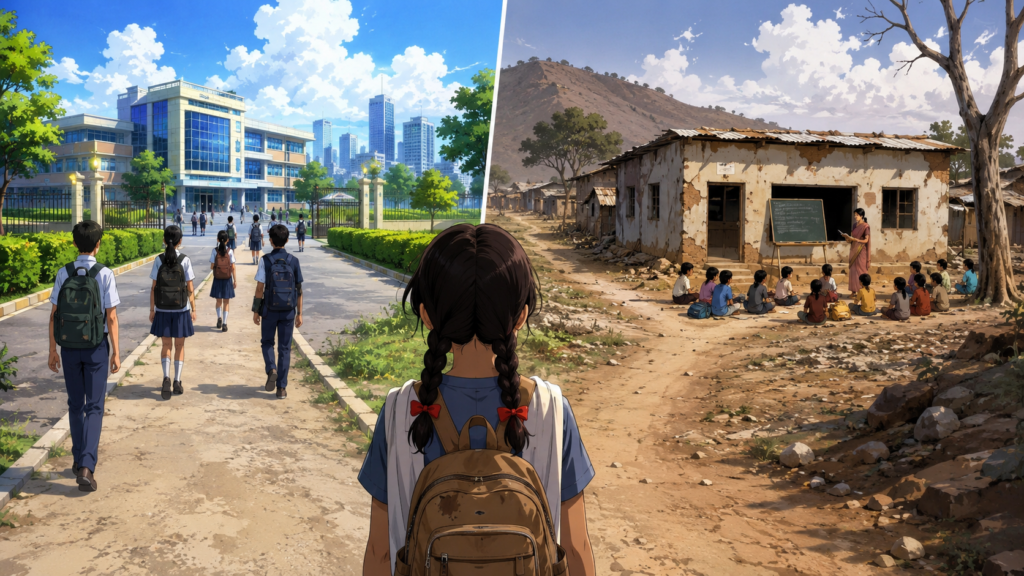
From a sociological perspective, privatization is not merely an economic or administrative change. It is deeply connected with issues such as social stratification, class inequality, cultural capital, gender disparity, rural-urban divisions, and the changing role of the state in society. Understanding privatization sociologically helps explain how education shapes power relations and social mobility in modern India.
Meaning of Privatization of Education
Privatization in education means the transfer of educational functions from the public sector to private ownership or control. It can take different forms:
- Private schools and colleges run by individuals or organizations
- Corporate investment in educational institutions
- Public-private partnerships
- Coaching and tutoring industries
- Commercialization of educational services
- Online private educational platforms
In India, privatization is visible in elite international schools, private engineering and medical colleges, coaching institutes for competitive examinations, and private universities. Education has increasingly become a market-oriented service rather than solely a social welfare activity.
Historical Background of Educational Privatization in India
During the colonial period, education in India was limited and largely controlled by missionary organizations and elite institutions. After independence, the Indian government emphasized public education to promote equality and national integration. Several commissions, including the Kothari Commission (1964–66), highlighted the importance of state responsibility in providing universal education.
However, by the 1980s and especially after the economic liberalization of 1991, privatization gained momentum. Economic reforms encouraged private investment in many sectors, including education. Due to population growth, increasing demand for higher education, and limited public funding, private institutions rapidly expanded.
The National Education Policy (NEP) 2020 also recognizes the role of private participation, though it stresses regulation and quality assurance. Today, India has one of the largest private education sectors in the world.
Sociological Perspectives on Privatization of Education
Functionalist Perspective
Functionalist sociologists view education as an institution that maintains social order and prepares individuals for societal roles. Privatization, from this perspective, may improve efficiency, innovation, and competition among educational institutions. Supporters argue that private institutions can provide better infrastructure, advanced technology, skilled teachers, and modern curricula.
Private institutions often introduce specialized courses and professional training aligned with labor market demands. They also reduce pressure on government institutions by increasing educational opportunities.
However, functionalists also recognize that excessive inequality in access to education may weaken social integration and create divisions in society.
Conflict Perspective
Conflict theorists, inspired by Karl Marx, view education as a tool that reproduces class inequality. According to this perspective, privatization strengthens the dominance of wealthy groups by making quality education accessible mainly to the upper and middle classes.
Private schools often charge high fees that poor families cannot afford. As a result, children from privileged backgrounds receive better education, English-language skills, and professional opportunities, while marginalized groups remain dependent on underfunded public schools.
Conflict theorists argue that privatization converts education into a commodity. Instead of promoting equality, the system reproduces economic and social inequalities across generations.
Symbolic Interactionist Perspective
Symbolic interactionists focus on everyday interactions within educational institutions. In private schools, students may develop confidence, communication skills, and social networks associated with elite status. The school environment shapes identity, aspirations, and social behavior.
Students in expensive institutions often gain cultural capital, such as fluency in English, technological exposure, and social etiquette, which provide advantages in higher education and employment. Meanwhile, students from government schools may experience social stigma or feelings of inferiority.
Thus, privatization influences not only academic achievement but also social identity and self-perception.
Growth of Private Education in India
The growth of private education in India can be observed at all levels.

School Education
Private schools have expanded significantly in urban and semi-urban areas. Parents increasingly prefer private schools due to perceptions of better discipline, English-medium instruction, and improved academic performance.
Even low-income families often send children to low-cost private schools despite financial difficulties because government schools are frequently criticized for poor infrastructure and teacher absenteeism.
Higher Education
Private colleges and universities dominate professional education in fields such as engineering, medicine, management, law, and pharmacy. Many students seek admission to private institutions due to limited seats in government colleges.
The rise of deemed universities and private universities reflects the commercialization of higher education. Some institutions provide quality education, while others prioritize profit over academic standards.
Coaching Industry
The privatization of education is also visible in the enormous coaching industry. Cities like Kota, Hyderabad, and Delhi have become centers for competitive examination coaching. Students preparing for IIT-JEE, NEET, UPSC, and other examinations often spend large amounts of money on private coaching.
This trend has created educational pressure and transformed learning into a competitive market-driven activity.
Causes of Privatization in India
Several social and economic factors have contributed to privatization.
Increasing Demand for Education
India’s growing population and rising aspirations have created massive demand for educational opportunities. Government institutions alone could not meet this demand.
Weak Public Education System
Poor infrastructure, lack of teachers, overcrowded classrooms, and declining quality in many public schools encouraged parents to seek private alternatives.
Economic Liberalization
After 1991, liberalization policies promoted private investment in social sectors. Education gradually became part of the market economy.
Employment-Oriented Education
Private institutions often focus on professional and technical education linked to employment opportunities. This attracts students seeking career advancement.
Social Prestige
Private education, especially English-medium schooling, is associated with status, modernity, and upward social mobility in Indian society.
Impact of Privatization on Society
Social Inequality
One of the most important sociological consequences of privatization is widening social inequality. Wealthy families can access high-quality institutions, advanced resources, and global opportunities, while poor students struggle in under-resourced schools.
Education, instead of reducing inequality, may reinforce class divisions. The gap between elite private institutions and ordinary government schools creates unequal life chances.
Rural-Urban Divide
Private educational institutions are concentrated mainly in urban areas. Rural students often lack access to quality private education due to geographical and economic limitations.
As a result, urban students gain better exposure, technology, and career opportunities compared to rural populations.
Gender Dimensions
Privatization has mixed effects on gender equality. In some cases, private schools encourage girls’ education and provide safer learning environments. However, high educational costs may lead poor families to prioritize boys’ education over girls’.
Thus, economic inequality intersects with gender inequality in educational access.
Commercialization of Education
Privatization has transformed education into a business sector. Many institutions prioritize profit-making through high fees, donations, and commercialization of services.
This market-oriented approach weakens the moral and social purpose of education. Students are increasingly viewed as customers rather than learners.
Cultural Changes
Private institutions often promote English language, Western lifestyles, and global culture. While this may enhance international competitiveness, it can also create cultural alienation and weaken local languages and traditions.
Students from elite schools may develop lifestyles and attitudes disconnected from rural or lower-class realities.
Mental Pressure and Competition
The privatized education system encourages intense academic competition. Students face pressure to achieve high marks, secure professional careers, and succeed in entrance examinations.
The coaching culture has contributed to stress, anxiety, and mental health issues among students.
Privatization and Social Mobility
Education is traditionally viewed as a pathway to social mobility. Privatization has created opportunities for some individuals to improve their social and economic status through professional education.
Middle-class families often invest heavily in private education to secure upward mobility. However, for economically weaker sections, expensive education can become a barrier rather than an opportunity.

Pierre Bourdieu’s concept of cultural capital is useful here. Wealthier families possess economic resources, language skills, and social networks that help children succeed in private educational environments. Therefore, privatization often benefits already privileged groups.
Role of the State in Education
The Indian Constitution recognizes education as a fundamental right under Article 21A. The state has a responsibility to ensure equitable and inclusive education for all citizens.
Despite privatization, public education remains essential for social justice. Government initiatives such as the Right to Education Act (2009), midday meal schemes, scholarships, and reservation policies aim to reduce inequality.
However, many sociologists argue that declining investment in public education weakens these goals. Strengthening government schools and universities is necessary to balance the effects of privatization.
Advantages of Privatization
Privatization has some positive aspects:
- Improved infrastructure and facilities
- Greater use of technology in education
- Better teacher accountability in some institutions
- Increased educational opportunities
- Professional and skill-oriented courses
- Global exposure and innovation
These factors have contributed to the expansion and modernization of India’s education system.
Challenges and Criticisms
Despite its benefits, privatization faces serious criticism:
- High fees exclude poor students
- Commercialization reduces educational ethics
- Unequal access deepens class divisions
- Quality varies greatly among institutions
- Coaching culture increases stress
- Rural areas remain neglected
- Education becomes market-driven rather than socially oriented
Many private institutions also lack proper regulation, leading to corruption, capitation fees, and exploitation.
Privatization and the Future of Indian Society
The future of Indian society will be deeply influenced by educational policies. If privatization continues without regulation, social inequality may intensify further. Elite groups may monopolize quality education, while marginalized communities remain excluded.
At the same time, completely rejecting private participation may not be practical given India’s huge population and educational demand. Therefore, a balanced approach is necessary.
The state must strengthen public education, regulate private institutions, ensure affordability, and promote inclusive policies. Equal educational opportunities are essential for democracy, social harmony, and national development.
Conclusion
Privatization of education in India is one of the most significant social transformations of the modern era. It reflects broader economic changes, globalization, rising aspirations, and the growing influence of market forces in society. From a sociological perspective, privatization affects not only education but also social structure, inequality, identity, and mobility.
While private institutions have expanded opportunities and improved infrastructure, they have also created serious concerns regarding inequality, commercialization, and exclusion. Education is more than a commodity; it is a social institution that shapes citizenship, values, and collective progress.
For India to achieve inclusive development, education must remain accessible, equitable, and socially responsible. A strong partnership between the state, society, and private institutions is essential to ensure that education serves the broader goals of justice, equality, and human development rather than merely economic profit.
FAQs on Privatization of Education in India
1. What is Privatization of Education in India?
Privatization of Education in India refers to the increasing involvement of private individuals, organizations, and companies in providing educational services through private schools, colleges, universities, and coaching institutes.
2. Why has Privatization of Education in India increased?
Privatization of Education in India has increased due to rising demand for quality education, population growth, limited government resources, economic liberalization, and the desire for English-medium and professional education.
3. What are the major forms of Privatization of Education in India?
The major forms include private schools, private universities, coaching centers, public-private partnerships, online learning platforms, and self-financed professional colleges.
4. How does Privatization of Education in India affect social inequality?
Privatization of Education in India often increases social inequality because high-quality private education is expensive and mainly accessible to wealthy and middle-class families.
5. What are the advantages of Privatization of Education in India?
Some advantages include better infrastructure, modern technology, improved facilities, professional courses, global exposure, and increased educational opportunities.
6. What are the disadvantages of Privatization of Education in India?
The disadvantages include commercialization of education, high tuition fees, unequal access, educational pressure, and the widening gap between rich and poor students.
7. How does Privatization of Education in India impact rural areas?
Privatization of Education in India has limited reach in rural regions, where many students still depend on government schools due to lack of private institutions and financial limitations.
8. What is the sociological significance of Privatization of Education in India?
From a sociological perspective, Privatization of Education in India influences class structure, social mobility, cultural capital, educational inequality, and identity formation.
9. How does Privatization of Education in India affect government schools?
Privatization of Education in India often reduces public confidence in government schools, leading to declining enrollments and pressure on public educational systems.
10. What role does globalization play in Privatization of Education in India?
Globalization encourages Privatization of Education in India through international educational models, foreign collaborations, technological advancement, and market-oriented learning.
11. How does Privatization of Education in India influence employment opportunities?
Private institutions often provide professional and technical education that improves employability, skill development, and access to corporate job markets.
12. Is Privatization of Education in India beneficial for students?
Privatization of Education in India benefits some students through better resources and career opportunities, but it can disadvantage economically weaker sections due to high costs.
13. What is the relationship between Privatization of Education in India and cultural capital?
Privatization of Education in India helps students from privileged backgrounds gain cultural capital such as English fluency, communication skills, and social networks.
14. How can the government regulate Privatization of Education in India?
The government can regulate Privatization of Education in India by controlling fees, ensuring quality standards, increasing transparency, and strengthening public education systems.
15. What is the future of Privatization of Education in India?
The future of Privatization of Education in India will likely involve a balance between public and private sectors, with greater focus on inclusiveness, technology, and quality education.