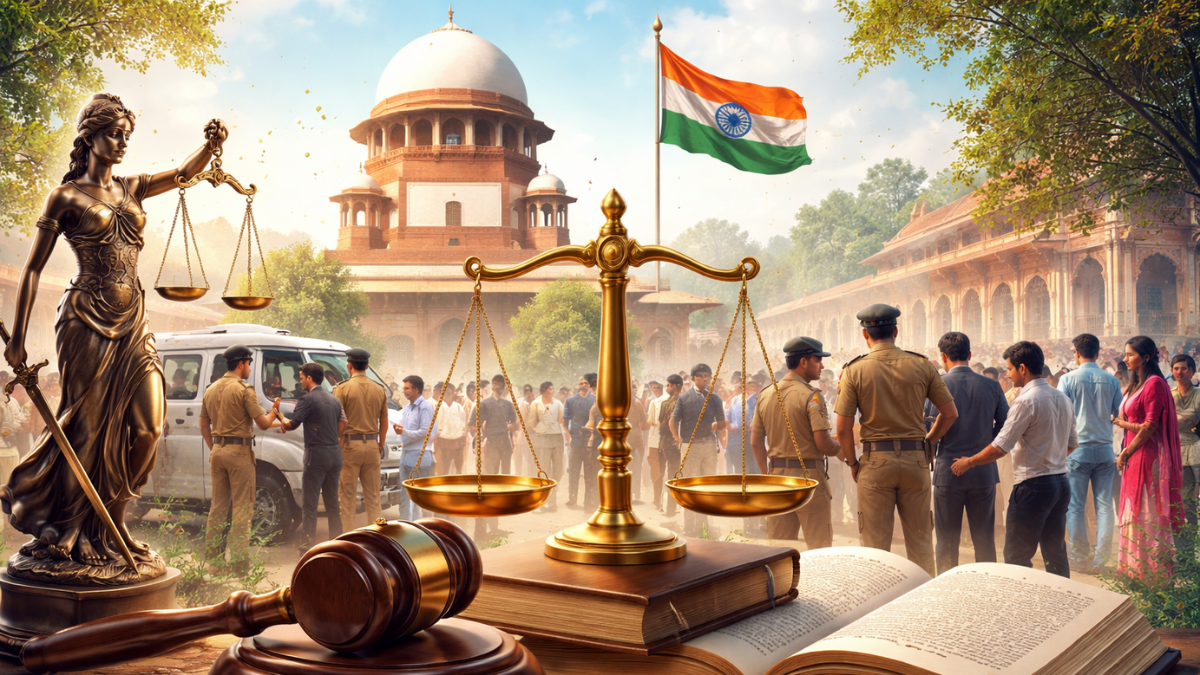
Introduction
Law, crime, and social control are deeply interconnected elements within any society. From a sociological perspective, they represent mechanisms through which social order is maintained, deviance is regulated, and collective values are preserved. In the context of India, these elements are shaped by a complex interplay of historical traditions, colonial legacies, constitutional frameworks, and contemporary socio-economic changes.
India’s vast diversity—cultural, linguistic, religious, and economic—creates a unique social landscape where law and crime cannot be understood in isolation. Rather, they must be analyzed within broader structures of power, inequality, and social norms. This article explores the sociological dimensions of law, crime, and social control in India, highlighting theoretical frameworks, institutional mechanisms, and emerging challenges.

Understanding Law in Sociological Context
Law as a Social Institution
Law is not merely a set of rules enforced by the state; it is a social institution that reflects the values, norms, and power structures of society. Sociologists argue that law serves both regulatory and integrative functions. It regulates behavior by defining acceptable and unacceptable actions, while also integrating society by promoting shared norms.
In India, the legal system is rooted in the Constitution of India, which guarantees fundamental rights and outlines the duties of citizens. The Constitution embodies ideals such as justice, liberty, equality, and fraternity, which guide the functioning of the legal system.
Historical Evolution of Law in India
The Indian legal system has evolved through multiple phases:
- Ancient Period: Laws were based on religious texts such as Dharmaśāstra, emphasizing moral duties.
- Medieval Period: Islamic law influenced governance during Mughal rule.
- Colonial Period: British rule introduced codified laws like the Indian Penal Code.
- Post-Independence Era: Democratic principles and constitutional values reshaped the legal framework.
This layered history has resulted in a hybrid legal system combining traditional norms with modern legal principles.
Concept of Crime in Sociology
Defining Crime
Crime is generally defined as an act that violates the law and is punishable by the state. However, sociologists emphasize that crime is socially constructed. What is considered criminal in one society or era may not be so in another.
For example, practices like untouchability, once socially accepted, are now criminalized under Indian law. This demonstrates how changing social values influence legal definitions of crime.
Types of Crime in India
Crime in India can be broadly categorized into:
- Violent Crimes: Murder, assault, rape.
- Property Crimes: Theft, burglary, robbery.
- White-Collar Crimes: Corruption, fraud, cybercrime.
- Cyber Crimes: Online fraud, identity theft, hacking.
- Gender-Based Crimes: Domestic violence, dowry deaths, sexual harassment.
Each category reflects underlying social issues such as inequality, patriarchy, economic disparity, and technological advancement.
Theoretical Perspectives on Crime
Functionalist Perspective
Functionalists like Émile Durkheim view crime as a normal and necessary part of society. According to Durkheim, crime serves functions such as:
- Reinforcing social norms.
- Promoting social change.
- Strengthening collective conscience.
In India, public outrage against crimes such as the 2012 Delhi gang rape case led to significant legal reforms, illustrating how crime can catalyze change.
Conflict Perspective
Conflict theorists, inspired by Karl Marx, argue that law reflects the interests of dominant classes. In India, this perspective highlights how marginalized communities often face disproportionate policing and legal challenges.
Issues such as caste-based violence and land disputes reveal how power inequalities influence both crime and law enforcement.
Symbolic Interactionism
This perspective focuses on how individuals interpret and respond to social labels. The concept of “labeling theory” suggests that being labeled as a criminal can lead to further deviant behavior.
In India, stigmatization of former prisoners often limits their reintegration into society, increasing the likelihood of recidivism.
Social Control Mechanisms in India
Social control refers to the methods used by society to regulate individual behavior and maintain order. These mechanisms can be formal or informal.
Formal Social Control
Formal mechanisms are institutionalized and enforced by the state:
- Police System: Responsible for maintaining law and order.
- Judiciary: Interprets laws and delivers justice.
- Correctional Institutions: Prisons and rehabilitation centers.
The judiciary, including the Supreme Court of India, plays a crucial role in upholding constitutional values and protecting citizens’ rights.
Informal Social Control
Informal mechanisms operate through social norms and community practices:
- Family
- Religion
- Community organizations
- Peer groups

In rural India, institutions like panchayats often influence dispute resolution, sometimes operating parallel to formal legal systems.
Crime and Social Structure in India
Role of Caste
The caste system significantly influences patterns of crime and justice in India. Marginalized communities, particularly Scheduled Castes and Scheduled Tribes, often face higher rates of victimization and limited access to justice.
Caste-based violence remains a critical issue, highlighting structural inequalities embedded in society.
Gender and Crime
Gender plays a crucial role in shaping both victimization and criminal behavior. Women in India face various forms of violence, including domestic abuse, sexual harassment, and honor killings.
Legal measures such as the Protection of Women from Domestic Violence Act aim to address these issues, but societal attitudes often hinder effective implementation.
Urbanization and Crime
Rapid urbanization has led to increased crime rates in metropolitan areas. Factors such as unemployment, migration, and social disorganization contribute to urban crime.
Cities like Delhi, Mumbai, and Kolkata experience diverse forms of crime, ranging from street crimes to sophisticated cyber offenses.
Law Enforcement Challenges in India
Overburdened Judicial System
India’s judiciary faces a massive backlog of cases, leading to delays in justice. This undermines public trust in the legal system.
Police Reforms
The police system is often criticized for:
- Corruption
- Political interference
- Use of excessive force
Efforts at reform aim to make policing more transparent and accountable.
Cybercrime and Technological Challenges
With the rise of digital technology, cybercrime has become a major concern. Law enforcement agencies struggle to keep pace with rapidly evolving technologies.
Role of Media in Crime and Social Control
Media plays a dual role in shaping public perceptions of crime:
- Positive Role: Raising awareness, exposing injustice.
- Negative Role: Sensationalism, trial by media.
In India, media coverage has influenced public opinion and legal outcomes in several high-profile cases.
Legal Reforms and Social Change
India has witnessed significant legal reforms aimed at addressing social issues:
- Criminal law amendments after the 2012 Delhi case.
- Anti-corruption laws.
- Laws protecting marginalized communities.
These reforms reflect the dynamic relationship between law and society.
Informal Justice Systems and Their Implications
While informal systems like khap panchayats provide quick dispute resolution, they often operate outside the framework of constitutional law and may violate human rights.
Their existence highlights the gap between formal legal systems and local social realities.
Crime Prevention Strategies
Effective crime prevention requires a multi-dimensional approach:
- Strengthening education and awareness.
- Reducing economic inequality.
- Community policing initiatives.
- Technological advancements in surveillance and investigation.
Globalization and Crime
Globalization has introduced new forms of crime, including:
- Human trafficking
- Drug smuggling
- Financial crimes
India’s integration into the global economy necessitates international cooperation in crime control.
Human Rights and Criminal Justice
Balancing crime control with human rights is a critical challenge. Issues such as custodial violence, wrongful convictions, and prison conditions raise concerns about the fairness of the criminal justice system.

Organizations like the National Human Rights Commission work to address these issues.
Conclusion
Law, crime, and social control in India are deeply embedded in the country’s social structure and cultural context. A sociological perspective reveals that crime is not merely an individual act but a reflection of broader social dynamics, including inequality, power relations, and cultural norms.
India’s legal system, while robust in its constitutional foundation, faces significant challenges in implementation and accessibility. Addressing these challenges requires not only legal reforms but also social transformation.
Ultimately, achieving a just and equitable society depends on the effective integration of law, social control mechanisms, and community participation. By understanding the sociological dimensions of law and crime, policymakers, scholars, and citizens can work towards a more inclusive and fair system of justice.
FAQs on Social Control in India
- What is Social Control in India?
Social Control in India refers to the mechanisms, both formal and informal, through which society regulates individual behavior to maintain order, stability, and conformity to norms. - What are the main types of Social Control in India?
Social Control in India is broadly divided into formal mechanisms (laws, police, judiciary) and informal mechanisms (family, religion, customs, and traditions). - How does law act as a tool of Social Control in India?
Law acts as a formal mechanism of Social Control in India by defining acceptable behavior and imposing penalties on those who violate societal norms. - What role does the family play in Social Control in India?
Family is a primary agent of Social Control in India, as it instills values, discipline, and social norms from early childhood. - How does religion contribute to Social Control in India?
Religion reinforces Social Control in India by promoting moral values, ethical behavior, and fear of divine punishment for wrongdoing. - What is the role of education in Social Control in India?
Education promotes Social Control in India by shaping responsible citizens, spreading awareness of laws, and encouraging social discipline. - How do informal institutions influence Social Control in India?
Informal institutions like community groups and traditions guide behavior and maintain Social Control in India without formal legal enforcement. - What challenges affect Social Control in India?
Challenges to Social Control in India include corruption, social inequality, illiteracy, population growth, and weak law enforcement. - How does caste impact Social Control in India?
The caste system influences Social Control in India by regulating social interactions, occupations, and social hierarchy, often reinforcing inequality. - What is the role of police in Social Control in India?
Police are key agents of Social Control in India, responsible for enforcing laws, preventing crime, and maintaining public order. - How does media influence Social Control in India?
Media shapes Social Control in India by raising awareness, influencing public opinion, and exposing crimes and injustices. - What is the relationship between crime and Social Control in India?
Crime challenges Social Control in India, while social control mechanisms aim to prevent, regulate, and punish criminal behavior. - How does urbanization affect Social Control in India?
Urbanization weakens traditional forms of Social Control in India and increases reliance on formal institutions like law enforcement. - What are the limitations of Social Control in India?
Limitations of Social Control in India include delays in the judicial system, lack of awareness, and social biases in enforcement. - Why is Social Control in India important for society?
Social Control in India is essential for maintaining social order, ensuring justice, and promoting harmony in a diverse society.