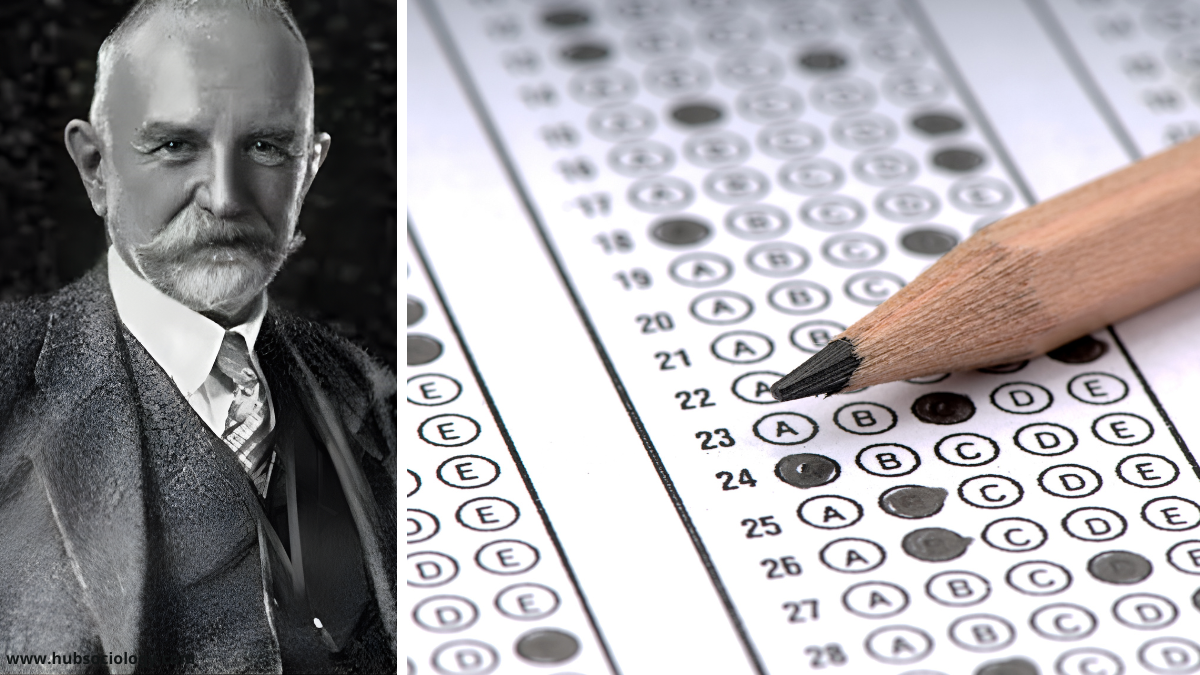
George Herbert Mead (1863–1931), one of the foundational thinkers of American Pragmatism and Symbolic Interactionism, made significant contributions to the interpretative traditions of sociology. While Mead is not a hermeneutician in the classical sense (like Dilthey, Weber, or Gadamer), his work deeply engages with the interpretation of meanings, signs, gestures, and social interaction — placing him at the heart of the interpretative turn in social sciences.
This set of 50 multiple-choice questions (with answers) is designed for UGC NET Sociology, MA-level examinations, and academic readers of Hub Sociology.
1. G.H. Mead is primarily associated with which sociological approach?
a) Structural functionalism
b) Symbolic Interactionism
c) Positivism
d) Conflict Theory
Answer: b
2. Mead’s work contributes mainly to which major sociological tradition?
a) Hermeneutic and Interpretative
b) Behaviouralist
c) Structural Marxism
d) Positivist empiricism
Answer: a
3. Mead argues that the self emerges from:

a) Biological instincts
b) Social interaction
c) Economic relations
d) Cultural hegemony
Answer: b
4. Mead’s concept of “significant symbols” refers to:
a) Genetic codes
b) Shared gestures with common meanings
c) Ritual symbols only
d) Biological signs
Answer: b
5. Mead’s contributions are foundational to which philosophical tradition?
a) Indian Idealism
b) American Pragmatism
c) British Empiricism
d) Continental Structuralism
Answer: b
6. Hermeneutics traditionally focuses on:
a) Interpretation of meaning
b) Statistical methods
c) Biological functioning
d) Economic production
Answer: a
7. In Mead’s theory, the “I” represents:
a) Social norms
b) Spontaneous and unpredictable aspect of self
c) Cultural expectations only
d) Professional identity
Answer: b
8. In Mead’s theory, the “Me” represents:
a) Creative expression
b) Internalized social expectations
c) Biological impulses
d) Psychological disorders
Answer: b
9. Mead’s major work published posthumously is:
a) The Elementary Forms of Religious Life
b) Mind, Self and Society
c) The Structure of Social Action
d) The Selfish Gene
Answer: b
10. Interpretative sociology is associated with which theorist?
a) Auguste Comte
b) Max Weber
c) Herbert Spencer
d) Karl Marx
Answer: b
11. Mead’s theory emphasizes the role of ______ in social life.
a) Money
b) Meaning
c) Class conflict
d) Evolution
Answer: b
12. Mead considered gestures to be:
a) Biological accidents
b) Socially meaningful acts
c) Non-social
d) Random behaviours
Answer: b
13. Mead’s notion of self develops through which stages?

a) Mimicry – Habituation – Identity
b) Play – Game – Generalized Other
c) Birth – Growth – Decline
d) Mirror – Reflection – Consciousness
Answer: b
14. The “generalized other” refers to:
a) Individual parents
b) Society’s expectations as a whole
c) Only peer groups
d) Only teachers
Answer: b
15. Mead’s ideas support which type of methodology?
a) Quantitative modelling
b) Interpretative qualitative analysis
c) Neuroscientific analysis
d) Genetic study
Answer: b
16. Hermeneutic sociology aims to understand:
a) Causality
b) Social facts
c) Subjective meanings
d) Genetic codes
Answer: c
17. Mead sees communication as:
a) One-directional
b) A process of shared meaning
c) Objective and fixed
d) Non-symbolic
Answer: b
18. Mead’s “role-taking” involves:
a) Economic planning
b) Taking the perspective of others
c) Random guessing
d) Genetic inheritance
Answer: b
19. In hermeneutics, understanding is achieved through:
a) Application of laws
b) Interpretation of signs and meanings
c) Biological evolution
d) Economic structure
Answer: b
20. Mead’s theory aligns with which epistemological position?
a) Positivism
b) Interpretivism
c) Materialism
d) Realism
Answer: b
21. Mead views society as:
a) An objective structure only
b) A web of interactions
c) A system of organisms
d) A fixed hierarchy
Answer: b
22. Mead’s self is:
a) Pre-social
b) Socially constructed
c) Biologically inherited
d) Fixed and stable
Answer: b
23. G.H. Mead’s analysis begins from:
a) Consciousness alone
b) Behaviour and interaction
c) Capitalism
d) Biological determinism
Answer: b
24. Mead called language:
a) A mere tool
b) The most important form of significant symbols
c) A biological necessity
d) A non-social phenomenon
Answer: b
25. In Mead’s theory, meaning arises from:
a) Internal thought exclusively
b) Interaction between actors
c) Laws of society
d) Divine inspiration
Answer: b
26. Mead’s approach to understanding social behaviour is:
a) Deterministic
b) Interpretative
c) Structuralist
d) Non-symbolic
Answer: b
27. Mead differs from classical hermeneutics by:
a) Rejecting interpretation altogether
b) Focusing on social action and interaction
c) Emphasizing religious texts
d) Promoting structural determinism
Answer: b
28. Mead’s “conversation of gestures” indicates:

a) Exchange of random movements
b) Mutual interpretation of actions
c) Non-social reflexes
d) Genetic patterns
Answer: b
29. Hermeneutics originally emerged from:
a) Interpretations of sacred texts
b) Economic theory
c) Political debates
d) Biological studies
Answer: a
30. Mead’s view of society is closest to:
a) Social facts
b) Meaningful social processes
c) Mechanical solidarity
d) Genetic design
Answer: b
31. Mead’s philosophy stresses:
a) Fixed meanings
b) Dynamic interpretation
c) Non-symbolic behaviour
d) Economic determinism
Answer: b
32. Mead believed that mind arises from:
a) Biology
b) Social process
c) Personal isolation
d) Education alone
Answer: b
33. The method most relevant to Mead’s approach is:
a) Experimental biology
b) Participant observation
c) Textual exegesis
d) Statistical regression
Answer: b
34. Mead’s ideas influenced which school?
a) Frankfurt School
b) Chicago School
c) Vienna Circle
d) Cambridge Realists
Answer: b
35. Mead’s theory explains action as:
a) Instinctual
b) Meaning-oriented
c) Economically driven
d) Politically imposed
Answer: b
36. Mead’s self is fundamentally:
a) Individualistic
b) Inter-subjective
c) Non-social
d) Non-reflexive
Answer: b
37. Mead challenges positivism by asserting:
a) Society has no structure
b) Meanings matter in social analysis
c) Only numbers reveal truth
d) Reality is fixed
Answer: b
38. For Mead, social order arises from:
a) Coercion
b) Shared meanings and interpretations
c) Genetic evolution
d) Economic production
Answer: b
39. Hermeneutics in sociology is primarily concerned with:
a) Explaining
b) Predicting
c) Understanding
d) Controlling
Answer: c
40. Mead’s interpretative approach rejects:
a) Symbolic meaning
b) Fixed universal laws
c) Role-taking
d) Generalized other
Answer: b
41. Mead considers human action as:
a) Stimulus–response only
b) Meaningful conduct
c) Mechanical
d) Predictable
Answer: b
42. Mead’s “Me” is closest to Durkheim’s:
a) Mechanical solidarity
b) Collective conscience
c) Organic solidarity
d) Anomie
Answer: b
43. Mead’s social psychology bridges:
a) Marxism and positivism
b) Psychology and sociology
c) Biology and genetics
d) Economics and politics
Answer: b
44. Mead’s interpretative emphasis is on:
a) Structure
b) Action
c) Symbol
d) Function
Answer: c
45. Mead believes interaction involves:
a) Pure instinct
b) Interpretation of gestures
c) Fixed responses
d) Transmission of genes
Answer: b
46. The hermeneutic circle refers to:
a) Circular reasoning
b) Understanding the whole through the parts and vice versa
c) Economic cycle
d) Biological cycle
Answer: b
47. Mead’s self is a:
a) Social process
b) Biological given
c) Religious entity
d) Fixed essence
Answer: a
48. Mead’s theory emphasizes the role of:
a) Power
b) Symbols
c) Genes
d) Territory
Answer: b
49. Mead’s ideas support which kind of sociology?
a) Interpretative sociology
b) Evolutionary sociology
c) Positivist sociology
d) Structural-functional sociology
Answer: a
50. Mead’s interpretative contribution is mainly to:
a) Macro-level structures
b) Micro-sociological analysis
c) Political hierarchy
d) Economic planning
Answer: b
Conclusion
G.H. Mead’s work stands at the intersection of interpretation, meaning, and social interaction, making him a central figure in the hermeneutic and interpretative tradition in sociology. These 50 MCQs provide a comprehensive overview for UGC NET aspirants and researchers exploring Mead’s intellectual contributions.
Do you like this this Article ? You Can follow as on :-
Facebook – https://www.facebook.com/hubsociology
WhatsApp Channel – https://whatsapp.com/channel/0029Vb6D8vGKWEKpJpu5QP0O
Gmail – hubsociology@gmail.com