Introduction
School segregation remains one of the most enduring manifestations of racial inequality in the United States. Despite legal victories and civil rights reforms, American schools continue to reflect deep social, economic, and racial divisions. From the era of legally sanctioned segregation under the “separate but equal” doctrine to contemporary patterns of de facto segregation shaped by housing, income inequality, and policy decisions, the education system has mirrored broader structures of power and stratification in American society.
This article examines School Segregation and Racial Inequality in America through a sociological lens. It explores historical foundations, theoretical interpretations, structural mechanisms, and contemporary consequences, emphasizing how educational inequality reproduces broader patterns of racial stratification.
Historical Foundations of School Segregation

The origins of school segregation in America are deeply connected to the country’s history of slavery, Reconstruction, and Jim Crow laws. After the abolition of slavery in 1865, Southern states implemented racial segregation policies that separated Black and white Americans in public spaces, including schools.
In 1896, the U.S. Supreme Court decision in Plessy v. Ferguson legitimized segregation under the doctrine of “separate but equal.” Although the ruling claimed equality, Black schools were chronically underfunded, overcrowded, and poorly resourced. This institutionalized inequality shaped generations of African American communities.
The turning point came in 1954 with Brown v. Board of Education, where the Supreme Court declared that segregated schools were inherently unequal and violated the Equal Protection Clause of the Fourteenth Amendment. This decision marked a milestone in civil rights history. However, desegregation was met with fierce resistance, particularly in Southern states. The crisis at Little Rock Central High School in 1957, where nine Black students required federal protection to attend school, symbolized the deep societal opposition to racial integration.
While legal segregation was dismantled, structural and social forces continued to reproduce racial separation in more subtle ways.
Sociological Theories and School Segregation
Sociological theory provides powerful tools to understand School Segregation and Racial Inequality in America.
Functionalist Perspective
From a functionalist standpoint, education serves to transmit shared values and prepare individuals for participation in society. However, when schools are segregated and unequal, they fail to provide equal opportunities. Instead of promoting meritocracy, they reinforce pre-existing inequalities. Dysfunction arises when certain racial groups systematically receive inferior education, limiting social mobility and perpetuating stratification.
Conflict Theory
Conflict theorists argue that education is not neutral but reflects the interests of dominant groups. Influenced by Marxist thought, this perspective suggests that racial segregation in schools serves to maintain power hierarchies. White-dominated institutions historically controlled funding, curricula, and administrative power, ensuring that racial minorities remained economically and politically marginalized.
Educational inequality thus becomes a mechanism for reproducing class and racial privilege. Schools in affluent, predominantly white neighborhoods often have advanced facilities, experienced teachers, and enriched curricula, while schools in minority communities struggle with limited resources.
Critical Race Theory
Critical Race Theory (CRT) emphasizes that racism is embedded within social institutions, including education. It challenges the assumption that racial inequality is accidental or temporary. Instead, it argues that legal and policy changes often benefit minority groups only when they align with the interests of dominant groups.
CRT scholars highlight how disciplinary policies, tracking systems, and standardized testing disproportionately disadvantage Black and Latino students. These institutional practices perpetuate inequality even without explicit racial segregation laws.
De Facto Segregation in Contemporary America
Although de jure segregation ended decades ago, American schools remain highly segregated in practice. This phenomenon, known as de facto segregation, results from residential patterns, economic inequality, and local funding structures.
Housing and Residential Segregation
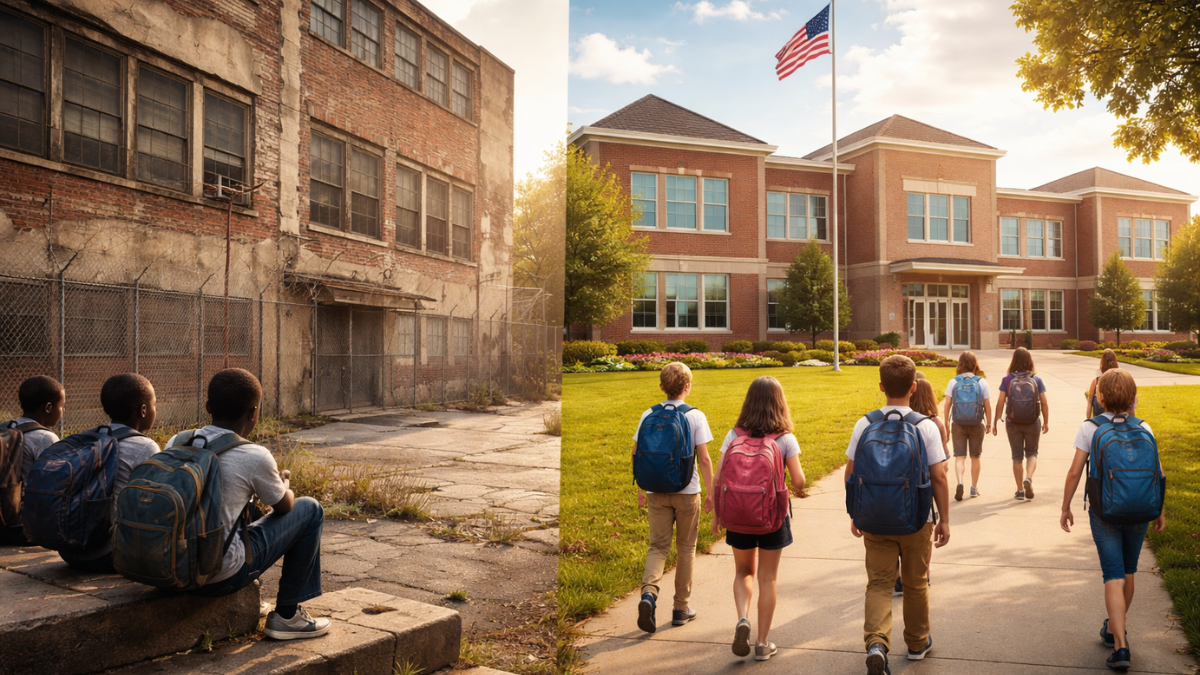
Residential segregation plays a central role in school segregation. Historical practices such as redlining—where banks and governments denied loans to minority neighborhoods—created racially divided communities. Because public schools are largely funded by local property taxes, neighborhoods with higher property values generate more school funding. Consequently, predominantly white suburban schools often have more resources than urban schools serving minority populations.
Economic Inequality
Race and class are deeply intertwined in the United States. Minority communities are disproportionately affected by poverty due to historical discrimination and labor market inequalities. Schools in low-income areas face challenges such as overcrowded classrooms, outdated materials, and fewer extracurricular opportunities.
School District Boundaries
School district lines often reinforce segregation. Suburban districts with high property values remain separate from urban districts with higher minority populations. Even when cities attempt integration, political resistance from affluent communities limits meaningful reform.
Educational Stratification and Tracking
Within schools, tracking systems further reinforce racial inequality. Tracking refers to the practice of grouping students by perceived ability. Research shows that minority students are disproportionately placed in lower academic tracks, which provide fewer opportunities for advanced coursework and college preparation.
Standardized testing, often used to determine placement, can reflect cultural biases and unequal access to preparatory resources. Over time, tracking creates self-fulfilling prophecies, where students internalize expectations and experience limited mobility.
The hidden curriculum—the implicit values and norms taught in schools—also shapes inequality. Minority students may encounter lower expectations, harsher disciplinary measures, and curricula that marginalize their histories and experiences.
Disciplinary Disparities and the School-to-Prison Pipeline
One of the most alarming aspects of School Segregation and Racial Inequality in America is the disproportionate discipline faced by Black students. Studies consistently show that Black students are more likely to be suspended or expelled than white students for similar behaviors.
This disciplinary gap contributes to the “school-to-prison pipeline,” where exclusionary practices increase the likelihood of involvement with the criminal justice system. Strict zero-tolerance policies and increased police presence in schools exacerbate these disparities.
From a sociological perspective, such practices reflect institutional racism and social control mechanisms. Schools not only educate but also regulate behavior, and minority students often bear the brunt of punitive systems.
Intersectionality: Race, Gender, and Class
School segregation and racial inequality intersect with gender and class. Black boys, for instance, face higher suspension rates and are often stereotyped as aggressive or disruptive. Latina girls may experience unique cultural and linguistic challenges. Low-income students of all races face structural barriers, but these barriers are intensified when combined with racial discrimination.
Intersectionality, a concept developed by legal scholar Kimberlé Crenshaw, highlights how overlapping identities create complex forms of disadvantage. Understanding educational inequality requires examining these multiple dimensions simultaneously.
Policy Efforts and Limitations
Since the civil rights era, numerous policies have aimed to reduce segregation. Busing programs in the 1970s attempted to integrate schools across district lines. While some progress was made, backlash from white communities led to “white flight,” where families moved to suburbs or enrolled children in private schools.
In recent decades, court decisions have limited the use of race-conscious policies in school assignments. As a result, many districts rely on income-based or geographic criteria, which often fail to address underlying racial patterns.
Charter schools and school choice initiatives present mixed outcomes. Some argue they provide alternatives for disadvantaged students, while others contend they increase segregation by drawing motivated families away from traditional public schools.
Long-Term Consequences of School Segregation
The consequences of school segregation extend far beyond the classroom. Educational attainment strongly influences employment opportunities, income levels, health outcomes, and political participation. When minority students receive unequal education, the effects reverberate across generations.
Racial gaps in graduation rates, college enrollment, and standardized test scores reflect structural inequalities rather than individual deficiencies. Segregated schools often limit access to Advanced Placement courses, experienced teachers, and college counseling services.
Moreover, segregation undermines social cohesion. Integrated schools can foster cross-cultural understanding and reduce prejudice. When children grow up in racially isolated environments, stereotypes and social divisions may deepen.
Contemporary Debates and the Future
Today, debates about curriculum, diversity initiatives, and systemic racism dominate public discourse. Discussions around teaching about slavery, civil rights, and structural racism often generate political controversy.
At the same time, grassroots movements advocate for equitable funding, restorative justice practices, and culturally responsive teaching. Sociologists emphasize that meaningful change requires addressing structural factors such as housing inequality, economic disparities, and political representation.

The future of American education depends on confronting these systemic issues rather than relying solely on individual-level solutions.
Conclusion
School Segregation and Racial Inequality in America remain central challenges in the pursuit of social justice and democratic equality. While legal segregation ended in the mid-twentieth century, structural and institutional forces continue to divide students along racial and economic lines.
From a sociological perspective, school segregation is not merely an educational problem but a reflection of broader patterns of stratification embedded in housing, labor markets, and political systems. Functionalist theory highlights the dysfunction of unequal education, conflict theory reveals the role of power and dominance, and critical race theory exposes the institutional roots of racial inequality.
Addressing these challenges requires comprehensive reform that integrates housing policy, equitable funding mechanisms, inclusive curricula, and fair disciplinary practices. Only by acknowledging the systemic nature of inequality can American society move closer to the promise of equal educational opportunity for all.
School segregation is not simply a relic of the past—it is an ongoing social issue that shapes the life chances of millions. Understanding its sociological dimensions is essential for building a more just and inclusive future.
FAQs on School Segregation and Racial Inequality in America
1. What is School Segregation and Racial Inequality in America?
School Segregation and Racial Inequality in America refer to the separation of students based on race and the unequal distribution of educational resources, opportunities, and outcomes among racial groups.
2. When did school segregation become legally enforced in the United States?
Legal segregation was reinforced in 1896 through the Supreme Court decision in Plessy v. Ferguson, which upheld the “separate but equal” doctrine.
3. How did Brown v. Board of Education change School Segregation and Racial Inequality in America?
The 1954 Supreme Court decision in Brown v. Board of Education declared that segregated schools were inherently unequal, making racial segregation in public schools unconstitutional.
4. Is school segregation still present in America today?
Yes, although legal segregation ended, de facto segregation continues due to residential patterns, economic inequality, and school district boundaries.
5. What is de facto segregation in education?
De facto segregation refers to racial separation that occurs in practice because of housing patterns, income inequality, and social structures rather than explicit segregation laws.
6. How does housing discrimination contribute to School Segregation and Racial Inequality in America?
Historical practices like redlining created racially divided neighborhoods. Since schools are often funded by local property taxes, segregated housing leads directly to segregated and unequal schools.
7. What role does funding play in School Segregation and Racial Inequality in America?
Schools in wealthier, often predominantly white areas receive more funding through property taxes, resulting in better facilities, smaller class sizes, and more academic opportunities.
8. How does tracking reinforce racial inequality in schools?
Tracking groups students by perceived ability. Minority students are often overrepresented in lower tracks, limiting access to advanced coursework and college preparation.
9. What is the school-to-prison pipeline?
The school-to-prison pipeline describes policies and disciplinary practices that push students—especially Black and Latino students—out of schools and into the criminal justice system.
10. Why are Black students disciplined more frequently than white students?
Research shows disparities in disciplinary practices due to implicit bias, institutional racism, and zero-tolerance policies, contributing to School Segregation and Racial Inequality in America.
11. How does School Segregation and Racial Inequality in America affect academic achievement?
Segregated schools often lack experienced teachers, advanced courses, and academic resources, leading to achievement gaps in graduation rates and college enrollment.
12. What is the sociological explanation for School Segregation and Racial Inequality in America?
Conflict theory and Critical Race Theory argue that education reflects broader power structures, where dominant groups maintain privilege through institutional arrangements.
13. Have government policies successfully reduced School Segregation and Racial Inequality in America?
Some progress was made through desegregation orders and busing programs, but recent court decisions and policy shifts have limited race-based integration efforts.
14. How does intersectionality relate to School Segregation and Racial Inequality in America?
Intersectionality shows how race, gender, and class combine to shape educational experiences. For example, Black boys often face higher suspension rates compared to other groups.
15. What can be done to reduce School Segregation and Racial Inequality in America?
Solutions include equitable school funding, fair housing policies, inclusive curricula, restorative justice practices, and integrated school district planning.