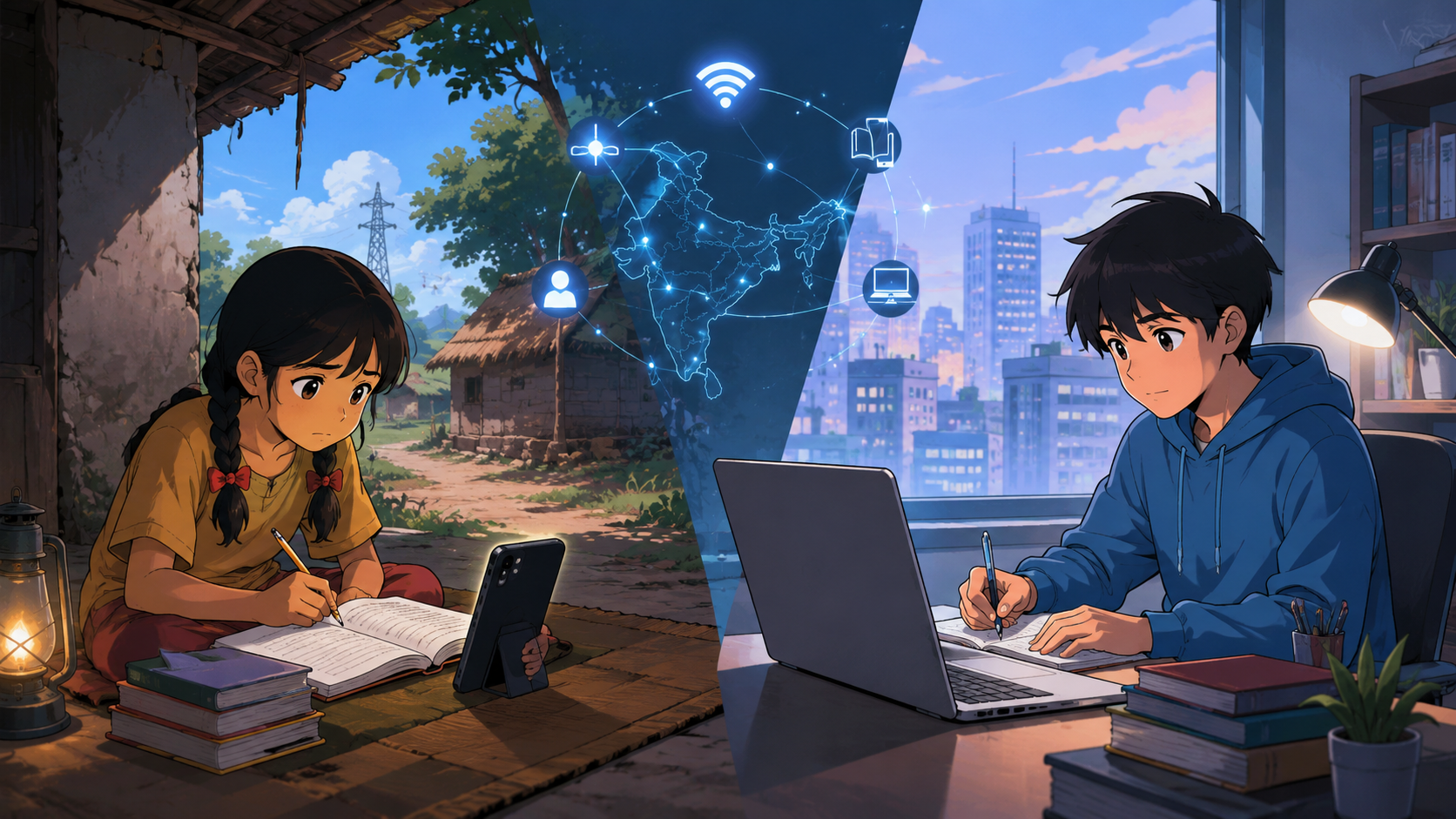
The rapid expansion of digital technology has transformed the education system across the world, and India is no exception. The rise of smartphones, internet connectivity, digital classrooms, and e-learning platforms has changed how students access knowledge. During the COVID-19 pandemic, online education became the primary mode of learning for millions of students in India. While this shift created opportunities for flexible and technology-driven learning, it also exposed deep social inequalities embedded within Indian society. The unequal access to digital technology, commonly known as the digital divide, became one of the biggest challenges in ensuring educational equality.
Explore the sociological aspects of Online Education in India, including the digital divide, social inequality, rural challenges, gender gaps, and the future of digital learning.
From a sociological perspective, the digital divide is not merely a technological issue. It reflects broader patterns of social stratification based on class, caste, gender, region, language, and economic status. In India, online education has highlighted the gap between urban and rural populations, rich and poor households, and privileged and marginalized communities. Students who lacked smartphones, internet access, or digital literacy were pushed further behind in educational achievement.

The concept of the digital divide refers to inequalities in access to information and communication technologies. These inequalities may include lack of internet connectivity, absence of digital devices, poor technological infrastructure, or limited digital skills. In India, the divide is visible between urban and rural regions, between men and women, and among different socio-economic groups. Reports indicate that rural households continue to have much lower internet access than urban households, limiting educational opportunities for millions of children.
Online education in India expanded rapidly after the introduction of initiatives such as Digital India, SWAYAM, DIKSHA, and various EdTech platforms. Government policies aimed to increase digital learning and make education accessible through technology. The Digital India initiative focused on creating digital infrastructure and promoting digital empowerment among citizens. However, sociologists argue that technological advancement alone cannot eliminate inequality because social structures often shape access to resources.
Understanding the Digital Divide in India
The digital divide in India exists at multiple levels. The first level involves access to digital devices and internet connectivity. The second level concerns digital literacy and the ability to use technology effectively. The third level relates to the benefits gained from digital participation, such as educational success and employment opportunities.
India has witnessed significant growth in internet users and mobile connectivity. Cheap data prices and smartphone expansion have increased internet penetration across the country. Government reports highlight that India has become one of the cheapest mobile data markets globally. Despite this growth, access remains highly unequal.
Urban students often have better access to smartphones, laptops, broadband internet, and digital learning resources. In contrast, many rural students struggle with poor network connectivity, electricity shortages, and lack of devices. This unequal access creates educational disadvantages for students from rural and marginalized backgrounds.
The digital divide is deeply linked with socio-economic inequality. Wealthier families can afford multiple digital devices, private internet connections, and online coaching classes. Poor households may have only one smartphone shared among several family members. During online classes, many children in low-income families faced difficulties attending lectures because parents used the phone for work or daily communication.
Sociologists view this inequality through the lens of social stratification. Access to education has historically been shaped by economic class, caste hierarchy, and regional disparities. Digital technology has not removed these barriers; instead, it has often reproduced them in new forms.
Online Education and Social Inequality
Online education was promoted as a solution for educational continuity during the pandemic. However, it quickly became clear that access to online learning was uneven. Many students from disadvantaged backgrounds were unable to participate effectively in digital classrooms.
Studies revealed that a large proportion of Indian schoolchildren could not access online learning opportunities due to lack of internet or devices. The closure of schools widened educational inequality because students from affluent families continued learning through private online platforms, while marginalized students experienced learning loss.
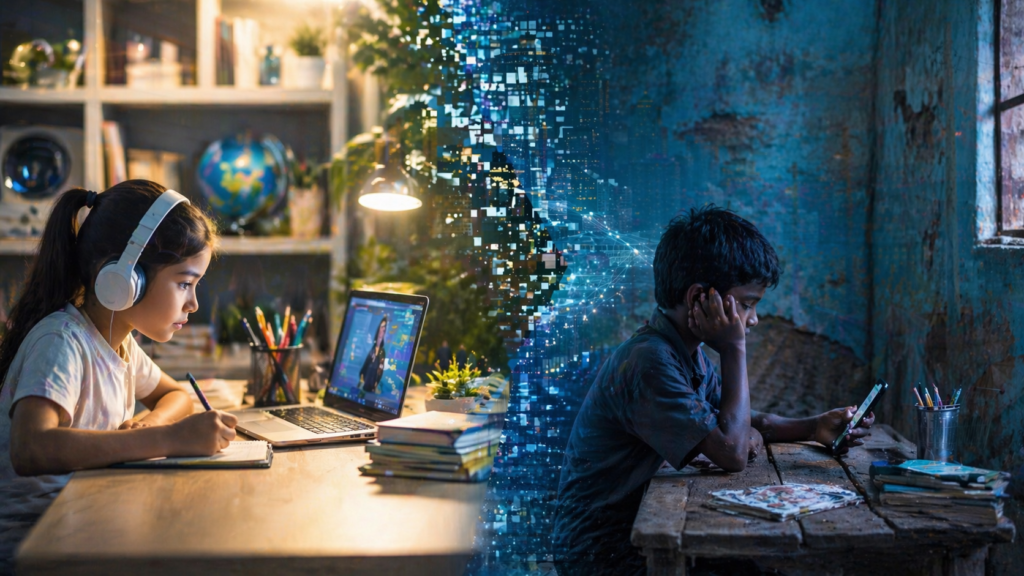
From a sociological perspective, online education reflects Pierre Bourdieu’s concept of cultural capital. Students from educated and privileged families often possess greater familiarity with digital technology, English language skills, and educational resources. Their parents are more capable of assisting them with online learning. In contrast, first-generation learners and students from low-literacy households face additional disadvantages.
The digital divide also affects social mobility. Education is considered an important instrument for upward mobility in Indian society. When access to online education becomes unequal, opportunities for employment and social advancement also become unequal. Thus, the digital divide contributes to the reproduction of social inequality.
Rural-Urban Divide in Online Education
One of the most visible aspects of the digital divide in India is the rural-urban gap. Urban areas generally have better internet infrastructure, electricity supply, and educational institutions. Rural areas often suffer from weak network coverage and lack of technological resources.
Government and survey reports show significant differences in internet access between rural and urban households. Many villages still face unstable internet connectivity, making online classes difficult. Students often travel long distances to access mobile networks or attend classes from public locations with better connectivity.
The rural-urban divide also reflects broader patterns of development in India. Urban regions benefit from economic investment, technological growth, and better educational infrastructure, while rural areas remain relatively underdeveloped. This imbalance affects educational opportunities and contributes to unequal social development.
Sociologists argue that educational inequality in rural India is linked with structural issues such as poverty, unemployment, and regional underdevelopment. The digital divide further intensifies these inequalities by limiting access to modern educational resources.
Caste and the Digital Divide
Caste remains a major factor influencing educational inequality in India. Marginalized caste groups, including Scheduled Castes and Scheduled Tribes, often face economic deprivation and limited access to educational resources.
Research on caste-based digital inequality suggests that disadvantaged caste groups have lower access to computers, internet facilities, and digital skills. Historical exclusion from education and economic opportunities continues to affect their participation in digital learning.
Students from marginalized caste backgrounds may also face discrimination in educational institutions and limited social support for learning. Online education can sometimes deepen exclusion because digital platforms require technological familiarity and financial resources that are unevenly distributed across caste groups.
From a sociological perspective, the caste-based digital divide demonstrates how traditional forms of inequality adapt to modern technological contexts. Although digital education appears modern and progressive, it often reproduces existing hierarchies unless inclusive policies are implemented.
Gender and Digital Inequality
Gender inequality is another important dimension of the digital divide in India. Women and girls often have less access to smartphones, internet usage, and digital literacy compared to men.
Social norms in many households prioritize male education and technological access. Girls may be discouraged from using smartphones or internet services due to concerns about safety and morality. In some rural households, boys receive priority in accessing digital devices for online classes.
Reports indicate that women’s internet usage in India remains significantly lower than men’s. This gender gap affects girls’ participation in online education and digital skill development.
Feminist sociologists argue that the digital divide reflects patriarchal structures within society. Technology is not gender-neutral because access and control over resources are influenced by social power relations. When girls are denied digital access, they face educational disadvantages that can affect employment opportunities and social empowerment.
Online education also created additional domestic burdens for girls during the pandemic. Many girls were expected to perform household chores while attending classes, reducing their concentration and participation in learning activities.
Economic Class and Educational Access
Economic inequality is one of the strongest determinants of digital access in India. Middle-class and upper-class families generally possess better digital infrastructure, while poor households struggle to afford smartphones, laptops, and internet data.
The pandemic revealed stark inequalities between private and government school students. Private schools rapidly shifted to online classes using Zoom, Google Meet, and learning management systems. Government school students often lacked the necessary devices and internet connectivity.

Students from economically weaker sections faced multiple challenges, including shared devices, inadequate study space, and inability to purchase online learning materials. In many cases, children dropped out of education due to financial hardship and digital exclusion.
Marxist sociologists interpret the digital divide as a reflection of class inequality within capitalist society. Technological resources are distributed according to economic power, allowing privileged groups to maintain educational advantages. Online education, therefore, may reinforce class divisions unless supported by redistributive policies.
Language and Cultural Barriers
India’s linguistic diversity also influences online education. Many digital learning platforms primarily use English or Hindi, creating barriers for students from regional language backgrounds.
Students studying in vernacular-medium schools often struggle to adapt to English-dominated online platforms. Lack of localized educational content reduces the effectiveness of digital learning for many learners.
Cultural differences also shape attitudes toward technology and education. Some communities may have limited exposure to digital tools, affecting students’ confidence and participation in online learning.
Sociologists emphasize that education is not only about access to technology but also about cultural inclusion. Effective online education must consider language diversity, regional identities, and local educational needs.
Impact of the COVID-19 Pandemic
The COVID-19 pandemic played a major role in accelerating online education in India. Schools, colleges, and universities were forced to close, making digital learning the only available option for many students.
However, the pandemic exposed the severity of India’s digital divide. Millions of students were unable to continue education due to lack of devices and internet access. Learning gaps widened significantly between privileged and marginalized students.
Teachers also faced challenges adapting to digital teaching methods. Many educators lacked training in online pedagogy and digital tools. Government school teachers in rural areas struggled with technological limitations and low student participation.
The pandemic demonstrated that technology alone cannot guarantee educational equality. Social and economic inequalities strongly influence access to digital learning opportunities.
Government Initiatives to Bridge the Divide
The Indian government has introduced several initiatives to reduce the digital divide and promote online education. Programs such as Digital India, BharatNet, PMGDISHA, DIKSHA, and SWAYAM aim to improve digital infrastructure and educational access.
BharatNet seeks to provide broadband connectivity to rural areas, while PMGDISHA focuses on digital literacy. DIKSHA offers online educational content for school students and teachers.
The National Education Policy (NEP) 2020 also emphasizes digital learning and technological integration in education. Various state governments have launched smart classroom initiatives and ICT labs to improve digital education infrastructure.
Despite these efforts, challenges remain. Many schools still lack computers and internet facilities. Reports show uneven distribution of digital infrastructure across states. Effective implementation and inclusive policy planning are necessary to ensure equal educational opportunities.
Sociological Theories and the Digital Divide
Different sociological theories help explain the relationship between digital inequality and education.
Functionalist theory views education as a means of social integration and skill development. From this perspective, digital technology can improve educational efficiency and national development. However, unequal access disrupts the functional role of education in promoting social equality.
Conflict theory argues that education often reproduces social inequality. The digital divide reflects unequal distribution of resources within society. Wealthy groups benefit more from digital education, while marginalized groups remain disadvantaged.
Symbolic interactionism focuses on everyday interactions and experiences. Students who lack digital access may experience feelings of exclusion, inferiority, and social isolation. Online education also changes teacher-student interaction and classroom dynamics.
Feminist theory highlights gender inequality in technological access and educational participation. Patriarchal norms influence girls’ access to digital resources and opportunities for learning.
Postmodern perspectives emphasize the role of technology in shaping identity and social relations. Digital education transforms the educational experience but also creates new forms of exclusion and inequality.
Challenges in Online Education
Several challenges continue to affect online education in India:
- Poor internet connectivity in rural areas
- Lack of affordable digital devices
- Low digital literacy among students and teachers
- Language barriers in educational content
- Gender inequality in technology access
- Lack of interaction in virtual classrooms
- Mental stress and screen fatigue among students
- Unequal learning environments at home
Hybrid learning models introduced in many schools have also highlighted unequal educational experiences between privileged and marginalized students.
The Way Forward
Bridging the digital divide requires a comprehensive and inclusive approach. Expanding internet connectivity alone is not sufficient. Social inequalities related to class, caste, gender, and region must also be addressed.
The government should invest in affordable digital infrastructure, especially in rural and marginalized areas. Public schools need better technological facilities, including computers, internet access, and smart classrooms.
Digital literacy programs should target students, teachers, parents, and local communities. Educational content must be available in regional languages to ensure inclusivity.
Policies should focus on gender equality in digital access. Providing free or subsidized devices to girls and economically weaker students can improve participation in online education.
Teachers should receive proper training in digital pedagogy to improve the quality of online learning. Blended learning models combining offline and online methods may help reduce educational exclusion.
Community learning centers and public digital libraries can support students who lack access to technology at home. Collaboration between government, private organizations, and civil society is essential for creating an inclusive digital education system.
Conclusion
The digital divide and online education in India represent a major sociological issue connected with social inequality, exclusion, and development. While digital technology has expanded educational opportunities, it has also exposed deep structural inequalities within Indian society.
The shift toward online education during the pandemic revealed how access to technology is shaped by class, caste, gender, language, and regional disparities. Students from marginalized communities faced significant barriers in continuing education, leading to unequal learning outcomes.
From a sociological perspective, the digital divide is not merely a technological problem but a reflection of broader social structures and power relations. Unless inclusive policies are implemented, digital education may reinforce existing inequalities rather than reduce them.
India’s future educational development depends on creating an equitable digital ecosystem where all students, regardless of social background, can access quality education. Bridging the digital divide is therefore essential not only for educational progress but also for social justice, democratic participation, and inclusive national development.
FAQs on Online Education in India
1. What is Online Education in India?
Online Education in India refers to the use of digital platforms, internet services, and virtual classrooms to provide teaching and learning opportunities to students across schools, colleges, and universities.
2. Why is Online Education in India important?
Online Education in India is important because it increases access to learning resources, supports remote education, and allows students from different regions to continue their studies through digital technology.
3. What are the major challenges of Online Education in India?
The major challenges of Online Education in India include poor internet connectivity, lack of digital devices, low digital literacy, language barriers, and social inequality.
4. How does the digital divide affect Online Education in India?
The digital divide affects Online Education in India by creating unequal access to smartphones, internet facilities, and online learning platforms among different social and economic groups.
5. How did COVID-19 influence Online Education in India?
COVID-19 accelerated Online Education in India as schools and colleges shifted to virtual learning during lockdowns, exposing both the opportunities and inequalities of digital education.
6. What role does the government play in Online Education in India?
The government supports Online Education in India through initiatives such as Digital India, DIKSHA, SWAYAM, PM eVIDYA, and BharatNet to improve digital learning infrastructure.
7. Is Online Education in India effective for rural students?
Online Education in India can benefit rural students, but poor network connectivity and lack of digital resources often limit its effectiveness in rural areas.
8. How does Online Education in India impact social inequality?
Online Education in India may increase social inequality because students from wealthy families often have better digital access and educational support than economically weaker students.
9. What are the advantages of Online Education in India?
The advantages of Online Education in India include flexible learning, access to digital resources, reduced travel costs, and opportunities for self-paced education.
10. What are the disadvantages of Online Education in India?
The disadvantages of Online Education in India include reduced classroom interaction, screen fatigue, technical problems, and unequal access to technology.
11. How does gender inequality affect Online Education in India?
Gender inequality affects Online Education in India because girls in some households receive less access to smartphones, internet facilities, and digital learning opportunities.
12. What is the role of digital literacy in Online Education in India?
Digital literacy is essential for Online Education in India because students and teachers need technological skills to effectively use online platforms and digital tools.
13. Can Online Education in India replace traditional classroom learning?
Online Education in India cannot fully replace traditional classrooms because face-to-face interaction, socialization, and practical learning remain important aspects of education.
14. How can India reduce the digital divide in education?
India can reduce the digital divide by expanding internet connectivity, providing affordable devices, improving digital literacy, and supporting marginalized communities.
15. What is the future of Online Education in India?
The future of Online Education in India is likely to involve hybrid learning models that combine traditional classroom teaching with digital education technologies.