
Introduction on Social Change in South Carolina
Coastal regions have long been sites of dynamic interaction between nature, economy, and society. In the United States, South Carolina stands as a compelling case where coastal development has significantly reshaped social structures, cultural identities, and economic relations. With its extensive Atlantic coastline, historic port cities, and thriving tourism industry, the state has experienced rapid transformation over the past few decades. This transformation, however, is not merely economic or infrastructural—it is deeply sociological.
The process of coastal development in South Carolina includes urban expansion, tourism-driven growth, real estate development, and environmental management. These changes have had profound impacts on local communities, particularly in terms of social stratification, migration patterns, cultural continuity, and environmental justice. This article explores the sociological dimensions of coastal development, examining how economic growth interacts with social change and what this means for the future of coastal communities.

Historical Context of Coastal South Carolina
The coastal region of South Carolina has a rich history shaped by colonialism, plantation economies, and maritime trade. Cities like Charleston played central roles in the transatlantic economy and were deeply tied to systems of slavery and racial hierarchy. Over time, these historical legacies influenced patterns of land ownership, social inequality, and cultural identity.
The Gullah Geechee communities, descendants of enslaved Africans, developed a unique cultural system along the coast. Their language, traditions, and communal lifestyles are deeply rooted in the coastal environment. However, modern coastal development has increasingly threatened these communities, creating tension between preservation and modernization.
Coastal Development: Economic Drivers and Patterns
The expansion of coastal development in South Carolina has been driven primarily by tourism, real estate, and infrastructure investment. Areas such as Myrtle Beach have become major tourist hubs, attracting millions of visitors annually. This growth has led to the construction of hotels, resorts, and commercial establishments.
Similarly, suburban expansion and the demand for beachfront properties have fueled real estate development. Wealthy individuals and retirees from other states have migrated to coastal areas, leading to rising property values and changing demographic compositions.
While these developments have generated employment opportunities and increased state revenue, they have also created uneven patterns of growth. Economic benefits are often concentrated among developers, investors, and higher-income groups, while local communities face displacement and rising living costs.
Social Stratification and Inequality
One of the most significant sociological impacts of coastal development is the intensification of social inequality. As coastal areas become economically valuable, land prices increase dramatically. This often results in the displacement of low-income residents who can no longer afford to live in these regions.
In South Carolina, this process is evident in the gradual marginalization of traditional communities. Working-class populations, particularly African American communities, are pushed inland, away from economic centers. This spatial segregation reinforces existing inequalities and limits access to resources such as quality education, healthcare, and employment opportunities.
The phenomenon can be understood through the lens of urban sociology, particularly the concept of “gentrification.” Coastal gentrification involves the transformation of previously affordable areas into high-end residential and commercial spaces, often at the expense of long-term residents.
Migration and Demographic Changes
Coastal development has significantly altered migration patterns in South Carolina. There has been a steady influx of migrants from other states, particularly retirees and professionals seeking better quality of life. This has led to population growth in coastal cities and towns.
At the same time, local populations are being displaced due to rising costs. This creates a dual migration process: in-migration of affluent groups and out-migration of lower-income residents. The resulting demographic shifts have implications for community cohesion, cultural identity, and social relations.

The diversity of incoming populations can lead to cultural exchange and innovation, but it can also generate social tensions. Differences in lifestyle, economic status, and cultural values may create divisions within communities.
Cultural Transformation and Identity
Coastal development has a profound impact on cultural identity, particularly among indigenous and historically marginalized communities. The Gullah Geechee culture, for example, is closely tied to the coastal environment. Traditional practices such as fishing, farming, and storytelling are integral to their way of life.
However, the expansion of tourism and real estate development threatens these cultural practices. Land loss, environmental degradation, and commercialization of culture can erode traditional lifestyles. In some cases, cultural elements are commodified for tourism, leading to a loss of authenticity.
Sociologically, this raises questions about cultural preservation and the role of development in shaping identity. Can economic growth coexist with cultural sustainability? Or does development inevitably lead to cultural homogenization?
Environmental Sociology and Coastal Development
From an environmental sociology perspective, coastal development in South Carolina highlights the complex relationship between human activity and natural ecosystems. Coastal areas are particularly vulnerable to climate change, including sea-level rise, hurricanes, and erosion.
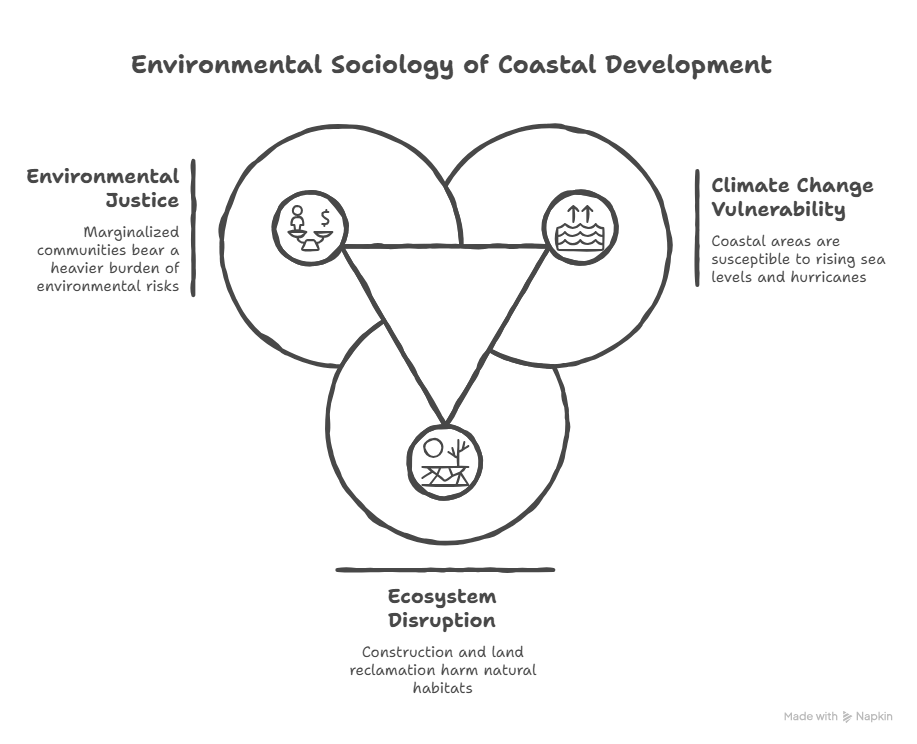
Development often involves altering natural landscapes through construction, dredging, and land reclamation. These activities can disrupt ecosystems, reduce biodiversity, and increase environmental risks. For example, the destruction of wetlands can reduce natural protection against flooding.
Environmental justice is another critical issue. Marginalized communities are often disproportionately affected by environmental degradation. They may live in areas more prone to flooding or have limited access to resources for adaptation and recovery.
Tourism and Social Change
Tourism plays a central role in coastal development, particularly in places like Myrtle Beach. It generates employment and contributes significantly to the economy. However, it also brings challenges.
Tourism-driven economies often rely on low-wage, seasonal jobs, which can create economic insecurity for workers. Additionally, the influx of tourists can strain local infrastructure, increase living costs, and disrupt community life.
There is also the issue of “touristification,” where local spaces are transformed to cater to visitors rather than residents. This can lead to the loss of community-oriented spaces and a shift in social priorities.
Governance and Policy Implications
The sociological impacts of coastal development raise important questions about governance and policy. Effective planning is essential to balance economic growth with social equity and environmental sustainability.
Policies should address issues such as affordable housing, land rights, and cultural preservation. Community participation in decision-making processes is crucial to ensure that development benefits all stakeholders.
In South Carolina, there have been efforts to implement coastal management programs and zoning regulations. However, challenges remain in enforcing these policies and addressing conflicting interests among developers, government agencies, and local communities.
Social Resilience and Adaptation
Despite the challenges, coastal communities in South Carolina have demonstrated resilience and adaptability. Grassroots movements, community organizations, and cultural preservation initiatives play a vital role in resisting displacement and advocating for rights.
Social resilience involves the ability of communities to adapt to change while maintaining their core identity and social structures. This includes developing strategies for economic diversification, environmental protection, and cultural preservation.
Education and awareness are also important in promoting sustainable development practices. By understanding the sociological impacts of coastal development, communities can better navigate the challenges and opportunities it presents.
Theoretical Perspectives
Several sociological theories can be applied to understand coastal development and social change in South Carolina:
Structural functionalism emphasizes the role of development in maintaining social stability and economic growth. From this perspective, coastal development is seen as a necessary process for societal progress.
Conflict theory, on the other hand, highlights the unequal distribution of resources and power. It views coastal development as a site of संघर्ष (conflict) between different social groups, particularly between elites and marginalized communities.
Symbolic interactionism focuses on the meanings and identities associated with coastal spaces. It examines how individuals and communities interpret and respond to changes in their environment.
Conclusion
Coastal development in South Carolina is a multifaceted process with far-reaching sociological implications. While it has contributed to economic growth and modernization, it has also intensified social inequalities, disrupted cultural traditions, and created environmental challenges.
The case of South Carolina illustrates the need for a balanced approach to development—one that prioritizes social equity, cultural preservation, and environmental sustainability. Sociological analysis provides valuable insights into these issues, highlighting the importance of inclusive and participatory development strategies.
As coastal regions continue to evolve, the challenge lies in ensuring that development benefits all members of society, rather than a select few. Only then can coastal development become a truly sustainable and equitable process.
FAQs
- What is meant by Social Change in South Carolina?
Social Change in South Carolina refers to the transformation of social structures, cultural patterns, and economic relations due to factors like coastal development, migration, and urbanization. - How has coastal development influenced Social Change in South Carolina?
Coastal development has accelerated Social Change in South Carolina by reshaping communities, increasing tourism, and altering economic opportunities. - What role does tourism play in Social Change in South Carolina?
Tourism contributes to Social Change in South Carolina by creating jobs, influencing cultural practices, and increasing living costs in coastal areas. - How does migration affect Social Change in South Carolina?
Migration drives Social Change in South Carolina through demographic shifts, cultural diversity, and changes in housing and labor markets. - What impact does gentrification have on Social Change in South Carolina?
Gentrification intensifies Social Change in South Carolina by displacing low-income residents and transforming neighborhoods into high-value areas. - How are indigenous communities affected by Social Change in South Carolina?
Indigenous and traditional communities experience Social Change in South Carolina through land loss, cultural erosion, and economic marginalization. - What is the relationship between economic growth and Social Change in South Carolina?
Economic growth accelerates Social Change in South Carolina by improving infrastructure while also increasing inequality and social stratification. - How does Social Change in South Carolina impact cultural identity?
Social Change in South Carolina can reshape cultural identity by blending traditions with modern influences or, in some cases, eroding traditional practices. - What environmental factors contribute to Social Change in South Carolina?
Environmental challenges like climate change, coastal erosion, and hurricanes significantly influence Social Change in South Carolina. - How does urbanization relate to Social Change in South Carolina?
Urbanization drives Social Change in South Carolina by expanding cities, increasing population density, and altering social relationships. - What are the main challenges of Social Change in South Carolina?
Key challenges include inequality, displacement, cultural loss, and environmental risks associated with rapid development. - How can policy address Social Change in South Carolina?
Effective policies can manage Social Change in South Carolina by promoting affordable housing, environmental protection, and inclusive development. - What is the role of education in Social Change in South Carolina?
Education supports Social Change in South Carolina by raising awareness, improving skills, and empowering communities. - How does Social Change in South Carolina affect rural communities?
Rural areas experience Social Change in South Carolina through migration, reduced traditional occupations, and changing lifestyles. - Is Social Change in South Carolina positive or negative?
Social Change in South Carolina has both positive and negative aspects, bringing economic growth while also creating social and environmental challenges.
1 thought on “Coastal Development and Social Change in South Carolina”