Introduction
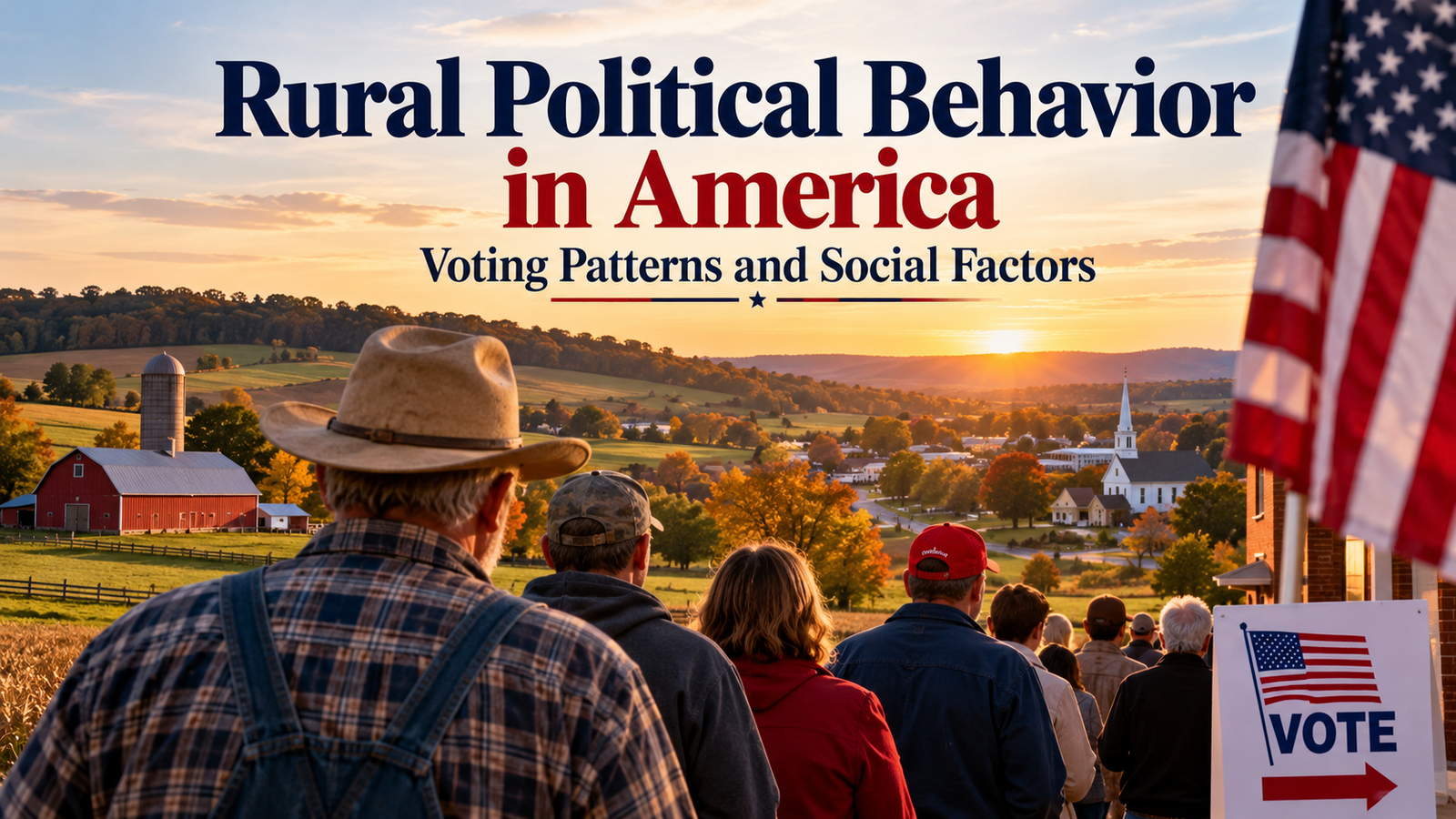
Why do rural voters in America often support political candidates and parties differently from voters in major cities? Is it simply a matter of economic interest, or does the answer lie in religion, community identity, education, social class, race, media consumption, and perceptions of cultural change? Understanding Rural Political Behavior in America requires looking beyond election results to examine the social relationships, institutions, and shared experiences that shape political attitudes.
Rural communities occupy a distinctive position in American society. They are associated with agricultural traditions, small businesses, local churches, family networks, and strong attachments to place. However, rural America is not socially or politically uniform. Farming communities in the Midwest, resource-dependent towns in Appalachia, Hispanic rural communities in the Southwest, and rural areas in the South can have very different political priorities.
The study of Rural Political Behavior in America therefore provides important insights into political polarization, social identity, economic insecurity, and the changing relationship between urban and rural populations. Recent American elections and political debates have made these differences particularly visible. From the 2024 presidential election to continuing disputes over immigration, agricultural policy, energy, education, and federal authority, rural voters remain an influential force in national politics.
A sociological analysis of Rural Political Behavior in America helps explain not only how rural citizens vote but also why political identities become deeply connected to community life, cultural values, and perceptions of social change.
Understanding Rural Political Behavior in America
Rural Political Behavior in America refers to the political attitudes, voting preferences, participation patterns, and collective actions of people living in rural areas of the United States. It includes voting in presidential and congressional elections, participation in local government, engagement with political organizations, and attitudes toward public policy.
From a sociological perspective, Rural Political Behavior in America is shaped by the interaction of individual interests and broader social structures. Political preferences are influenced by occupation, family background, religious participation, educational opportunities, economic conditions, and relationships within local communities.
Unlike explanations that treat voting as an entirely individual decision, sociology emphasizes that political choices develop within social environments. People discuss elections with relatives, neighbors, coworkers, religious communities, and friends. These interactions can reinforce existing beliefs and create a shared understanding of which political candidates represent the community.
The concept of social embeddedness is particularly useful in understanding Rural Political Behavior in America. Political opinions do not emerge in isolation; they are often connected to longstanding relationships and local traditions. A candidate who expresses support for farming, gun ownership, religious freedom, or local control may be perceived as representing rural identity itself.
Nevertheless, rural political behavior should not be understood as a fixed set of beliefs. Economic transformations, demographic changes, generational differences, and new communication technologies continue to reshape political attitudes across rural America.
Voting Patterns and the Rural-Urban Political Divide
One of the most significant features of contemporary American elections is the political difference between many rural and urban communities. Rural counties have generally become more Republican in recent presidential elections, while large metropolitan areas have tended to support Democratic candidates.
The 2024 presidential election reinforced this broad pattern. Donald Trump won the national popular vote as well as the Electoral College, and Republican support remained particularly strong across many rural areas. Kamala Harris performed better in many metropolitan centers, although the political geography of the United States includes important regional and local exceptions.
The sociological significance of this pattern lies in the relationship between geography and political identity. Rural Political Behavior in America increasingly reflects how voters understand their position in relation to cities, national institutions, and cultural change.
For some rural voters, supporting Republican candidates represents opposition to perceived metropolitan influence over taxation, environmental regulation, education, and economic policy. Other voters are motivated by conservative religious beliefs, immigration concerns, gun rights, or dissatisfaction with Democratic leadership.
However, rural voting patterns are not simply the product of ideological conservatism. Local employment opportunities, population decline, healthcare access, agricultural markets, and the availability of public services can also influence political preferences.
A crucial distinction must be made between aggregate voting patterns and individual beliefs. A county that votes Republican may still contain Democratic voters, politically independent residents, and people who do not participate in elections. Consequently, Rural Political Behavior in America must be studied through both election statistics and the social diversity that exists within rural communities.
Social Class, Economic Insecurity, and Political Choice
Economic structure plays a central role in Rural Political Behavior in America. Rural economies often depend on agriculture, manufacturing, mining, forestry, tourism, small businesses, and public-sector employment. Changes in these industries can affect household income, occupational security, and expectations about the future.

The decline of manufacturing employment in some regions, pressure on small farms, population loss, and limited access to well-paying jobs have contributed to economic anxiety in many rural communities. Such conditions can influence voting behavior, especially when residents believe that national economic policies favor large corporations or metropolitan populations.
From a Marxist perspective, political behavior can be examined through class relations and the distribution of economic power. Farmers facing concentrated corporate purchasing power, workers experiencing industrial decline, and small-business owners struggling with rising costs may develop different political grievances, even when they live in the same community.
These economic experiences help explain Rural Political Behavior in America, but they do not determine political choices automatically. Two households experiencing similar financial difficulties may support opposing candidates because they interpret the causes of economic insecurity differently.
Some voters emphasize lower taxes, reduced regulation, domestic energy production, and business investment. Others prioritize agricultural subsidies, rural infrastructure, labor protections, affordable healthcare, or investment in public education.
Recent debates over tariffs and trade policy illustrate these competing interests. In 2025, changes in American trade policy and tariff announcements renewed concerns about costs for businesses, agricultural exporters, imported inputs, and international trading relationships. Farmers and rural business owners can face conflicting effects when policies intended to protect domestic industries also increase input costs or invite retaliatory measures against agricultural exports.
This demonstrates that Rural Political Behavior in America cannot be explained by assuming that all rural voters share the same economic interests. Their political decisions reflect both material conditions and the social narratives through which those conditions are interpreted.
Religion, Family, and Traditional Values
Religion remains an important influence on Rural Political Behavior in America, particularly in communities where churches serve as major institutions of social life. Religious organizations can provide spiritual guidance, emotional support, charitable services, community activities, and opportunities for social interaction.
In many rural communities, churches also function as spaces where residents develop social networks and discuss questions of morality, family responsibility, education, and public affairs. These connections can influence political attitudes without requiring formal political campaigning.
The sociology of religion helps explain this relationship. Émile Durkheim emphasized that religious practices can strengthen social solidarity by creating shared rituals, values, and collective identities. Applied to rural politics, this perspective suggests that religious participation may reinforce a sense of belonging and shape perceptions of which candidates represent community values.
For some voters, conservative positions on abortion, religious liberty, gender, and family policy are important factors in supporting Republican candidates. Religious beliefs may also influence views on welfare, poverty, immigration, and the responsibilities of government.
However, religion does not produce a single political response. Rural religious communities vary considerably, and some Christian organizations emphasize poverty reduction, environmental stewardship, racial equality, or assistance to migrants. Religious affiliation must therefore be understood alongside denomination, local leadership, race, class, and personal experience.
The relationship between religion and politics is a significant dimension of Rural Political Behavior in America because political debates often become connected to moral identity. When voters interpret elections as contests over fundamental values, compromise may appear more difficult than when disagreements concern specific policy details.
Education, Social Networks, and Political Socialization
Educational attainment is another factor associated with political differences between rural and urban populations. In many recent elections, voters with college degrees have been more likely to support Democratic candidates than voters without four-year degrees, although these patterns vary by race, religion, age, occupation, and location.
Education can influence political behavior through exposure to different social environments, professional networks, information sources, and cultural experiences. However, it would be misleading to assume that rural residents are less informed or less capable of political reasoning simply because they have different educational opportunities.
Rural schools and colleges often operate under different financial and geographic constraints. Long travel distances, declining enrollment, limited course offerings, and the cost of higher education can influence young people’s opportunities and their decisions about whether to remain in their home communities.
Political socialization begins long before individuals cast their first votes. Families, schools, religious organizations, workplaces, and friendship groups all contribute to the development of political attitudes. A person raised in a household where one party has been supported for generations may initially adopt that political orientation through social learning.
Yet Rural Political Behavior in America also changes as younger residents encounter new educational experiences, migrate to cities, return home with different perspectives, or engage with online communities. Political identities are reproduced through tradition but can also be challenged through new experiences.
Race, Ethnicity, and the Diversity of Rural America
The image of rural America as a predominantly white and culturally homogeneous society obscures substantial demographic diversity. Rural communities include Black Americans, Hispanic and Latino populations, Native American communities, Asian Americans, immigrants, and multiracial households.
These groups may experience rural political institutions differently because of their distinct histories, economic positions, access to public services, and relationships with government agencies.
In parts of the rural South, the legacy of slavery, segregation, and the civil rights movement remains relevant to political identity and party alignment. In rural areas of the Southwest, immigration, border security, agricultural labor, and bilingual education can influence political debates. Native American communities may prioritize tribal sovereignty, land rights, healthcare, infrastructure, and federal obligations.
The sociological concept of intersectionality helps explain why rural voters cannot be understood through geography alone. Class, race, gender, religion, and ethnicity interact to shape how people experience public policy and political representation.
For example, a rural agricultural worker and a rural landowner may share concerns about the future of their community but have different interests regarding wages, labor regulation, immigration, and taxation.
Therefore, Rural Political Behavior in America must account for differences within rural populations rather than treating rural identity as a uniform political category.
Media, Social Media, and Political Polarization

The transformation of the American media environment has changed how rural residents encounter political information. Traditional newspapers, local radio, television networks, and community discussions continue to matter, while social media platforms and digital news sources have expanded access to national political debates.
In some rural areas, the decline of local newspapers has reduced the availability of detailed reporting on county government, school boards, public spending, and local elections. Residents may consequently rely more heavily on national news outlets or online political commentary.
Social media can help rural communities share information, organize campaigns, and draw attention to local problems. It can also amplify partisan messages, misinformation, and narratives that portray political opponents as threats to community identity.
The sociological idea of selective exposure is useful here. People often prefer information that confirms their existing beliefs, particularly when political attitudes become connected to personal identity and social belonging.
In the context of Rural Political Behavior in America, online political communication can reinforce perceptions that rural communities are ignored by national elites or misunderstood by urban residents. At the same time, digital communication can expose rural voters to alternative perspectives and enable organizing across geographic boundaries.
These effects are not unique to rural America, but they may be especially important where local news resources and face-to-face political discussions are changing. Understanding rural voting behavior therefore requires examining both media access and the social relationships through which information is interpreted.
Recent Political Developments and Their Sociological Significance
The 2024 presidential election and political developments during 2025 and 2026 provide important contexts for examining Rural Political Behavior in America. Several major policy debates illustrate how political identities, material interests, and community relationships intersect.
First, immigration and border security remained prominent national political issues following the 2024 election. Rural communities experience these debates differently depending on their proximity to the southern border, reliance on immigrant labor, demographic composition, and local economic conditions. In agricultural regions, immigration policy can directly affect labor availability and production costs. Sociologically, this demonstrates how national political narratives interact with the practical needs of local economies.
Second, trade and tariff disputes during 2025 highlighted tensions between economic nationalism and the international relationships on which many agricultural producers depend. Rural voters may support policies framed as protecting American workers while also worrying about retaliatory tariffs, export markets, and higher prices for equipment or supplies. These tensions reveal the difference between symbolic political commitments and the complex material consequences of policy.
Third, debates over energy production and environmental regulation continue to divide rural interests. Communities dependent on coal, oil, gas, wind energy, or agricultural production may evaluate federal policies according to their potential effects on employment, land use, electricity costs, and environmental quality. Rural political attitudes are therefore shaped by regional economic structures rather than by a single nationwide rural ideology.
Fourth, disputes over education, gender policy, reproductive rights, and local control have reinforced the cultural dimension of American political polarization. School boards and state legislatures can become important arenas in which residents negotiate competing definitions of parental authority, public education, religious freedom, and social inclusion.
Finally, the 2026 midterm election cycle has renewed attention to congressional representation, economic policy, and the political consequences of federal decisions. As voters assess the effects of national policies on household budgets, agricultural markets, employment, and public services, rural political alignments may be reinforced or challenged by changing local conditions.
These developments should not be interpreted as evidence that every rural voter responds in the same way. Rather, they show that Rural Political Behavior in America emerges from the interaction of national political debates with local experiences, economic interests, and community identities.
Theoretical Perspectives on Rural Political Behavior
Several sociological theories help explain Rural Political Behavior in America.
Conflict theory emphasizes unequal access to resources and political influence. From this perspective, rural political dissatisfaction may arise when residents believe that economic investment, infrastructure, healthcare, and government attention are concentrated in metropolitan regions. Political movements can then express demands for recognition and a fairer distribution of resources.
Symbolic interactionism focuses on the meanings people attach to political identities. Terms such as “rural,” “working class,” “traditional,” and “elite” do not merely describe social positions; they can become symbols through which people understand themselves and others. Political campaigns often use these symbols to establish solidarity with supporters and distance themselves from opponents.
Social capital theory highlights the importance of networks, trust, and civic participation. Rural communities may possess strong connections through churches, voluntary organizations, schools, and family relationships. These networks can encourage political participation and collective problem-solving, although tightly connected groups can also reinforce exclusion or discourage dissent.
Finally, the theory of relative deprivation helps explain political resentment. People may experience dissatisfaction not only because their economic circumstances are difficult but because they believe other groups receive greater recognition, opportunities, or influence. This perceived comparison can shape voting behavior even when objective economic indicators do not fully explain political attitudes.
Together, these approaches show why Rural Political Behavior in America is best understood as a social process rather than merely a collection of individual voting decisions.
The Future of Rural Political Behavior in America
The future of Rural Political Behavior in America will depend on economic restructuring, demographic change, access to education and healthcare, technological development, and the performance of political institutions.
Broadband expansion and remote work may create new opportunities for some rural communities, while population decline and the closure of hospitals, schools, and local businesses may intensify political dissatisfaction elsewhere. Climate change, water availability, energy transitions, and agricultural market volatility are also likely to influence political priorities.
Generational change may further complicate established party alignments. Younger rural residents can hold different views from older generations on climate policy, reproductive rights, social equality, and economic opportunity. Nevertheless, younger voters are not politically uniform, and their preferences are influenced by religion, occupation, family background, and regional culture.
Political parties seeking rural support will need to address practical concerns rather than relying exclusively on cultural messaging. Reliable infrastructure, accessible healthcare, educational investment, support for small businesses, and sustainable economic opportunities can all affect perceptions of government responsiveness.
Ultimately, Rural Political Behavior in America will continue to evolve as rural residents negotiate the relationship between local traditions and national political change. Recognizing rural diversity is essential for understanding the future of American democracy.
Conclusion
Rural Political Behavior in America reflects the combined influence of economic interests, religious institutions, educational experiences, racial and ethnic identities, social networks, media consumption, and perceptions of political representation. Rural voting patterns are important, but they cannot be explained through a simple opposition between conservative countryside and liberal cities.
A sociological approach reveals that political choices are embedded in community relationships and shaped by how people interpret economic uncertainty, cultural change, and government authority. Recent debates over tariffs, immigration, energy, education, and social policy demonstrate how national issues acquire different meanings in different rural settings.
Understanding Rural Political Behavior in America requires moving beyond stereotypes and examining the everyday experiences that influence political participation. Rural communities are neither politically identical nor socially isolated. They are diverse places where tradition, economic transformation, collective identity, and democratic participation interact.
By examining these processes, sociologists can better explain contemporary American polarization and identify ways to strengthen political representation, civic trust, and democratic inclusion across rural and urban communities.
References and further reading
For stronger academic credibility and SEO, add these references at the end of the article.
1. Pew Research Center — How Voting Patterns Changed in the 2024 Election. Reports that 69% of validated rural voters supported Donald Trump in 2024, compared with 29% supporting Kamala Harris.
2. KFF — KFF/AP Rural Voters Survey. Its 2026 findings identify cost of living and healthcare costs as major rural voter concerns.
3. Annual Review of Political Science — Rural Politics in the United States. Reviews political-economic transformation, social issues, and place-based polarization.
4. Associated Press — Trump’s Immigration Crackdown Divides Rural Voters as Midterms Approach. Examines rural voters’ conflicting views on immigration enforcement and its effects on local communities.
5. Congressional Research Service — Retaliatory Tariffs on U.S. Agriculture and USDA’s Responses. Provides background on 2025 retaliatory tariffs affecting American agricultural exports.
FAQs: Rural Political Behavior in America
1. What is Rural Political Behavior in America?
Rural Political Behavior in America refers to the voting patterns, political attitudes, civic participation, and policy preferences of people living in rural communities across the United States. It is influenced by economic conditions, religion, education, social class, family traditions, and local community networks.
2. What factors influence Rural Political Behavior in America?
The major factors influencing Rural Political Behavior in America include economic opportunities, religious beliefs, educational attainment, cultural values, race, ethnicity, media consumption, and perceptions of government representation. These factors interact differently across rural regions.
3. Why do many rural Americans vote Republican?
Many rural voters support Republican candidates because of conservative social values, gun rights, religious beliefs, lower-tax policies, and concerns about federal regulation. However, Rural Political Behavior in America is diverse, and rural residents do not all support the same political party.
4. How does the rural-urban divide affect Rural Political Behavior in America?
The rural-urban divide influences political attitudes through differences in employment, public services, cultural experiences, and perceptions of political power. Rural Political Behavior in America often reflects concerns that metropolitan interests receive greater attention from national policymakers.
5. How does social class influence Rural Political Behavior in America?
Social class affects political preferences through income, occupation, property ownership, job security, and access to resources. In Rural Political Behavior in America, farmers, industrial workers, small-business owners, and agricultural laborers may support different policies because their economic interests differ.
6. What role does religion play in Rural Political Behavior in America?
Religion influences political attitudes through moral values, community relationships, religious institutions, and beliefs about family and social responsibility. In Rural Political Behavior in America, church networks can shape political discussions and encourage civic participation.
7. How does education affect Rural Political Behavior in America?
Education can influence political preferences by shaping access to information, occupational opportunities, social networks, and exposure to different perspectives. Nevertheless, Rural Political Behavior in America cannot be explained by educational attainment alone because political attitudes also depend on culture, class, religion, and personal experience.
8. How do social media platforms influence Rural Political Behavior in America?
Social media allows rural residents to access political news, discuss public issues, organize campaigns, and communicate with elected representatives. However, it can also spread misinformation and reinforce partisan divisions, influencing Rural Political Behavior in America.
9. How did the 2024 presidential election demonstrate Rural Political Behavior in America?
The 2024 presidential election reinforced the broad tendency of many rural communities to support Republican candidates, particularly Donald Trump. This pattern illustrates how political identity, cultural values, economic concerns, and perceptions of urban-rural differences shape Rural Political Behavior in America.
10. How do economic problems influence Rural Political Behavior in America?
Economic problems such as declining employment, agricultural market uncertainty, rising costs, and limited access to healthcare can influence voting decisions. In Rural Political Behavior in America, voters may support candidates they believe can improve local economic conditions and protect their livelihoods.