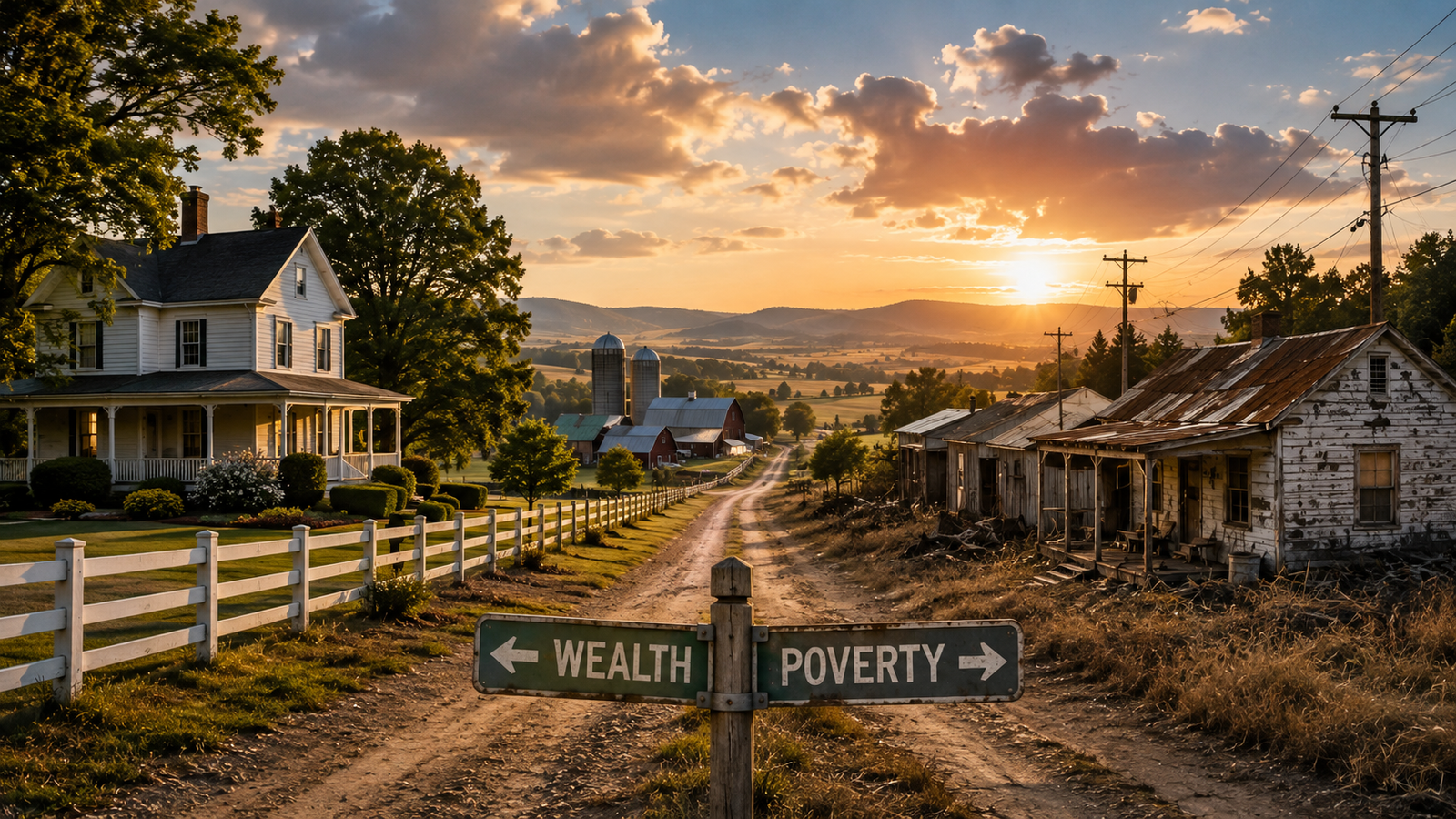
Introduction on Class Structure in Rural America
When people think about social inequality in the United States, their attention often turns toward large cities. Images of luxury apartments standing beside poor neighborhoods, homelessness, racial segregation, and unequal access to education and healthcare have made urban inequality highly visible. However, inequality is not confined to New York, Los Angeles, Chicago, or other metropolitan centers. Rural America also has a deeply structured system of social class, although it is often less visible to the national media and public discussion.
The popular image of rural America is frequently associated with small communities, close social relationships, agriculture, traditional values, and a relatively simple way of life. This image can create the impression that rural communities are socially homogeneous. In reality, rural America contains substantial differences in wealth, income, land ownership, education, occupational status, political influence, and access to essential services. A wealthy agricultural landowner, a professional working remotely from a rural community, a small business owner, a schoolteacher, a farmworker, and an unemployed worker may all live within the same county but occupy very different positions in the social hierarchy.
From a sociological perspective, class structure in rural America refers to the systematic arrangement of individuals and groups according to their economic resources, occupations, ownership of property, educational opportunities, and social power. Rural inequality is not simply a matter of some individuals earning more money than others. It is connected to historical patterns of land ownership, changes in agriculture, industrial decline, racial inequality, educational disadvantages, population loss, and unequal access to healthcare and infrastructure.
The United States Department of Agriculture‘s Economic Research Service continues to identify poverty, employment, education, population change, and geographic concentration of disadvantage as major features of rural social conditions. Its research also shows that nonmetropolitan poverty has historically remained higher than metropolitan poverty, while poverty is concentrated unevenly across regions and communities.

Understanding rural class structure is therefore essential for understanding American society as a whole. Inequality beyond the cities reveals that class is shaped not only by individual effort but also by geography, institutions, history, and unequal access to resources.
Table of Contents
Understanding Social Class in Rural America
Social class is one of the central concepts of sociology. Although class can be measured through income, sociologists generally understand it more broadly. Social class includes a person’s economic resources, occupation, education, property ownership, lifestyle, social networks, and ability to influence institutions.
Karl Marx viewed class primarily through people’s relationship to the means of production. Those who own productive resources, such as land, factories, businesses, and capital, occupy a different position from those who must sell their labor to survive. Max Weber developed a broader understanding of stratification by emphasizing class, status, and power. According to Weberian sociology, people may have different economic positions while also possessing different levels of social prestige and political influence.
These perspectives are particularly useful in examining rural America.
In a rural community, ownership of land can be a major source of class power. A large landowner may possess significant economic resources even if their lifestyle appears modest. A family that owns hundreds or thousands of acres of productive farmland occupies a very different social position from a farmworker who does not own land. Similarly, a successful agricultural corporation may control substantial resources while local workers remain economically insecure.
Class structure in rural America can therefore be understood through several interconnected dimensions:
Ownership of land and property, income and wealth, occupational position, educational attainment, access to institutions, and political and social influence.
These dimensions do not always overlap perfectly. A farmer may own valuable land but experience unstable annual income. A rural professional may earn a relatively high salary without owning significant agricultural property. A person may possess a college degree but find limited employment opportunities in their rural community.
Consequently, rural class structure is complex. It cannot be reduced to a simple division between “farmers” and “everyone else.”
The Myth of the Classless Rural Community
One reason rural inequality receives less attention is the persistence of the belief that rural communities are socially equal. Small communities often have strong social relationships, and residents may interact across occupational and economic boundaries. People may attend the same schools, religious institutions, local events, and community organizations.
However, social proximity does not necessarily mean economic equality.
A wealthy family and a low-income family may live only a few miles apart. Their children may attend the same school, yet their opportunities outside the classroom can be dramatically different. One family may possess land, savings, vehicles, internet access, private healthcare, and social connections. Another may struggle with unstable employment, transportation problems, debt, inadequate housing, or limited access to medical services.
The visibility of inequality can also differ between rural and urban areas. In cities, wealthy and poor populations may live in visibly different neighborhoods. Rural poverty can be geographically dispersed. A struggling household may live in an isolated home rather than a clearly identifiable poor neighborhood.
This makes rural poverty easier to ignore.
Furthermore, rural culture often emphasizes self-reliance and independence. These values can influence how poverty and inequality are understood. Economic hardship may be interpreted as a private family problem rather than as a consequence of larger structural conditions.
From a sociological perspective, however, individual experiences must be connected to broader social structures. C. Wright Mills described this relationship through the concept of the sociological imagination. Personal difficulties, such as unemployment or financial insecurity, can reflect larger public issues involving economic transformation, institutional decline, and unequal opportunities.
A rural worker losing a job is not always simply experiencing an individual failure. The loss may be connected to factory closure, technological change, agricultural consolidation, declining local populations, or changes in the national economy.
Land Ownership and Rural Class Power

Land has historically been one of the most important foundations of social class in rural societies.
In agricultural communities, land represents more than physical space. It is a productive resource, a source of income, an asset that can increase in value, and often a form of inherited wealth. Families that own substantial amounts of land may pass this advantage to future generations.
Those without land occupy a fundamentally different economic position.
Historically, rural societies have often contained a hierarchy involving large landowners, medium-sized farmers, small farmers, tenant farmers, and agricultural laborers. Although modern American agriculture has changed significantly, ownership remains an important source of inequality.
Agriculture has increasingly become technologically advanced and economically concentrated. Large-scale operations often possess greater access to machinery, capital, credit, technology, and markets. Smaller farms may face greater economic pressure.
This process can contribute to class differentiation.
A large agricultural operation may benefit from economies of scale, while smaller producers face difficulties related to production costs, market prices, debt, and competition. As a result, some rural families possess significant agricultural assets while others work primarily as wage laborers.
The class differences associated with agriculture are also increasingly connected to corporate structures. Modern rural economies are not composed only of independent family farms. Agricultural production may involve large corporations, food-processing companies, supply chains, contractors, and industrial-scale operations.
From a Marxist perspective, these developments demonstrate the importance of ownership. Individuals and corporations that control productive resources possess greater economic power than workers who depend upon wages.
Therefore, the romantic image of the independent farmer should not obscure the diversity of economic positions within rural America.
Agricultural Change and the Decline of Traditional Employment
Economic transformation has significantly affected the class structure of rural America.
For much of American history, agriculture provided employment for a large part of the rural population. Technological development dramatically increased agricultural productivity. Modern machinery, automation, scientific farming methods, and advanced technology allow fewer workers to produce greater amounts of agricultural output.
This has an important sociological consequence.
Agricultural productivity can increase without creating a similar increase in employment. In fact, technological efficiency may reduce the number of workers needed.

The USDA Economic Research Service has noted that major traditional rural industries, including agriculture and manufacturing, have experienced increases in output and productivity without corresponding growth in employment. At the same time, rural economies have become more diverse, with employment expanding in sectors such as healthcare, hospitality, and other services.
This economic transformation has created both opportunities and insecurity.
Highly skilled workers may benefit from new industries and technologies. However, workers with limited education or specialized skills may experience declining opportunities. Manufacturing jobs that once supported rural middle-class families have also disappeared from some communities because of automation, relocation, or economic restructuring.
The decline of stable employment can weaken the traditional rural middle class.
A worker who previously earned a stable wage in a factory may eventually find employment in lower-paying service-sector work. Such employment may provide fewer benefits, less job security, and fewer opportunities for economic advancement.
Thus, class inequality in rural America is closely connected to changes in the labor market.
The Rural Working Class
The rural working class includes people who depend primarily on wages rather than significant ownership of productive property.
This group is highly diverse. It includes agricultural workers, factory employees, retail workers, restaurant employees, healthcare assistants, construction workers, transportation workers, cleaners, and many others.
Rural workers often face challenges that differ from those experienced by urban workers.
One major problem is the limited number of available employers. A large city may have hundreds of businesses and organizations offering employment opportunities. A small rural community may depend heavily on only a few employers.
If a major factory, mine, agricultural operation, or business closes, the effects can spread throughout the entire community.
Workers may have few alternatives.
Geographic isolation can also increase the cost of unemployment. Finding another job may require long-distance commuting or relocation. Families may remain in economically declining areas because of family connections, housing costs, or limited resources.
Transportation is another important issue. Public transportation is often limited or nonexistent in rural areas. A person without a reliable vehicle may struggle to access employment, education, healthcare, and social services.
These conditions demonstrate that class inequality is connected to geography.
Two workers with similar qualifications may experience very different opportunities depending on where they live.
Poverty in Rural America
Poverty remains a major dimension of rural inequality.
Rural poverty is often misunderstood because rural areas may have lower housing costs than major cities. However, lower prices do not automatically eliminate economic hardship. Rural households may face additional expenses related to transportation, healthcare, energy, and access to essential services.
USDA research shows that the higher incidence of poverty in nonmetropolitan areas compared with metropolitan areas has been a long-standing feature of American social conditions. In the most recent estimates highlighted by the USDA’s rural poverty research, the 2019 nonmetro poverty rate was 15.4 percent compared with 11.9 percent in metropolitan areas.
Poverty is also not distributed equally within rural America.
Some regions have experienced persistent poverty across generations. Poverty can become geographically concentrated in particular counties and communities. When an entire area has limited employment, weak infrastructure, underfunded institutions, and low levels of investment, individuals may find it difficult to escape economic disadvantage.
The consequences of concentrated poverty are significant.
According to the USDA Economic Research Service, people living in areas where poverty is prevalent can face disadvantages beyond their individual circumstances. Concentrated poverty can be associated with poor housing and health conditions, educational difficulties, employment problems, and limited opportunities that may reproduce poverty over time.
This is an important sociological point.
Poverty is not only an individual condition. It can also become a community-level condition.
When an entire community lacks economic resources, local institutions may struggle. Schools may have difficulty attracting teachers. Healthcare facilities may be limited. Businesses may be reluctant to invest. Young people may leave in search of better opportunities.
These processes can create a cycle of decline.
Persistent Poverty and the Reproduction of Class
One of the most important sociological questions is why inequality continues across generations.
Pierre Bourdieu’s concept of social reproduction helps explain this process. According to Bourdieu, social inequality is reproduced through different forms of capital.
Economic capital includes money, property, and financial resources.
Cultural capital includes knowledge, education, language, skills, and familiarity with institutions.
Social capital includes relationships and networks that can provide information and opportunities.
Families from privileged backgrounds often possess greater amounts of these resources.
A child growing up in a wealthy rural household may benefit from financial security, educated parents, stable housing, technology, transportation, and social connections. A child growing up in poverty may have fewer resources.
This does not mean that poor children cannot succeed. Many individuals overcome difficult circumstances. However, sociology focuses on patterns rather than exceptional cases.
If one group consistently begins life with greater resources, opportunities will not be equally distributed.
Persistent rural poverty can therefore reproduce class inequality.
Children growing up in economically disadvantaged areas may face limited educational opportunities. Their parents may lack financial resources for college, transportation, tutoring, or relocation. After graduation, young adults may have limited access to high-paying employment.
The result can be a cycle in which poverty becomes intergenerational.
Education and Rural Class Inequality
Education is frequently described as a path toward social mobility. However, access to education and its economic benefits are not equally distributed.
Rural education has improved substantially over time, but significant differences remain between metropolitan and nonmetropolitan populations.
The USDA Economic Research Service reports that educational attainment in rural America has increased, yet rural areas have not kept pace with metropolitan areas in college and postgraduate education. From 2000 to 2023, the gap between metro and nonmetro adults holding a bachelor’s degree or higher widened.
Education is closely connected to class.
Families with greater economic resources can often provide more educational advantages. They may live in communities with stronger schools, possess reliable internet access, provide books and educational materials, and support children who wish to attend college.
Lower-income families may face greater obstacles.
A student from a rural community may need to travel long distances to attend a university. The cost of transportation and housing can become a major barrier. Some students may choose employment instead of higher education because their families need financial support.
Educational inequality can therefore become occupational inequality.
The USDA also reports a substantial earnings difference between metropolitan and nonmetropolitan workers. In 2023, median earnings for nonmetro working adults were $42,407, compared with $52,109 for their metropolitan counterparts. Educational attainment was associated with higher earnings, but rural workers generally earned less than metro workers across educational categories.
This demonstrates that education alone does not completely eliminate geographic inequality.
A college-educated person living in a rural area may still face a limited labor market.
The Rural Middle Class
The rural middle class occupies an important position between wealthy landowners and economically insecure workers.
This group may include teachers, nurses, small business owners, government employees, skilled technicians, managers, successful farmers, and other professionals.
Historically, stable employment and homeownership helped create economic security for many rural middle-class families.
However, the rural middle class is not immune to economic transformation.
The closure of schools, hospitals, factories, or local businesses can weaken communities. Declining populations may reduce the customer base for small businesses. Young adults may leave for metropolitan areas.
The increasing cost of healthcare, housing, education, and other necessities can also create financial pressure.
A family may appear middle class because it owns a home and has stable employment. Yet it may possess limited savings and be vulnerable to unexpected economic problems.
This reveals the difference between income and wealth.
Income refers to money received through employment or other sources. Wealth refers to accumulated assets, including savings, property, investments, and other resources.
A household may earn a reasonable income but possess little wealth.
Wealth is particularly important because it provides protection during economic crises. Families with significant assets can survive unemployment or unexpected expenses more easily than families living from paycheck to paycheck.
Therefore, rural class structure cannot be understood only by examining income.
Wealth, Property, and Inherited Advantage
Wealth inequality is often less visible than income inequality.
Two families may earn similar annual incomes but have very different levels of accumulated wealth.
One family may own farmland that has been passed down through generations. It may own a house without significant debt and possess financial investments.
Another family may rent a home, have student loans or other debts, and possess little savings.
These differences can become increasingly important over time.
Property ownership provides economic security and opportunities for wealth accumulation. Landowners may benefit when property values increase. They can pass assets to their children.
Families without property may pay rent without building comparable wealth.
Inheritance can therefore contribute to the reproduction of rural class structure.
A family that inherits productive land receives an advantage that cannot easily be explained through individual achievement alone.
From a sociological perspective, this challenges the idea that economic success is entirely based on merit.
Hard work is important, but people begin life from unequal starting positions.
Race, Ethnicity, and Rural Class on Class Structure in Rural America
Rural America is often portrayed as racially homogeneous, but this image is inaccurate.
Rural communities include Black Americans, Indigenous peoples, Hispanic and Latino populations, immigrant communities, and other racial and ethnic groups.
Class inequality cannot be separated completely from racial inequality.
Historical discrimination has influenced land ownership, employment opportunities, education, housing, and wealth accumulation.
USDA data show significant differences in poverty rates among racial and ethnic groups in nonmetropolitan America. In the 2019 estimates discussed by the Economic Research Service, nonmetro Black residents and American Indian/Alaska Native populations experienced particularly high poverty rates.
These inequalities must be understood historically.
The economic position of a group is influenced by past and present institutions. Historical discrimination can affect access to land, credit, education, and employment.
For example, Indigenous communities may experience geographic isolation and historical economic marginalization. Black rural communities in parts of the American South have been shaped by the legacy of slavery, segregation, and unequal access to economic resources.
Latino and immigrant workers also play important roles in agricultural and food-production systems. Many work in physically demanding and economically vulnerable occupations.
Therefore, rural class structure is not simply a matter of individual income.
It is shaped by the intersection of class, race, ethnicity, geography, and historical inequality.
Gender and Rural Economic Inequality on Class Structure in Rural America
Gender also influences class position.
Women in rural communities may face limited employment opportunities, particularly in areas with a narrow economic base. Traditional gender roles can influence occupational choices and family responsibilities.
Childcare is another important issue.
In communities with limited childcare services, parents may struggle to participate fully in the labor market. This can particularly affect women, who often continue to perform a larger share of unpaid caregiving work.
Single-parent households may experience greater economic vulnerability.
The USDA’s rural poverty research has shown significant poverty differences according to family structure. In the 2019 nonmetro data, families headed by women without a spouse present experienced substantially higher poverty rates than married-couple families.
This illustrates the relationship between family structure and economic resources.
A household with two potential earners may possess greater economic security than a household dependent upon one income.
However, sociology must avoid blaming individuals for structural inequality.
Single parents may experience poverty not because of personal irresponsibility but because of low wages, childcare costs, limited employment opportunities, and unequal access to social support.
Healthcare and Class Inequality on Class Structure in Rural America
Healthcare access is another major dimension of rural inequality.
Rural communities may have fewer hospitals, doctors, specialists, and mental healthcare services. Residents may need to travel long distances to receive medical treatment.
For wealthy households, transportation and private resources can reduce these barriers.
For low-income households, however, distance can become a serious obstacle.
A person may postpone treatment because of transportation costs, lost wages, or the inability to travel.
Healthcare inequality therefore intersects with class inequality.
Economic resources influence a person’s ability to access medical care, maintain health, and recover from illness.
Poor health can also contribute to poverty.
An individual who cannot work because of illness may lose income. Medical expenses can create debt. A family may become economically vulnerable because a major earner experiences health problems.
Thus, poverty and health can reinforce each other.
Infrastructure, Technology, and the Digital Divide
Modern class inequality increasingly involves access to technology.
Internet access has become essential for education, employment, business, healthcare, and communication.
A student without reliable internet may struggle to complete assignments. A worker may have difficulty searching for jobs. A small business may lose access to online markets.
The COVID-19 pandemic made the digital divide particularly visible, but the issue extends beyond the pandemic.
Rural communities may have weaker broadband infrastructure. However, access is also shaped by class.
Even when high-speed internet is available, low-income households may struggle to afford services or devices.
Technology therefore represents a new form of social inequality.
Digital resources can function as a form of cultural and economic capital.
A family with computers, reliable internet, and technological knowledge may possess significant advantages.
Population Decline and the Geography of Inequality
Many rural communities face population decline.
Young adults often move to cities or larger towns for education and employment. This process can create what sociologists describe as selective migration.
Individuals with higher education and greater mobility may be more likely to leave economically declining communities.
Those who remain may include older populations, individuals with limited economic resources, and families strongly connected to the local community.
Population decline can weaken the local economy.
Schools may lose students. Small businesses may lose customers. Healthcare facilities may experience financial pressure.
The loss of young workers can also reduce the local tax base and economic vitality.
However, rural America is not uniformly declining.
Some rural areas have experienced growth because of tourism, natural amenities, retirement migration, or remote work. The economic diversity of rural regions is an important reminder that there is no single rural American experience.
The USDA’s annual Rural America at a Glance reports emphasize that rural social and economic conditions are shaped by changing demographics, migration, employment, poverty, and infrastructure.
Therefore, geography itself becomes a dimension of class inequality.
Living in a prosperous rural community can provide different opportunities from living in an isolated county experiencing long-term economic decline.
Political Power and Rural Class Structure on Class Structure in Rural America
Class is also connected to political power.
Wealthy individuals and business interests often possess greater access to political institutions. They may contribute to political campaigns, participate in influential organizations, or maintain relationships with decision-makers.
In rural communities, economic elites may include major landowners, business owners, agricultural corporations, and other powerful actors.
Small communities can also have informal power structures.
A person may possess influence because of family reputation, property ownership, business connections, or leadership within community institutions.
This reflects Max Weber’s argument that power is not determined solely by income.
Social status and networks also matter.
Working-class and poor residents may have fewer resources to participate politically. Economic insecurity can limit the time and energy available for political involvement.
However, rural residents are not politically passive.
Rural communities have strong traditions of collective action, local activism, labor organizing, agricultural organizations, and community-based movements.
Class conflict and cooperation can therefore coexist.
Social Capital: Strength and Limitation
One important characteristic of many rural communities is strong social capital.
Neighbors may know one another. Families may maintain close relationships across generations. Community organizations and religious institutions may provide assistance during difficult times.
These networks can be extremely valuable.
A family experiencing financial problems may receive food, childcare, transportation, or temporary support from relatives and neighbors.
However, social capital cannot completely replace economic resources.
A poor community may have strong social relationships but lack jobs, hospitals, or educational institutions.
This distinction is important.
Community solidarity can reduce the immediate effects of hardship, but it cannot necessarily eliminate structural inequality.
Moreover, close social networks can sometimes reproduce class boundaries.
Powerful families may possess strong local connections. Employment opportunities may circulate through social networks. Outsiders may find it difficult to gain access to influential institutions.
Thus, social capital can both support communities and reproduce inequality.
Rural America and the Sociology of Social Mobility
The American Dream is based partly on the belief that individuals can improve their social position through education and hard work.
Social mobility certainly occurs.
Children from low-income families can become professionals. Small businesses can become successful. Farmers can expand their operations.
However, mobility should not be evaluated only through individual success stories.
Sociology asks broader questions.
How likely is upward mobility for people born into different social classes?
What resources are available to children from poor families?
How does geography influence opportunity?
The answer is that opportunities are unequal.
A rural student from a wealthy family may receive financial support to attend college. A student from a poor family may need to work immediately after high school.
A professional may move to a city to pursue a career. A low-income person may lack the resources necessary to relocate.
Therefore, social mobility depends partly on structural conditions.
Class structure influences who has access to opportunities.
The Role of Institutions on Class Structure in Rural America
Institutions play a central role in maintaining or reducing inequality.
Schools influence educational opportunities.
Labor markets determine wages and employment.
Banks and financial institutions influence access to credit.
Healthcare systems influence well-being.
Government policies influence taxation, welfare, infrastructure, and public services.
These institutions do not affect all social groups equally.
For example, access to credit can influence whether a family purchases a home, starts a business, or invests in agriculture.
Education can influence occupational opportunities.
Healthcare access can influence the ability to work.
Infrastructure investment can influence whether businesses enter a community.
Therefore, rural inequality should not be understood only as a result of individual decisions.
It is also produced through institutions.
A Conflict Perspective on Rural Inequality
The conflict perspective emphasizes competition over resources and power.
From this viewpoint, social inequality exists because resources are distributed unequally.
In rural America, important resources include land, capital, employment, education, technology, and political influence.
Those who control these resources often possess greater power.
Agricultural corporations may have greater economic influence than individual workers.
Large landowners may possess more resources than tenant farmers.
Employers may possess greater bargaining power when workers have limited alternative employment.
This perspective also helps explain why economic inequality can continue even when productivity increases.
Economic growth does not automatically mean that everyone benefits equally.
A company may become more productive while reducing its workforce.
Agricultural technology may increase production while decreasing the need for workers.
Therefore, economic development and social equality are not the same thing.
A Functionalist Perspective on Class Structure in Rural America
Functionalist sociology offers a different interpretation.
From a functionalist perspective, social stratification can be viewed as a system through which societies allocate people to different occupational roles.
Education and training help prepare individuals for specialized positions.
However, critics argue that this explanation does not adequately address unequal starting conditions.
If educational opportunities are unequal, competition cannot be considered completely fair.
A rural child who lacks reliable internet, transportation, financial resources, and access to advanced educational opportunities does not begin from the same position as a wealthy child.
Therefore, contemporary sociology often combines different perspectives.
Some inequality may reflect differences in education, skills, and occupational roles. However, structural inequality also affects access to the resources required for success.
The Future of Class Structure in Rural America
The future of rural class inequality will be influenced by several major developments.
Technology may create new opportunities through remote work and digital business. At the same time, automation may eliminate certain jobs.
Broadband expansion may reduce geographic isolation, but only if low-income households can afford access and possess the necessary skills.
Changes in agriculture may continue to favor large-scale and technologically advanced operations.
Climate change may also influence agricultural production, employment, migration, and rural economies.
Population aging presents another challenge.
As rural populations become older, communities may face increasing demand for healthcare and caregiving while experiencing a smaller working-age population. The USDA has identified aging, migration, employment, childcare, eldercare, and broadband as important aspects of contemporary rural demographic change.
The future of rural America will therefore depend partly on public investment.
Investment in education, healthcare, transportation, broadband, affordable housing, and local economic development can influence social mobility.
Without such investment, existing inequalities may become stronger.
Reducing Rural Inequality on Class Structure in Rural America
Reducing class inequality in rural America requires a structural approach.
Individual hard work is valuable, but individual effort alone cannot solve problems caused by limited employment, poor infrastructure, unequal education, and concentrated poverty.
Rural development policies should focus on creating stable and diverse employment opportunities.
Investment in public education can improve social mobility. Rural students need access to quality teachers, technology, advanced courses, and higher education opportunities.
Healthcare infrastructure is also essential.
Communities require access to hospitals, doctors, mental health services, and affordable treatment.
Broadband expansion can support education, entrepreneurship, remote employment, and access to services.
Transportation investment can improve access to jobs and institutions.
Policies addressing wealth inequality and access to property are equally important. Economic security depends not only on wages but also on assets.
Finally, policymakers must recognize the diversity of rural America.
A policy suitable for a prosperous agricultural region may not work in an economically declining manufacturing community or an isolated Indigenous community.
Rural inequality requires local understanding.
Conclusion on Class Structure in Rural America
The class structure in rural America demonstrates that inequality exists far beyond major cities.
Rural communities are not socially homogeneous. They contain wealthy landowners, agricultural corporations, professionals, small business owners, middle-class families, wage workers, unemployed individuals, and households living in persistent poverty.
These groups possess unequal access to income, wealth, land, education, healthcare, technology, and political influence.
From a sociological perspective, rural inequality is produced through the interaction of class, geography, history, race, gender, and institutions.
Land ownership remains an important source of economic power. Changes in agriculture and manufacturing have transformed employment opportunities. Educational differences influence occupational mobility. Poverty can become concentrated geographically and reproduced across generations.
Recent USDA research continues to show that rural and nonmetropolitan communities face distinctive challenges involving poverty, education, employment, demographic change, and unequal access to opportunities. Rural educational attainment has improved, but gaps with metropolitan areas remain, while rural workers generally experience lower median earnings than their metropolitan counterparts.
The most important lesson is that inequality should not be understood only through the contrast between rich cities and poor rural areas.
Rural America contains its own internal class divisions.
A wealthy landowner and a low-income farmworker may live in the same community but experience completely different realities. A college-educated professional may have access to opportunities unavailable to a worker with limited education. A family with inherited property may possess security that a renting family cannot easily achieve.
Therefore, Class Structure in Rural America is not simply about income. It is about the unequal distribution of resources, opportunities, power, and life chances.
Studying inequality beyond the cities expands our understanding of American society. It reminds us that social class is shaped by where people live, what resources they inherit, the institutions available to them, and the opportunities provided by society.
The sociology of rural America ultimately challenges a powerful assumption: that inequality is primarily an urban problem.
It is not.
Inequality exists across the American landscape, from crowded metropolitan neighborhoods to isolated rural counties. Understanding this reality is essential for building a more accurate and complete picture of social stratification in the United States.
Frequently Asked Questions About Class Structure in Rural America
1. What is the Class Structure in Rural America?
The Class Structure in Rural America refers to the social and economic divisions among rural populations based on income, wealth, land ownership, occupation, education, and access to resources and opportunities.
2. What are the main social classes in rural America?
The main groups within the Class Structure in Rural America include wealthy landowners and business owners, upper-middle-class professionals, middle-class families, small farmers, working-class laborers, agricultural workers, and people living in poverty.
3. How does land ownership affect the Class Structure in Rural America?
Land ownership plays a major role in the Class Structure in Rural America because land provides economic security, income, wealth, and social influence. Families owning large amounts of land often have greater economic advantages than landless workers.
4. Is inequality common in rural America?
Yes. Inequality is an important feature of the Class Structure in Rural America. Rural communities can have significant differences in income, property ownership, education, employment opportunities, healthcare access, and wealth.
5. How does poverty influence the Class Structure in Rural America?
Poverty creates a lower economic position within the Class Structure in Rural America. Low-income families may experience limited access to quality education, healthcare, employment, transportation, technology, and other essential resources.
6. How has agriculture changed the Class Structure in Rural America?
Modern agriculture has transformed the Class Structure in Rural America through mechanization, technology, and large-scale farming. Large agricultural businesses and landowners often have greater resources, while small farmers and agricultural workers may experience economic insecurity.
7. What is the role of education in the Class Structure in Rural America?
Education strongly influences the Class Structure in Rural America because educational qualifications affect employment opportunities, income, occupational status, and social mobility.
8. How does employment affect rural social class?
Employment is a major factor in the Class Structure in Rural America. People with stable, well-paying professional jobs generally have greater economic security than workers employed in low-wage, seasonal, or unstable occupations.
9. How does wealth differ from income in rural America?
In the Class Structure in Rural America, income refers to money earned through employment or other sources, while wealth includes accumulated assets such as land, homes, savings, and investments. Wealth often provides greater long-term economic security.
10. How does race influence the Class Structure in Rural America?
Race and ethnicity can influence the Class Structure in Rural America because historical discrimination and unequal access to land, education, employment, and wealth have contributed to economic differences among racial and ethnic groups.
11. What is persistent poverty in rural America?
Persistent poverty refers to long-term poverty that continues across generations or remains concentrated within particular communities. It is an important feature of inequality within the Class Structure in Rural America.
12. How does the digital divide affect rural inequality?
The digital divide affects the Class Structure in Rural America by creating unequal access to high-speed internet, computers, online education, remote employment, and digital services. Low-income households may experience greater disadvantages.
13. Can people achieve social mobility in rural America?
Yes, social mobility is possible within the Class Structure in Rural America. Education, employment, entrepreneurship, and migration can help individuals improve their economic position. However, opportunities are not equally available to everyone.
14. How does geography affect the Class Structure in Rural America?
Geography significantly affects the Class Structure in Rural America because isolated communities may have fewer employment opportunities, educational institutions, healthcare facilities, transportation services, and economic resources.
15. How can inequality in the Class Structure in Rural America be reduced?
Inequality within the Class Structure in Rural America can be reduced through better access to quality education, healthcare, broadband internet, transportation, affordable housing, stable employment, and community economic development.
1 thought on “Class Structure in Rural America: Inequality Beyond the Cities”