Introduction
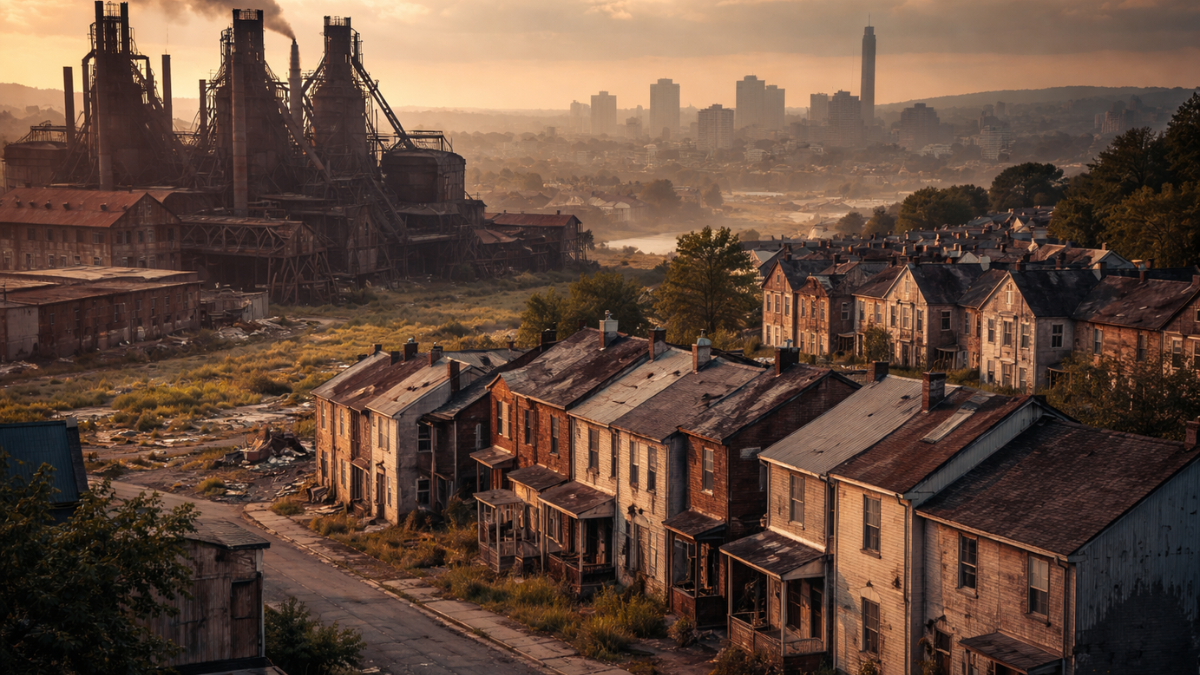
Pennsylvania, once the industrial heartland of the United States, represents one of the most significant case studies of industrial rise and decline in modern economic history. Cities such as Pittsburgh, Bethlehem, and Philadelphia were symbols of heavy industry—especially steel, coal, and manufacturing—throughout the late 19th and early 20th centuries. However, by the late 20th century, Pennsylvania experienced a dramatic transformation due to deindustrialization. This transformation not only reshaped the economic landscape but also fundamentally altered class structures, identities, and social relations.
From a sociological perspective, the industrial decline of Pennsylvania is not merely an economic event; it is a process deeply embedded in class relations, labor dynamics, urban restructuring, and cultural change. The decline of industry disrupted working-class communities, reshaped middle-class aspirations, and intensified inequality. This article explores how industrial decline in Pennsylvania led to profound class changes, drawing on key sociological theories and empirical realities.

Explore Class Change in Pennsylvania through a sociological lens, analysing deindustrialization, shifting class structures, inequality, and the transformation of working-class communities.
Understanding Deindustrialization in Pennsylvania
Deindustrialization refers to the reduction or removal of industrial capacity in a region, often leading to factory closures, job losses, and economic restructuring . In Pennsylvania, this process accelerated during the 1970s and 1980s, particularly affecting the steel industry in western Pennsylvania.
The collapse of steel production in cities like Pittsburgh marked a turning point. By the early 1980s, the region faced massive layoffs, with over 150,000 workers losing jobs in the steel sector alone . This was not just a cyclical downturn but a structural transformation driven by global competition, technological change, and shifting economic priorities.
The consequences were severe. In 1983, Pennsylvania experienced unemployment rates as high as 17.1%, significantly above the national average . Entire communities built around factories found themselves economically and socially dislocated.
The Rise and Fall of the Industrial Working Class
Formation of a Strong Working-Class Identity
During its industrial peak, Pennsylvania was characterized by a strong, organized working class. Steelworkers, miners, and factory laborers formed the backbone of the economy. Trade unions, particularly in the steel industry, played a central role in shaping class consciousness and collective identity.
The working class in Pennsylvania was not merely an economic category; it was a cultural and social identity. Stable employment, relatively high wages, and union protections enabled workers to achieve a degree of economic security and social mobility. Industrial jobs supported homeownership, education, and community institutions such as churches and local clubs.
Disintegration of Working-Class Stability
With deindustrialization, this stability collapsed. Factory closures eliminated not only jobs but also the social infrastructure associated with them. The loss of employment meant the erosion of union power, weakening collective bargaining and worker solidarity.
The sudden displacement of workers created what sociologists describe as “class dislocation.” Individuals who once identified as skilled industrial workers were forced into low-wage service jobs or long-term unemployment. This transition marked a downward shift in class position, often accompanied by a loss of dignity and identity.
The impact was uneven across racial groups. Black workers, who had gained access to industrial jobs during earlier decades, were disproportionately affected by layoffs, highlighting the intersection of class and race in deindustrialization .
Emergence of the Post-Industrial Economy
As industrial jobs declined, Pennsylvania transitioned toward a post-industrial economy dominated by services, healthcare, education, and technology. Cities like Pittsburgh reinvented themselves as hubs of innovation and research.
While this transformation generated new opportunities, it also produced new forms of inequality. The post-industrial economy requires higher levels of education and specialized skills, creating a divide between those who can access these jobs and those who cannot.
Polarization of the Labor Market
One of the key sociological outcomes of industrial decline is labor market polarization. On one end, there is a growing professional class employed in high-skill, high-wage sectors such as technology and healthcare. On the other end, there is an expanding service sector characterized by low wages, precarious employment, and limited benefits.

This polarization reflects a shift from a relatively cohesive working class to a fragmented class structure. The disappearance of middle-income industrial jobs has hollowed out the traditional middle class, contributing to economic insecurity and social stratification.
Urban Transformation and Spatial Inequality
Industrial decline also reshaped the spatial organization of Pennsylvania’s cities. Urban centers that once thrived on manufacturing experienced population decline, economic stagnation, and infrastructural decay.
Decline of Industrial Cities
Cities like Pittsburgh and Philadelphia faced significant population losses following industrial decline . As jobs disappeared, many residents migrated to suburban areas or other regions in search of employment.
This process, often referred to as “urban shrinkage,” led to vacant buildings, reduced tax revenues, and declining public services. Former industrial neighborhoods became sites of poverty and social exclusion.
Suburbanization and Class Segregation
At the same time, suburban areas experienced growth, particularly among middle- and upper-class populations. This migration created spatial segregation along class lines, with affluent communities located in suburbs and disadvantaged populations concentrated in urban cores.
The case of Allentown illustrates this dynamic, where working-class families moved to suburban areas, leaving behind economically weakened urban neighborhoods . This spatial restructuring reinforced class divisions and limited social mobility for urban residents.
Cultural and Psychological Impacts of Class Change
The decline of industry had profound cultural and psychological effects on individuals and communities. Sociologists emphasize that class is not only an economic position but also a source of identity, meaning, and social belonging.
Loss of Identity and “Wounds of Class”
The collapse of industrial employment created what scholars describe as the “wounds of class”—a sense of loss, dislocation, and marginalization experienced by former industrial workers . For many, work was central to their identity, and its loss led to feelings of purposelessness and alienation.
Communities that once revolved around factories struggled to redefine themselves. The closure of mills and mines symbolized not only economic decline but also the end of a way of life.
Nostalgia and Memory
Deindustrialization also generated a cultural politics of nostalgia. Former industrial regions often celebrate their industrial past through museums, monuments, and local narratives. This nostalgia reflects both pride in past achievements and a longing for lost stability.
However, nostalgia can also obscure structural inequalities and hinder efforts to adapt to new economic realities.
Inequality and Social Stratification
Industrial decline intensified social inequality in Pennsylvania. The transition to a post-industrial economy created new hierarchies based on education, skills, and access to opportunities.

Income Inequality
The gap between high-income professionals and low-wage workers has widened significantly. While some individuals benefit from the growth of new industries, others remain trapped in precarious employment or unemployment.
Intergenerational Effects
Class change is not limited to a single generation. The children of displaced workers often face limited educational and economic opportunities, perpetuating cycles of disadvantage. This intergenerational transmission of inequality is a key concern in sociological analysis.
Race, Class, and Deindustrialization
The impact of industrial decline cannot be understood without considering the intersection of race and class. In Pennsylvania, racial minorities, particularly African Americans, were disproportionately affected by job losses.
Industrial jobs had provided a pathway to economic stability for many minority workers. Their disappearance exacerbated existing inequalities and contributed to urban poverty and segregation.
This intersection highlights the importance of analyzing class change within broader social structures, including race, gender, and ethnicity.
Political Consequences of Class Transformation
The restructuring of class relations in Pennsylvania has had significant political implications. Deindustrialization has contributed to shifts in political attitudes, voting patterns, and social movements.
Decline of Labor Politics
The weakening of trade unions has reduced the political influence of the working class. Labor unions once played a crucial role in advocating for workers’ rights and social welfare policies. Their decline has left a gap in representation.
Rise of Populism
Economic insecurity and class dislocation have fueled populist sentiments in many industrial regions. Displaced workers often feel neglected by political elites, leading to distrust in institutions and support for alternative political movements.
Community Resilience and Adaptation
Despite the challenges of industrial decline, many communities in Pennsylvania have demonstrated resilience and adaptability. Local governments, organizations, and individuals have sought to reinvent their economies and identities.
Economic Diversification
Cities like Pittsburgh have successfully diversified their economies, focusing on technology, education, and healthcare. This transformation has created new opportunities, although not equally distributed.
Community Initiatives
Grassroots initiatives, including community development projects and cultural programs, have played a role in revitalizing former industrial areas. These efforts highlight the importance of social capital and collective action in addressing economic challenges.
Theoretical Perspectives on Industrial Decline and Class Change
Marxist Perspective
From a Marxist viewpoint, deindustrialization represents a restructuring of capitalism. The relocation of production to regions with lower labor costs reflects the logic of capital accumulation. This process leads to the displacement of workers and the reconfiguration of class relations.
Weberian Perspective
Max Weber’s concept of class emphasizes market position and life chances. In the post-industrial economy, access to education and skills becomes a key determinant of class position, replacing traditional industrial occupations.
Post-Industrial Theory
Post-industrial theorists argue that advanced societies are characterized by a shift from manufacturing to services and knowledge-based industries. While this transition creates new opportunities, it also generates new forms of inequality and social fragmentation.
Conclusion
The industrial decline of Pennsylvania is a powerful example of how economic transformations reshape social structures. The transition from an industrial to a post-industrial economy has fundamentally altered class relations, creating new inequalities and challenges.
From a sociological perspective, this transformation highlights the interconnectedness of economy, class, culture, and space. The decline of industry not only disrupted employment but also redefined identities, communities, and political dynamics.
Understanding these changes is essential for addressing the ongoing challenges of inequality, social exclusion, and economic insecurity. As Pennsylvania continues to evolve, its experience offers valuable insights into the broader processes of deindustrialization and class change in contemporary society.
FAQs on Class Change in Pennsylvania
- What is meant by Class Change in Pennsylvania?
Class Change in Pennsylvania refers to the transformation of social classes due to industrial decline, economic restructuring, and the shift toward a service-based economy. - What caused Class Change in Pennsylvania?
The primary cause of Class Change in Pennsylvania was deindustrialization, especially the collapse of steel and manufacturing industries in the late 20th century. - How did deindustrialization influence Class Change in Pennsylvania?
Deindustrialization led to job losses, weakening of unions, and a shift from stable industrial jobs to insecure service-sector employment, reshaping class structures. - Which industries were most responsible for Class Change in Pennsylvania?
The steel, coal, and manufacturing industries played a major role in shaping and later contributing to Class Change in Pennsylvania. - How did Class Change in Pennsylvania affect the working class?
The working class experienced downward mobility, unemployment, and loss of identity as stable industrial jobs disappeared. - Did Class Change in Pennsylvania impact the middle class?
Yes, Class Change in Pennsylvania weakened the traditional middle class by eliminating many well-paying industrial jobs. - What role did education play in Class Change in Pennsylvania?
Education became a key factor, as higher skills were required for new jobs, widening the gap between skilled and unskilled workers. - How did urban areas reflect Class Change in Pennsylvania?
Urban areas faced population decline, poverty concentration, and reduced economic opportunities, highlighting spatial inequality. - What is the connection between inequality and Class Change in Pennsylvania?
Class Change in Pennsylvania increased income inequality by creating a divide between high-skill professionals and low-wage workers. - How did Class Change in Pennsylvania affect rural communities?
Rural areas also suffered job losses and economic stagnation, leading to migration and demographic shifts. - What was the role of unions in Class Change in Pennsylvania?
The decline of unions reduced worker protection and collective bargaining power, accelerating class transformation. - Did Class Change in Pennsylvania affect racial groups differently?
Yes, minority groups were disproportionately impacted, facing higher unemployment and limited access to new opportunities. - How has the service sector influenced Class Change in Pennsylvania?
The service sector created jobs but often with lower wages and less security, contributing to class polarization. - Can Class Change in Pennsylvania be reversed?
While not fully reversible, policies focused on education, skill development, and economic diversification can reduce its negative effects. - Why is Class Change in Pennsylvania important for sociological study?
It provides insight into how economic transformations reshape social structures, identities, and inequalities in modern societies.