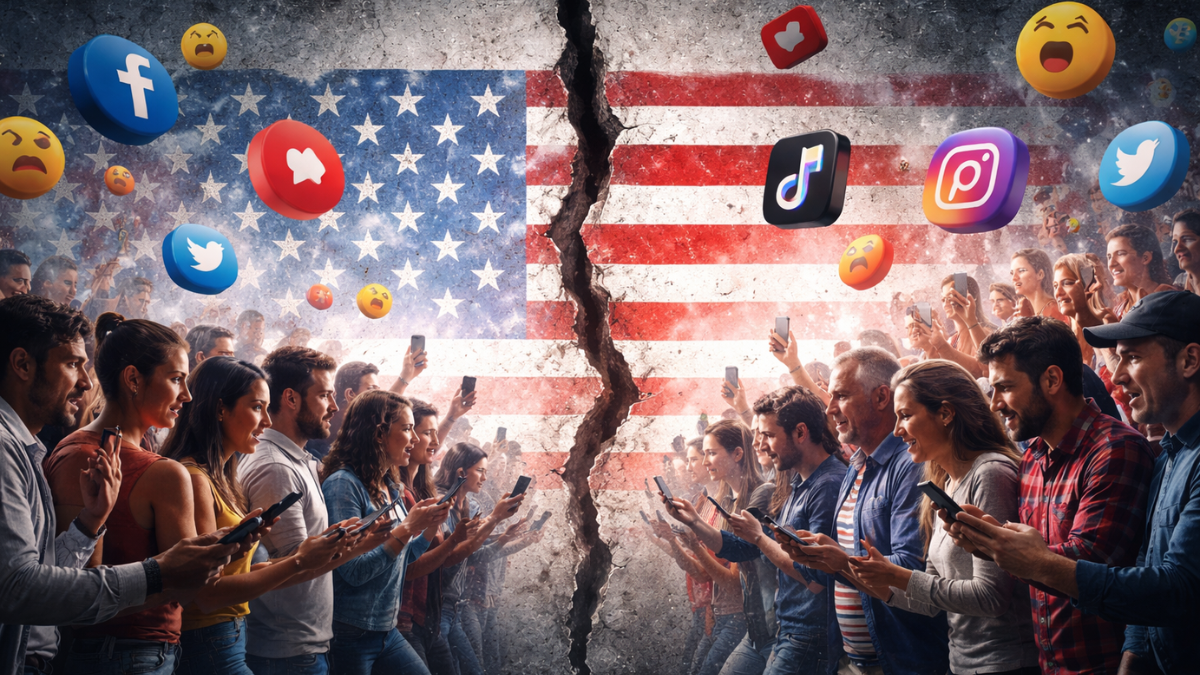
In the 21st century, social media has become one of the most influential forces shaping public life in the United States. Platforms such as Facebook, X, Instagram, and TikTok are no longer mere tools for communication; they are powerful institutions that influence politics, culture, identity, and social relationships. From presidential elections to racial justice movements, from youth culture to conspiracy theories, social media plays a central role in American public discourse.
The pressing question is: Is social media dividing American society? From a sociological perspective, the answer is complex. Social media both connects and fragments, empowers and polarizes, democratizes and destabilizes. To understand its impact, we must analyze it through sociological theories, empirical observations, and the broader context of American social structure.
Social Media as a Social Institution
Sociologists define institutions as structured systems of social relationships that address fundamental societal needs. Social media has evolved into a quasi-institutional structure that influences political participation, economic exchange, and cultural production. Unlike traditional media—such as newspapers and television—social media decentralizes content creation. Ordinary users become producers, influencers, and opinion leaders.
However, this decentralization also weakens traditional gatekeeping mechanisms. In earlier media systems, editors and journalists filtered information. Today, algorithms determine what users see, often prioritizing engagement over accuracy. This transformation has profound implications for social cohesion.
Functionalist Perspective: Integration or Dysfunction?
From a functionalist perspective, society is a system of interconnected parts that work together to maintain stability. Social media can serve integrative functions:
- It connects geographically dispersed families and communities.
- It facilitates civic engagement and mobilization.
- It amplifies marginalized voices.
Movements such as Black Lives Matter demonstrate how social media can foster solidarity and collective action. During times of crisis—natural disasters or national emergencies—platforms provide real-time information and support networks.
Yet, functionalists also emphasize dysfunctions. Social media can spread misinformation rapidly, generate moral panics, and intensify political polarization. When institutions fail to maintain shared norms and values, social integration weakens. Thus, while social media can unite, it can also destabilize societal equilibrium.
Conflict Theory: Power, Inequality, and Control
Conflict theorists argue that society is characterized by inequality and power struggles between dominant and subordinate groups. From this perspective, social media is not neutral. It is embedded within capitalist structures and controlled by corporate entities whose primary goal is profit maximization.
Algorithms often amplify sensational and emotionally charged content because it increases user engagement. This economic logic may intensify division, as controversial content generates more clicks, shares, and advertising revenue. Political actors exploit these dynamics, using targeted messaging to influence voter behavior.
Moreover, social media reflects and reproduces existing inequalities. Access to digital literacy, technological resources, and online visibility is unevenly distributed. Marginalized communities may gain voice, but they also face harassment, surveillance, and algorithmic bias.
Conflict theory thus suggests that social media divisions are not accidental—they are structurally embedded in systems of power and economic incentives.
Symbolic Interactionism: Identity and Everyday Interaction
Symbolic interactionism focuses on micro-level interactions and the construction of meaning. Social media platforms are spaces where individuals curate identities, perform roles, and negotiate social status. Likes, shares, and comments become symbolic currencies of validation.

However, digital interaction can distort communication. Without face-to-face cues, misunderstandings and hostility increase. Online anonymity sometimes reduces accountability, leading to trolling, cyberbullying, and extreme expression.
Furthermore, social media encourages selective self-presentation. Users often engage with like-minded individuals, reinforcing existing beliefs. This phenomenon contributes to what sociologists call “echo chambers”—environments where people are exposed primarily to views that confirm their own.
Through everyday digital interactions, individuals may gradually distance themselves from those holding opposing perspectives, deepening social divides.
Political Polarization and Echo Chambers
One of the most debated issues is the relationship between social media and political polarization. The United States has experienced increasing ideological division over the past two decades. While polarization predates social media, digital platforms intensify its visibility and emotional intensity.
Algorithms personalize content based on user behavior. If a person engages with conservative content, they are likely to see more conservative posts; if they interact with liberal content, the same pattern follows. Over time, this personalization can limit exposure to diverse viewpoints.
Political debates on social media often become performative rather than deliberative. Instead of reasoned discussion, users engage in symbolic signaling to their in-groups. The result is a fragmented public sphere where mutual understanding declines.
The events surrounding the 2020 presidential election illustrate how misinformation and online mobilization can spill into offline conflict. Conspiracy theories circulated widely on social platforms, demonstrating how digital networks can facilitate rapid ideological consolidation.
Social Media and Cultural Fragmentation
American society has always been culturally diverse. However, social media accelerates the formation of niche communities based on highly specific interests, identities, and beliefs. While diversity itself is not inherently divisive, digital segmentation can reduce shared cultural experiences.
In the past, mass media created common reference points—national news broadcasts, popular television programs, shared cultural events. Today, individuals consume personalized content streams. This shift reduces collective narratives and increases subcultural isolation.
Youth culture, in particular, is shaped by digital trends. Platforms like TikTok generate micro-trends that spread rapidly but often remain confined within algorithmically defined communities. Generational divides may widen as older Americans struggle to navigate rapidly evolving digital norms.
Race, Gender, and Online Conflict
Social media has become a battleground for debates about race, gender, and social justice. Discussions about systemic racism, gender identity, and inequality frequently unfold online. While these conversations raise awareness, they also provoke backlash.
Hashtags and viral campaigns amplify marginalized voices. At the same time, counter-movements and extremist groups use the same platforms to mobilize supporters. Online discourse often lacks nuance, reducing complex sociological issues to simplified slogans.
The visibility of conflict on social media may create the perception that American society is more divided than it actually is. However, the intensity and speed of digital communication undeniably magnify tensions.
The Role of Misinformation
Misinformation is a central concern in debates about social media division. False information spreads quickly because it often evokes strong emotional reactions. Unlike traditional media, social platforms allow unverified content to circulate widely before correction.

Conspiracy theories related to public health, elections, and immigration have gained traction online. When individuals inhabit separate informational realities, consensus becomes difficult. Shared facts are essential for democratic deliberation; without them, public trust erodes.
Sociologically, misinformation undermines social solidarity. It weakens institutional trust—trust in government, science, journalism, and education. When trust declines, societal fragmentation increases.
Digital Capitalism and Surveillance
Social media platforms operate within a system of digital capitalism. User data is commodified and sold to advertisers. Surveillance is embedded in everyday digital life. This economic structure shapes platform design and user experience.
The commodification of attention encourages addictive behaviors. Continuous scrolling, notifications, and algorithmic reinforcement keep users engaged. However, prolonged exposure to emotionally charged content can increase anxiety and hostility.
From a sociological standpoint, digital capitalism contributes to structural conditions that may foster division. Profit-driven algorithms prioritize engagement over social cohesion.
Counterarguments: Social Media as a Unifying Force
It is important not to overstate the divisive effects of social media. Research shows that many Americans maintain diverse networks online. Cross-cutting interactions do occur. Moreover, social media has enabled unprecedented levels of grassroots organization.
Community groups, educational initiatives, and charitable campaigns rely on digital platforms to mobilize resources. During crises, such as natural disasters or pandemics, social media can coordinate collective responses.
Additionally, divisions in American society have deep historical roots—racial inequality, economic disparities, regional differences. Social media may amplify these divisions, but it did not create them.
Generational and Regional Dimensions
Sociological analysis must also consider generational differences. Younger Americans, often labeled “digital natives,” integrate social media seamlessly into daily life. Older generations may view it as disruptive or unreliable.
Regional disparities in internet access and digital literacy shape how communities experience social media. Rural and urban areas differ in connectivity, political culture, and online engagement patterns.
Thus, the impact of social media is not uniform. It interacts with existing social structures—class, race, education, geography—to produce varied outcomes.
Toward Digital Civic Responsibility
If social media contributes to division, what can be done? Sociologists emphasize structural solutions rather than purely individual responsibility. Potential approaches include:
- Promoting digital literacy education.
- Encouraging platform transparency and algorithmic accountability.
- Strengthening community-based dialogue initiatives.
- Supporting independent journalism.
Public policy debates increasingly focus on regulating platform power. However, balancing free speech with content moderation remains contentious.
Ultimately, social cohesion requires shared norms, trust, and inclusive institutions. Social media can either support or undermine these elements, depending on how it is structured and used.
Conclusion: Division, Reflection, or Amplification?
Is social media dividing American society? From a sociological perspective, social media acts less as a root cause and more as an amplifier. It magnifies existing inequalities, ideological divisions, and cultural tensions. It accelerates communication, intensifies emotional reactions, and reshapes public discourse.
At the same time, it provides tools for connection, mobilization, and democratic participation. The impact of social media depends on broader social structures—economic systems, political institutions, and cultural norms.
American society stands at a crossroads. As digital technologies continue to evolve, the challenge is not merely to critique social media but to shape it in ways that promote dialogue rather than division. The future of social cohesion may depend on how effectively institutions, communities, and individuals adapt to this transformative digital landscape.
In the end, social media does not simply divide or unite—it reflects the complexities of American society itself.
FAQs on Social Media Dividing American Society
1. What does the phrase “Social Media Dividing American Society” mean?
The phrase Social Media Dividing American Society refers to the idea that digital platforms may be increasing political polarization, cultural fragmentation, and social conflict by reinforcing ideological differences and limiting exposure to diverse viewpoints.
2. How is Social Media Dividing American Society politically?
Social media can intensify political divisions by promoting algorithm-driven content that favors emotionally charged posts. This often creates echo chambers where users mainly encounter opinions that align with their existing beliefs.
3. Is Social Media Dividing American Society through misinformation?
Yes, misinformation plays a key role in discussions about Social Media Dividing American Society. False or misleading content spreads rapidly online, weakening trust in institutions and deepening ideological divides.
4. Does Social Media Dividing American Society affect younger generations more?
Younger generations are heavy users of digital platforms, so they may experience stronger exposure to polarized content. However, older generations are also vulnerable to misinformation and ideological segregation online.
5. How do algorithms contribute to Social Media Dividing American Society?
Algorithms personalize content based on past behavior. This personalization can limit exposure to diverse perspectives, reinforcing pre-existing views and contributing to Social Media Dividing American Society.
6. Is Social Media Dividing American Society along racial lines?
Online discussions about race can both promote awareness and intensify conflict. While social media empowers marginalized voices, it can also amplify racial tensions and hostility.
7. Does Social Media Dividing American Society weaken democracy?
Some sociologists argue that Social Media Dividing American Society undermines democratic deliberation by spreading misinformation and reducing meaningful cross-party dialogue.
8. Can Social Media Dividing American Society increase social isolation?
Yes, heavy reliance on online interactions may reduce face-to-face communication, leading to weakened community bonds and social fragmentation.
9. Is Social Media Dividing American Society economically?
Economic inequality is reflected online. Access to digital literacy, technology, and influence varies by class, which can intensify existing social inequalities.
10. How does Social Media Dividing American Society influence public opinion?
Viral trends, influencers, and algorithmic amplification shape public narratives, sometimes promoting extreme viewpoints over balanced discussions.
11. Is Social Media Dividing American Society more than traditional media did?
Unlike traditional media, social media allows anyone to create and share content instantly. This decentralization can accelerate polarization compared to earlier media systems.
12. Can Social Media Dividing American Society be reduced through regulation?
Policy reforms focusing on transparency, accountability, and digital literacy may reduce the negative effects associated with Social Media Dividing American Society.
13. Does Social Media Dividing American Society create echo chambers?
Yes, echo chambers are central to debates about Social Media Dividing American Society, as users often interact primarily with like-minded communities.
14. Are there positive aspects despite Social Media Dividing American Society?
Absolutely. Social media also fosters activism, community support, and civic engagement, showing that its impact is not entirely negative.
15. Is Social Media Dividing American Society the main cause of polarization?
Most sociologists agree that social media amplifies existing divisions rather than creating them. Structural inequalities, historical tensions, and political factors also contribute significantly.