Introduction
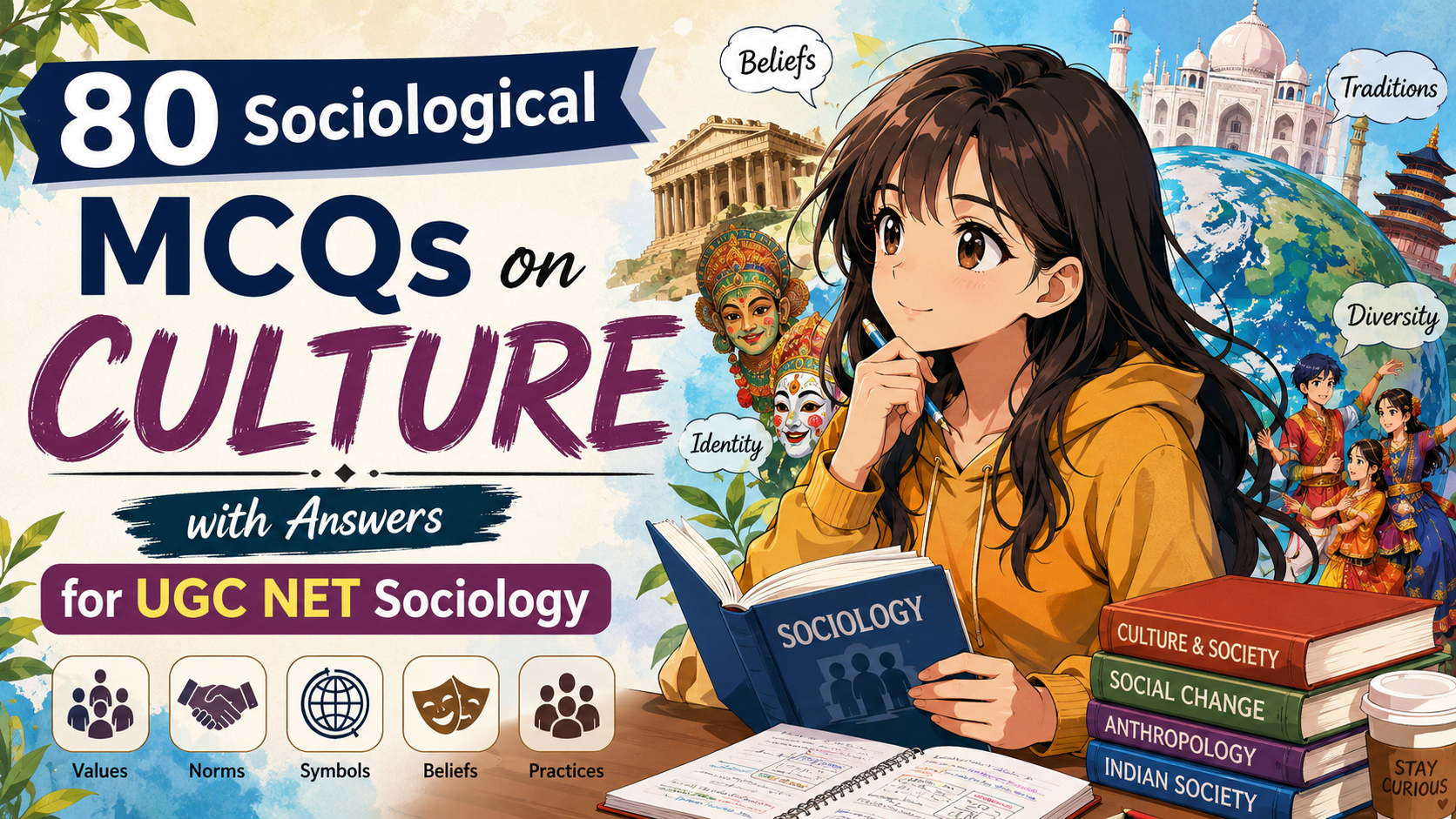
Culture is one of the most fundamental concepts in sociology. It refers to the shared beliefs, values, norms, customs, language, symbols, and material objects that characterize a society. Understanding culture is essential for UGC NET Sociology aspirants because questions related to culture frequently appear in the examination. This collection of 80 multiple-choice questions (MCQs) covers important concepts such as cultural traits, cultural lag, ethnocentrism, cultural relativism, subculture, counterculture, globalization, and cultural change.
1. Basic Concepts of Culture
1. Who defined culture as “that complex whole which includes knowledge, belief, art, morals, law, custom, and any other capabilities acquired by man as a member of society”?
A. Emile Durkheim
B. Edward B. Tylor
C. Max Weber
D. Karl Marx
Answer: B. Edward B. Tylor
2. Culture is:
A. Biological inheritance
B. Learned behavior
C. Genetic trait
D. Natural instinct
Answer: B. Learned behavior
3. Which of the following is a characteristic of culture?
A. Innate
B. Static
C. Learned
D. Biological
Answer: C. Learned
4. Culture is transmitted through:

A. Heredity
B. Socialization
C. Mutation
D. Evolution
Answer: B. Socialization
5. Culture provides:
A. Physical strength
B. Social guidelines
C. Genetic traits
D. Economic resources
Answer: B. Social guidelines
6. Which sociologist emphasized culture as a way of life?
A. Robert Bierstedt
B. Kingsley Davis
C. MacIver
D. Parsons
Answer: A. Robert Bierstedt
7. The smallest unit of culture is called:
A. Institution
B. Cultural Complex
C. Cultural Trait
D. Cultural Pattern
Answer: C. Cultural Trait
8. A collection of related cultural traits forms:
A. Cultural Complex
B. Social Group
C. Institution
D. Community
Answer: A. Cultural Complex
9. Culture is:
A. Universal
B. Individual
C. Genetic
D. Temporary
Answer: A. Universal
10. Culture satisfies:
A. Biological needs only
B. Social needs only
C. Human needs
D. Economic needs only
Answer: C. Human needs
Rural Sociology MCQs with Answer
2. Material and Non-Material Culture
11. Material culture refers to:
A. Ideas and beliefs
B. Values and norms
C. Physical objects created by society
D. Customs
Answer: C. Physical objects created by society
12. Which is an example of material culture?

A. Religion
B. Smartphone
C. Values
D. Language
Answer: B. Smartphone
13. Non-material culture includes:
A. Buildings
B. Vehicles
C. Beliefs and values
D. Machines
Answer: C. Beliefs and values
14. Who popularized the distinction between material and non-material culture?
A. William F. Ogburn
B. Durkheim
C. Marx
D. Weber
Answer: A. William F. Ogburn
15. Language is a part of:
A. Material culture
B. Non-material culture
C. Economic culture
D. Political culture
Answer: B. Non-material culture
16. Which of the following is non-material culture?
A. Temple building
B. Book
C. Religious belief
D. Vehicle
Answer: C. Religious belief
17. Technology belongs to:
A. Material culture
B. Non-material culture
C. Social norms
D. Values
Answer: A. Material culture
18. Laws are part of:
A. Material culture
B. Non-material culture
C. Technology
D. Artifacts
Answer: B. Non-material culture
19. Cultural values influence:
A. Human behavior
B. Weather conditions
C. Biological inheritance
D. Genetics
Answer: A. Human behavior
20. Cultural symbols belong to:
A. Material culture only
B. Non-material culture
C. Economic structure
D. Political system
Answer: B. Non-material culture
3. Cultural Lag and Cultural Change
21. The concept of Cultural Lag was developed by:
A. Parsons
B. Ogburn
C. Sorokin
D. Merton
Answer: B. Ogburn
22. Cultural lag occurs when:
A. Material culture changes faster than non-material culture
B. Non-material culture changes faster than material culture
C. Both change equally
D. Culture disappears
Answer: A. Material culture changes faster than non-material culture
23. Which is an example of cultural lag?
A. Adoption of smartphones before privacy laws develop
B. Learning language
C. Marriage customs
D. Folk songs
Answer: A. Adoption of smartphones before privacy laws develop
24. Cultural change may occur through:
A. Diffusion
B. Innovation
C. Acculturation
D. All of these
Answer: D. All of these
25. Diffusion means:
A. Destruction of culture
B. Spread of cultural elements
C. Cultural isolation
D. Cultural conflict
Answer: B. Spread of cultural elements
26. Innovation refers to:
A. Creation of new cultural elements
B. Cultural decline
C. Cultural isolation
D. Ethnocentrism
Answer: A. Creation of new cultural elements
27. Globalization accelerates:
A. Cultural exchange
B. Cultural isolation
C. Cultural disappearance only
D. Social stagnation
Answer: A. Cultural exchange
28. Cultural borrowing is associated with:
A. Diffusion
B. Isolation
C. Segregation
D. Revolution
Answer: A. Diffusion
29. Acculturation occurs when:
A. Cultures come into continuous contact
B. Society disappears
C. No interaction exists
D. Traditions end
Answer: A. Cultures come into continuous contact
30. Modernization often leads to:
A. Cultural change
B. Cultural stagnation
C. No change
D. Isolation
Answer: A. Cultural change
4. Ethnocentrism and Cultural Relativism
31. Ethnocentrism means:
A. Evaluating other cultures by one’s own standards
B. Appreciating all cultures equally
C. Cultural exchange
D. Cultural diffusion
Answer: A. Evaluating other cultures by one’s own standards
32. The concept of ethnocentrism was developed by:
A. Sumner
B. Weber
C. Durkheim
D. Parsons
Answer: A. Sumner
33. Cultural relativism emphasizes:
A. Judging cultures according to their own context
B. Judging all cultures by Western standards
C. Cultural superiority
D. Ethnocentrism
Answer: A. Judging cultures according to their own context
34. Which promotes tolerance?
A. Ethnocentrism
B. Cultural Relativism
C. Cultural Lag
D. Cultural Trait
Answer: B. Cultural Relativism
35. Ethnocentrism may lead to:
A. Prejudice
B. Tolerance
C. Equality
D. Integration
Answer: A. Prejudice
36. Cultural relativism is important in:

A. Sociological research
B. Engineering only
C. Medicine only
D. Mathematics
Answer: A. Sociological research
37. Viewing one’s culture as superior reflects:
A. Relativism
B. Ethnocentrism
C. Diffusion
D. Acculturation
Answer: B. Ethnocentrism
38. Anthropologists generally support:
A. Cultural Relativism
B. Ethnocentrism
C. Racism
D. Isolationism
Answer: A. Cultural Relativism
39. Cultural relativism helps understand:
A. Cultural diversity
B. Cultural superiority
C. Cultural decline
D. Genetic differences
Answer: A. Cultural diversity
40. Ethnocentrism can hinder:
A. Intercultural understanding
B. Cultural identity
C. Socialization
D. Learning
Answer: A. Intercultural understanding
5. Norms, Values and Symbols
41. Social norms are:
A. Expected standards of behavior
B. Biological traits
C. Economic policies
D. Political ideologies
Answer: A. Expected standards of behavior
42. Values represent:
A. Shared ideas about what is desirable
B. Laws only
C. Traditions only
D. Economic goods
Answer: A. Shared ideas about what is desirable
43. Symbols are:
A. Objects carrying shared meanings
B. Natural phenomena
C. Economic assets
D. Genetic features
Answer: A. Objects carrying shared meanings
44. Language is a system of:
A. Symbols
B. Genetics
C. Institutions
D. Organizations
Answer: A. Symbols
45. Folkways are:
A. Informal norms
B. Formal laws
C. Economic policies
D. Political ideologies
Answer: A. Informal norms
46. Mores are:
A. Socially significant norms
B. Simple customs only
C. Economic values
D. Symbols
Answer: A. Socially significant norms
47. Violation of mores may invite:
A. Strong social sanctions
B. Rewards only
C. No reaction
D. Appreciation
Answer: A. Strong social sanctions
48. Norms help maintain:
A. Social order
B. Biological adaptation
C. Climate stability
D. Economic growth only
Answer: A. Social order
49. Cultural values differ from society to society because:
A. Cultures are diverse
B. Genetics differ
C. Climate alone determines values
D. Religion alone determines values
Answer: A. Cultures are diverse
50. Symbols facilitate:
A. Communication
B. Isolation
C. Segregation
D. Competition
Answer: A. Communication
6. Subculture and Counterculture
51. A subculture is:
A. A culture within a larger culture
B. A culture opposed to society
C. A vanished culture
D. Primitive culture
Answer: A. A culture within a larger culture
52. Youth culture is often considered:
A. Subculture
B. Counterculture only
C. Folk culture
D. Popular culture only
Answer: A. Subculture
53. Counterculture opposes:
A. Dominant cultural values
B. All cultural practices
C. Traditions only
D. Religion only
Answer: A. Dominant cultural values
54. Hippie movement is an example of:
A. Counterculture
B. Folk culture
C. Material culture
D. Cultural lag
Answer: A. Counterculture
55. Subcultures contribute to:
A. Cultural diversity
B. Cultural destruction only
C. Uniformity only
D. Isolation
Answer: A. Cultural diversity
56. Countercultures often emerge due to:
A. Dissatisfaction with dominant culture
B. Economic growth only
C. Technology alone
D. Language change
Answer: A. Dissatisfaction with dominant culture
57. Religious sects may develop:
A. Subcultures
B. No culture
C. Anti-culture only
D. Isolation
Answer: A. Subcultures
58. Counterculture challenges:
A. Mainstream values
B. Scientific laws
C. Natural laws
D. Geography
Answer: A. Mainstream values
59. Punk culture is commonly cited as:
A. Counterculture
B. Folkway
C. Cultural lag
D. Cultural trait
Answer: A. Counterculture
60. Subcultures coexist with:
A. Dominant culture
B. No other culture
C. Isolated communities only
D. Ancient societies only
Answer: A. Dominant culture
7. Advanced UGC NET Questions on Culture
61. The concept of “collective conscience” is associated with:
A. Durkheim
B. Weber
C. Marx
D. Parsons
Answer: A. Durkheim
62. Culture as a system of symbols was emphasized by:
A. Clifford Geertz
B. Ogburn
C. Comte
D. Spencer
Answer: A. Clifford Geertz
63. “Way of life” refers to:
A. Culture
B. Economy
C. Politics
D. Religion only
Answer: A. Culture
64. Cultural universals are:
A. Elements found in all societies
B. Elements found only in modern societies
C. Religious beliefs only
D. Political institutions only
Answer: A. Elements found in all societies
65. Marriage is generally regarded as:
A. Cultural universal
B. Counterculture
C. Cultural lag
D. Subculture
Answer: A. Cultural universal
66. Which concept refers to the blending of cultures?
A. Syncretism
B. Isolation
C. Ethnocentrism
D. Segregation
Answer: A. Syncretism
67. Cultural imperialism refers to:
A. Dominance of one culture over another
B. Cultural relativism
C. Folk culture
D. Subculture
Answer: A. Dominance of one culture over another
68. McDonaldization was proposed by:
A. George Ritzer
B. Parsons
C. Durkheim
D. Sorokin
Answer: A. George Ritzer
69. Global media contributes to:
A. Cultural globalization
B. Cultural isolation
C. Cultural extinction only
D. No change
Answer: A. Cultural globalization
70. Popular culture is largely spread through:
A. Mass media
B. Family only
C. Religion only
D. Schools only
Answer: A. Mass media
71. Cultural diversity refers to:
A. Variety of cultural expressions
B. One culture only
C. Cultural isolation
D. Uniformity
Answer: A. Variety of cultural expressions
72. Cultural identity is shaped by:
A. Shared traditions and values
B. Genetics only
C. Climate only
D. Geography only
Answer: A. Shared traditions and values
73. UNESCO promotes:
A. Cultural heritage preservation
B. Cultural destruction
C. Isolationism
D. Ethnocentrism
Answer: A. Cultural heritage preservation
74. Sanskritization was developed by:
A. M. N. Srinivas
B. G. S. Ghurye
C. Yogendra Singh
D. A. R. Desai
Answer: A. M. N. Srinivas
75. Westernization in India was studied extensively by:
A. M. N. Srinivas
B. Marx
C. Durkheim
D. Parsons
Answer: A. M. N. Srinivas
76. Cultural reproduction is associated with:
A. Pierre Bourdieu
B. Spencer
C. Comte
D. Ogburn
Answer: A. Pierre Bourdieu
77. Habitus is a concept developed by:
A. Bourdieu
B. Weber
C. Durkheim
D. Mead
Answer: A. Bourdieu
78. Cultural capital refers to:
A. Knowledge, skills, and cultural competencies
B. Economic wealth only
C. Political power only
D. Technology
Answer: A. Knowledge, skills, and cultural competencies
79. Which concept explains the spread of global consumer culture?
A. Globalization
B. Isolationism
C. Segregation
D. Tribalism
Answer: A. Globalization
80. Culture and society are:
A. Interdependent
B. Completely separate
C. Opposed to each other
D. Unrelated
Answer: A. Interdependent
Conclusion
Culture forms the foundation of social life and remains one of the most important topics in UGC NET Sociology. Questions on cultural traits, cultural lag, ethnocentrism, cultural relativism, subcultures, globalization, cultural capital, and cultural change are frequently asked in examinations. Regular practice of these MCQs will strengthen conceptual understanding and improve performance in UGC NET, SET, UPSC, and university-level sociology examinations.