Introduction

Urban growth is one of the defining features of contemporary society, particularly in rapidly expanding regions of the United States. The state of Arizona stands as a compelling case study of how economic expansion, demographic change, and spatial development intersect with social inequality. Over the past several decades, Arizona has experienced significant population growth, urban sprawl, and economic transformation. These processes have not only reshaped cities like Phoenix but have also produced new forms of social stratification and inequality.
From a sociological perspective, urban growth in Arizona cannot be understood merely as demographic expansion. It involves complex interactions between migration, housing, labor markets, racial diversity, and public policy. While growth has created opportunities for economic mobility and innovation, it has simultaneously intensified disparities in income, housing access, education, and infrastructure.
This article explores the relationship between urban growth and social inequality in Arizona, examining its causes, patterns, and consequences through sociological theories and empirical insights.
Table of Contents
Historical Context of Urban Growth in Arizona
Arizona’s urbanization is deeply rooted in post-World War II development patterns. Like many Sunbelt states, Arizona attracted migrants due to its favorable climate, economic opportunities, and relatively low cost of living. Over time, this influx transformed rural and semi-arid landscapes into sprawling metropolitan regions.
The city of Phoenix, in particular, exemplifies rapid urban expansion. It evolved from a modest desert settlement into one of the largest metropolitan areas in the United States. The Phoenix metropolitan area now accounts for a substantial portion of the state’s population and economic activity.
Urban growth in Arizona has largely followed a suburban model characterized by decentralization and outward expansion. Research shows that metropolitan Phoenix developed through extensive suburban sprawl, with growth concentrated at the urban edges rather than the city center.
This pattern reflects broader trends in American urbanization but is particularly pronounced in Arizona due to abundant land availability and automobile dependence.
Demographic Transformation and Diversity
Urban growth in Arizona has been accompanied by significant demographic change. The state is one of the fastest-growing in the United States, with notable population increases driven by both domestic migration and immigration.
Arizona’s population is also highly diverse. Approximately 47% of residents belong to racial or ethnic minority groups, including a large Hispanic population and a significant Native American presence.
This demographic transformation has important sociological implications:
- It introduces cultural diversity into urban spaces
- It reshapes labor markets and economic structures
- It influences patterns of residential segregation
Migration, particularly from other U.S. states and Latin America, has played a central role in shaping Arizona’s cities. Sociologically, this aligns with theories of urban ecology, which emphasize how population movements influence spatial organization and social relations.
However, diversity does not automatically lead to equality. Instead, it often intersects with existing social hierarchies, producing uneven access to resources and opportunities.
Economic Growth and Labor Market Inequality
Urban expansion in Arizona has been closely tied to economic development. The state has become a hub for industries such as technology, manufacturing, real estate, and tourism. This growth has generated employment opportunities and contributed to rising incomes.
Yet, economic growth has not been evenly distributed. Income inequality remains a significant concern. Data indicates that Arizona’s income distribution, measured by the Gini coefficient, reflects persistent disparities, even if slightly lower than the national average.
From a sociological standpoint, this reflects the concept of dual labor markets:
- A primary sector with stable, high-paying jobs
- A secondary sector characterized by low wages and job insecurity
In Arizona’s cities, high-skilled professionals in sectors like technology and finance coexist with low-wage workers in service industries, construction, and agriculture. This division contributes to widening income gaps and social stratification.
Urban Sprawl and Spatial Inequality

One of the most distinctive features of Arizona’s urban growth is urban sprawl. Cities like Phoenix have expanded outward into surrounding desert areas, creating low-density suburban landscapes.
While suburbanization offers benefits such as affordable housing and improved living conditions for some, it also produces spatial inequality:
- Wealthier populations often reside in well-developed suburban neighborhoods
- Lower-income groups are concentrated in inner-city areas or poorly serviced outskirts
- Access to transportation, healthcare, and education varies significantly across regions
Studies on urban systems show that spatial inequality is closely linked to access to infrastructure. Disadvantaged communities typically have lower access to essential services, reinforcing cycles of poverty and exclusion.
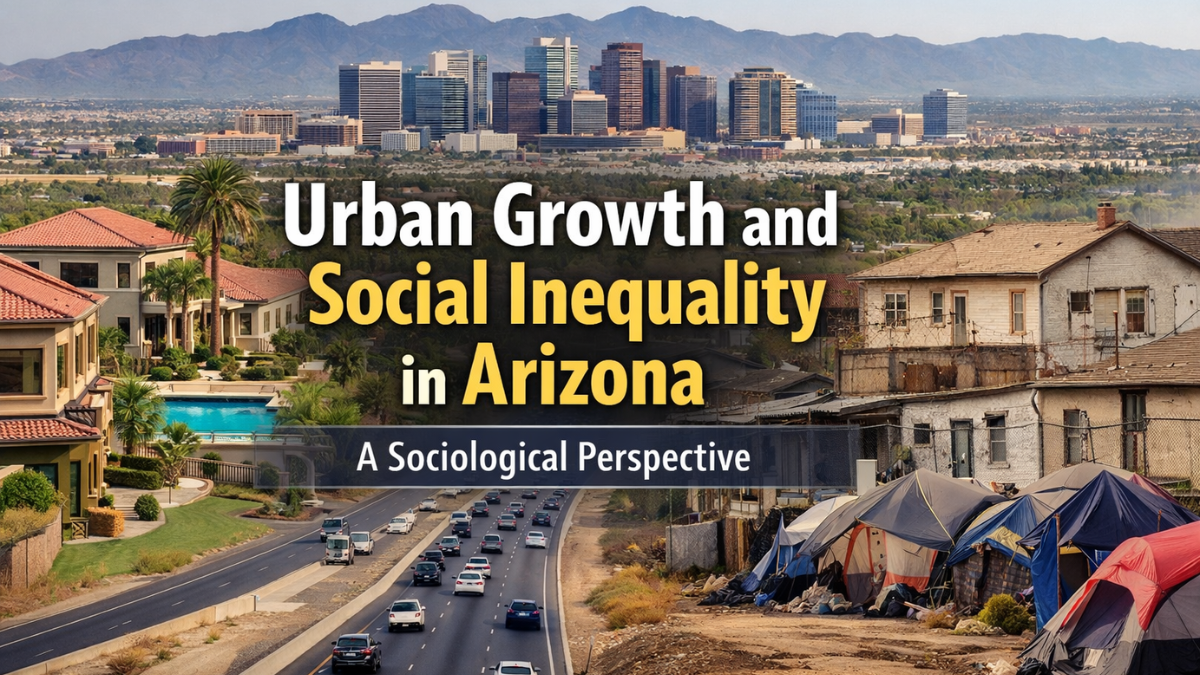
In Arizona, this spatial divide is evident in the contrast between affluent suburbs and marginalized urban neighborhoods. Gated communities, for example, symbolize exclusivity and socio-economic separation.
Housing Crisis and Affordability Issues
Rapid urban growth has placed immense pressure on Arizona’s housing market. Increasing demand, coupled with limited supply in certain areas, has led to rising housing costs.
This has several sociological consequences:
- Gentrification: Urban redevelopment often displaces low-income residents, pushing them to less desirable areas.
- Housing insecurity: Many households struggle to afford rent or homeownership.
- Homelessness: Economic disparities contribute to increasing homelessness in urban centers.
Housing inequality reflects broader structural issues within capitalism, where market-driven development prioritizes profit over social welfare.
In cities like Phoenix, the expansion of real estate markets has benefited developers and investors but has often marginalized vulnerable populations.
Racial and Ethnic Inequality
Arizona’s demographic diversity also highlights issues of racial and ethnic inequality. Hispanic and Native American communities, in particular, face systemic disadvantages in areas such as:
- Education
- Employment
- Healthcare
- Housing
Historical marginalization and discrimination have contributed to these disparities. Native American reservations, for example, often experience limited economic opportunities and infrastructural challenges.
Sociological theories of structural inequality and institutional racism help explain how these disparities persist despite overall economic growth.
Urban growth can sometimes exacerbate these inequalities by concentrating minority populations in under-resourced neighborhoods, leading to segregation and social exclusion.
Education and Social Mobility
Education is a critical factor in addressing social inequality. However, urban growth in Arizona has produced uneven educational outcomes.
Schools in affluent suburban areas tend to have better funding, facilities, and resources compared to those in low-income neighborhoods. This disparity affects students’ opportunities for upward mobility.
Sociologically, this reflects the concept of social reproduction, where inequalities are passed down across generations through institutions like education.
Without equitable access to quality education, urban growth risks reinforcing existing class divisions rather than reducing them.
Infrastructure and Public Services
Rapid population growth has placed significant strain on Arizona’s infrastructure. Transportation systems, healthcare facilities, and public services often struggle to keep pace with expanding urban populations.
In fast-growing regions, particularly at the urban fringe, local governments face challenges in providing adequate services.
This results in:
- Longer commute times
- Limited access to healthcare
- Overcrowded schools
- Environmental degradation
Infrastructure inequality further deepens social disparities, as wealthier communities are better able to access private services and amenities.
Environmental Inequality
Urban growth in Arizona also raises environmental concerns. The expansion of cities into desert ecosystems has led to issues such as:
- Water scarcity
- Air pollution
- Loss of natural habitats
Environmental inequality occurs when marginalized communities are disproportionately affected by these issues. For example, low-income neighborhoods may be located near industrial zones or areas with poor air quality.
Sociologically, this aligns with the concept of environmental justice, which examines how environmental burdens and benefits are distributed across different social groups.
Migration, Globalization, and Urban Inequality
Arizona’s urban growth is closely tied to globalization. Migration, both domestic and international, has reshaped the state’s demographic and economic landscape.
Immigrants contribute significantly to the labor force, particularly in sectors such as construction, agriculture, and services. However, they often face precarious working conditions and limited access to social services.

Research indicates that demographic changes, including the influx of foreign-born populations, play a crucial role in shaping urban inequality.
Globalization thus creates both opportunities and challenges, integrating Arizona into global economic networks while also intensifying local inequalities.
Sociological Theories Explaining Inequality
Several sociological theories help explain the relationship between urban growth and inequality in Arizona:
1. Conflict Theory
This perspective argues that inequality arises from competition over resources. Urban growth benefits powerful groups, such as developers and corporations, while marginalizing others.
2. Urban Ecology
This theory examines how population distribution and environmental factors shape urban spaces, highlighting patterns of segregation and spatial inequality.
3. Political Economy Approach
This approach focuses on how economic systems and policies influence urban development and inequality.
4. Social Exclusion Theory
This theory explains how certain groups are systematically excluded from economic and social opportunities.
These frameworks provide a comprehensive understanding of how urban growth can simultaneously generate prosperity and inequality.
Policy Responses and Solutions
Addressing social inequality in Arizona requires comprehensive policy interventions:
- Affordable housing programs to reduce displacement
- Investment in public education to promote social mobility
- Improved public transportation to enhance accessibility
- Inclusive urban planning to ensure equitable development
- Environmental regulations to protect vulnerable communities
Policymakers must adopt a holistic approach that balances economic growth with social justice.
Conclusion
Urban growth in Arizona presents a paradox. On one hand, it has driven economic development, population expansion, and cultural diversity. On the other hand, it has intensified social inequality, spatial segregation, and environmental challenges.
From a sociological perspective, this duality reflects broader patterns of urbanization in contemporary society. Growth is not inherently equitable; it must be managed through deliberate policies and inclusive planning.
Arizona’s experience offers valuable insights into the complexities of urban development in the 21st century. As cities continue to expand, the challenge lies in ensuring that growth benefits all members of society, rather than deepening existing inequalities.
FAQs on Social Inequality in Arizona
1. What is Social Inequality in Arizona?
Social Inequality in Arizona refers to unequal access to resources, opportunities, and services among different social groups based on income, race, education, and location.
2. What are the main causes of Social Inequality in Arizona?
The main causes include rapid urban growth, income disparities, housing shortages, racial discrimination, and unequal education systems.
3. How does urban growth contribute to Social Inequality in Arizona?
Urban growth often leads to uneven development, where affluent areas receive better infrastructure while poorer communities lack basic services.
4. Which cities are most affected by Social Inequality in Arizona?
Cities like Phoenix and Tucson show clear patterns of economic and spatial inequality.
5. How does housing affect Social Inequality in Arizona?
Rising housing costs and gentrification push low-income families into marginalized areas, increasing inequality.
6. What role does education play in Social Inequality in Arizona?
Unequal school funding leads to differences in quality education, limiting upward mobility for disadvantaged groups.
7. How does race influence Social Inequality in Arizona?
Hispanic and Native American populations often face systemic disadvantages in employment, housing, and healthcare.
8. Is Social Inequality in Arizona increasing?
Yes, with rising population and economic growth, inequality has become more visible in recent years.
9. How does employment structure affect Social Inequality in Arizona?
A dual labor market creates a gap between high-income professionals and low-wage workers.
10. What is spatial inequality in Arizona?
Spatial inequality refers to unequal distribution of resources across different geographic areas, especially between urban and suburban zones.
11. How does migration impact Social Inequality in Arizona?
Migration increases diversity but also creates pressure on jobs, housing, and public services, sometimes widening inequality.
12. What is the role of government in reducing Social Inequality in Arizona?
Government policies on housing, education, and infrastructure can help reduce disparities.
13. How does healthcare access relate to Social Inequality in Arizona?
Low-income communities often have limited access to quality healthcare services.
14. What is environmental inequality in Arizona?
It refers to marginalized communities facing higher exposure to pollution, water scarcity, and poor living conditions.
15. Can Social Inequality in Arizona be reduced?
Yes, through inclusive urban planning, policy reforms, and equitable distribution of resources.