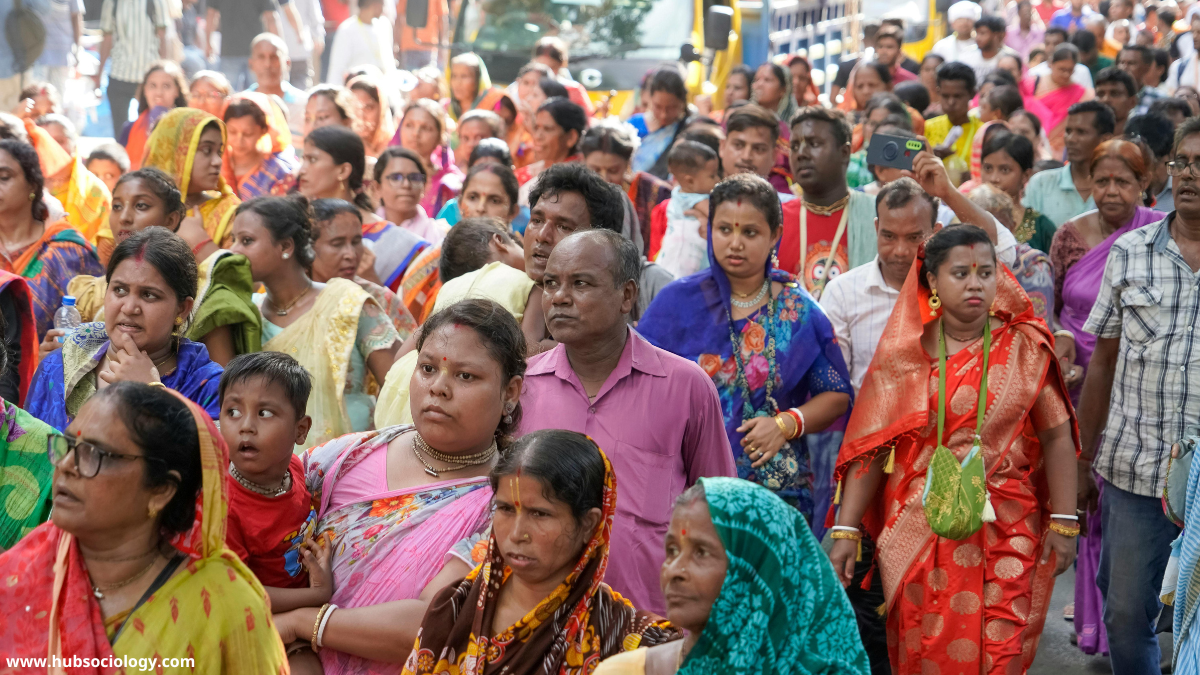
Introduction on Indian Society
India in the 21st century is a study in simultaneity: ancient traditions persist alongside rapid technological adoption; village life and hyper-urban consumerism co-exist; a rising middle class aspires upward while structural inequalities remain entrenched. These dynamics make contemporary India an especially rich subject for sociological analysis. Rather than presenting change as linear “modernization” replacing “tradition,” a more useful sociological frame recognizes multiple, overlapping transformations in demography, economy, politics, culture, and everyday social relations. This essay maps key directions of change, highlights their interactions, and reflects on social tensions and possibilities that follow.

Demographic shifts: smaller families, an ageing-but-still-young population, and urbanization
One of the most consequential trends is demographic change. Fertility has declined significantly — India reached replacement-level fertility in recent years, with the Total Fertility Rate around 2.0 according to the National Family Health Survey (NFHS-5). This shift alters family structures, dependency ratios, and long-term planning for pensions, health care, and urban infrastructure.
Urbanization continues steadily: a growing share of the population now lives in urban areas, reshaping occupational patterns, social networks, and political concerns. Urban growth concentrates educational and employment opportunities but also creates new forms of exclusion—slums, precarious labor, and overstretched civic services. Contemporary India’s urban transition is not simply migration to big metropolises; it includes expansion of small towns and peri-urban belts that reconfigure rural economies and social hierarchies.
Finally, rapid expansion of digital connectivity—hundreds of millions of internet users and near-ubiquitous mobile coverage—mediates nearly every social domain today, from education to activism to consumer culture. By the mid-2020s India registers among the world’s largest online populations, a fact that accelerates cultural diffusion while amplifying social visibility and political mobilization.
Economy and work: new sectors, informality and precarious livelihoods
Economic change brings a complex mix of opportunity and vulnerability. India has grown into a major services and technology hub, producing highly skilled IT and knowledge-sector labor concentrated in cities. Simultaneously, a large portion of the workforce remains in agriculture or informal services with low wages and insecure work. The gig economy, platform labor, and contract work create flexibility but also erode labor protections and benefits.
A crucial sociological point: economic transformation is uneven across gender, region, and caste. Women’s labour force participation, for example, has been rising in recent years but remains low compared with many peers; much female work is informal or self-employed, reflecting persistent care responsibilities and gender norms that shape how economic opportunity is experienced. Discussions about India’s “jobs challenge” are therefore also debates about dignity, social protection, and equitable inclusion.
Families, marriage, and gender relations: negotiation and change
Family patterns are shifting but in complex, non-uniform ways. Nuclear families are more visible in urban areas, and young people delay marriage or opt for smaller families; yet extended kinship ties and expectations continue to matter in social life, property transmission, and caregiving arrangements. Rising educational attainment and employment among women has altered household bargaining power in many instances—but the outcome is ambiguous. Women’s expanded education does not automatically translate into commensurate participation in formal employment or commensurate voice in family decision-making.
Marriage practices are also changing. Love marriages and partner choice outside caste or regional boundaries have increased in metropolitan milieus; at the same time arranged marriages remain the norm across much of the country. Social media and dating apps have created new spheres for meeting and negotiating relationships; they can expand individual autonomy while also exposing people to new social surveillance and moral panics.
Domestic care work remains predominantly unpaid and gendered. The state’s limited childcare and eldercare infrastructures push care responsibilities onto families, with large implications for women’s labour market choices. Policy interventions (childcare provision, parental leave, flexible workplaces) are therefore central to debates about equitable modernization.
Education and mobility: aspiration, credentialing, and inequality
Education has expanded dramatically in sheer scale: more young people are in school and higher education than earlier generations. Literacy and enrolment improvements have widened horizons for many families, creating stronger aspirations for upward mobility. Higher education and competitive examinations remain crucial gateways into elite occupations, but access remains stratified by class, region, and social capital.

Credential inflation—where degrees become necessary but not sufficient for stable employment—has produced frustration among graduates. Skill mismatches and regional disparities mean that education alone does not guarantee secure social mobility. The sociological consequence is a generation of aspirational youth balancing cultural capital with economic precarity.
Caste, religion and identity: persistence and politically salient transformations
Caste remains a structuring principle of Indian social life—affecting marriage, occupation, politics, and spatial segregation. Yet its public manifestations are changing: there is greater contestation, assertion, and legal mobilization by historically marginalized groups, who seek redistribution, representation, and dignity. Affirmative-action politics and caste-based mobilization continue to shape electoral and policy outcomes.
Religious identity has become more politically visible in recent decades. The rise of majoritarian politics in some contexts has intensified debates about secularism, minority rights, and citizenship. At the same time, religious reform movements, interfaith activism, and local solidarities complicate any monolithic portrayal of communal relations.
Notable legal and social advances on rights-based issues—such as the decriminalization of consensual same-sex relations by the Supreme Court in 2018—signal institutional openings for marginalized sexual minorities, even as social acceptance varies widely by region and class. The court’s Navtej Singh Johar judgment was a landmark turning point for LGBT rights in India and has facilitated greater public visibility and activism.
Technology, media, and public culture: speed, scale, and social mediation
Digital technologies and social media are central to 21st-century change. They reconfigure intimate life, political mobilization, information ecosystems, consumer culture, and labor markets. On one hand, the internet has democratized voice: social movements, whistleblowers, and grassroots campaigns can gain national attention rapidly. On the other, platforms create echo chambers, spread misinformation, and enable targeted political messaging that shapes electoral outcomes and social anxieties.
The scale of internet adoption in India—hundreds of millions of active users and near-universal 4G coverage—means social media is not only an urban elite phenomenon anymore; rural and small-town users contribute massively to digital cultures, political discourse, and market demand. This has transformed how cultural products circulate, how political narratives are built, and how social norms are contested.
Politics, civil society, and contestation
Political life in India continues to be vigorously contested in both electoral and extra-electoral arenas. The expansion of the political centrality of identity—religious, caste, linguistic—has reshaped party strategies, policy priorities, and public debates. Civil society remains active: NGOs, grassroots organizations, student movements, and legal litigations are important arenas for rights claims and public debate.
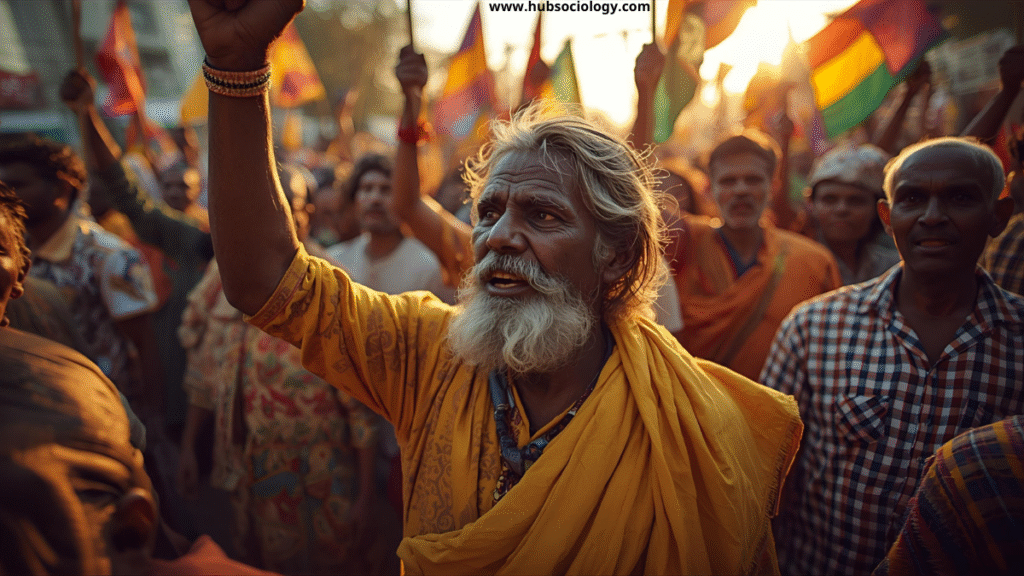
However, restrictions on civic space, surveillance concerns, and polarized media environments have complicated civic activism. Protest movements—over labor rights, land acquisition, environment, and gender—underscore the continuing centrality of contentious politics in shaping social change.
Health, welfare and the social determinants of wellbeing
Health indicators have improved in aggregate terms—infant mortality has fallen, immunization coverage increased, and fertility declined—but access remains uneven. The COVID-19 pandemic (2020–21) exposed deep weaknesses in public health infrastructure, social protections, and labor market safety nets. It also highlighted the interplay between economic vulnerability and health outcomes, intensifying debates about universal health coverage, social insurance, and rural health provisioning.
Chronic diseases (diabetes, cardiovascular conditions) are rising alongside persistent malnutrition in many regions—creating a dual burden that challenges both health policy and household coping strategies. Aging populations in certain regions bring new questions about elderly care, pensions, and chronic disease management.
Migration and mobility: internal and international flows
Internal migration—rural-to-urban, inter-state, and circular migration—remains a major force. Migrant labor undergirds construction, services, and informal manufacturing in cities, but migrants often face precarious housing, lack of social protections, and limited political voice. The social consequences include changing family arrangements (left-behind elders and children), remittance economies, and urban stratification.
International migration—skilled outward mobility and labor migration to Gulf countries—has created diasporic ties that affect remittances, cultural exchange, and political lobbying. Mobility reshapes identities, with transnational networks influencing local aspirations and consumption.
Culture, consumption, and everyday life
Rising incomes for many have shifted patterns of consumption: branded goods, digital subscriptions, processed food, and new leisure industries expand. Yet consumption patterns are uneven, and marked inequalities remain. Cultural life reflects both cosmopolitan influences and revived interest in regional traditions, film, and vernacular literatures. The simultaneous global and local orientation is a hallmark of contemporary Indian culture.
Everyday life is also governed by new rhythms—work commutes, app-based services, and media consumption—that alter time use, family interactions, and civic engagement. For many, life becomes a juggling act between new economic demands and persistent social expectations.
Inequality and social justice: persistent divides and emerging claims
Despite economic growth and expanded access to education and technology, inequality—by income, caste, gender, and region—remains a central social problem. Economic growth has not guaranteed equitable distribution of benefits; urban elites often experience a qualitatively different life from rural poor. Movements for social justice—from caste-based mobilization to feminist activism to environmental justice campaigns—reflect ongoing struggles to secure access to resources, dignity, and representative power.
Addressing inequality requires multi-sectoral responses: targeted redistribution, universal social protection systems, investments in public goods (health, education, sanitation), and policies that address structural discrimination.
Tensions, contradictions and pathways forward
Three broad contradictions define Indian social change:
- Opportunity vs. Exclusion. While millions access education, internet, and new jobs, many remain excluded from stable livelihoods and quality public services.
- Individualization vs. Social Embeddedness. Growing individual autonomy (in partner choice, consumer behavior) coexists with continued dependence on kin networks, caste ties, and community norms.
- Legal Progress vs. Social Practice. Legal advances (rights for marginalized groups) often lead social norms; institutional change precedes, follows, or gets stuck in culture in unpredictable ways.
Pathways forward must therefore be plural and intersectional. Policy must combine growth with redistribution; technological gains must be matched by digital literacy and regulation; and rights advances must be paired with grassroots education to transform social attitudes. Building inclusive cities, expanding social protection, investing in universal public services, and strengthening democratic institutions are central to making change equitable and sustainable.
Conclusion
Indian society in the 21st century is not simply “modernizing” in a single, uniform direction. It is reconfiguring along multiple axes—demographic, economic, technological, cultural, and political—producing both unprecedented opportunities and persistent inequalities. Sociological analysis reminds us to trace how macro-level processes (globalization, digitalization, policy reforms) are lived and negotiated in households, neighborhoods, workplaces, and courts. It also foregrounds agency: people—women activists, migrant workers, grassroots organizations, students, litigants—are not just passive recipients of change but active makers of new social arrangements.
Understanding India’s transformations therefore requires attention to both structure and agency, to deep continuities as well as emergent ruptures. The sociological lens invites policymakers, scholars, and citizens to focus not only on growth statistics, but on the quality of social bonds, the fairness of institutions, and the lived dignity of diverse groups. If the 21st century is to be one of more equitable and humane progress in India, that project must be built as much in law and macro-policy as in everyday solidarities and struggles.
Frequently Asked Questions (FAQs) on Indian Society
1. What is meant by Indian Society in sociological terms?
Indian Society refers to the complex social structure of India shaped by caste, class, religion, family systems, traditions, and modern institutions. Sociologically, it studies how these elements interact and change over time.
2. How is Indian Society changing in the 21st century?
Indian Society is changing through urbanization, digitalization, declining fertility rates, changing family patterns, increased education, and growing political and cultural awareness.
3. What role does globalization play in transforming Indian Society?
Globalization influences Indian Society by expanding markets, cultural exchange, migration, and digital connectivity, while also increasing inequality and cultural tensions.
4. Is caste still important in contemporary Indian Society?
Yes, caste continues to influence marriage, politics, education, and employment in Indian Society, though its forms of expression and resistance have changed significantly.
5. How has urbanization affected Indian Society?
Urbanization has reshaped Indian Society by altering occupations, weakening joint family systems, increasing anonymity, and creating new forms of inequality and social mobility.
6. What changes are occurring in family and marriage in Indian Society?
Indian Society is witnessing delayed marriages, smaller families, rising nuclear households, and growing acceptance of love marriages, especially in urban areas.
7. How is technology transforming Indian Society?
Technology has transformed Indian Society through social media, online education, digital payments, political mobilization, and changing communication patterns.
8. What is the status of women in modern Indian Society?
Women in Indian Society have gained better access to education and legal rights, but gender inequality persists in employment, wages, safety, and domestic responsibilities.
9. How does education influence social mobility in Indian Society?
Education is a major driver of aspiration and mobility in Indian Society, though unequal access and credential inflation limit its equalizing potential.
10. How has religion shaped changes in Indian Society?
Religion continues to be a powerful force in Indian Society, influencing politics, identity, and social norms, while also becoming a site of contestation and reform.
11. What impact has migration had on Indian Society?
Internal and international migration has reshaped Indian Society by changing family structures, urban labor markets, and cultural identities.
12. How did COVID-19 expose inequalities in Indian Society?
The pandemic revealed deep inequalities in Indian Society, especially in healthcare access, migrant labor conditions, and social security systems.
13. Is Indian Society becoming more individualistic?
Indian Society shows growing individualism in lifestyle and choices, but collective identities like family, caste, and community still strongly influence behavior.
14. How does media influence public opinion in Indian Society?
Traditional and digital media shape narratives, political opinions, and social values in Indian Society, often intensifying polarization and social debates.
15. What are the major challenges facing Indian Society today?
Key challenges facing Indian Society include inequality, unemployment, social polarization, environmental stress, gender injustice, and uneven access to public services.