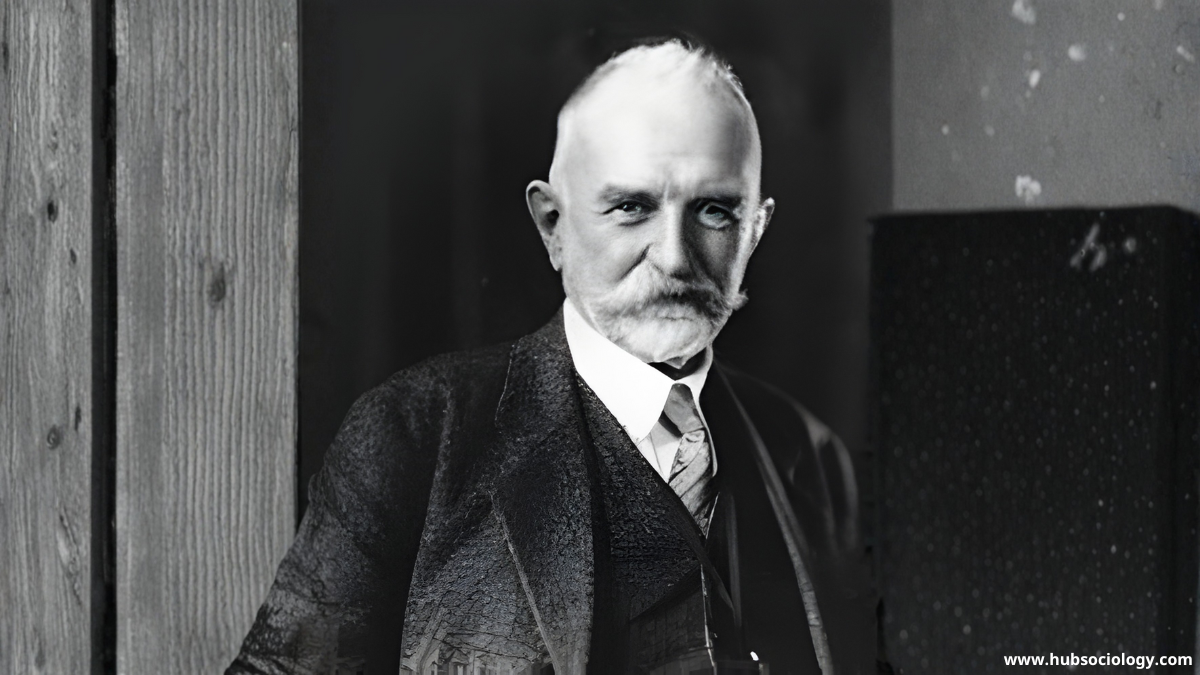
George Herbert Mead (1863–1931) stands as one of the most influential figures in the development of modern sociology, particularly for his contributions to the theory of Symbolic Interactionism. His ideas laid the foundation for understanding how individuals and societies are interrelated through symbols, language, and communication. Mead’s intellectual legacy transcends psychology and philosophy, profoundly shaping sociological thought about self, identity, and social interaction.
This article explores the sociological dimensions of Mead’s work, focusing on his concept of the self, the role of symbols and communication, and the emergence of social order through everyday interactions.
1. Introduction: The Foundations of Symbolic Interactionism
Symbolic Interactionism is a micro-sociological perspective that emphasizes the meanings individuals attach to their social world through symbols and interactions. Unlike macro-theories such as functionalism or conflict theory, which examine structures and systems, symbolic interactionism focuses on the everyday interactions that shape human behavior and social reality.
At the heart of this approach lies the idea that society is constructed through shared meanings and symbols, rather than being an external force imposed upon individuals. Mead’s intellectual foundation was influenced by pragmatism, social behaviorism, and Darwinian evolution, which together informed his understanding of human action as a social and interpretive process.
Mead’s posthumously published work, Mind, Self, and Society (1934), compiled from his lecture notes, became the cornerstone of symbolic interactionism.
2. The Concept of the Self
One of Mead’s most important contributions to sociology is his theory of the self. According to Mead, the self is not innate or biological; rather, it arises through social interaction. He proposed that the self emerges when an individual becomes an object to themselves — when they can view themselves from the perspective of others.
Mead divided the self into two components: the “I” and the “Me”.
- The “I” represents the spontaneous, creative, and individual aspect of the self. It is the response of the individual to the attitudes of others.
- The “Me” represents the socialized aspect — the internalized attitudes, norms, and expectations of the larger society.
The interaction between the “I” and the “Me” forms the dynamic process of selfhood. This duality illustrates how personal identity is both individual and social. The “I” allows for freedom and creativity, while the “Me” ensures conformity and social order.
In sociological terms, Mead’s concept of self highlights how socialization shapes human behavior. Through the process of interaction, individuals learn societal values, norms, and roles — thereby integrating themselves into the collective social structure.
3. Role-Taking and the Development of Self
A key mechanism in Mead’s theory is role-taking — the ability to put oneself in another person’s position and anticipate their responses. Through role-taking, individuals learn to view themselves from the perspective of others and develop empathy and understanding.

Mead described three stages in the development of the self:
- The Preparatory Stage:
Children imitate the behavior of others without fully understanding the meaning behind their actions. This stage involves mimicry rather than conscious role-playing. - The Play Stage:
Children begin to take on roles of specific others, such as parents or teachers. They act out roles in a playful manner, which helps them internalize different perspectives. - The Game Stage:
Individuals learn to understand multiple roles simultaneously and the broader expectations of society. They grasp the concept of the “generalized other” — the collective attitudes and norms of their community.
This process culminates in the formation of a mature self, capable of functioning within complex social systems.
Sociologically, Mead’s model explains how social roles and expectations are internalized by individuals, shaping their behavior and identity in a structured social environment.
4. The Role of Symbols and Communication
Symbols are central to Mead’s theory of interaction. A symbol is anything that carries a specific meaning recognized by people who share a culture — such as words, gestures, or objects. For Mead, language is the most important system of symbols, as it allows humans to communicate abstract ideas, reflect on themselves, and coordinate actions with others.
Mead introduced the concept of significant symbols, referring to gestures or words that evoke the same response in both the individual making them and the individual receiving them. This shared understanding makes social interaction possible.
Through communication, individuals negotiate meanings, establish social norms, and construct social reality. Society, therefore, is seen as an ongoing process of symbolic interaction — constantly created and recreated through communication.
This insight marked a departure from deterministic sociological theories that viewed individuals as passive recipients of social forces. Instead, Mead emphasized agency, where individuals actively interpret and define their social world.
5. Mind, Self, and Society: Interrelation
In Mead’s framework, mind, self, and society are interdependent processes.
- The mind arises from social interaction and symbolic communication — it is not a precondition but a product of social life.
- The self develops through reflection and role-taking within social contexts.
- The society provides the structure of shared meanings and norms that enable communication and cooperation.
These three elements form a dynamic process where individuals and society continuously shape one another. The social process precedes the individual — that is, humans become individuals only through social experience.

This interrelation forms the core of symbolic interactionism, suggesting that reality itself is socially constructed through interpretation and communication.
6. Sociological Implications of Mead’s Theory
Mead’s theory has profound implications for sociology. It provides the basis for understanding micro-level interactions, identity formation, and the construction of social reality. His ideas influenced later sociologists such as Herbert Blumer, who coined the term symbolic interactionism, as well as Erving Goffman and Howard Becker, who expanded the theory in the study of self-presentation and deviance.
Some key sociological implications include:
- Socialization: Mead’s framework explains how individuals internalize societal norms and values through interaction, forming the foundation of social order.
- Identity Formation: The self is dynamic, changing with new interactions and experiences, highlighting the fluid nature of identity.
- Communication and Meaning: Social reality is built through communication, emphasizing the interpretive process in everyday life.
- Agency and Structure: Mead bridged the gap between individual freedom (agency) and social constraint (structure) by showing how both interact through the self.
In applied sociology, symbolic interactionism has been used to study socialization in education, identity in gender roles, deviance labeling, and interpersonal relationships — areas where meaning and interpretation are central.
7. Criticisms of Symbolic Interactionism
Despite its influence, symbolic interactionism has faced several criticisms.
- Micro-level focus: Critics argue that it neglects macro-social structures like institutions, class, and power relations.
- Subjectivity: Its emphasis on interpretation makes it difficult to generalize findings or establish objective sociological laws.
- Neglect of Emotion and Conflict: The theory often underplays emotional, irrational, or conflictual dimensions of human behavior.
However, these critiques also highlight its strength — its sensitivity to individual meaning-making and its capacity to capture the nuances of everyday social life.
8. Conclusion: Mead’s Enduring Legacy
George Herbert Mead’s symbolic interactionism remains one of sociology’s most insightful theoretical frameworks. His emphasis on communication, role-taking, and symbolic understanding transformed how we perceive the relationship between individuals and society.

By illustrating that the self and social reality are not fixed entities but ongoing processes shaped through interaction, Mead opened new pathways for studying human behavior. In today’s digital and globalized world, where identity and communication have taken new symbolic forms — from social media interactions to virtual communities — Mead’s ideas are more relevant than ever.
In the sociological perspective, G.H. Mead teaches that society is not merely an external structure but a living process — created, maintained, and transformed by the meanings we share and the symbols we use. Through interaction, we not only shape the world but continuously recreate ourselves within it.
Do you like this Article ? You Can follow as on :-
Facebook – https://www.facebook.com/hubsociology
Whatsapp Channel – https://whatsapp.com/channel/0029Vb6D8vGKWEKpJpu5QP0O
Gmail – hubsociology@gmail.com
Topic Related Questions
5 Marks Questions
- Who was George Herbert Mead, and why is he important in sociology?
- Define Symbolic Interactionism according to G.H. Mead.
- What do Mead’s terms “I” and “Me” signify?
- Explain the concept of the generalized other.
- What is a significant symbol in Mead’s theory?
- Mention the three stages of self-development according to Mead.
- How does Mead distinguish between the self and the mind?
- State two main features of Symbolic Interactionism.
- What is the role of communication in Mead’s theory of self?
- How is Mead’s theory different from structural functionalism?
10 Marks Questions
- Discuss the process of self-development according to G.H. Mead.
- Explain the main ideas of Symbolic Interactionism in sociological terms.
- Analyze the role of language and symbols in Mead’s theory of the self.
- Explain the concepts of “I” and “Me” and their interaction in forming the self.
- Describe Mead’s contribution to the understanding of socialization.
- How does role-taking contribute to the development of self according to Mead?
- Evaluate the relationship between mind, self, and society in Mead’s theory.
- What are the sociological implications of Mead’s Symbolic Interactionism?
- Discuss the stages of self-development with suitable examples.
- Examine how Mead’s ideas influenced later sociologists like Herbert Blumer and Erving Goffman.
15 Marks Questions
- Critically examine George Herbert Mead’s theory of Symbolic Interactionism.
- Discuss in detail the process of formation of self in Mead’s theory. How does the self emerge through interaction?
- Explain how mind, self, and society are interrelated in Mead’s sociological framework.
- Evaluate the sociological significance of symbols and communication in the development of society according to G.H. Mead.
- Compare and contrast Mead’s Symbolic Interactionism with structural and conflict theories of society.
- Discuss the major criticisms of Symbolic Interactionism. How do they affect the applicability of Mead’s theory in modern sociology?
- Analyze the contribution of G.H. Mead to micro-sociological thought with reference to contemporary social interactions.
- “The self is a social product.” Explain this statement with reference to Mead’s theory.
- Examine the relevance of Mead’s ideas in understanding identity formation in the digital age.
- Discuss how Mead’s Symbolic Interactionism helps in understanding the relationship between individual agency and social structure.