
Elections are the cornerstone of democracy — a process through which citizens exercise their right to choose representatives and shape the direction of their societies. However, voting is not merely a political act; it is a deeply social phenomenon shaped by cultural values, class structures, group identities, and historical experiences. Sociology seeks to understand why people vote the way they do, not just how they vote. The sociology of elections examines voting behaviour through the lens of social structures, collective consciousness, and group affiliations, highlighting that the ballot box reflects more than individual choice — it reveals patterns of social life.
This article explores the sociological foundations of voting behaviour, focusing on the interplay of social class, religion, caste, ethnicity, gender, media influence, and modernization. It also discusses theoretical perspectives and empirical findings that explain electoral dynamics in both developed and developing societies.
1. Introduction: Voting as a Social Phenomenon
From a sociological standpoint, elections are arenas where social divisions, cultural beliefs, and collective aspirations are expressed. Although democratic theory often portrays voters as rational actors making calculated decisions, sociology emphasizes that individual voting behaviour is influenced by social context — family, peer groups, community networks, and cultural traditions.
Emile Durkheim, the father of sociology, argued that social facts shape individual actions. Voting, too, can be understood as a social fact — it reflects the norms, values, and collective consciousness of a society. People often vote not purely for policies, but for identity, belonging, and social recognition. Elections become moments when citizens reaffirm their place within a moral and cultural community.
2. Theoretical Perspectives on Voting Behaviour
Sociologists and political scientists have proposed several models to explain why people vote the way they do. Three major sociological models — the socio-structural model, the party identification model, and the rational choice model — offer complementary insights.
a. The Socio-Structural Model (Columbia School)
Developed by Paul Lazarsfeld and colleagues in the 1940s through studies in the United States, this model emphasizes that voting behavior is determined by social group membership. Class, religion, and region are key determinants. Lazarsfeld’s “The People’s Choice” (1944) found that political opinions are largely shaped by group affiliations and social networks, rather than individual reasoning.
For instance, working-class individuals tend to support parties that promise economic redistribution, while upper-class voters align with parties favoring market liberalization. Religious voters may favor parties reflecting their moral values. Hence, people vote as members of social categories, not as isolated citizens.
b. The Party Identification Model (Michigan School)
This model, developed by Angus Campbell and others in the 1950s, suggests that people develop a long-term psychological attachment to a political party — much like loyalty to a social group. This identification is often inherited from family and reinforced by community norms.
Voting becomes an expression of social identity. For example, in India, families or castes may traditionally support the Congress Party or a regional party. In the UK, working-class families historically aligned with Labour, while middle-class families favored Conservatives.
c. The Rational Choice Model
While the rational choice theory originates in economics, it intersects with sociology when examining how individuals weigh costs and benefits within their social constraints. Voters may choose parties that maximize perceived self-interest — economic gain, social welfare, or identity security. However, sociologists critique this model for underestimating the power of culture, emotion, and community belonging in shaping decisions.
3. Social Class and Voting Patterns
Social class remains one of the most enduring factors influencing electoral behavior. Karl Marx viewed class as a fundamental division shaping political consciousness — “the ruling ideas of each age are the ideas of the ruling class.” From this perspective, elections often reflect struggles between economic classes, mediated through political parties.
In industrial societies, working-class voters traditionally supported socialist or labor-oriented parties, while the bourgeoisie favored conservative or liberal parties defending property rights. Although class-based voting has weakened in post-industrial societies, economic inequalities still strongly influence political attitudes.
In India, class divisions intersect with caste and religion, producing complex voting patterns. Urban working classes may vote for populist parties promising subsidies and welfare programs, while middle and upper classes may prefer pro-market reforms. Sociological studies of Indian elections reveal that economic aspirations are often filtered through social identity rather than pure material interest.
4. Caste, Religion, and Ethnicity in Voting Behavior
Caste and religion are particularly significant in South Asian societies. The sociologist M.N. Srinivas described caste as a “segmental division of society,” and this segmentation often extends into political behavior. Political parties mobilize caste groups through identity-based appeals, known as vote banks.
In India, the rise of regional parties such as the Bahujan Samaj Party (BSP) and Samajwadi Party (SP) illustrates how caste-based solidarity can transform into political power. Similarly, religion influences voting through the formation of communal identities. Parties often draw support from religious communities by promising protection of cultural or moral values.
In multi-ethnic societies like the United States, ethnicity also shapes voting. African Americans have largely supported the Democratic Party since the Civil Rights Movement, while white evangelical Christians often favor conservative candidates. In both cases, group identity, discrimination, and collective history influence political choices.
5. Gender and Voting Behavior
Gender is another crucial axis of electoral sociology. Historically, women were underrepresented in political participation due to patriarchal structures. Over time, as gender equality movements gained momentum, women emerged as a significant electoral force.
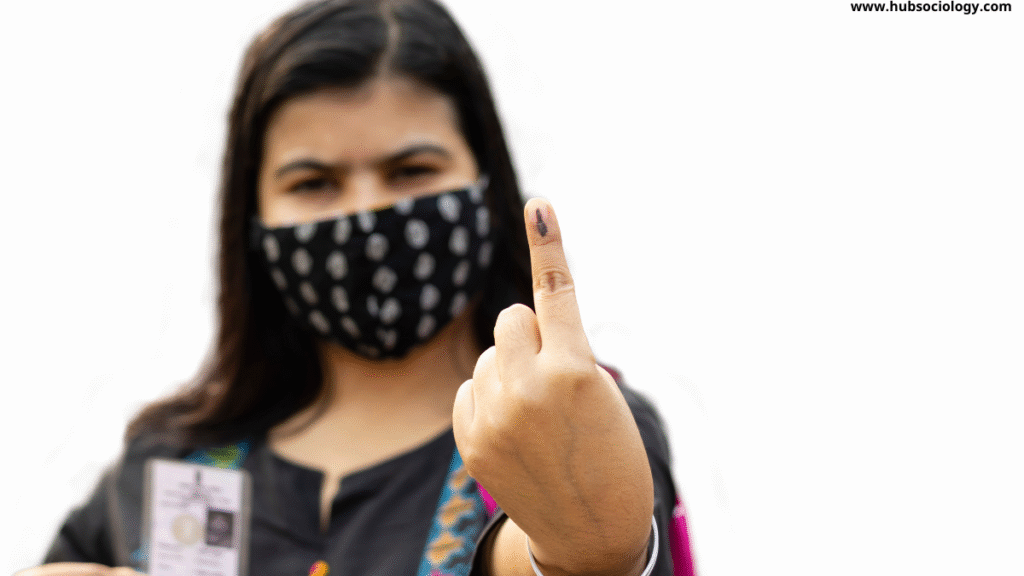
Feminist sociologists argue that women’s voting patterns reflect both gender-based experiences and social expectations. In many countries, women are more likely to support parties advocating for welfare, education, healthcare, and peace — issues aligning with caregiving roles historically associated with women.
In India, the increasing turnout of women voters has transformed electoral politics. Parties have introduced gender-sensitive policies, such as LPG subsidies, free education for girls, and women’s reservation in local governance, recognizing that women voters are not passive participants but active agents of change.
6. Family, Community, and Peer Influence
Voting behavior is deeply socialized within families and communities. Early political orientation is often shaped by parental influence — a phenomenon known as political socialization. Family discussions, community norms, and peer pressure play a vital role in transmitting political values.
In rural areas or traditional societies, local leaders, religious figures, or caste panchayats may influence community voting behavior. In urban settings, peer groups and workplace discussions shape opinions. Sociologists note that individuals often align their voting preferences with those of people they trust and identify with socially.
7. The Role of Media and Political Communication
In modern societies, mass media and digital platforms have become powerful agents of political socialization. Television, newspapers, social media, and online campaigns not only inform but also shape public perceptions and emotions.
The “agenda-setting” function of media — deciding which issues are important — influences voters indirectly. Social media, through algorithms, often reinforces echo chambers, where individuals are exposed only to opinions matching their existing beliefs. This creates polarization and identity-driven politics.
From a sociological standpoint, media does not simply transmit information but constructs meanings, symbols, and narratives. For example, the portrayal of leaders as “messiahs of the poor” or “protectors of the nation” taps into collective emotions and group identities. Thus, elections in the digital era are not just contests of ideas but of mediated images.
8. Regional and Cultural Variations
Sociological studies show that regional cultures shape political behavior differently. In agrarian societies, kinship and land relations influence voting. In industrial societies, class and occupation play a greater role.
In India, regional variations are striking. The Dravidian movement in Tamil Nadu reflects linguistic and cultural assertion, while in West Bengal, leftist ideologies dominated for decades due to historical class struggles. In contrast, northern states exhibit more caste and religious polarization.
These variations demonstrate that electoral behavior cannot be universalized; it must be understood in its socio-historical context. Each election reflects the specific configuration of social forces within a region.
9. Modernization, Urbanization, and Changing Voting Patterns
With modernization and urbanization, traditional determinants such as caste and class are gradually giving way to issue-based politics. Young voters, especially in urban areas, are influenced more by economic opportunities, governance performance, and digital campaigns than by traditional loyalties.
Anthony Giddens’ concept of reflexive modernity explains this shift: individuals today make choices based on self-awareness and changing life circumstances, rather than inherited structures. However, this does not eliminate identity politics; rather, it reconfigures it in new forms — nationalism, environmentalism, or digital activism.
In developing democracies, modernization has expanded political participation but also intensified competition, leading to populism, celebrity politics, and emotional appeals. Sociologically, these trends show how modernization reshapes the relationship between citizens and the state.
10. The Sociological Meaning of Voting
Voting can be viewed as both an individual and collective act of meaning-making. It expresses not only preference but belonging. The act of voting ties individuals to their communities, traditions, and visions of the future.
Pierre Bourdieu’s concept of habitus — internalized dispositions shaped by social experience — helps explain why people often vote consistently across generations or social groups. Voting reflects the “feel for the game” that individuals acquire through their social position and experiences.

Moreover, elections reinforce the legitimacy of the political system. Even those who abstain from voting make a sociological statement — often of alienation or protest. Hence, participation or non-participation are both socially meaningful acts.
11. Case Study: Electoral Sociology in India
India offers a fascinating laboratory for the sociology of elections. With its diversity of caste, religion, language, and region, voting behavior here illustrates the complex intersection of traditional and modern factors.
Studies by political sociologists like Yogendra Yadav and Rajni Kothari highlight that Indian elections are not only about policies but also about social representation. Caste alliances, regional pride, and charismatic leadership often outweigh ideological commitments.
However, the increasing participation of youth, women, and urban voters is transforming the political landscape. The shift toward issue-based campaigns — such as employment, corruption, and development — shows that Indian democracy is evolving while remaining rooted in its social diversity.
12. Conclusion: Understanding Democracy Through Sociology
The sociology of elections reveals that voting is far more than an individual decision — it is a mirror of society’s structures, conflicts, and aspirations. People vote the way they do because they are embedded in networks of family, class, religion, and culture that shape their worldview.
Sociology helps us see that democracy is not just about procedures but about social belonging. Electoral outcomes are products of social forces — of collective identities negotiating power within a shared political space.
As societies modernize, traditional determinants like caste and class evolve, but they are replaced by new social divisions — between rural and urban, digital and non-digital, local and global citizens. To understand why people vote the way they do, one must therefore look beyond manifest choices to the underlying social currents that guide them.
Ultimately, elections are a sociological mirror — reflecting who we are, what we value, and how we imagine our collective future.
Do you like this this Article ? You Can follow as on :-
Facebook – https://www.facebook.com/hubsociology
Whatsapp Channel – https://whatsapp.com/channel/0029Vb6D8vGKWEKpJpu5QP0O
Gmail – hubsociology@gmail.com
15 FAQs on the Sociology of Elections
1. What is the Sociology of Elections?
The Sociology of Elections is the study of how social factors such as class, caste, religion, gender, and community influence voting behavior and electoral outcomes. It examines elections not just as political events but as reflections of social structures and collective identities.
2. Why is the Sociology of Elections important?
It helps us understand why people vote the way they do, how group identities shape political preferences, and how social inequalities are expressed through electoral participation. This understanding strengthens democratic analysis and policy-making.
3. How does social class affect voting behavior?
In the Sociology of Elections, social class is seen as a major determinant of voting behavior. Working-class voters often support parties advocating for economic equality, while middle and upper classes tend to favor parties promoting market freedom and stability.
4. What role does caste play in the Sociology of Elections in India?
Caste is a key factor in Indian elections. Many voters align with parties representing their caste interests or social status. The Sociology of Elections in India highlights how caste-based solidarity transforms into political alliances and “vote banks.”
5. How does religion influence electoral behavior?
Religion shapes voters’ moral values and political identities. In the Sociology of Elections, religion is studied as a collective force that influences political alignment, communal voting, and party support based on faith-based ideologies.
6. What is the socio-structural model in the Sociology of Elections?
The socio-structural model (Columbia School) explains that people vote according to their social group memberships—such as class, religion, and region—rather than purely individual preferences. It emphasizes that voting is socially patterned behavior.
7. How do family and community influence voting patterns?
According to the Sociology of Elections, family and community act as agents of political socialization. People often inherit political preferences from parents or are influenced by peer groups and community networks during elections.
8. What is the role of gender in the Sociology of Elections?
Gender shapes voting through social roles, identity, and life experiences. Women’s voting behavior often reflects concerns for welfare, education, and family security. The Sociology of Elections examines how gender equality and empowerment impact political participation.
9. How does modernization affect voting behavior?
Modernization leads to changing values and reduced influence of traditional structures like caste or religion. In the Sociology of Elections, modernization is seen as creating more issue-based, individual, and rational voting patterns.
10. What impact does media have in the Sociology of Elections?
Media and digital platforms shape voter perceptions through information framing and emotional appeal. The Sociology of Elections studies how mass communication, advertisements, and social media campaigns influence public opinion and voting behavior.
11. How does urbanization change electoral sociology?
Urbanization diversifies social interactions and exposes individuals to new issues like employment, infrastructure, and governance. The Sociology of Elections finds that urban voters are often more issue-oriented and less influenced by traditional loyalties.
12. What are the key sociological theories explaining voting behavior?
Major theories in the Sociology of Elections include the socio-structural model, the party identification model, and the rational choice model. Each explains voting through different lenses — group membership, psychological attachment, and calculated self-interest.
13. How do ethnicity and race influence the Sociology of Elections globally?
Ethnicity and race shape political alliances and collective consciousness. The Sociology of Elections highlights how marginalized ethnic groups often support parties that promise representation, equality, and social justice.
14. What is the relationship between democracy and the Sociology of Elections?
Democracy depends on understanding social participation. The Sociology of Elections reveals that electoral behavior reflects not only political choice but also social belonging, legitimacy, and the health of democratic culture.
15. How can studying the Sociology of Elections help policymakers?
By analyzing social patterns of voting, policymakers can design inclusive policies, promote equitable representation, and address group-specific needs. The Sociology of Elections provides insight into how social factors shape political stability and citizen engagement.