Introduction
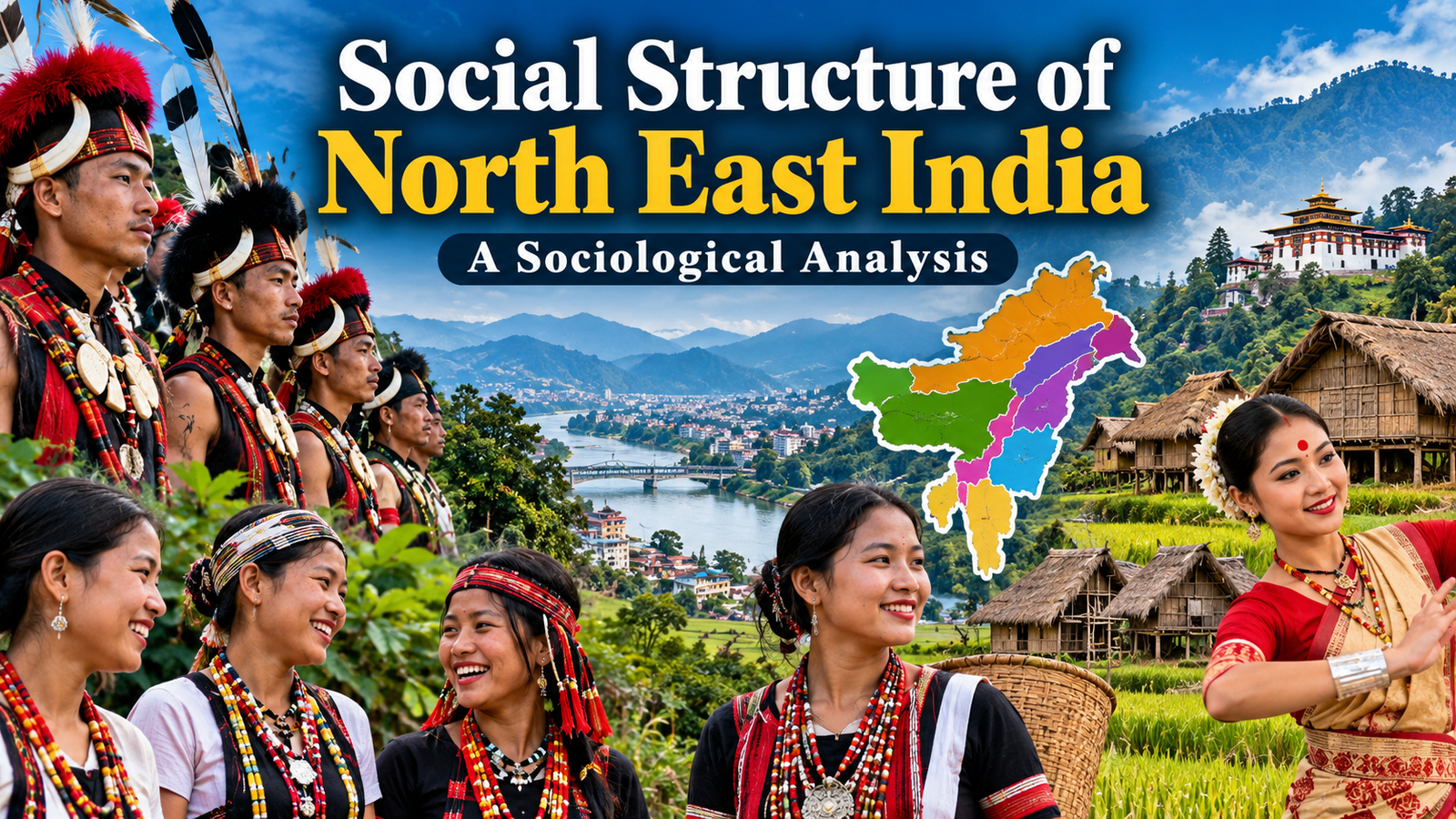
The Social Structure of North East India represents one of the most diverse and distinctive social formations in the Indian subcontinent. The region, comprising eight states—Assam, Arunachal Pradesh, Manipur, Meghalaya, Mizoram, Nagaland, Sikkim and Tripura—is characterised by a rich variety of ethnic communities, languages, religious traditions, kinship systems and cultural practices. Its geographical position between South Asia and Southeast Asia has historically influenced migration, trade, cultural exchange and the development of different social institutions.
From a sociological perspective, the Social Structure of North East India can be understood through the relationships between individuals, families, communities, social institutions and wider political and economic systems. Tribal social organisation, customary laws, village institutions, clan relationships and community-based practices have played important roles in shaping everyday life. At the same time, urbanisation, education, migration, religious change and modern political institutions have transformed traditional patterns of social organisation.
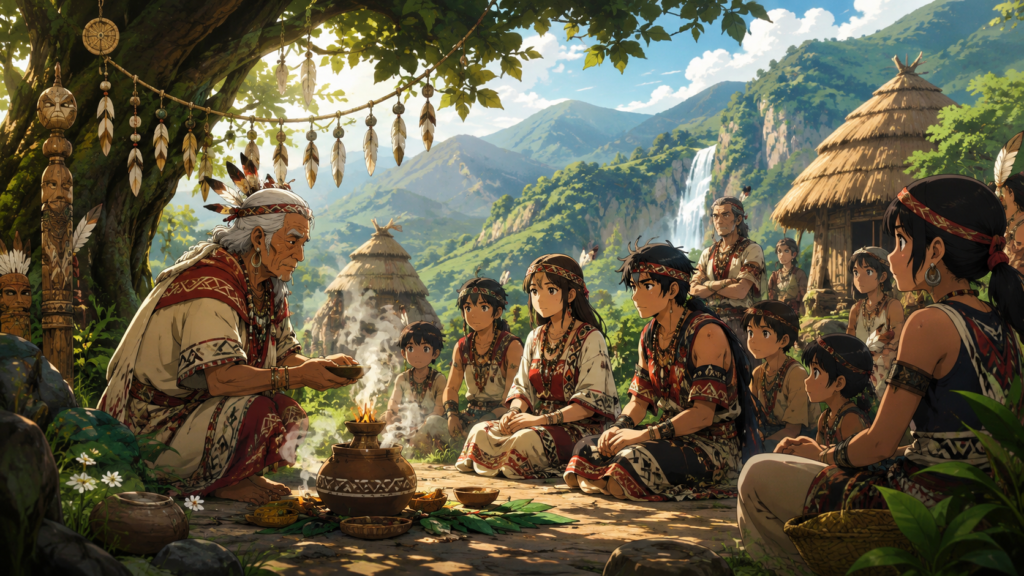
It is important to recognise that North East India is not a single homogeneous society. The region contains numerous communities with distinct histories and social arrangements. For example, Khasi and Garo societies in Meghalaya are known for matrilineal traditions, while many Naga, Mizo, Assamese, Meitei and other communities have different systems of descent, inheritance, family organisation and community governance.
Therefore, studying the Social Structure of North East India requires an approach that recognises both cultural diversity and shared experiences. This article examines the region through major sociological concepts, including ethnicity, kinship, family, religion, social stratification, gender relations, economy, political organisation and social change.
1. Meaning and Sociological Significance of Social Structure
In sociology, social structure refers to the relatively stable patterns of social relationships, institutions, statuses and roles through which society is organised. It determines how individuals interact, how resources are distributed and how social expectations are maintained across generations.
The Social Structure of North East India can be examined through several interconnected institutions, including family, marriage, kinship, religion, economy, education and local governance. These institutions influence people’s identities, responsibilities, opportunities and relationships within their communities.
Social structure is not merely a collection of customs or traditions. It also involves power relations, social inequalities, systems of authority and access to resources. For example, customary institutions may strengthen community solidarity, but particular practices can also produce inequalities based on gender, class, ethnicity or social position.
The sociological importance of the Social Structure of North East India lies in its ability to demonstrate how societies organise themselves under different geographical, cultural and historical conditions. The region offers valuable examples of community-based social organisation, diverse kinship arrangements, customary governance and the interaction between indigenous institutions and modern state structures.
2. Ethnic Diversity and Community Identity
Ethnic diversity is one of the most important characteristics of the Social Structure of North East India. The region is home to numerous indigenous peoples and other communities with distinctive languages, cultural practices, historical memories and collective identities.
Major communities include the Bodos, Misings, Karbis, Dimasas and Ahoms in Assam; the Nagas and Kukis in Manipur and Nagaland; the Khasis, Jaintias and Garos in Meghalaya; the Mizos in Mizoram; the numerous tribal communities of Arunachal Pradesh; and the Tripuri, Reang or Bru and other communities in Tripura. Sikkim has its own diverse social composition, including Lepcha, Bhutia, Nepali-speaking and other communities.
Ethnic identity often develops through shared ancestry narratives, language, customary practices, territory and collective historical experiences. These elements help individuals understand their relationship with their community and distinguish their group identity from others.
In the Social Structure of North East India, ethnicity can promote solidarity, mutual assistance and cultural preservation. Community organisations frequently play significant roles in festivals, dispute resolution, education and collective development.
However, ethnic identity can also become connected with political competition, demands for autonomy, land rights and debates over migration and citizenship. These tensions should not be interpreted as inevitable consequences of ethnic diversity. They are shaped by historical experiences, political representation, resource distribution and institutional arrangements.
A sociological understanding must therefore examine both the integrative and conflict-producing dimensions of ethnic identity.
3. Tribal Society and Traditional Community Organisation
Tribal communities occupy a significant place in the Social Structure of North East India. Many communities have historically organised social life through clans, village networks, customary institutions and community-based systems of resource management.
Traditional village life often involves cooperation in agriculture, festivals, construction, religious activities and the resolution of disputes. Community relationships can provide social security, particularly where formal welfare institutions are limited or difficult to access.
In several communities, village councils, elders or customary authorities have traditionally exercised influence over social conduct and dispute settlement. Their powers and responsibilities vary considerably across communities and states. In some areas, customary institutions continue to function alongside elected local bodies and formal legal institutions.
The Social Structure of North East India also demonstrates that tribal societies are not static or isolated. Communities have continuously adapted to new technologies, education, markets, administrative arrangements and political developments.
Moreover, the term tribal covers highly diverse populations and should not be treated as a synonym for one uniform social system. Some communities maintain strong customary institutions, while others have experienced substantial urbanisation and changes in occupation, education and lifestyle.
The sociological significance of tribal social organisation lies in the relationship between community solidarity, cultural continuity, local authority and changing social conditions.
4. Family, Marriage and Kinship Systems

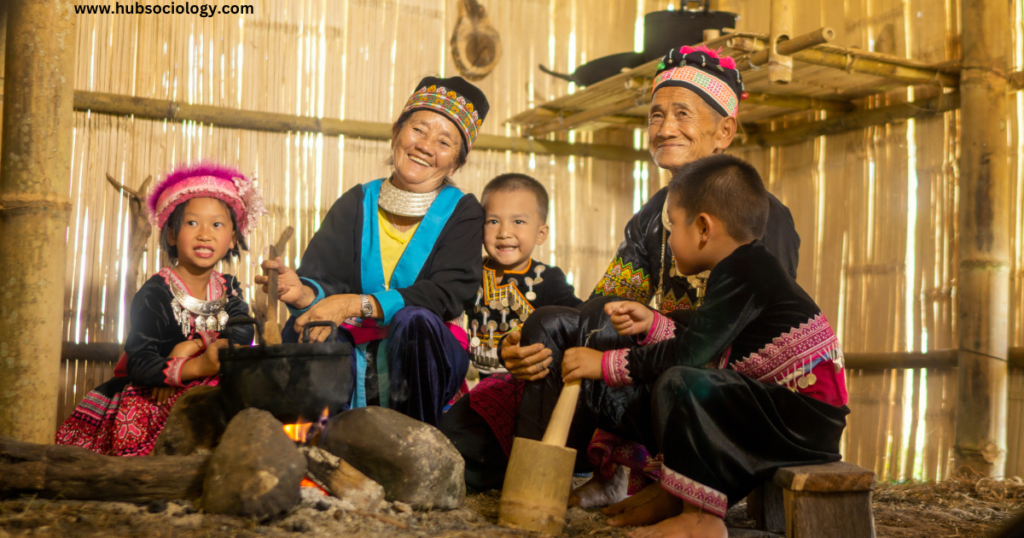
Family and kinship are fundamental components of the Social Structure of North East India. They influence inheritance, residence, marriage, caregiving, social identity and obligations between generations.
Nuclear families have become increasingly visible in urban areas, especially among people pursuing education and employment away from their ancestral villages. However, extended family networks and wider kinship relationships continue to influence social life in many communities.
Marriage practices differ across the region. Community customs, religious traditions, family preferences and contemporary legal frameworks all shape marital relationships. Marriage may establish alliances between families, strengthen community networks and influence access to property and social support.
Kinship is particularly important because it connects individuals with larger networks of relatives and community members. These networks may provide assistance during illness, unemployment, marriage ceremonies and other important life events.
Matrilineal Society in Meghalaya
One of the most distinctive features of the Social Structure of North East India is the existence of matrilineal traditions among Khasi, Jaintia and Garo communities in Meghalaya.
Matrilineality refers to tracing descent through the mother’s line. In many Khasi and Garo traditions, children belong to their mother’s clan, and customary inheritance arrangements may favour particular female descendants. Among Khasi communities, the youngest daughter has traditionally held a special inheritance role in many families, although actual practices vary.
Matrilineality should not be confused with matriarchy. A matrilineal society does not necessarily mean that women control all political, economic or religious institutions. Men may retain important roles in community leadership, household decision-making or public affairs, depending on the community and context.
This distinction is sociologically significant because it demonstrates that descent, property ownership, household authority and political power are separate dimensions of social organisation.
The Social Structure of North East India thus challenges the assumption that all Indian societies follow the same patrilineal family model.
5. Religion, Belief Systems and Social Solidarity
Religion is another important institution shaping the Social Structure of North East India. The region contains Christianity, Hinduism, Buddhism, Islam, indigenous belief systems and other religious traditions.
Christianity has had a particularly significant influence in several parts of Nagaland, Mizoram and Meghalaya. Hindu traditions are important among many communities in Assam, Tripura and Manipur, while Buddhism has a prominent presence in parts of Arunachal Pradesh and Sikkim. Islam also forms an important component of Assam’s religious and social diversity.
Indigenous religious traditions have historically connected communities with ancestral practices, sacred landscapes, agricultural cycles and ideas about the natural world. Some communities continue to maintain indigenous beliefs alongside or in interaction with organised religions.
Religion contributes to social solidarity through festivals, collective worship, moral expectations, charitable activities and community organisations. Religious institutions can also provide education, healthcare and social assistance.
In the Social Structure of North East India, religious change has sometimes reshaped marriage customs, education, community leadership and relationships with neighbouring groups. These changes have not necessarily eliminated older cultural practices; instead, traditional and newer forms of social organisation frequently coexist.
A sociological analysis must also recognise that religion can become intertwined with ethnic identity and political mobilisation. Understanding these relationships requires attention to historical context rather than generalisations about religious communities.
6. Social Stratification, Class and Inequality
Although many communities in North East India have strong traditions of community cooperation, their societies are not entirely free from social inequality. The Social Structure of North East India includes differences based on wealth, education, occupation, gender, ethnicity, land ownership and access to political institutions.
Economic stratification has become increasingly significant with the expansion of markets, salaried employment, business activities and urban development. Individuals with higher educational qualifications or access to government employment may possess advantages in income, status and social mobility.
Land ownership and access to forests and other natural resources can also shape social relationships, particularly in rural and indigenous communities. Changes in land use, infrastructure development and commercial activity may create conflicts over ownership, livelihoods and community rights.
Caste relations also exist in parts of the region, particularly among communities influenced by wider Hindu social traditions. However, caste should not be assumed to operate identically across all North Eastern societies. Ethnic identity, customary status, class and other forms of social differentiation may be more prominent in particular contexts.
The Social Structure of North East India therefore requires a multidimensional understanding of stratification. Social inequality emerges through the interaction of traditional institutions, modern economic processes and unequal access to public resources.
7. Gender Relations and Women’s Social Position
Gender relations are a significant aspect of the Social Structure of North East India. Women’s roles in household management, agriculture, trade, education and community life differ across communities and geographical settings.
Women in several North Eastern societies participate actively in agricultural production, local markets and informal economic activities. In parts of the region, women have also established influential organisations and participated in social movements.
The Naga Mothers’ Association in Nagaland and the Meira Paibi movement in Manipur illustrate different forms of women’s collective action. In Meghalaya, matrilineal customs influence descent and inheritance, providing an important comparison with patrilineal systems elsewhere in India.
Nevertheless, matrilineality does not automatically eliminate gender inequality. Women may still encounter restrictions in political representation, employment, control over household decisions or access to economic opportunities. Similarly, women in patrilineal communities may exercise considerable influence through family networks and community organisations.
The Social Structure of North East India is also changing through women’s education, professional employment, migration and participation in public institutions. These changes can alter household authority, marriage expectations and gender roles.
From a feminist sociological perspective, the region demonstrates the need to distinguish between cultural customs, formal rights and women’s actual access to power and resources.
8. Economy, Occupation and Community Life
Economic activities influence the Social Structure of North East India by shaping settlement patterns, occupational relationships and access to resources.
Agriculture remains important in many rural areas. Depending on local ecology and community traditions, livelihoods may include wet-rice cultivation, shifting cultivation, horticulture, livestock rearing, fishing and forest-based activities. Shifting cultivation, often called jhum in the region, has historically been practised by several communities, although its importance varies geographically.
Other economic activities include tea production, handicrafts, weaving, tourism, trade, public-sector employment, small businesses and service-sector work. Assam’s tea economy, traditional weaving in several communities and tourism in mountainous areas illustrate the diversity of regional livelihoods.
Economic change has created new occupational opportunities while also transforming established social relationships. Young people increasingly seek higher education and employment in urban centres and other parts of India. Migration may increase household incomes through remittances but can also change family structures and intergenerational relationships.
In the Social Structure of North East India, economic development is closely connected with land rights, environmental protection, transport infrastructure and access to markets. Development projects may improve connectivity and employment, but they can also create concerns about displacement and the distribution of benefits.
Sociologically, the relationship between economic change and community life is essential for understanding contemporary regional transformation.
9. Political Organisation and Customary Institutions
Political institutions play a major role in shaping the Social Structure of North East India. Traditional systems of leadership, village councils, customary laws and community organisations continue to influence social life in many areas.
The region also contains distinctive constitutional and administrative arrangements. The Sixth Schedule of the Indian Constitution provides for autonomous district and regional councils in specified tribal areas of Assam, Meghalaya, Tripura and Mizoram. Other arrangements, including state institutions and local governance bodies, operate in different parts of the region.
These institutions seek, among other objectives, to accommodate aspects of tribal self-governance and protect particular customary and community interests. Their actual powers and effectiveness vary.
The Social Structure of North East India is therefore shaped by the interaction between customary authority and formal state institutions. In some circumstances, the two systems cooperate; in others, questions arise concerning jurisdiction, representation, customary practices and individual rights.
Regional political movements have also influenced collective identity and demands for autonomy, recognition and control over local resources. Such movements have emerged from varied historical circumstances and cannot be explained through a single cause.
A sociological approach examines how political institutions distribute authority, manage social differences and negotiate the relationship between local communities and the wider Indian state.
10. Language, Education and Cultural Transmission
Language is central to the Social Structure of North East India because it carries cultural knowledge, collective memories, social values and community identity.
The region contains languages belonging to several linguistic families, including Indo-Aryan, Tibeto-Burman and Austroasiatic. Assamese, Bengali, Manipuri, Bodo, Khasi, Garo, Mizo, Nepali and numerous other languages are used across different communities, alongside English and Hindi in various educational, administrative and everyday settings.
Language can strengthen social solidarity and preserve cultural identity. However, linguistic differences may also influence educational opportunities, political representation and access to public services.
Education has become a major force of social change. Schools, colleges and universities create opportunities for social mobility, employment and interaction between communities. Education can also challenge inherited inequalities and expand awareness of legal rights and public institutions.
At the same time, educational migration may weaken everyday use of some local languages among younger generations. Communities therefore face the challenge of combining modern education with the preservation of linguistic and cultural heritage.
The Social Structure of North East India is continuously reshaped by these relationships between language, education, identity and social mobility.
11. Urbanisation, Migration and Modernisation
Urbanisation and modernisation have transformed the Social Structure of North East India. Cities and towns such as Guwahati, Shillong, Imphal, Aizawl, Kohima, Agartala, Gangtok and Itanagar provide expanding opportunities for education, employment, healthcare, commerce and administration.
Urban life brings people from different ethnic, linguistic and religious backgrounds into closer contact. This interaction may encourage cultural exchange, new friendships and broader social networks.
However, urbanisation can also produce housing pressures, occupational competition, unequal access to services and concerns about cultural preservation. Migrants may face challenges relating to language, social acceptance and employment.
Modern communication technologies and social media have further transformed the region’s social relationships. Young people can participate in wider cultural networks while maintaining connections with their home communities.
In the Social Structure of North East India, modernisation does not necessarily mean the disappearance of tradition. Instead, older institutions frequently adapt to changing circumstances. Family networks remain important even as employment patterns change, and community festivals continue alongside modern forms of entertainment and communication.
The sociological task is to understand how these changes affect social solidarity, identity, inequality and the relationship between generations.
12. Major Sociological Challenges
Despite its rich cultural heritage, the Social Structure of North East India faces several interconnected challenges.
Ethnic tensions and disputes over land, identity and political representation have affected parts of the region at different times. Their causes are complex and may involve historical grievances, administrative boundaries, resource competition and perceptions of unequal treatment.
Economic inequalities and limited employment opportunities in some areas encourage migration. Rural communities may face difficulties accessing quality healthcare, higher education, reliable transport and diverse employment options.
Environmental change is another important concern. Deforestation, land-use changes, floods, erosion and other ecological pressures can threaten livelihoods and reshape settlement patterns. The effects differ across the region’s varied landscapes.
Gender inequality and the marginalisation of particular communities also require attention. Cultural preservation must be balanced with the protection of individual rights, equal opportunities and inclusive development.
Finally, the Social Structure of North East India must be understood in relation to the broader question of regional integration. Greater connectivity and economic cooperation can expand opportunities, but successful development requires meaningful participation by local communities and sensitivity to cultural differences.
Conclusion
The Social Structure of North East India offers a rich field for sociological inquiry because it combines ethnic diversity, distinctive kinship systems, religious pluralism, customary institutions and rapidly changing economic and political relationships.
The region demonstrates that social organisation can take multiple forms. Matrilineal traditions among Khasi, Jaintia and Garo communities, diverse tribal institutions, community-based networks and different religious practices challenge the assumption that Indian society follows one uniform social model.
At the same time, the Social Structure of North East India cannot be understood solely through traditional customs. Urbanisation, education, migration, economic inequality, state institutions and political movements have become equally important in shaping contemporary social life.
A balanced sociological perspective recognises both the strengths and the challenges of the region’s social institutions. Community solidarity, cultural diversity and local knowledge are important resources, while inequalities, ethnic tensions and unequal access to development require sustained attention.
Ultimately, studying the Social Structure of North East India helps explain how communities preserve cultural identities while adapting to broader social transformations. It also highlights the importance of inclusive governance, educational opportunities, gender equality and culturally sensitive development in building a more equitable and cohesive society.
Frequently Asked Questions (FAQs)
1. What is the Social Structure of North East India?
The Social Structure of North East India refers to the patterns of social relationships, family systems, kinship, ethnic identities, religious institutions, economic arrangements and political organisations that shape life across the region.
2. Which states are included in North East India?
The region consists of Assam, Arunachal Pradesh, Manipur, Meghalaya, Mizoram, Nagaland, Sikkim and Tripura.
3. What are the main features of the Social Structure of North East India?
Its major features include ethnic diversity, tribal communities, varied kinship systems, religious pluralism, customary institutions, community-based relationships and ongoing social change.
4. Why is tribal society important in North East India?
Tribal societies contribute significantly to the region’s cultural diversity, customary governance, community solidarity, traditional knowledge and social organisation.
5. What is matrilineality in North East India?
Matrilineality is a system in which descent is traced through the mother’s line. It is particularly associated with Khasi, Jaintia and Garo communities in Meghalaya.
6. Is matrilineality the same as matriarchy?
No. Matrilineality concerns descent and kinship, whereas matriarchy implies a broader system of women’s authority. The two concepts are not interchangeable.
7. What role does religion play in North Eastern society?
Religion shapes community identity, moral values, festivals, social solidarity, education and collective activities. Religious traditions vary considerably across the region.
8. How does ethnicity influence social relationships?
Ethnicity can strengthen solidarity and cultural preservation, but it may also influence political representation, land disputes and debates over identity and resources.
9. What is the role of family in North East India?
Family provides socialisation, emotional support, economic cooperation, caregiving and the transmission of cultural values. Its structure and inheritance practices differ across communities.
10. How has modernisation affected North East India?
Modernisation has influenced education, employment, migration, family relationships, communication, urbanisation and the interaction between customary and formal institutions.
11. What are the major challenges facing North Eastern society?
Important challenges include ethnic tensions, unemployment, economic inequality, environmental pressures, unequal access to services and the preservation of cultural and linguistic heritage.
12. Why is the Social Structure of North East India important for sociology?
It provides comparative examples of kinship, ethnicity, gender relations, community governance, social stratification and the relationship between tradition and modernity.