
Introduction
Rural society has always formed the backbone of Indian civilization. Even today, despite rapid urbanization, a large proportion of India’s population lives in villages. Rural India is not just a geographical space; it represents a complex social system shaped by traditions, customs, caste relations, agricultural practices, and community life. From the ancient village republics to the present-day Panchayati Raj system, rural society in India has undergone significant transformation.
Sociologically, rural society is important because it reflects the deep-rooted social structure of Indian culture. It shows how institutions like caste, family, religion, and land ownership organize social life. At the same time, rural India is changing due to modernization, education, migration, technology, and government policies. This article examines the structure of rural society in India and the major changes it has experienced over time.
Meaning of Rural Society
Rural society refers to the social life of people living in villages, primarily dependent on agriculture and related activities. It is characterized by close social relationships, traditional values, and a strong sense of community. Unlike urban society, rural society is more homogeneous, conservative, and tradition-oriented.
In India, rural society is deeply influenced by historical traditions, caste hierarchy, kinship systems, and religious practices. Social interactions are personal and face-to-face, and social control is maintained through customs and informal norms rather than formal laws.
Structural Features of Rural Society in India
The structure of rural society can be understood through its major social institutions and patterns of organization.
1. Caste System
The caste system is one of the most significant features of Indian rural society. Villages are usually divided into caste-based groups, each having a specific social status and traditional occupation. Upper castes often control land and political power, while lower castes have historically been associated with manual labor and service roles.
Caste determines social interactions, marriage, occupation, and even residential patterns in villages. Though legal equality exists today, caste-based discrimination still influences rural social life in many areas.
2. Agrarian Economy
Agriculture is the main economic activity in rural India. Most villagers depend directly or indirectly on farming. Land ownership plays a crucial role in determining social status and power. Large landowners often enjoy higher prestige, while landless laborers remain economically vulnerable.

Traditional farming methods, seasonal employment, and dependence on monsoon rains make rural livelihoods uncertain. This economic structure affects education, health, and living standards.
3. Joint Family System
The joint family has been a dominant feature of rural society. Several generations live together, sharing property, responsibilities, and resources. The family functions as an economic unit, a social security system, and a center of socialization.
Elders hold authority, and decisions are usually taken collectively. The joint family promotes cooperation, discipline, and respect for tradition.
4. Community Life
Rural life is community-centered. Festivals, rituals, marriages, and agricultural activities are celebrated collectively. Social relations are personal and emotionally bonded. Informal social control through customs, village elders, and moral pressure maintains order.
The sense of “we-feeling” is strong, and individuals often prioritize community interests over personal goals.
5. Panchayat System
The village Panchayat acts as the local governing body. Traditionally, it settled disputes and maintained social norms. In modern India, Panchayati Raj institutions play an important role in rural administration, development, and political participation.
Panchayats promote grassroots democracy and help in implementing government welfare schemes.
Social Stratification in Rural Society
Rural India has a clear system of social stratification based on caste, class, and gender.
Caste hierarchy places upper castes at the top and Dalits at the bottom. Economic class is linked to land ownership and income. Gender inequality is also visible, with women often having limited access to education, property, and decision-making power.
This layered structure shapes opportunities, life chances, and social mobility in rural areas.
Traditional Values and Beliefs
Rural society is deeply rooted in tradition. Religious beliefs, rituals, and customs guide everyday life. Superstitions, faith in local deities, and ancestral worship are common.
Respect for elders, obedience to authority, and preservation of cultural heritage are valued. Change is often slow because traditions are seen as sacred and unchangeable.
Forces of Change in Rural Society
Over the past few decades, rural India has experienced major transformations. These changes have been driven by economic development, education, technology, political reforms, and globalization.
1. Impact of Education
Education has brought awareness, critical thinking, and new aspirations to rural youth. Schools and colleges have expanded in rural areas, increasing literacy rates.
Educated villagers are more likely to question caste discrimination, support gender equality, and seek non-agricultural jobs. Education has become a key factor in social mobility.
2. Agricultural Modernization
The Green Revolution introduced new seeds, fertilizers, irrigation systems, and machinery. This increased food production and improved farmers’ incomes in many regions.
However, it also created inequalities. Large farmers benefited more than small farmers. Traditional farming practices declined, and dependency on chemical inputs increased.
3. Migration and Urban Influence
Many rural people migrate to cities for work. This migration brings new ideas, lifestyles, and attitudes back to villages.
Exposure to urban culture has weakened traditional norms related to caste, dress, marriage, and occupation. Rural youth now aspire to modern careers and lifestyles.
4. Technological Change
Mobile phones, internet access, and social media have connected villages to the wider world. Farmers now receive information about weather, markets, and government schemes online.
Technology has reduced isolation and increased awareness of rights and opportunities.
5. Government Policies and Welfare Programs
Schemes like MGNREGA, PM Awas Yojana, Digital India, and rural electrification have improved infrastructure, employment, and living conditions.
Reservations for Scheduled Castes, Scheduled Tribes, and women in Panchayats have increased political participation and social inclusion.
Changing Caste Relations
Although caste remains influential, its rigid control over occupation and social interaction is weakening. People now choose professions based on education and economic opportunity rather than caste identity.
Inter-caste marriages, though still limited, are increasing. Legal protection and social movements have reduced overt discrimination against lower castes.
Caste is gradually shifting from a traditional hierarchy to a more flexible social identity.
Transformation of Family Structure
The joint family system is slowly giving way to nuclear families, especially among educated and economically mobile groups. Migration, urban employment, and individualism have contributed to this change.
However, family ties remain strong, and emotional support continues to be a key feature of rural life.
Status of Women in Rural Society
Women in rural India have traditionally faced restrictions in education, mobility, and decision-making. Patriarchal norms limited their role to domestic and agricultural labor.

Today, women’s participation in education, self-help groups, and Panchayats has increased. Government schemes promote girls’ education, maternal health, and financial inclusion.
Despite progress, challenges like early marriage, domestic violence, and wage inequality still exist.
Political Awareness and Participation
Rural people are now more politically aware than before. Elections, media, and social movements have increased participation in democratic processes.
Panchayati Raj institutions have empowered local communities to plan development projects and manage resources. Political mobilization has also strengthened the voices of marginalized groups.
Economic Diversification
Rural economy is no longer limited to agriculture. Small industries, dairy farming, handicrafts, rural tourism, and service jobs are growing.
This diversification has reduced dependence on farming and created new employment opportunities, especially for youth and women.
Cultural Continuity and Change
While modernization has brought change, rural India continues to preserve its cultural heritage. Folk music, festivals, traditional crafts, and local customs remain important.
At the same time, cinema, television, and digital media influence fashion, language, and lifestyle. Rural culture today is a blend of tradition and modernity.
Challenges Facing Rural Society
Despite development, rural India still faces many problems.
Poverty, unemployment, poor healthcare, lack of quality education, and inadequate infrastructure remain serious concerns. Climate change affects agriculture through droughts and floods.
Social inequalities based on caste and gender have not disappeared completely. Balancing tradition with modern values is an ongoing challenge.
Sociological Significance of Rural Change
From a sociological perspective, the transformation of rural society reflects the broader process of social change in India. It shows how traditional institutions adapt to modern influences.
Rural society demonstrates the interaction between structure and agency, where people negotiate between inherited customs and new opportunities. The study of rural India helps us understand inequality, development, identity, and social mobility.
Conclusion
Rural society in India is a dynamic and evolving social system. Rooted in tradition, it has long been shaped by caste, agriculture, community life, and family structure. Over time, forces such as education, technology, government policies, and urban influence have brought significant changes.
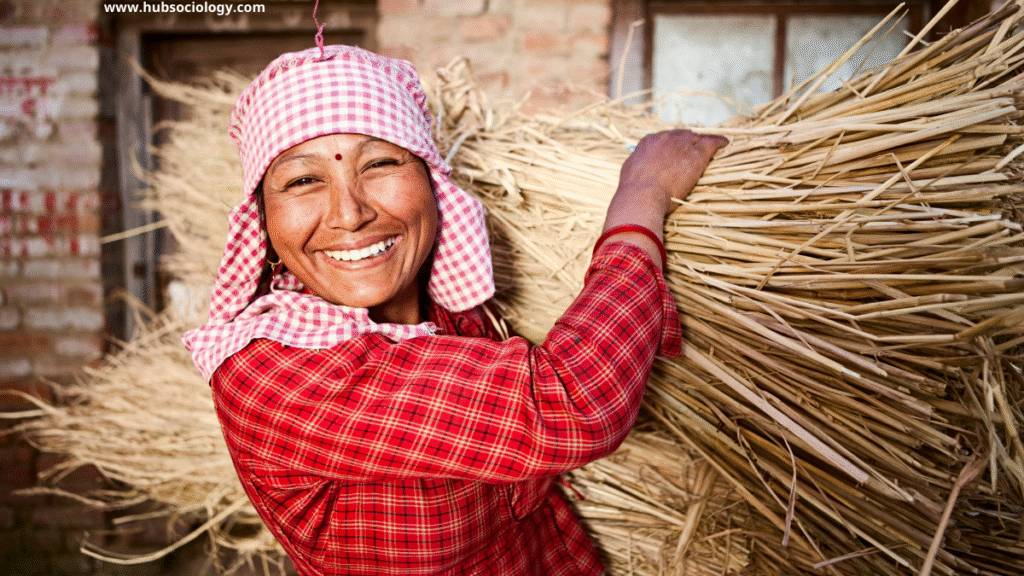
While many traditional practices continue, new values of equality, mobility, and modernization are gaining ground. Rural India today stands at the intersection of past and future, where continuity and change coexist.
Understanding rural society is essential for sociologists, policymakers, and citizens who seek to promote inclusive and sustainable development in India.
FAQs on Rural Society in India
- What is Rural Society in India?
Rural Society in India refers to the social life of people living in villages, mainly dependent on agriculture and guided by traditional values, caste system, and community-based living. - What are the main features of Rural Society in India?
The main features of Rural Society in India include caste hierarchy, agrarian economy, joint family system, strong community ties, and traditional customs. - How does the caste system affect Rural Society in India?
The caste system shapes social status, occupation, marriage, and daily interactions in Rural Society in India, although its influence is slowly declining. - Why is agriculture important in Rural Society in India?
Agriculture is the primary source of livelihood in Rural Society in India and determines economic status, social power, and village life. - What role does the joint family play in Rural Society in India?
The joint family provides economic support, social security, and cultural continuity in Rural Society in India. - How is Rural Society in India changing today?
Rural Society in India is changing due to education, technology, migration, government schemes, and modernization. - What is the impact of education on Rural Society in India?
Education has increased awareness, reduced caste discrimination, and improved social mobility in Rural Society in India. - How has technology influenced Rural Society in India?
Mobile phones and the internet have improved communication, access to information, and awareness in Rural Society in India. - What is the role of Panchayati Raj in Rural Society in India?
Panchayati Raj promotes local governance, development, and political participation in Rural Society in India. - How are women’s roles changing in Rural Society in India?
Women in Rural Society in India are becoming more educated, politically active, and economically independent. - What challenges does Rural Society in India face?
Rural Society in India faces poverty, unemployment, poor healthcare, and social inequality. - How has migration affected Rural Society in India?
Migration has brought urban ideas, new lifestyles, and economic opportunities to Rural Society in India. - Is the caste system weakening in Rural Society in India?
Yes, caste influence is reducing due to education, laws, and social movements in Rural Society in India. - What is the importance of community life in Rural Society in India?
Community life promotes cooperation, social harmony, and cultural traditions in Rural Society in India. - Why is Rural Society in India important for sociological study?
Rural Society in India helps sociologists understand tradition, change, inequality, and development.