Introduction
Rural communities are often associated with close social relationships, shared traditions, mutual assistance, and a strong sense of belonging. In the northeastern United States, Vermont provides an important setting for understanding how these social relationships develop and change over time. Its small towns, agricultural landscapes, village centers, local associations, and community institutions offer valuable insights into the relationship between rural life and collective identity.
Social Cohesion in Vermont refers to the social bonds, shared values, mutual trust, civic participation, and sense of belonging that connect individuals and groups within rural communities. These relationships influence how residents cooperate, respond to local problems, support vulnerable populations, and preserve community traditions. However, rural cohesion is not simply a natural consequence of living in a small town. It develops through everyday interactions, local institutions, economic conditions, and opportunities for collective participation.
The study of Social Cohesion in Vermont is particularly important because rural communities face several interconnected challenges, including an aging population, housing affordability, limited access to certain services, economic transitions, and differences between long-term residents and newcomers. These developments can strengthen some community relationships while weakening others.

From a sociological perspective, Vermont demonstrates that rural communities are dynamic social systems rather than isolated settlements. Understanding Social Cohesion in Vermont therefore requires examining both the relationships that unite residents and the inequalities and conflicts that may divide them.
Understanding Social Cohesion in Vermont
Social cohesion describes the extent to which people feel connected to their communities, trust one another, participate in collective activities, and recognize some shared responsibility for the common good. It includes emotional attachment, practical cooperation, social inclusion, and confidence in local institutions.
In Vermont, Social Cohesion in Vermont can be observed through community meetings, volunteer organizations, town celebrations, school activities, agricultural networks, neighborhood assistance, and participation in local decision-making. These activities create opportunities for people to interact regularly and develop relationships beyond their immediate households.
Sociologists distinguish between structural and relational dimensions of cohesion. Structural cohesion concerns the institutions and networks that connect people, such as schools, libraries, religious organizations, community centers, and local government. Relational cohesion concerns the quality of these connections, including trust, solidarity, reciprocity, and mutual respect.
Both dimensions are important for Social Cohesion in Vermont. A town may have numerous community organizations but still experience social divisions if residents feel excluded from decision-making. Similarly, people may express strong attachment to their town while lacking access to the services and resources needed to participate fully in community life.
Social cohesion should therefore not be measured only by the number of local events or the apparent friendliness of residents. It also requires examining who participates, whose voices are heard, and whether different social groups experience a genuine sense of belonging.
Rural Traditions and Community Identity
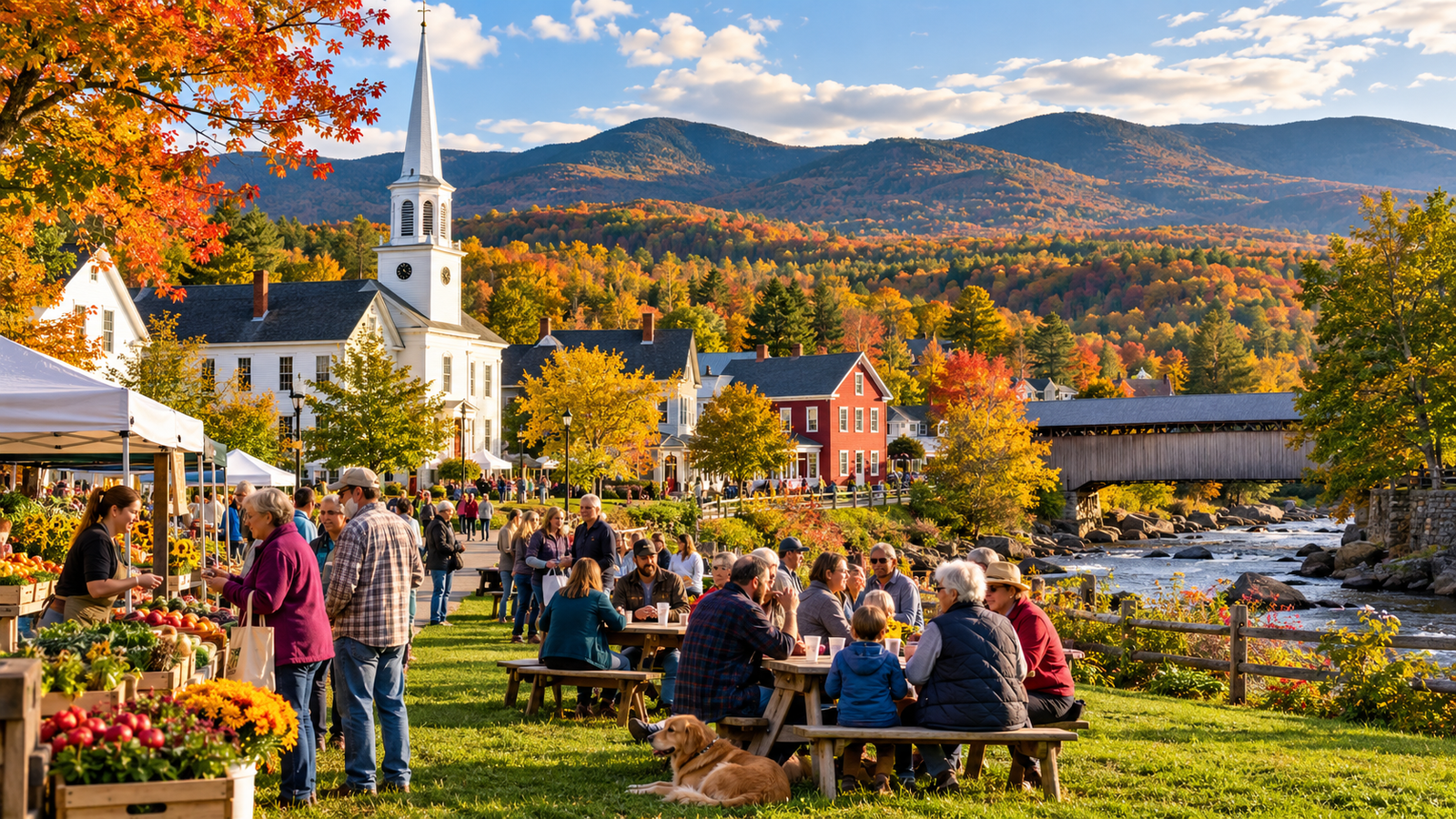
Vermont’s rural identity is closely associated with agriculture, forests, village centers, local traditions, and small-town institutions. Dairy farming, maple syrup production, seasonal festivals, farmers’ markets, and local craft activities contribute to the cultural identity of many communities.
These traditions can support Social Cohesion in Vermont by creating shared experiences and opportunities for cooperation. Agricultural fairs and community festivals, for example, bring together residents from different households and age groups. Such gatherings allow people to exchange information, maintain friendships, celebrate local achievements, and strengthen their identification with the community.
From a symbolic interactionist perspective, community identity develops through repeated social interactions and shared symbols. A village green, town hall, local school, or annual festival can become more than a physical location or event. It may represent collective memories, historical continuity, and a shared understanding of what makes a place distinctive.
This symbolic attachment contributes to Social Cohesion in Vermont because it connects personal identity with community membership. Residents may understand their participation in local traditions as a responsibility to preserve the social and cultural life of their town.
Nevertheless, tradition can have an exclusionary dimension. Long-established customs may be more familiar to established residents than to newcomers or people from different cultural backgrounds. For this reason, healthy Social Cohesion in Vermont depends on preserving meaningful traditions while allowing them to evolve and become more inclusive.
Family Networks and Neighbourhood Relationships
Family and neighbourhood relationships are important foundations of rural social life. In small communities, people may encounter the same individuals at schools, grocery stores, community meetings, workplaces, and public events. Repeated interaction can encourage familiarity and create opportunities for mutual assistance.
Such relationships can strengthen Social Cohesion in Vermont through practical support. Neighbours may help older residents with transportation, assist families during emergencies, share local information, or organize community responses to severe weather. Informal networks can be especially important when formal services are distant or difficult to access.

The sociological concept of social capital helps explain these relationships. Social capital refers to the resources people can access through relationships, networks, trust, and cooperation. Strong social networks can help residents obtain information, find employment opportunities, organize community projects, and manage everyday difficulties.
In this context, Social Cohesion in Vermont benefits from both bonding and bridging social capital. Bonding social capital connects people who share close relationships, backgrounds, or experiences. Bridging social capital connects individuals across different generations, occupations, social classes, and cultural groups.
Bonding relationships can provide emotional security and dependable support. However, excessive dependence on close networks may exclude people who lack established family connections. Bridging relationships are therefore essential for ensuring that Social Cohesion in Vermont extends beyond familiar social circles.
For rural communities to remain inclusive, neighbourhood networks must create opportunities for newcomers, young adults, single-person households, and socially isolated residents to participate in community life.
Local Institutions and Civic Participation
Local institutions play a central role in maintaining community relationships. Vermont’s town meetings, municipal governments, public libraries, schools, volunteer fire departments, and community organizations provide settings where residents can discuss shared concerns and work toward common goals.
The tradition of town meeting governance is particularly relevant to Social Cohesion in Vermont. In communities that use this form of direct local participation, residents may have opportunities to debate municipal budgets, public services, infrastructure, and other local issues. These interactions can develop civic knowledge, encourage accountability, and reinforce the idea that community decisions are a collective responsibility.
From the perspective of Émile Durkheim, social solidarity emerges through the relationships and shared moral commitments that connect members of society. In rural settings, collective participation can reinforce solidarity by making residents aware of their interdependence.
Public schools also contribute to Social Cohesion in Vermont. School events, parent organizations, sports activities, and educational programs connect families and encourage interaction across generations. Libraries and community centers can perform similar functions by offering educational resources, public programs, and accessible spaces for social interaction.
However, civic participation does not automatically guarantee equality. Residents who have more time, money, education, or established community connections may exercise greater influence than others. People working multiple jobs, living with disabilities, or facing transportation barriers may find it harder to attend meetings.
Consequently, stronger Social Cohesion in Vermont requires accessible participation, transparent local government, and genuine opportunities for residents from different backgrounds to influence community decisions.
Agriculture, Local Economies, and Social Solidarity
Agriculture remains an important part of Vermont’s rural identity, even as many communities diversify their economies through tourism, education, health services, remote work, small businesses, and recreation.

Farming creates economic relationships that can extend beyond individual households. Farmers may exchange knowledge, cooperate through agricultural associations, purchase supplies locally, and participate in regional markets. Maple producers and other small businesses can also contribute to community networks.
These connections support Social Cohesion in Vermont by linking economic activity with local identity and cooperation. When businesses employ local residents and purchase goods and services within the region, economic relationships can reinforce community interdependence.
Nevertheless, economic changes can create social pressures. Rising operating costs, fluctuations in agricultural markets, limited employment options, and uncertainty about the future of family farms may affect the stability of rural households. When economic opportunities decline, younger residents may leave to pursue education or employment elsewhere.
The relationship between economic security and Social Cohesion in Vermont is therefore significant. People who face persistent financial insecurity may have less time and energy for volunteering, community events, or local governance. Businesses under pressure may struggle to maintain employment or sponsor community activities.
Local economic development can help strengthen cohesion when it provides stable employment, supports small businesses, preserves working landscapes, and enables residents to remain in their communities. However, economic growth that raises living costs without improving opportunities for existing residents may generate resentment rather than solidarity.
A sociological understanding of Social Cohesion in Vermont must therefore examine not only whether local economies grow, but also how the benefits and costs of that growth are distributed.
Housing Affordability and the Challenge of Belonging
Housing is a major issue in many rural and resort-oriented parts of Vermont. Seasonal properties, tourism-related demand, limited housing construction, and competition for homes can make it difficult for some workers and young families to find suitable accommodation.
Housing conditions affect Social Cohesion in Vermont because stable residence helps people develop long-term relationships, participate in local institutions, and build a sense of belonging. When teachers, healthcare workers, service employees, and young families cannot afford to live near their workplaces, community institutions may struggle to recruit and retain essential workers.
Frequent residential moves can also weaken social networks. Residents who cannot remain in one place for long periods may have fewer opportunities to develop enduring relationships with neighbours, participate in local organizations, or become involved in town decisions.
Housing inequality can create tension between permanent residents, second-home owners, landlords, and tourism businesses. Different groups may have conflicting interests regarding development, land use, property taxation, and the preservation of local character.
These tensions demonstrate that Social Cohesion in Vermont depends partly on the distribution of material resources. Shared community identity cannot fully compensate for a lack of affordable housing or secure employment.
Policies that expand housing supply, support affordable rentals, encourage appropriate development, and help essential workers live locally can strengthen social inclusion. When residents have a realistic opportunity to establish long-term homes, they are better positioned to contribute to the social life of their communities.
Ageing, Youth Migration, and Intergenerational Relationships
Demographic change influences the social organization of rural Vermont. In some communities, population ageing increases the need for healthcare, accessible transportation, home assistance, and social activities for older residents. At the same time, younger adults may move away for higher education, specialized employment, or more affordable housing.
These developments present important challenges for Social Cohesion in Vermont. When younger residents leave, communities may lose volunteers, future business owners, local leaders, and potential caregivers. Older people who remain may experience social isolation, particularly when they no longer drive or have limited access to public transportation.
However, ageing can also create opportunities for intergenerational solidarity. Older residents may share historical knowledge, practical skills, and community memories, while younger people can contribute technological knowledge, new ideas, and organizational energy.
Intergenerational projects can strengthen Social Cohesion in Vermont by connecting students with older residents, supporting community gardens, documenting local history, and developing volunteer transportation programs. Schools, libraries, and local organizations can help create these opportunities.
Youth participation is equally important. Young people are more likely to develop lasting community attachments when they can access education, meaningful employment, recreational facilities, and affordable housing. Opportunities to participate in local decision-making can also help them see rural communities as places where they can shape the future.
The long-term sustainability of Social Cohesion in Vermont therefore depends on creating communities where people of different ages can live, work, participate, and support one another.
Social Inequality, Diversity, and Inclusion
Rural communities are sometimes portrayed as socially homogeneous, but they contain differences in income, occupation, education, political opinion, cultural background, disability, and access to services. These differences influence who participates in community life and who experiences exclusion.
Social class can shape Social Cohesion in Vermont through unequal access to housing, transportation, leisure activities, and civic networks. Wealthier residents may have more flexibility to volunteer or participate in public affairs, while lower-income workers may have limited time because of long working hours or multiple jobs.
Geographical isolation can create further barriers. Residents living far from village centers may find it difficult to attend events, access healthcare, or participate in local meetings, particularly when transportation options are limited.
Newcomers and long-term residents may also differ in their expectations regarding development, land use, environmental protection, and local traditions. Such disagreements are not necessarily evidence of social breakdown. Constructive disagreement can help communities reconsider priorities and respond to changing circumstances.
A more inclusive form of Social Cohesion in Vermont recognizes that solidarity should not require everyone to share the same identity or opinions. Instead, it should be based on respect, equal participation, mutual responsibility, and the ability to resolve disagreements peacefully.
Community organizations can support inclusion by organizing accessible events, providing multilingual information where needed, offering low-cost activities, and actively inviting underrepresented residents to participate. These measures help transform social cohesion from a privilege enjoyed by established networks into a broader community resource.
Technology, Remote Work, and Changing Rural Life
Digital technology has changed how many rural residents communicate, work, study, and access information. Broadband internet can support remote employment, online education, telehealth, small businesses, and connections with family members living elsewhere.
These developments may strengthen Social Cohesion in Vermont by helping residents remain in rural areas while accessing opportunities beyond their immediate local economies. Digital platforms can also support volunteer coordination, community announcements, emergency information, and local fundraising.
Nevertheless, technological access is not equally distributed. Poor connectivity, limited digital skills, and the cost of devices or internet subscriptions can prevent some households from benefiting fully. Older adults and lower-income residents may face additional barriers, although these difficulties vary considerably between individuals and communities.
Remote work can also produce mixed social effects. Some remote workers may contribute new skills, support local businesses, and participate in civic life. Others may remain socially disconnected from long-term residents or increase competition for housing in desirable locations.
Technology can support Social Cohesion in Vermont, but it cannot replace every form of face-to-face interaction. Community meetings, shared meals, volunteer projects, and neighbourhood activities remain important ways of developing trust and mutual understanding.
The most effective approach combines digital connectivity with physical spaces and activities that encourage residents to interact across social boundaries.
Environmental Challenges and Collective Action
Vermont’s rural communities are closely connected to forests, rivers, agricultural land, mountains, and seasonal weather patterns. Environmental conditions influence livelihoods, recreation, tourism, infrastructure, and local identity.
Flooding and severe weather can threaten homes, roads, farms, and public facilities. Such events may disrupt daily routines and place additional pressure on households already experiencing financial difficulties.
At the same time, environmental challenges can create opportunities for Social Cohesion in Vermont. Residents may organize volunteer clean-ups, support affected neighbours, coordinate emergency assistance, and participate in local resilience planning.
Collective action around conservation, sustainable agriculture, forest management, and watershed protection can also connect people with shared interests. These initiatives can create a sense of responsibility for the future of the local environment.
However, environmental policy may generate disagreement when conservation goals conflict with development, agricultural needs, property rights, or household affordability. Effective cooperation requires transparent information, meaningful consultation, and fair consideration of different interests.
Environmental resilience and Social Cohesion in Vermont are closely related because communities with strong networks may be better positioned to share information, coordinate assistance, and recover from disruptions. Yet social networks alone cannot replace adequate infrastructure, public funding, and professional emergency services.
Theoretical Perspectives on Social Cohesion in Vermont
Several sociological theories help explain the development of Social Cohesion in Vermont.
Émile Durkheim’s concept of social solidarity emphasizes the moral bonds and shared practices that connect members of society. Rural communities can develop solidarity through common traditions, local institutions, and mutual responsibilities. However, modern rural communities also depend on cooperation between people with different occupations, skills, and lifestyles.
Ferdinand Tönnies’ distinction between Gemeinschaft and Gesellschaft offers another useful perspective. Gemeinschaft describes social relationships characterized by familiarity, tradition, and a sense of belonging, while Gesellschaft emphasizes more impersonal, contractual, and instrumental relationships. Vermont’s rural towns may display elements of both: close neighbourhood relationships coexist with market transactions, professional networks, tourism, and digital communication.
Robert Putnam’s work on social capital highlights the importance of trust, networks, and civic participation. His distinction between bonding and bridging social capital helps explain why close-knit communities may be supportive while still excluding outsiders. For Social Cohesion in Vermont to remain strong, relationships within established groups need to be complemented by connections across social differences.
Conflict theory adds an essential dimension by examining unequal power and access to resources. Housing ownership, economic inequality, and differences in political influence can shape whose interests dominate local decisions. From this perspective, lasting Social Cohesion in Vermont requires attention to fairness and social inclusion, not merely shared identity.
Together, these theories show that cohesion is produced through everyday interaction, institutions, civic practices, and the distribution of power and resources.
Strengthening Social Cohesion in Vermont
Strengthening Social Cohesion in Vermont requires coordinated action by local governments, community organizations, educational institutions, businesses, and residents. Although every town has distinct needs, several broad priorities can help sustain inclusive rural communities.
Affordable housing and stable employment are essential because people need material security to participate fully in social life. Support for local businesses, farms, and community services can help residents maintain long-term connections to their towns.
Public institutions should also provide accessible opportunities for participation. Flexible meeting times, online access where appropriate, inclusive community events, and outreach to underrepresented groups can broaden involvement in local decision-making.
Investment in libraries, schools, public spaces, broadband infrastructure, and transportation can improve the practical conditions that make social participation possible. Volunteer programs and intergenerational initiatives can strengthen networks between residents who might otherwise have limited contact.
Finally, community cohesion should be evaluated through meaningful indicators, including residents’ reported trust, participation rates, access to services, housing stability, perceived inclusion, and the strength of mutual-aid networks. Such measures provide a more complete picture than simply counting community events.
The future of Social Cohesion in Vermont depends on balancing continuity with change. Rural traditions can remain valuable while communities adapt to new residents, economic pressures, demographic changes, and environmental risks.
Conclusion
Rural Vermont offers an important sociological setting for examining how social relationships, community institutions, economic conditions, and local identities shape collective life. Strong neighbourhood networks, civic participation, agricultural traditions, and community organizations can create a foundation for trust and cooperation.
At the same time, Social Cohesion in Vermont faces challenges related to housing affordability, economic inequality, demographic change, geographical isolation, and unequal participation. Close relationships do not automatically produce inclusion, and shared traditions cannot eliminate structural inequalities.
A sociological approach shows that sustainable cohesion requires more than friendliness or a common rural identity. It depends on accessible institutions, fair economic opportunities, affordable housing, meaningful civic participation, and respect for social differences.
Ultimately, Social Cohesion in Vermont is best understood as an ongoing social process through which people build trust, negotiate disagreements, share responsibilities, and create a sense of belonging. By strengthening both close relationships and connections across social groups, Vermont’s rural communities can preserve their distinctive identities while building a more inclusive and resilient future.