
Introduction on Marriage among Muslims in India
In the vast and complex tapestry of Indian society, Muslim marriage, or nikaah, represents a fascinating intersection of religious doctrine, social structure, and cultural adaptation. While often simplistically viewed through a purely religious lens, the institution of marriage among Indian Muslims is a rich sociological phenomenon. It is a dynamic field where divine injunctions from the Quran and Hadith interact with pre-Islamic local customs, caste-like hierarchies, state legislation, and the pressures of modernity. A sociological analysis moves beyond the theological to understand how this institution functions as a mechanism of social cohesion, identity formation, and sometimes, social stratification. This article delves into the structures, processes, and evolving challenges that define matrimony within the world’s second-largest Muslim population.

Table of Contents on Marriage among Muslims
The Conceptual Framework: Sacrament, Contract, or Social Institution?
Unlike the Hindu conception of marriage as a sacred, indissoluble union (sanskara), Islam fundamentally views nikaah as a civil contract (aqd). This contractual nature is its defining sociological and legal feature. The contract is established through an offer (ijab) and acceptance (qubool) in the presence of witnesses, and it stipulates mutual rights and obligations.
However, to categorize it as merely a contract would be a sociological oversight. In practice, it embodies a dual character:
- Sacralized Contract: While a contract, it is solemnized in a religious ceremony, invoking divine blessings. It is considered an ibadah (act of worship) when performed with righteous intent.
- Social Institution: It functions as the primary institution for the formation of family, the regulation of sexuality, the establishment of kinship alliances, and the reproduction of social norms. It is deeply embedded in the social fabric, making it far more than a simple legal agreement.
This dual nature creates a unique space where individual agency (in choosing terms of the contract) constantly negotiates with communal and familial expectations.
Key Structural Components and Their Social Functions
1. Endogamy and the Role of Biradari
A paramount feature of Muslim marriage in India is endogamy, particularly within the biradari (brotherhood) or quom. These are kinship-based social groups that often function analogously to caste, despite Islam’s theological emphasis on equality.
- Social Stratification: Groups like the Syeds (claiming descent from the Prophet), Mughals, Pathans, and Sheikhs historically practiced, and often still practice, strict endogamy. Artisan groups (e.g., Ansaris weavers, Qureshis butchers) also marry within their community.
- Reinforcing Social Hierarchy: This endogamy reinforces social hierarchies and preserves group identity, economic interests, and traditional occupations. Marriage becomes a tool for maintaining social boundaries rather than dissolving them.
- Kinship Alliances: Marriages are frequently seen as alliances between families rather than just between individuals, strengthening the biradari’s political and social capital.
2. The Mechanics of Mate Selection
The process of finding a spouse is a critical site for observing the tension between tradition and modernity.
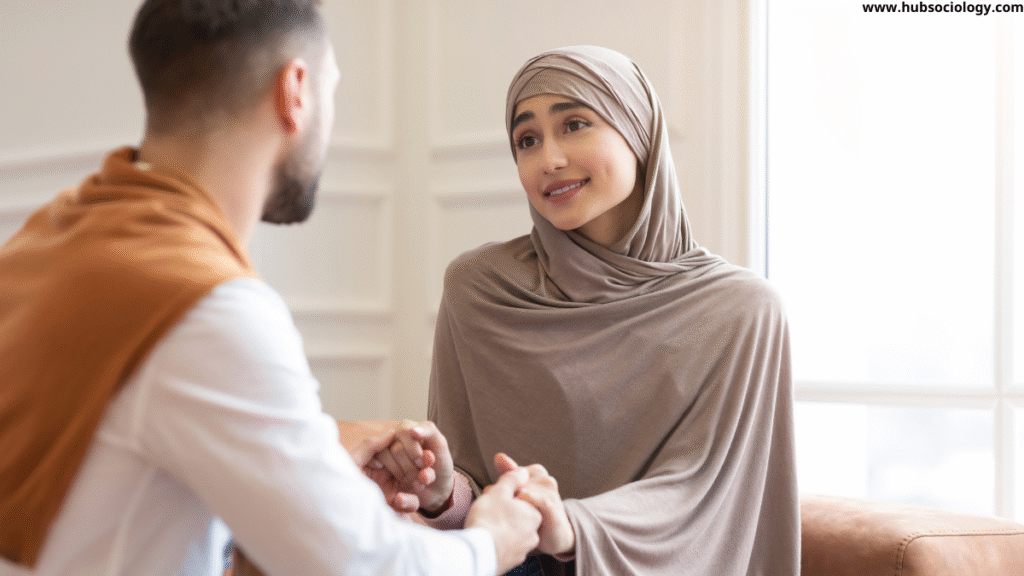
- Arranged Marriage: The predominant mode remains arranged marriage, where families take the lead in finding a suitable match based on criteria like family status, economic stability, religious observance, and educational background.
- The Rise of “Assisted” Marriage: A significant modern trend is the shift from purely arranged to “assisted” marriages, where prospective spouses are allowed to meet, interact, and veto a proposal, reflecting the influence of urban, educated, middle-class values that prioritize compatibility.
- Love Marriage and Social Resistance: While love marriages occur, they often face significant social resistance, especially if they cross biradari or sectarian lines (e.g., Sunni-Shia), highlighting the enduring power of social norms over individual choice.
3. Mahr: The Dowry Paradox
One of the most misunderstood institutions is the mahr. It is a mandatory payment, in money or property, pledged by the groom to the bride as part of the marriage contract. It is her exclusive, inalienable right.
- Sociological Significance: Sociologically, mahr is a form of economic security for the woman, recognizing her financial worth within the contract. It is a non-negotiable element that empowers her financially.
- The Indian Paradox: In a stark distortion, many Indian Muslim communities, particularly in North India, have adopted the un-Islamic practice of dowry (jahez), where the bride’s family provides gifts, cash, and goods to the groom’s family. This reflects the powerful influence of dominant Hindu cultural practices and the pressures of hypergamy. The coexistence of mahr (for the bride) and jahez (for the groom) creates a significant financial burden on the bride’s family and represents a complex, often contradictory, cultural synthesis.
Gendered Realities within the Islamic Framework
The institution of marriage is a primary site for the construction of gender roles.
- Idealized Roles: Classical Islamic jurisprudence, interpreted through patriarchal social structures, often prescribes complementary but hierarchical roles: the husband as the financial provider (qawwam) and the wife as the manager of the home and nurturer of children.
- Agency and Negotiation: However, women are not merely passive subjects. They negotiate their space within these frameworks. The contract of nikaah can include clauses (shart) stipulating conditions, such as the right to continue education, practice a profession, or initiate divorce (talaq-e-tafweez), granting a degree of agency within the marital structure.
- The Impact of Education: Rising female education is a key driver of change, leading to delayed marriage ages, greater say in spouse selection, and renegotiation of domestic power dynamics.
Legal Pluralism: The Shadow of the Uniform Civil Code Debate
A unique sociological aspect of Muslim marriage in India is its governance by uncodified Muslim Personal Law (MPL), derived from religious texts and interpretations.
- Community Identity vs. Gender Justice: For many Muslims, MPL is a cornerstone of community identity and religious freedom in a majority-Hindu nation. It allows the community to self-regulate personal affairs according to its beliefs.
- A Site of Contention: However, MPL, particularly provisions related to polygyny, divorce, and maintenance, has been fiercely critiqued by Muslim feminists and reformers as often being out of sync with modern notions of gender justice. They argue that classical interpretations are unfairly applied without the context in which they were revealed.
- The Triple Talaq Moment: The landmark 2017 Supreme Court judgment outlawing the practice of instant triple talaq (talaq-e-biddat) was a seismic event. It highlighted the intense interplay between the state, the community’s religious leaders (ulema), and internal reform movements. It demonstrated the state’s willingness to intervene in personal law on the grounds of constitutional morality and gender equality, creating a new dynamic in the sociology of Muslim marriage.
Conclusion on Marriage among Muslims in India
Marriage among Muslims in India cannot be understood through a monolithic lens. It is a living, breathing institution characterized by constant negotiation and adaptation. It is shaped by the core principles of Islam, deeply influenced by the subcontinent’s pervasive caste and kinship structures, and increasingly pressured by the forces of education, urbanization, and globalized discourse on rights and equality.

The future of nikaah in India lies at the crossroads of this negotiation. Will the biradari system weaken further in urban landscapes? How will the community reconcile its religious laws with the evolving demands for gender justice? The answers to these questions will determine the trajectory of this central social institution. Ultimately, the sociology of Muslim marriage in India is the story of a community striving to preserve its identity while navigating the relentless currents of social change. It is a microcosm of the larger Indian story—a quest for a balance between tradition and modernity, community rights and individual freedoms, and religious identity and national citizenship.
Do you like this this Article ? You Can follow as on :-
Facebook – https://www.facebook.com/hubsociology
Whatsapp Channel – https://whatsapp.com/channel/0029Vb6D8vGKWEKpJpu5QP0O
Gmail – hubsociology@gmail.com
Topic Related Questions on Marriage among Muslims in India
5 Marks Questions on Marriage among Muslims in India (Short Answer)
- Define the term nikaah and briefly explain its significance in Islam.
- Differentiate between mahr and jahez with suitable examples.
- What is the sociological importance of the biradari in Muslim mate selection?
- List any three key changes influencing the institution of Muslim marriage in modern India.
- Explain the concept of endogamy as practiced among Indian Muslims.
10 Marks Questions on Marriage among Muslims in India (Detailed Answer)
- “Marriage among Muslims in India is a sacralized contract, not just a sacrament.” Discuss this statement sociologically.
- Analyze the role of the biradari system in maintaining social stratification among Indian Muslims.
- How has the process of mate selection among Indian Muslims evolved from purely arranged to ‘assisted’ marriages? Discuss the factors driving this change.
- Examine the gendered realities within a Muslim marriage, highlighting the spaces for agency and negotiation available to women.
- The practice of jahez is a paradox within the Islamic framework of marriage. Explain.
15 Marks Questions on Marriage among Muslims in India (Essay-type/Long Answer)
- Critically examine Marriage among Muslims in India as a site of negotiation between religious doctrine, patriarchal social structures, and modern ideals of individual choice and gender justice.
- Discuss the various factors that contribute to social stratification within the Muslim community in India. How does the institution of marriage reinforce these hierarchies?
- Analyze the interplay between Muslim Personal Law and the Indian state in shaping the institution of marriage. Use the example of the Triple Talaq judgment to illustrate your answer.
- “The institution of Muslim marriage in India is characterized by a complex process of cultural synthesis and adaptation.” Elaborate on this statement with reference to prevalent customs and practices.