Introduction
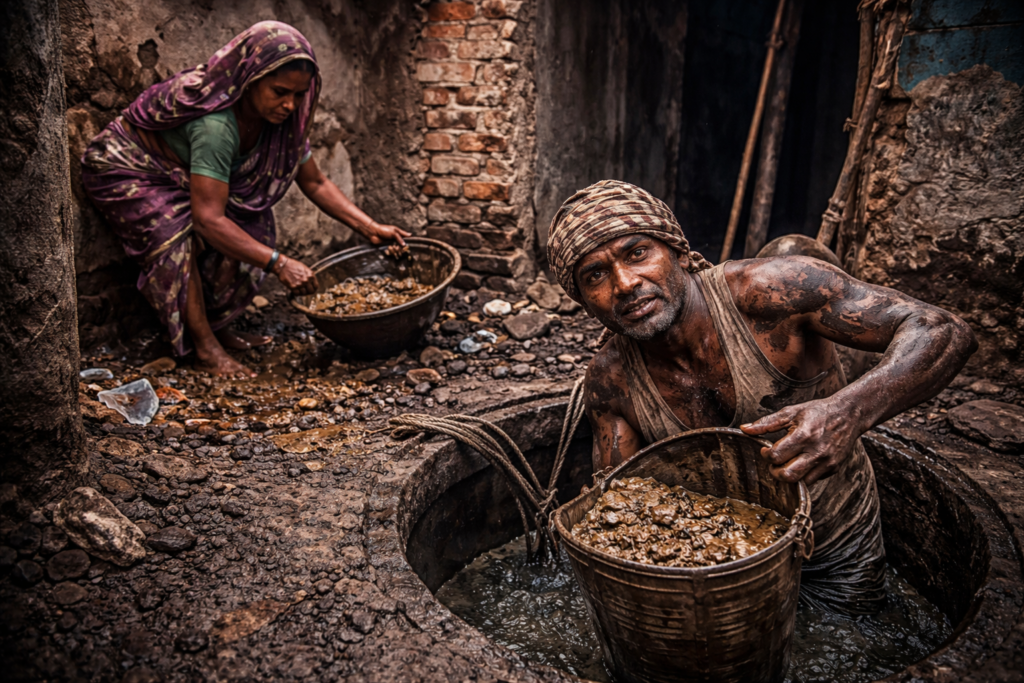
Manual scavenging remains one of the most painful and persistent reminders of caste-based inequality in India. Despite constitutional guarantees of equality and multiple legal prohibitions, the practice continues in different forms across rural and urban spaces. It refers to the manual handling, carrying, disposing, or cleaning of human excreta from dry latrines, open drains, septic tanks, and sewers. This occupation has historically been assigned to specific Dalit sub-castes, embedding the practice within the rigid structure of the caste system.
From a sociological perspective, manual scavenging is not merely a sanitation issue; it is a manifestation of structural inequality, ritual hierarchy, and social exclusion. It reflects how caste operates as a system of stratification, organizing labor, status, and power in Indian society. The persistence of caste-based occupations such as manual scavenging illustrates the complex interplay between tradition, economy, state policy, and social change.
Historical Roots of Caste-Based Occupations
The origins of caste-based occupational segregation can be traced to the traditional varna and jati system. While the fourfold varna model placed Brahmins, Kshatriyas, Vaishyas, and Shudras in a hierarchical order, thousands of jatis developed as localized, endogamous groups associated with hereditary occupations. Over time, certain occupations were labeled as ritually pure or impure. Tasks involving bodily waste, dead animals, leatherwork, or sweeping were considered polluting and were assigned to communities placed at the bottom of the social hierarchy.
The ideology of purity and pollution formed the basis of untouchability. Communities engaged in cleaning human waste were treated as “untouchables,” excluded from temples, water sources, schools, and common spaces. Sociologists have described this as a system of “graded inequality,” where status is determined by ritual ranking rather than economic class alone.
Manual scavenging emerged within this structure as a hereditary occupation. It was not simply a job chosen for economic reasons but an enforced role tied to caste identity. Even when individuals sought to leave the occupation, social norms, economic dependency, and discrimination often prevented mobility.
Manual Scavenging as Structural Violence
Manual scavenging can be analyzed as a form of structural violence. The concept of structural violence refers to social structures that harm individuals by preventing them from meeting basic needs or enjoying equal opportunities. In this context, caste operates as a structure that systematically disadvantages certain communities.
Manual scavengers often work without protective equipment, facing exposure to toxic gases, infections, and life-threatening accidents. Deaths in septic tanks and sewers are frequently reported. However, these deaths are not accidental in a sociological sense; they are embedded in a system that normalizes the devaluation of Dalit lives.
The stigma attached to the occupation also produces symbolic violence. Communities engaged in manual scavenging face humiliation, segregation, and exclusion. Their children may experience discrimination in schools, limiting educational attainment and perpetuating intergenerational poverty. Thus, the occupation becomes a mechanism for reproducing social inequality across generations.
Gender Dimensions of Manual Scavenging
Manual scavenging has a significant gendered dimension. Women constitute a large proportion of those engaged in cleaning dry latrines and handling waste manually. In many regions, women from specific Dalit sub-castes collect human excreta daily from households in exchange for minimal wages, leftover food, or old clothes.
This gendered division of labor reflects the intersection of caste and patriarchy. Dalit women face “triple discrimination” based on caste, class, and gender. They are often subjected to sexual harassment and violence by dominant caste men, with limited access to justice. Sociologically, this illustrates the concept of intersectionality, where multiple forms of oppression overlap and reinforce each other.
The invisibility of women’s labor further compounds their marginalization. While sewer deaths often draw media attention when men are involved, the daily exploitation of women cleaning dry latrines remains underreported. Their work is normalized within local social relations, making resistance difficult.
Legal Framework and Policy Interventions
India has enacted several laws to abolish manual scavenging and untouchability. The Constitution prohibits untouchability under Article 17 and guarantees equality before the law. The Employment of Manual Scavengers and Construction of Dry Latrines (Prohibition) Act, 1993, and the Prohibition of Employment as Manual Scavengers and their Rehabilitation Act, 2013, criminalize the practice and provide for rehabilitation measures.
However, the gap between law and practice remains wide. Sociologists describe this as the difference between formal equality and substantive equality. While legal provisions exist, their implementation is weak due to bureaucratic apathy, lack of political will, and deep-rooted social attitudes.
Rehabilitation schemes often focus on skill development and financial assistance, but they do not adequately address stigma and discrimination. Without structural transformation, individuals who leave manual scavenging may struggle to find alternative employment due to caste-based prejudice.
Urbanization, Modernity, and Continuity
One might assume that urbanization and modernization would eliminate caste-based occupations. However, manual scavenging persists even in metropolitan cities. The expansion of urban infrastructure has created new forms of sanitation labor, including sewer and septic tank cleaning. Often, private contractors employ Dalit workers informally, avoiding accountability.
This reveals the paradox of modernity. While India aspires to be a global economic power, it continues to rely on marginalized communities for the most degrading forms of labor. Sociologically, this suggests that modernization does not automatically dismantle traditional hierarchies; instead, caste adapts to new economic contexts.
Technological solutions such as mechanized cleaning exist, but their adoption is uneven. The reluctance to fully mechanize sanitation work reflects cost considerations as well as a social mindset that assumes certain communities will continue to perform these tasks.
Social Movements and Resistance
Resistance against manual scavenging has a long history. Dalit movements have challenged caste-based discrimination and demanded dignity and equality. Organizations such as Safai Karmachari Andolan have played a crucial role in documenting the prevalence of manual scavenging, mobilizing affected communities, and advocating for policy change.

Activists have organized protests, filed public interest litigations, and engaged with international human rights bodies. These efforts have brought visibility to the issue and pressured governments to take action. The framing of manual scavenging as a human rights violation rather than merely a sanitation problem has shifted public discourse.
Sociologically, such movements represent collective action aimed at transforming social structures. They challenge dominant ideologies of purity and pollution and assert the dignity of labor. However, resistance often faces backlash from entrenched interests and conservative social forces.
Education and Social Mobility
Education is frequently presented as a pathway out of caste-based occupations. Access to schooling, scholarships, and affirmative action policies has enabled some individuals from manual scavenging communities to achieve upward mobility. Reservation policies in education and public employment have opened opportunities that were historically denied.
Yet, mobility remains uneven. Children of manual scavengers may drop out of school due to poverty, discrimination, or the need to contribute to household income. Even educated individuals may encounter caste-based discrimination in workplaces and housing.
From a sociological standpoint, this reflects the limits of individual mobility within a stratified system. Structural barriers cannot be fully overcome through personal effort alone. Collective transformation of social attitudes and institutional practices is essential.
Media Representation and Public Perception
Media coverage of manual scavenging often focuses on tragic sewer deaths or government announcements. While such reporting raises awareness, it can also reduce the issue to episodic events rather than a systemic problem. Popular narratives sometimes portray manual scavengers as passive victims rather than agents of resistance.
Cinema and literature have occasionally addressed caste oppression, contributing to public debate. However, the normalization of caste hierarchies in everyday life continues to shape attitudes. Many urban middle-class households remain unaware of who cleans their septic tanks or where their waste goes.
Public perception is influenced by deeply ingrained notions of purity, pollution, and social distance. Changing these perceptions requires sustained social education and engagement.
Caste, Capitalism, and Labor Markets
The relationship between caste and capitalism is complex. While market economies are often seen as merit-based, in India, labor markets are shaped by caste networks and discrimination. Manual scavenging demonstrates how pre-modern hierarchies coexist with modern economic structures.
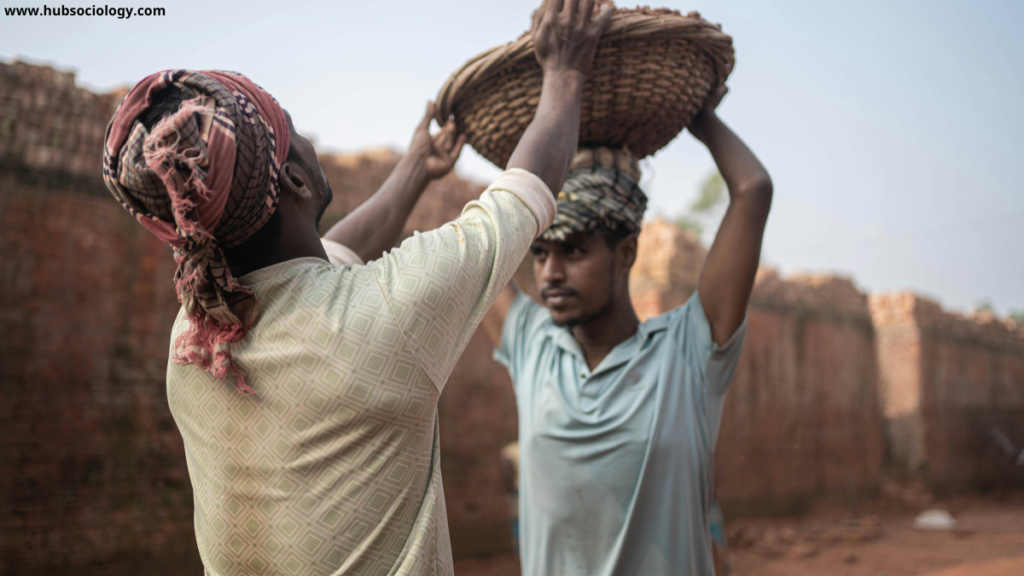
Contractualization and informalization of labor have further marginalized sanitation workers. Without job security, health insurance, or social protection, they remain vulnerable. Capitalist cost-cutting practices intersect with caste discrimination, reinforcing exploitation.
Sociologists argue that addressing manual scavenging requires confronting both caste hierarchy and economic inequality. Redistribution of resources, enforcement of labor rights, and technological investment are necessary but insufficient without social transformation.
Toward Dignity and Social Justice
Eliminating manual scavenging requires a multidimensional approach. First, strict enforcement of existing laws is essential. Accountability mechanisms must ensure that employers and officials who perpetuate the practice face consequences. Second, comprehensive rehabilitation programs must address not only economic needs but also psychological and social dimensions.
Third, technological modernization of sanitation infrastructure is crucial. Mechanization can reduce dependence on manual labor and prevent hazardous conditions. However, technology must be accompanied by training and secure employment for former manual scavengers.
Finally, transforming social attitudes is fundamental. Caste-based stigma cannot be eradicated solely through legislation. Educational curricula, community dialogues, and media campaigns should promote equality and dignity. Religious and community leaders can play a role in challenging discriminatory norms.
From a sociological perspective, manual scavenging is a test of India’s commitment to social justice. It reveals the tension between constitutional ideals and social realities. The struggle against caste-based occupations is part of a broader movement toward an egalitarian society.
Conclusion
Manual scavenging and caste-based occupations in India illustrate the enduring power of social stratification. Rooted in historical notions of purity and pollution, the practice persists despite legal prohibitions and modernization. It represents structural violence, intersectional oppression, and the reproduction of inequality.
Addressing this issue requires more than policy reform; it demands a transformation of social relations. Sociological analysis highlights that caste is not merely a cultural relic but an active system shaping labor, status, and power. The eradication of manual scavenging is therefore not only a matter of sanitation but of human dignity and democratic equality.
As India moves forward, the challenge lies in translating constitutional promises into lived realities. The elimination of caste-based occupations will signify not just technological progress but moral and social progress. Only when no individual is compelled by birth to perform degrading labor can the vision of equality enshrined in the Constitution be truly realized.
FAQs on Manual Scavenging and Caste-Based Occupations in India
1. What is manual scavenging?
Manual scavenging refers to the practice of manually cleaning, carrying, disposing, or handling human excreta from dry latrines, open drains, septic tanks, and sewers, often without protective equipment.
2. How is manual scavenging linked to caste-based occupations in India?
Manual scavenging is historically assigned to specific Dalit sub-castes under the caste system. It is not merely an economic activity but a hereditary occupation enforced by social hierarchy and stigma.
3. Is manual scavenging legal in India?
No. It is prohibited under the Constitution (Article 17 abolishing untouchability) and the Prohibition of Employment as Manual Scavengers and their Rehabilitation Act, 2013.
4. Why does manual scavenging still exist despite legal bans?
Weak implementation of laws, social stigma, lack of alternative employment, and deeply rooted caste attitudes contribute to its persistence.
5. Which communities are mostly affected by manual scavenging?
Primarily Dalit communities, particularly certain sub-castes traditionally labeled as “untouchable,” are disproportionately engaged in this occupation.
6. How does manual scavenging affect social mobility?
It limits upward mobility by reinforcing stigma, restricting access to education and employment, and perpetuating intergenerational poverty.
7. What are the health risks faced by manual scavengers?
Workers face exposure to toxic gases, infections, skin diseases, respiratory issues, and even death due to hazardous working conditions.
8. What is the gender dimension of manual scavenging?
Many women are engaged in cleaning dry latrines, facing both caste-based discrimination and gender-based exploitation, including low wages and vulnerability to harassment.
9. How does manual scavenging represent structural inequality?
It reflects how caste-based social structures assign degrading labor to certain communities, maintaining social and economic hierarchies.
10. What rehabilitation measures are provided by the government?
Rehabilitation schemes include financial assistance, skill training, housing support, and alternative employment programs for former manual scavengers.
11. How does urbanization influence caste-based occupations in India?
Urbanization has changed the form of sanitation work but has not eliminated caste-based labor divisions. Many sanitation workers in cities still come from marginalized castes.
12. What role do social movements play in ending manual scavenging?
Dalit movements and civil society organizations advocate for dignity, legal enforcement, and policy reforms to eradicate caste-based occupations.
13. How is manual scavenging a human rights issue?
It violates the right to equality, dignity, safe working conditions, and freedom from discrimination, making it a major human rights concern.
14. Can technology help eliminate manual scavenging?
Yes. Mechanized sewer cleaning, improved sanitation infrastructure, and modern waste management systems can significantly reduce dependence on manual labor.
15. What is the sociological significance of studying manual scavenging?
It helps scholars understand caste, social stratification, intersectionality, structural violence, and the persistence of inequality in modern India.