Introduction
The housing crisis in California is not merely a problem of supply and demand; it is a deeply rooted sociological issue that reflects and reproduces urban inequality. From the tech corridors of San Francisco to the sprawling neighborhoods of Los Angeles, and the agricultural heartlands of Fresno, housing insecurity has become a defining feature of life for millions. Rising rents, skyrocketing home prices, homelessness, and displacement reveal structural inequalities embedded in race, class, migration status, and geography.
California, often imagined as a land of opportunity, innovation, and diversity, simultaneously embodies one of the most severe housing affordability crises in the United States. Sociologically, this paradox invites deeper reflection: How do historical patterns of segregation, neoliberal economic policies, urban governance, and global capital flows shape who can live where—and under what conditions?

This article examines the housing crisis and urban inequality in California through sociological frameworks, highlighting structural causes, social consequences, and possible pathways toward housing justice.
Historical Roots of Urban Inequality
Urban inequality in California did not emerge overnight. It has been shaped by decades of racially discriminatory housing policies, suburbanization, and uneven development.
In the mid-20th century, redlining practices and racially restrictive covenants prevented African American, Latino, and Asian communities from accessing mortgage loans and purchasing homes in certain neighborhoods. Although such practices were outlawed after the Civil Rights Movement, their effects remain visible. Neighborhoods that were once redlined still experience lower property values, fewer public services, and higher poverty rates.
The post–World War II suburban boom further intensified inequality. Public investments in highways and suburban infrastructure enabled middle-class (often white) families to move to newly developed suburbs, while inner cities were left with concentrated poverty. Over time, urban redevelopment projects displaced low-income communities, often in the name of modernization.
Thus, the present housing crisis cannot be separated from historical segregation, racial capitalism, and institutional discrimination.
Neoliberal Urbanism and Market-Driven Development
From a sociological perspective, the housing crisis in California is closely tied to neoliberal urban governance. Since the late twentieth century, housing has increasingly been treated as a commodity rather than a social right. Cities compete for investment, tourism, and high-income residents, often prioritizing luxury developments over affordable housing.
In cities like San Diego and Oakland, high-end condominiums and tech-driven gentrification have transformed urban landscapes. Developers frequently focus on profitable projects, while affordable housing construction lags behind. This market-oriented approach exacerbates inequality because it assumes that private markets will meet social needs—a claim that empirical realities contradict.
Sociologists argue that when housing becomes financialized—treated as an investment vehicle rather than shelter—urban space is reshaped by global capital. International investors purchase properties as assets, sometimes leaving them vacant, thereby reducing available housing stock for residents. Housing becomes disconnected from community needs and embedded in speculative markets.
Gentrification and Displacement
Gentrification is one of the most visible manifestations of urban inequality in California. Working-class neighborhoods, often inhabited by racial minorities, become attractive to higher-income professionals. Rising property values and rents push out long-term residents, altering the social fabric.
In parts of Los Angeles and San Jose, the influx of technology workers has dramatically increased housing demand. Landlords raise rents, and older apartment buildings are renovated or replaced with luxury units. For long-standing residents, especially immigrants and elderly tenants, displacement becomes inevitable.
From a sociological standpoint, displacement is not just physical relocation. It disrupts social networks, cultural identity, and community solidarity. Churches, small businesses, and local organizations disappear. The result is what scholars describe as “cultural erasure,” where the history and identity of marginalized communities are overwritten by affluent newcomers.
Homelessness as Structural Inequality
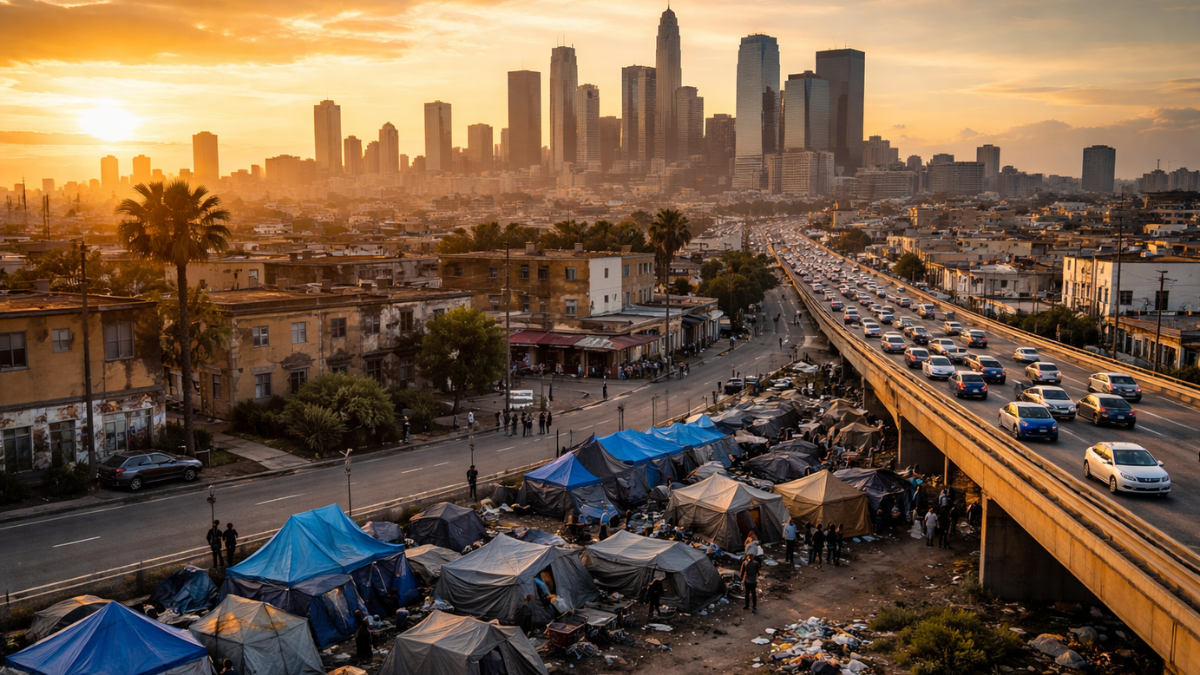
California has one of the largest homeless populations in the United States. Homelessness is often framed as an individual failure, but sociologically it must be understood as a structural outcome of housing unaffordability, wage stagnation, mental health gaps, and insufficient public housing.
In cities such as Sacramento and San Francisco, visible encampments highlight the severity of the crisis. The mismatch between median wages and median rents makes stable housing unattainable for many working-class individuals.

Sociological research shows that even full-time workers struggle to afford housing in high-cost urban areas. Service workers, teachers, and healthcare aides—essential to urban life—often commute long distances because they cannot afford to live near their workplaces. This spatial inequality deepens social stratification and environmental stress.
Homelessness also intersects with race. African Americans and Native Americans are disproportionately represented among the homeless population, reflecting historical discrimination and ongoing systemic inequality.
Immigration, Labor, and Informal Housing
California’s diverse immigrant population plays a crucial role in its economy, particularly in agriculture, construction, and service sectors. Yet many immigrants face housing precarity due to low wages, language barriers, and undocumented status.
In agricultural regions around Fresno and Bakersfield, overcrowded and substandard housing conditions are common among farmworkers. Multiple families may share small units to afford rent. Informal housing arrangements emerge as coping strategies, reflecting both resilience and structural neglect.
From a sociological lens, such conditions illustrate how economic exploitation and housing inequality are interconnected. Immigrant labor sustains California’s economy, yet affordable housing for these workers remains insufficient.
Environmental Inequality and Spatial Segregation
Urban inequality in California is also environmental. Low-income neighborhoods often face higher exposure to pollution, poor infrastructure, and limited green space. Proximity to highways, industrial zones, or wildfire-prone areas increases health risks.
In parts of Oakland and inland communities near Riverside, residents experience disproportionate air pollution and heat vulnerability. Housing affordability pushes marginalized populations into environmentally hazardous zones.
Climate change intensifies these inequalities. Wildfires and rising insurance costs make housing even more unaffordable in certain areas. Those with fewer resources face displacement without safety nets, revealing the intersection of environmental justice and housing justice.
The Role of Policy and Governance
Housing policy in California is complex and often contested. Zoning laws, local opposition (commonly known as NIMBYism—“Not In My Backyard”), and bureaucratic hurdles restrict housing development. Wealthier neighborhoods often resist affordable housing projects, fearing property value decline or demographic change.
Sociologically, NIMBYism reflects class and racial anxieties masked as concerns about infrastructure or neighborhood character. Local control over zoning perpetuates spatial inequality by enabling affluent communities to exclude lower-income residents.
At the same time, state-level reforms have attempted to address the crisis through rent control expansions, increased funding for affordable housing, and incentives for denser development. However, the scale of the crisis often outpaces policy interventions.
Urban Inequality and Social Reproduction
Housing is central to social reproduction—the process by which societies maintain and reproduce social structures over time. Where families live influences access to schools, healthcare, transportation, and employment opportunities.
Children growing up in overcrowded or unstable housing face educational disruptions and psychological stress. In contrast, families in affluent neighborhoods benefit from well-funded schools and safer environments. Thus, housing inequality directly contributes to intergenerational inequality.
In metropolitan areas like San Jose, proximity to technology hubs creates extreme wealth concentration. Yet service workers who sustain these cities often live in peripheral areas, reinforcing spatial class divisions.
Community Resistance and Housing Justice Movements
Despite the severity of the crisis, community activism has emerged across California. Tenant unions, grassroots organizations, and housing justice movements demand rent control, eviction protections, and public housing expansion.
In cities like Los Angeles, organized tenant movements have successfully pressured policymakers to strengthen tenant protections. These movements frame housing as a human right rather than a commodity.

From a sociological perspective, such activism represents collective agency against structural inequality. It challenges dominant narratives that prioritize market efficiency over social equity.
Rethinking Housing as a Social Right
A key sociological question is whether housing should be treated as a fundamental social right. If housing is recognized as essential to dignity and citizenship, then state intervention becomes morally and politically justified.
Countries with strong public housing systems demonstrate that alternative models are possible. California’s crisis reveals the limitations of relying solely on private markets. Expanding social housing, cooperative housing models, and inclusionary zoning policies could reduce inequality.
Addressing the housing crisis requires confronting broader structures of capitalism, racial inequality, and political power. Without structural reform, urban inequality will continue to deepen.
Conclusion
The housing crisis and urban inequality in California represent intertwined structural challenges shaped by history, policy, and global capitalism. From gentrification in San Francisco to farmworker housing precarity in Fresno, the crisis reveals how urban space is contested and unequal.
Sociologically, housing is not merely about shelter. It is about power, belonging, opportunity, and justice. Urban inequality in California reflects broader patterns of social stratification, where race, class, and immigration status determine access to safe and affordable housing.
If California is to remain a place of opportunity, policymakers, communities, and scholars must reimagine housing beyond market logic. The future of its cities depends not only on economic growth but on the pursuit of equity, inclusion, and social justice.
FAQs on Urban Inequality in California
1. What is Urban Inequality in California?
Urban Inequality in California refers to unequal access to housing, education, healthcare, employment, and public services among different social groups within cities. It is shaped by class, race, immigration status, and geography.
2. How does the housing crisis contribute to Urban Inequality in California?
The high cost of housing forces low- and middle-income families into overcrowded or distant neighborhoods, increasing social segregation and limiting upward mobility.
3. Why are cities like Los Angeles and San Francisco central to discussions of Urban Inequality in California?
These cities have extreme wealth concentration alongside high homelessness and housing unaffordability, highlighting sharp social contrasts.
4. How does race influence Urban Inequality in California?
Historical redlining, segregation, and discrimination have limited property ownership and wealth accumulation among minority communities, reinforcing long-term inequality.
5. What role does gentrification play in Urban Inequality in California?
Gentrification raises rents and property values, often displacing long-term residents and deepening class-based and racial divisions.
6. How is homelessness connected to Urban Inequality in California?
Homelessness reflects structural inequality, including wage stagnation, lack of affordable housing, and limited access to mental health services.
7. Does income inequality worsen Urban Inequality in California?
Yes, high-income tech professionals and low-wage service workers live in the same cities but experience vastly different living conditions and opportunities.
8. How does environmental injustice relate to Urban Inequality in California?
Low-income communities are more likely to live near polluted areas, highways, or wildfire-prone zones, increasing health risks and vulnerability.
9. What is the impact of zoning laws on Urban Inequality in California?
Restrictive zoning limits affordable housing development and reinforces segregation between affluent and low-income neighborhoods.
10. How does immigration shape Urban Inequality in California?
Many immigrant workers face housing precarity due to low wages, overcrowding, and limited legal protections.
11. Can education reduce Urban Inequality in California?
Access to quality education can improve mobility, but housing-based school zoning often perpetuates unequal opportunities.
12. What is the relationship between transportation and Urban Inequality in California?
High housing costs push workers far from city centers, increasing commute times and reducing quality of life.
13. How does Urban Inequality in California affect children?
Children in unstable or overcrowded housing environments face higher stress levels and educational disruptions.
14. What policies aim to reduce Urban Inequality in California?
Policies include rent control, affordable housing mandates, tenant protections, and increased funding for social housing.
15. Why is Urban Inequality in California considered a structural issue?
Because it is rooted in systemic factors such as economic policy, racial discrimination, and political power—not merely individual choices.