Introduction on Development and Displacement
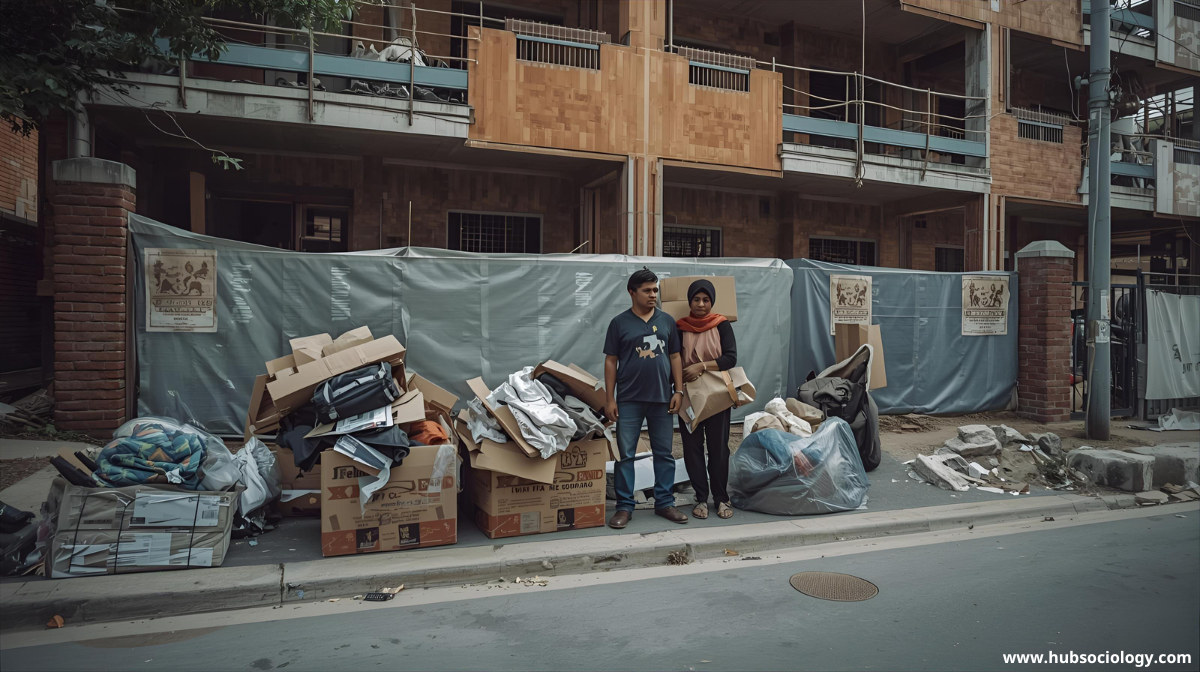
Development is often portrayed as a pathway to progress, modernization, and economic growth. Governments and corporations across the globe promote developmental projects such as dams, highways, industries, and mining as symbols of national advancement. However, beneath this vision of prosperity lies a harsh social reality — displacement. Millions of people, particularly those from marginalized communities, are uprooted from their ancestral lands in the name of development. This paradox of “development-induced displacement” raises critical sociological questions about justice, inequality, and the meaning of development itself.
From a sociological standpoint, the relationship between development and displacement is not merely about economic growth or physical relocation; it is deeply embedded in power relations, cultural disruptions, and identity crises. It reflects how modernization often benefits a few while marginalizing others.
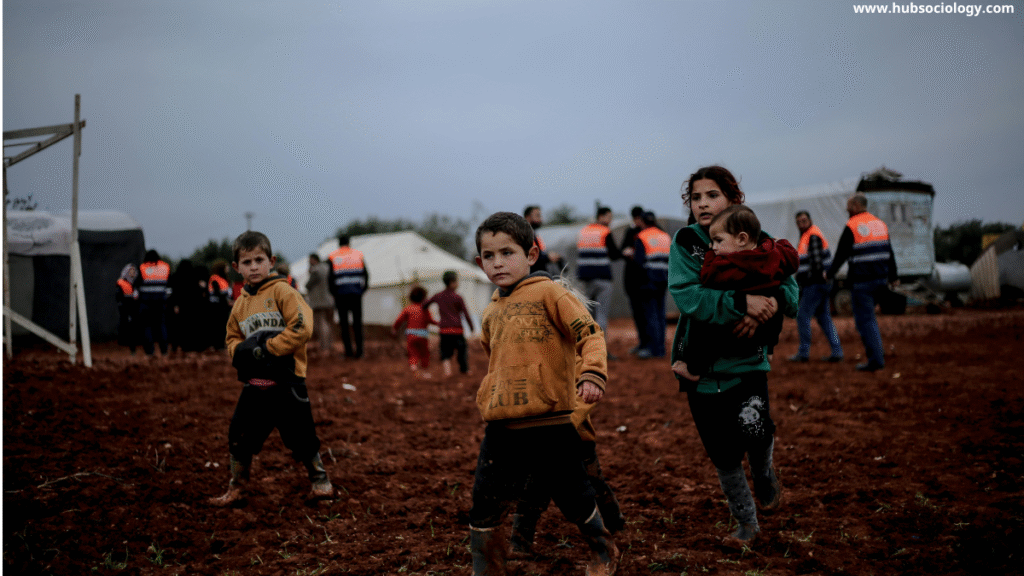
Table of Contents
The Concept of Development and Its Sociological Dimensions
Sociologically, development is not limited to economic indicators such as GDP or industrial output. It encompasses social well-being, equality, education, healthcare, and cultural preservation. According to thinkers like Amartya Sen, true development is about the expansion of human capabilities — enabling people to lead lives they value.
However, the mainstream development model — rooted in capitalist and modernization theories — often views land and natural resources as commodities for exploitation. This approach prioritizes large-scale infrastructural projects and industrialization, frequently ignoring their human and ecological costs. In this context, displacement becomes an unintended, yet recurring, consequence of development policies.
Understanding Displacement: Beyond Physical Relocation
Displacement refers to the forced movement of people from their homes, land, and livelihood sources. It can occur due to dams, highways, urban expansion, mining, and even conservation projects like wildlife sanctuaries. In India, the construction of projects such as the Sardar Sarovar Dam, Tehri Dam, and various mining operations in Jharkhand and Odisha have displaced millions of people — many of whom belong to tribal, rural, and economically vulnerable groups.
From a sociological perspective, displacement is not just about the physical act of moving people. It is a multidimensional process that includes:
- Economic displacement – Loss of land, livelihood, and economic independence.
- Social displacement – Breakdown of community structures, kinship ties, and traditional institutions.
- Cultural displacement – Erosion of local customs, belief systems, and sense of belonging.
- Psychological displacement – Feelings of alienation, insecurity, and loss of identity.
Thus, displacement transforms not just physical space but the entire social fabric of communities.
Theoretical Perspectives on Development and Displacement
1. Marxian Perspective
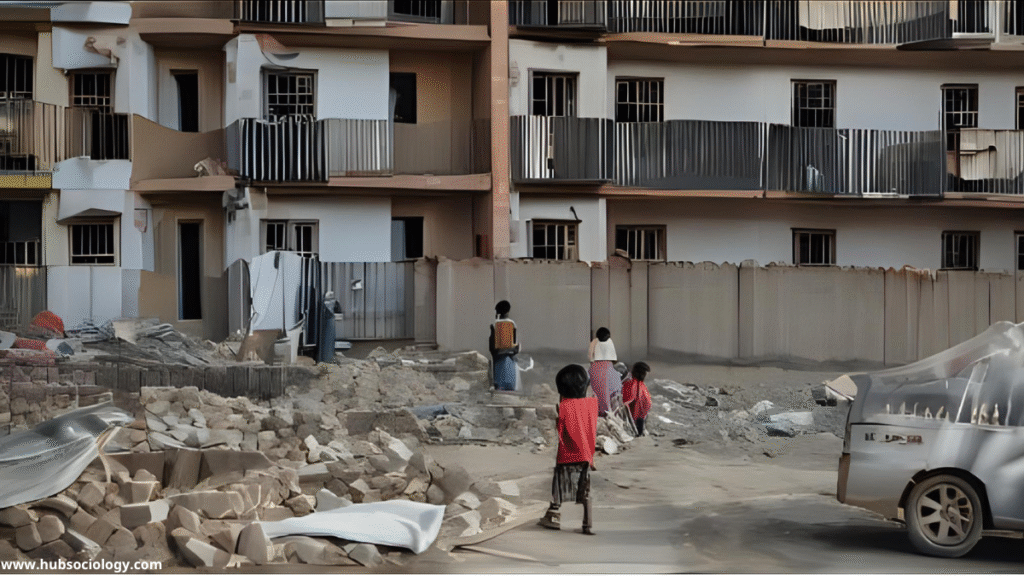
From a Marxian point of view, displacement is an outcome of capitalist expansion. Development projects, especially those involving land acquisition, reflect what David Harvey calls “accumulation by dispossession.” In other words, capital expands by dispossessing the poor of their land and resources. The displaced population becomes part of the reserve army of labor — cheap, unorganized, and exploitable.
Thus, development-induced displacement serves the interests of the capitalist class, while the poor bear the cost of “national progress.” This process widens the gap between the rich and the poor, reinforcing class inequality.
2. Functionalist Perspective
Functionalists, on the other hand, might argue that displacement is a necessary cost of modernization. According to modernization theorists like W.W. Rostow, societies must pass through certain “stages of growth.” Displacement, in this view, is a transitional phase toward achieving industrial and urban advancement.
However, critics argue that this perspective justifies social suffering in the name of national development, failing to consider the human rights and dignity of displaced populations.
3. Postcolonial and Dependency Perspectives
Postcolonial sociologists emphasize that the development paradigm imposed on the Global South mirrors colonial patterns of exploitation. The state often acts like a colonial power within its borders, dispossessing indigenous and rural communities in favour of corporate interests. Dependency theorists further argue that development in poorer nations often serves the interests of global capital, leading to internal displacement and underdevelopment of local communities.
Displacement in India: Scale and Impact
India is one of the countries most affected by development-induced displacement. According to the Indian Social Institute and other studies, since Independence, more than 60 million people have been displaced due to development projects. Dams alone account for nearly 40% of these displacements.
A striking feature of displacement in India is its social selectivity — it disproportionately affects Scheduled Tribes, Scheduled Castes, and rural poor. For example:
- Tribal communities, who constitute around 8% of India’s population, represent nearly 40% of displaced people.
- Many of these communities are relocated to areas with little access to basic amenities, leading to impoverishment and cultural disintegration.
Case Studies
- Narmada Valley Project – One of the most controversial examples of development-induced displacement in India. While the project promised irrigation and electricity, it submerged hundreds of villages, displacing thousands of families. The Narmada Bachao Andolan (Save Narmada Movement) emerged as a powerful social movement questioning the ethics of such development.
- Mining in Odisha and Jharkhand – The expansion of mining industries in tribal belts has led to large-scale land acquisition and environmental degradation. Despite promises of rehabilitation, most displaced families received inadequate compensation and lost their traditional livelihoods.
Rehabilitation and Resettlement: A Sociological Critique
Rehabilitation and resettlement (R&R) policies aim to compensate and restore the livelihoods of displaced persons. However, sociological studies reveal that most R&R programs fail to achieve their objectives due to several reasons:
- Monetary compensation often undervalues land and cannot replace the socio-cultural environment of the community.
- Loss of common property resources such as forests and grazing lands affects collective survival.
- Lack of participation of affected people in decision-making processes reflects structural inequality and state paternalism.
Scholars like Michael Cernea have described displacement as a process of “impoverishment risks” — loss of land, income, social networks, and cultural identity. Without inclusive planning, development becomes a form of “internal colonization.”
Social Movements and Resistance on Development and Displacement
In response to displacement, numerous grassroots movements have emerged worldwide. In India, movements like Narmada Bachao Andolan, Anti-POSCO Movement, and Adivasi Mukti Morcha have challenged the top-down model of development. These movements advocate for “people-centered development”, emphasizing sustainability, participation, and social justice.
Such resistance movements highlight that true development cannot be achieved by sacrificing the rights and dignity of vulnerable populations. They call for alternative paradigms — such as sustainable development and participatory planning — that balance economic growth with social equity.
Toward Inclusive and Sustainable Development
A sociological approach to development urges policymakers to rethink the meaning of progress. Development must be human-centered, focusing on enhancing well-being rather than maximizing profit. Sustainable development emphasizes the balance between economic growth, social inclusion, and environmental protection.
Key principles for inclusive development include:
- Prior informed consent of affected communities.
- Equitable distribution of development benefits.
- Community-based rehabilitation respecting local culture and ecology.
- Transparency and accountability in project planning.
Only when these principles are upheld can development become truly emancipatory rather than displacing.
Conclusion on Development and Displacement
The dialectic between development and displacement exposes a deep contradiction in modern societies. While development is projected as a universal good, it often leads to the suffering and marginalization of vulnerable groups. Sociology reminds us that progress should not be measured merely by infrastructure or GDP but by human well-being, social justice, and ecological balance.
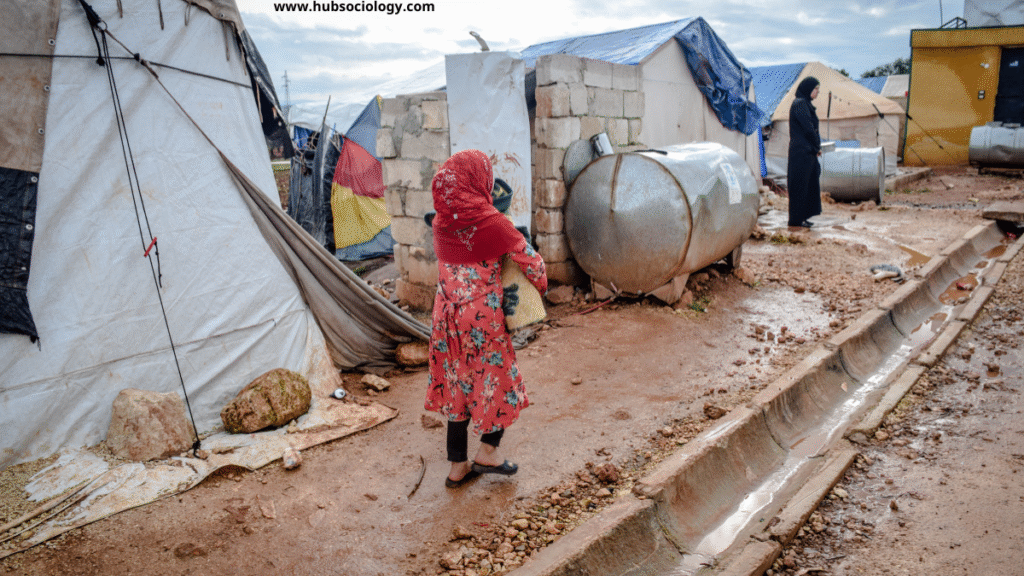
Development that displaces people from their roots is a paradox — a form of growth that undermines its own moral and social foundation. Therefore, the future of development must lie in inclusive, participatory, and sustainable approaches that empower, rather than displace, communities.
Do you like this this Article ? You Can follow as on :-
Facebook – https://www.facebook.com/hubsociology
Whatsapp Channel – https://whatsapp.com/channel/0029Vb6D8vGKWEKpJpu5QP0O
Gmail – hubsociology@gmail.com
Topic related question on Development and Displacement
5 Marks Questions on Development and Displacement (Short Answer Type)
(Answer in about 100–150 words each)
- Define development-induced displacement.
- Mention any two major causes of displacement in developing countries.
- What is meant by rehabilitation and resettlement in the context of displacement?
- Write a short note on the sociological implications of displacement.
- Identify two social groups most affected by development-induced displacement in India.
- How does displacement affect tribal communities?
- What role do NGOs play in addressing displacement issues?
- Explain the term accumulation by dispossession in the context of development.
10 Marks Questions on Development and Displacement (Medium Answer Type)
(Answer in about 250–300 words each)
- Discuss the relationship between development and displacement from a sociological perspective.
- Examine the major social consequences of displacement caused by large development projects in India.
- Explain the Marxian interpretation of development-induced displacement.
- What are the challenges faced in rehabilitation and resettlement of displaced persons?
- Evaluate the impact of displacement on social structure and community life.
- Discuss any one case study of displacement in India (e.g., Narmada Valley Project or Tehri Dam).
- How does displacement reflect inequality and injustice in the process of development?
- What are the main limitations of current development policies regarding displacement in India?
15 Marks Questions on Development and Displacement (Long Answer / Essay Type)
(Answer in about 400–500 words each)
- Critically analyze the paradox of “Development and Displacement” with special reference to India.
- Discuss various sociological theories explaining the link between development and displacement.
- Evaluate the effectiveness of rehabilitation and resettlement policies in addressing the problems of displaced populations.
- “Development without social justice leads to displacement and inequality.” Discuss this statement with suitable examples.
- Examine the role of social movements in resisting displacement and promoting people-centered development.
- Discuss how displacement affects cultural identity, livelihood, and psychological well-being of affected communities.
- Suggest sociologically informed measures to make development inclusive and sustainable.
- Analyze the concept of sustainable development as an alternative to displacement-oriented growth models.