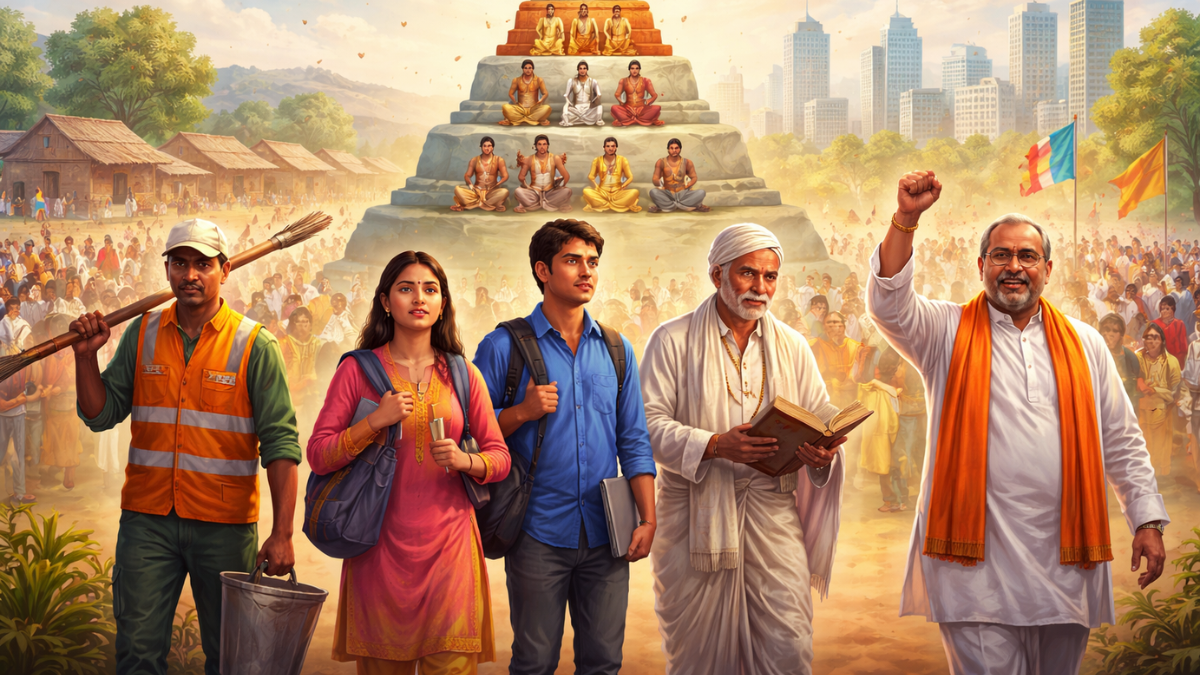
The caste system has long been one of the most discussed and debated features of Indian society. While often associated with tradition and hierarchy, caste is not merely a relic of the past. In modern India, it continues to influence social relations, politics, economic opportunities, and cultural identities. At the same time, significant changes have taken place due to urbanization, industrialization, education, constitutional reforms, and social movements. Thus, the sociological study of the caste system in modern India must focus on both continuity and change.
This article examines how caste persists as a structural and cultural force in contemporary India while also transforming in response to modernization and democratic politics.

Explore the Caste System in Modern India through a sociological lens, examining its historical roots, constitutional reforms, political dynamics, social mobility, and the ongoing continuity and change shaping contemporary Indian society.
Historical Background of the Caste System
The origins of the caste system are generally traced to the ancient varna system described in Hindu scriptures. Society was divided into four broad categories: Brahmins (priests), Kshatriyas (warriors), Vaishyas (traders), and Shudras (servants). Outside this hierarchy were communities historically labeled as “untouchables,” now referred to as Scheduled Castes.
Over time, the varna model became more complex through the development of jatis—thousands of localized, birth-based groups with specific occupations, customs, and marriage rules. Sociologically, caste was characterized by hierarchy, endogamy (marriage within the group), hereditary occupation, restrictions on food and social interaction, and notions of purity and pollution.
During British colonial rule, caste categories were further institutionalized through censuses and administrative classification. This rigidification paradoxically strengthened caste identities, even as modern education and economic change began to challenge traditional structures.
Constitutional Vision and Legal Reforms
After independence in 1947, the Indian state adopted a constitutional framework that rejected caste-based discrimination. The Constitution of India guarantees equality before the law and prohibits discrimination on the basis of caste. Article 17 abolished untouchability, marking a historic break from past practices.
B. R. Ambedkar, a principal architect of the Constitution and a leading Dalit intellectual, played a crucial role in shaping policies aimed at social justice. Affirmative action policies, known as reservations, were introduced for Scheduled Castes (SC), Scheduled Tribes (ST), and later Other Backward Classes (OBCs) in education, government jobs, and political representation.
These legal reforms reflect a sociological shift from a status-based system to a rights-based system. However, the gap between legal ideals and social realities continues to be a central issue.
Continuity of Caste in Social Life
Despite modernization, caste remains deeply embedded in social relations in India.
Endogamy and Marriage
Marriage is one of the strongest sites of caste continuity. Most marriages in India continue to be arranged within the same caste or sub-caste. Matrimonial advertisements, online platforms, and family networks often prioritize caste identity. Inter-caste marriages are increasing but still represent a small percentage of total marriages.
This persistence of endogamy demonstrates that caste is not merely an economic category but also a cultural and symbolic boundary that structures intimate relationships.
Social Networks and Community
Caste-based associations and community organizations remain influential in both rural and urban settings. They organize festivals, provide mutual aid, and influence voting behavior. In villages, caste often shapes settlement patterns, with different groups living in separate hamlets.
Even in cities, migrants tend to rely on caste networks for housing, employment, and social support. Thus, caste adapts to urban contexts rather than disappearing.
Occupational Patterns
While hereditary occupation is less rigid than before, certain professions still show caste concentration. For example, sanitation work is disproportionately performed by members of Scheduled Castes. Conversely, historically dominant castes often control landownership and local economic resources in rural areas.
This continuity indicates that caste inequality intersects with class inequality, reproducing structural disadvantages across generations.
Caste and Politics in Modern India
Democracy has transformed caste from a purely ritual hierarchy into a powerful political identity. Political mobilization based on caste has become a central feature of Indian electoral politics.
Political parties often appeal to specific caste groups, forming vote banks. In several states, caste-based parties have emerged to represent marginalized communities. The Mandal Commission recommendations implemented in the 1990s expanded reservations for OBCs, leading to significant political realignments.

Sociologically, this shift represents what scholars call the “politicization of caste.” Instead of disappearing, caste has become a resource for collective mobilization. Marginalized groups have used democratic institutions to demand representation, dignity, and redistribution.
Thus, while caste hierarchy as a ritual order may weaken, caste as a political category has intensified.
Urbanization and Changing Identities
Urbanization has created new spaces for interaction beyond traditional caste boundaries. In cities, occupational mobility and anonymity reduce the visibility of caste in daily interactions. Workplaces, educational institutions, and public spaces often bring together people from diverse backgrounds.
However, caste does not vanish entirely in urban settings. It may become less visible but continues to influence social networks, housing patterns, and marriage choices. Urban middle-class families may downplay caste publicly while maintaining it privately.
Education has also played a transformative role. Access to higher education and professional careers has enabled many individuals from marginalized castes to achieve upward mobility. This mobility challenges stereotypes and alters traditional power relations.
Dalit Movements and Assertion of Identity
One of the most significant changes in modern India is the rise of Dalit consciousness and activism. Inspired by leaders like B. R. Ambedkar, Dalit movements have challenged caste oppression and demanded equality and dignity.
Dalit literature, art, and scholarship have created new narratives that center the experiences of historically oppressed communities. Organizations such as the Bhim Army mobilize youth to fight discrimination and violence.
Conversion movements, particularly to Buddhism following Ambedkar’s example, represent a symbolic rejection of caste hierarchy. These developments illustrate that marginalized communities are not passive victims but active agents of social change.
Caste and Economic Transformation
Economic liberalization since the 1990s has introduced market-driven changes in Indian society. The expansion of private sector employment and entrepreneurship has opened new avenues for mobility. However, access to these opportunities is uneven.
Upper and dominant castes often possess better educational capital, social networks, and financial resources, enabling them to benefit more from economic reforms. Meanwhile, many lower-caste communities continue to face barriers such as poor schooling, discrimination, and lack of assets.
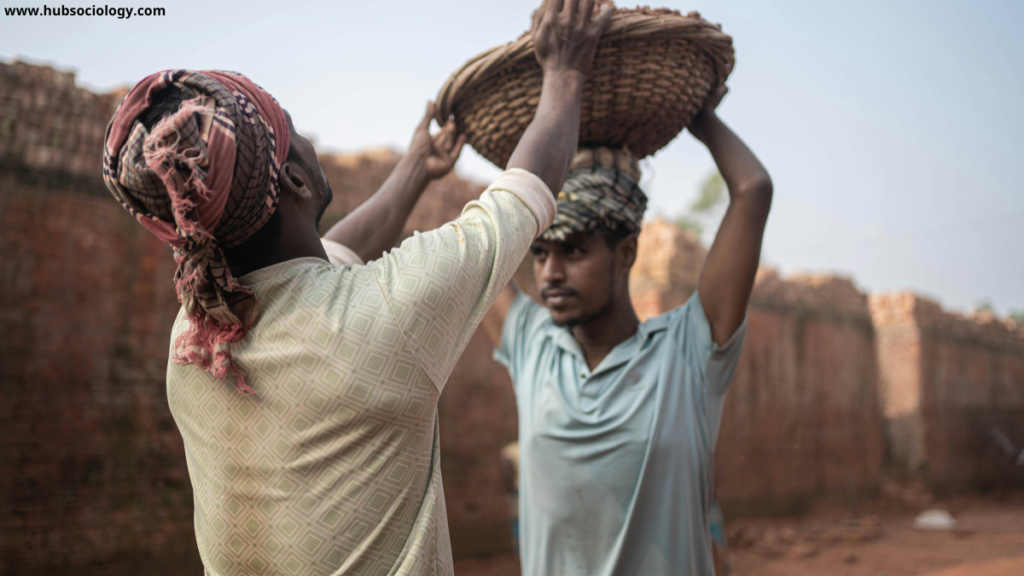
Microfinance initiatives, self-help groups, and government welfare schemes have attempted to address these inequalities. Yet structural disparities persist, showing that economic modernization alone cannot dismantle caste-based inequality.
Gender and Caste Intersection
The intersection of caste and gender reveals another dimension of continuity and change. Women from marginalized castes often experience “double discrimination”—both as women and as members of oppressed castes.
Caste-based honor norms frequently regulate women’s sexuality and marriage choices. Inter-caste relationships sometimes provoke violent reactions in certain regions. At the same time, education and feminist movements have empowered many women to challenge these restrictions.
The sociological concept of intersectionality helps us understand how caste interacts with gender, class, and religion to shape life chances.
Media, Technology, and New Public Spaces
The rise of digital media has created new platforms for discussing caste issues. Social media campaigns expose caste discrimination, mobilize solidarity, and amplify marginalized voices. Online activism has brought national attention to local incidents of caste violence.
At the same time, digital spaces can reproduce caste prejudice through trolling and hate speech. Thus, technology becomes both a site of emancipation and conflict.
Cinema, literature, and web series increasingly portray caste realities, contributing to public debate. Representation in mainstream culture signals a growing awareness of caste as a contemporary issue rather than a historical relic.
Rural-Urban Differences
Caste tends to be more visibly rigid in rural areas, where land ownership, agricultural relations, and traditional authority structures remain influential. Dominant castes often control local institutions such as panchayats.
In urban areas, class stratification may overshadow caste in some contexts, but caste-based housing discrimination and social exclusion persist. Migrants often recreate caste-based community associations in cities.
Therefore, the transformation of caste varies across regions and social settings.
Continuity and Change: A Sociological Interpretation
From a functionalist perspective, caste once provided social order and division of labor. However, from a conflict perspective, it institutionalized inequality and exploitation. In modern India, both elements of continuity and change coexist.
Continuity is visible in marriage patterns, social networks, political mobilization, and persistent discrimination. Change is evident in legal reforms, educational mobility, urban interaction, Dalit assertion, and shifting cultural norms.
Sociologist M. N. Srinivas introduced concepts such as “Sanskritization” and “Westernization” to explain social mobility and cultural change within the caste system. These processes illustrate how lower castes adopt practices of higher castes to improve status, while Western education and institutions challenge traditional hierarchies.
Yet, contemporary scholarship emphasizes that caste is not disappearing but transforming. It adapts to capitalism, democracy, and globalization.
The Future of Caste in India
The future of the caste system in modern India depends on multiple factors: quality of education, economic inclusivity, political will, and social awareness. Inter-caste marriages, urban integration, and anti-discrimination enforcement can weaken rigid boundaries. At the same time, identity politics and social inequalities may sustain caste as a mobilizing force.
Young generations increasingly question caste prejudice, especially in metropolitan areas. However, structural inequalities require sustained policy intervention and cultural transformation.
Conclusion
The caste system in modern India represents a complex interplay of continuity and change. While constitutional ideals promote equality and justice, social realities reveal enduring hierarchies and discrimination. Caste persists in marriage, politics, social networks, and economic structures. Yet it also undergoes transformation through education, urbanization, democratic mobilization, and Dalit assertion.
Sociologically, caste should not be understood as a static institution frozen in time. It is a dynamic system that evolves with broader social changes. The challenge for modern India lies in reconciling cultural diversity with social equality—ensuring that caste identity does not determine one’s life chances.
The journey from hierarchy to equality remains incomplete, but the forces of change are undeniable.
FAQs on Caste System in Modern India
1. What is the Caste System in Modern India?
The Caste System in Modern India refers to the continuing influence of traditional caste divisions on social, political, and economic life, even after constitutional reforms promoting equality.
2. Is the Caste System in Modern India legally recognized?
No, discrimination based on caste is prohibited under the Constitution of India, and untouchability has been abolished under Article 17.
3. How does the Caste System in Modern India affect marriage patterns?
The Caste System in Modern India strongly influences marriage, as most marriages still occur within the same caste (endogamy), although inter-caste marriages are gradually increasing.
4. Does the Caste System in Modern India influence politics?
Yes, caste plays a major role in electoral politics, voting behavior, political mobilization, and the formation of caste-based political parties.
5. How has education impacted the Caste System in Modern India?
Education has enabled social mobility among marginalized groups, challenging traditional hierarchies within the Caste System in Modern India.
6. What role does reservation policy play in the Caste System in Modern India?
Reservation policies provide affirmative action in education, employment, and political representation to historically disadvantaged communities.
7. Is the Caste System in Modern India stronger in rural or urban areas?
The Caste System in Modern India tends to be more rigid and visible in rural areas, though it still influences social networks and housing patterns in cities.
8. How does the Caste System in Modern India affect economic opportunities?
Access to land, capital, education, and employment opportunities often reflects caste-based inequalities, though economic liberalization has created new mobility pathways.
9. What is the relationship between caste and class in the Caste System in Modern India?
Caste and class intersect, as historically privileged castes often hold economic advantages, while marginalized castes face structural disadvantages.
10. How do social movements challenge the Caste System in Modern India?
Dalit movements, student activism, and civil society campaigns advocate equality, dignity, and legal enforcement against discrimination.
11. Has globalization reduced the impact of the Caste System in Modern India?
Globalization has introduced new economic opportunities, but it has not completely eliminated caste-based inequalities.
12. How does the Caste System in Modern India affect women?
Women from marginalized castes often face double discrimination based on both caste and gender.
13. Are younger generations rejecting the Caste System in Modern India?
Many urban and educated youth question caste discrimination, but traditional practices still persist in many families.
14. Does the Caste System in Modern India influence social identity?
Yes, caste remains an important aspect of identity, shaping community belonging, cultural practices, and political affiliation.
15. What is the future of the Caste System in Modern India?
The future of the Caste System in Modern India depends on social reform, inclusive development, education, and stronger enforcement of anti-discrimination laws.