Introduction
Switzerland is one of the most interesting examples of a multicultural and multilingual society in the modern world. Despite having several linguistic communities, distinct cultural traditions, and regional identities, the country has maintained a relatively strong sense of national unity. The relationship between multilingualism and social cohesion makes Swiss Society an important subject for sociological investigation.
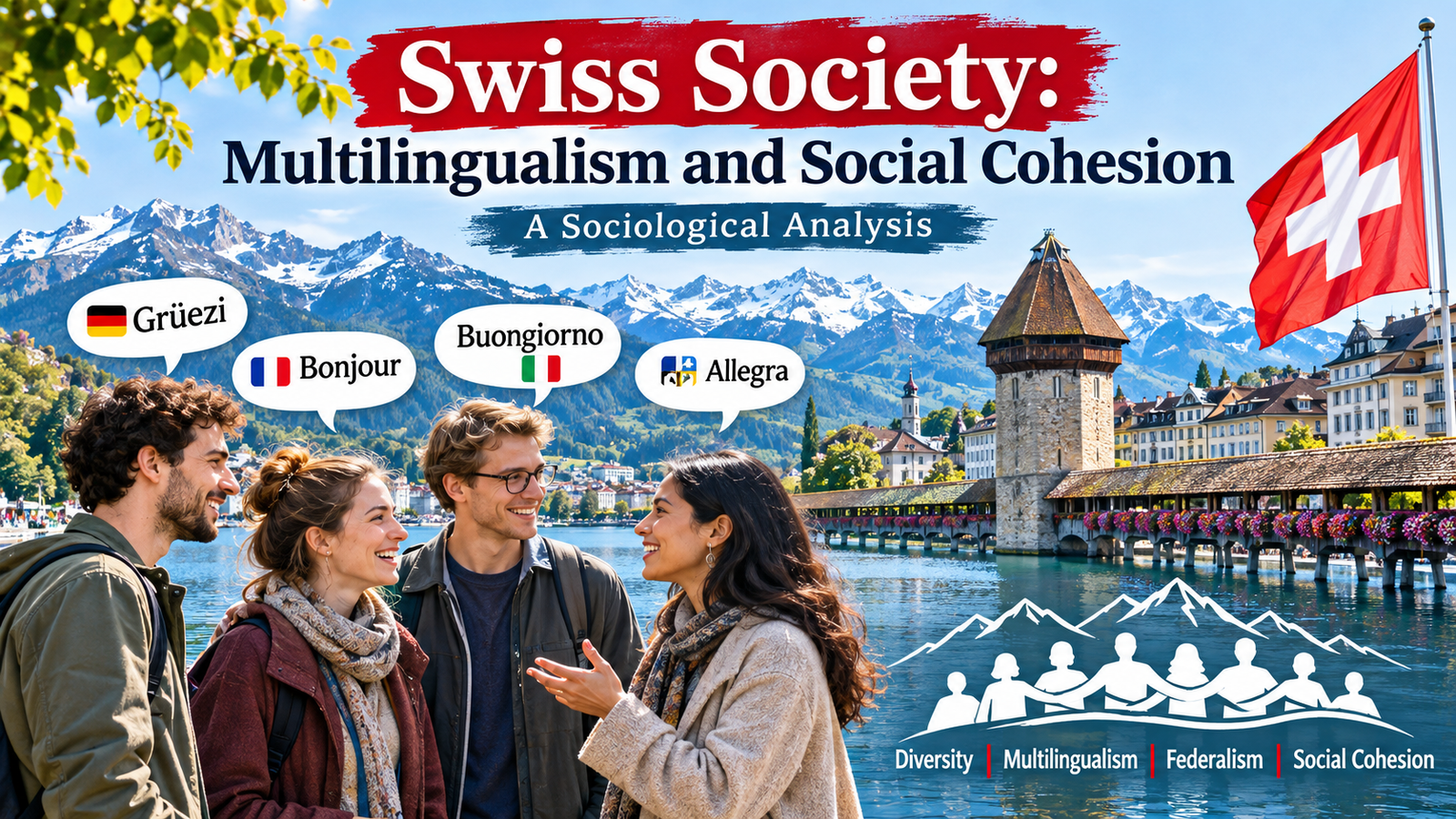
Swiss Society is characterised by four nationally recognised languages: German, French, Italian, and Romansh. These languages represent different historical experiences, cultural traditions, and regional identities. Unlike many nation-states that developed around a single dominant language, Switzerland has built its national identity through political cooperation, cultural accommodation, democratic participation, and respect for linguistic diversity.
However, Swiss Society is not entirely free from linguistic tensions, regional inequalities, and cultural divisions. Differences between German-speaking, French-speaking, Italian-speaking, and Romansh-speaking communities sometimes create political disagreements regarding education, administration, economic opportunities, and national representation.

From a sociological perspective, Switzerland provides an excellent example of how cultural diversity can coexist with national integration. This article examines how multilingualism influences Swiss Society, how social institutions maintain cohesion, and what challenges threaten the country’s multicultural model.
1. Understanding the Linguistic Structure of Swiss Society
Switzerland is officially a multilingual country with four national languages: German, French, Italian, and Romansh. These languages are geographically distributed across different regions, creating distinct linguistic and cultural communities.
German is the most widely spoken language, particularly in central, eastern, and northern Switzerland. French is dominant in the western region, commonly known as Romandy. Italian is primarily spoken in the southern canton of Ticino and certain parts of Graubünden. Romansh is spoken by a relatively small population, mainly in the canton of Graubünden.
According to Switzerland’s Federal Statistical Office, 2024 data indicate that approximately 61.1% of the permanent resident population reported German as one of their main languages, 22.6% French, 7.8% Italian, and 0.4% Romansh. Other languages accounted for approximately 24.5%. These percentages overlap because individuals can report more than one main language.
This linguistic structure demonstrates that Swiss Society is not culturally homogeneous. Instead, it consists of multiple communities that maintain their linguistic traditions while participating in a common political and economic system.
An important feature of Swiss Society is that linguistic identity does not necessarily determine national identity. People may identify strongly with their regional language and culture while simultaneously considering themselves Swiss citizens.
This reflects the sociological concept of multiple identities, in which individuals maintain different layers of belonging, including local, regional, linguistic, and national identities.
2. Historical Development of Multilingualism in Swiss Society
The multilingual character of Swiss Society developed through a long historical process rather than through a single cultural or political movement.
Switzerland emerged from a collection of historically independent territories and cantons that gradually developed political cooperation. Different regions maintained their own languages, religious traditions, economic systems, and local institutions.
The establishment of the modern Swiss federal state in 1848 was particularly important. The federal constitution created a political framework through which different linguistic communities could participate in a common national system without abandoning their regional identities.
Rather than imposing one language on the entire population, Switzerland developed an approach based on linguistic recognition and political decentralisation.
This historical arrangement became an important foundation of Swiss Society. The federal system allowed cantons to retain considerable autonomy over education, administration, and cultural affairs.
Sociologically, this development can be understood through the concept of institutional pluralism. Different cultural communities are able to preserve their identities because political institutions recognise and accommodate their differences.
The Swiss experience demonstrates that national integration does not always require cultural uniformity. A society can develop a shared political identity while maintaining different cultural traditions.
3. Multilingualism as a Foundation of Social Cohesion
Social cohesion refers to the strength of relationships, mutual trust, solidarity, cooperation, and shared belonging among members of a society.
In Swiss Society, multilingualism plays an important role in maintaining these relationships. The recognition of four national languages creates an institutional environment in which different linguistic communities receive constitutional and political recognition.
The Swiss government promotes communication between language groups through educational programmes, cultural exchanges, translation services, and federal institutions.
According to the Federal Statistical Office’s 2024 Language, Religion and Culture Survey, published in August 2025, approximately 86% of the population consider knowledge of several national languages important for national cohesion. Almost two-thirds regularly use several languages in everyday life.
These findings demonstrate that multilingualism is not simply a constitutional arrangement. It is also an important social value among the Swiss population.
In sociological terms, multilingualism contributes to bridging social capital. Bridging social capital refers to relationships that connect individuals belonging to different social and cultural groups.
When people communicate across linguistic boundaries, they develop greater cultural understanding and opportunities for cooperation.
However, multilingualism alone cannot guarantee social cohesion. It must be supported by equal opportunities, inclusive institutions, political representation, and mutual respect.
4. The Role of Federalism in Maintaining Social Unity
One of the most important institutional features of Swiss Society is federalism.
Switzerland consists of 26 cantons, each possessing considerable authority over regional administration, education, taxation, and cultural policies.
This decentralised political structure allows linguistic communities to maintain control over many aspects of their social and cultural lives.
For example, French-speaking cantons can organise education and administration primarily in French, while German-speaking cantons use German. Italian-speaking Ticino maintains its Italian linguistic and cultural traditions.
Multilingual cantons such as Bern, Fribourg, Valais, and Graubünden provide additional examples of institutional accommodation.
Federalism reduces the possibility that one linguistic community will dominate every aspect of national administration. It creates opportunities for different groups to participate in decision-making.
From a sociological perspective, federalism functions as a mechanism of conflict management. Instead of suppressing regional differences, the political system provides institutional arrangements through which communities can negotiate their interests.
Swiss Society therefore demonstrates how decentralisation can contribute to national integration.
Nevertheless, federalism also creates challenges. Different cantons may adopt different educational policies, creating disagreements about the best way to promote national languages and cultural exchange.
5. Language, Education and Cultural Integration

Education is one of the most important institutions through which Swiss Society reproduces its multilingual character.
Swiss students generally learn at least one additional national language during compulsory education. The purpose is to encourage communication between linguistic communities and strengthen national understanding.
For example, students in German-speaking regions generally study French, while students in French-speaking regions commonly study German.
However, the effectiveness of this system has become a subject of political and educational debate.
In September 2025, the canton of Zurich decided to remove French from primary-school foreign-language teaching, and St. Gallen subsequently moved in a similar direction. These decisions renewed the national debate about the position of French in compulsory education.
The debate is sociologically significant because it reveals the tension between regional autonomy and national integration.
Some policymakers prioritise educational flexibility and the practical importance of English. Others argue that learning another national language is essential for maintaining communication between Switzerland’s linguistic communities.
A further important development occurred in Bern. According to a November 2025 report by SWI swissinfo.ch, the city decided to discontinue its experimental bilingual primary-school programme, known as Classes bilingues, from summer 2026.
The programme had attracted considerable interest since its introduction in 2019. Its closure was associated with practical difficulties involving school infrastructure, staffing, and differences between educational curricula.
From a sociological perspective, this development demonstrates that multicultural policies require more than constitutional recognition. They also require financial resources, institutional coordination, and sustained political commitment.
Education must therefore be understood not only as a means of transmitting knowledge but also as an instrument of social integration.
6. Linguistic Identity and Regional Differences
Language is an important marker of cultural identity in Swiss Society.
German-speaking, French-speaking, Italian-speaking, and Romansh-speaking communities possess distinctive cultural traditions, communication styles, historical experiences, and regional attachments.
These differences influence everyday social interactions and political attitudes.
For example, German-speaking Switzerland has considerable demographic and economic influence because it contains the largest linguistic population. French-speaking communities sometimes express concerns about their representation in national institutions and the distribution of political and economic power.
Such differences demonstrate that formal linguistic equality does not automatically produce complete social equality.
Sociologically, this can be analysed through the concepts of majority-minority relations and cultural power.
A numerically larger community may enjoy greater influence over public institutions, employment networks, media representation, and political decision-making.
The challenge for Swiss Society is to ensure that smaller linguistic communities receive meaningful opportunities to preserve their identities and participate in national life.
The situation of Romansh is particularly important. Although Romansh is constitutionally recognised, its relatively small speaker population creates difficulties for intergenerational language transmission and everyday institutional use.
Therefore, protecting linguistic diversity requires continuous cultural and institutional support.
7. Immigration, Multiculturalism and New Linguistic Communities

Modern Swiss Society is becoming increasingly diverse due to international migration, globalisation, education, and economic development.
Immigration has introduced several additional languages, including Portuguese, Albanian, English, Spanish, and many others.
The linguistic composition of Switzerland is therefore no longer limited to its four national languages.
This development creates new opportunities for intercultural communication but also raises questions about integration, citizenship, employment, and social inequality.
English has become particularly influential in international business, higher education, tourism, and communication between people from different linguistic backgrounds.
In some professional environments, English functions as a bridge language between German-, French-, and Italian-speaking individuals.
However, the growing importance of English also raises concerns about the position of smaller national languages.
From a sociological perspective, this situation illustrates the relationship between globalisation and cultural change. Global languages can create new forms of communication while simultaneously challenging traditional linguistic identities.
Immigrant communities also face the challenge of maintaining their heritage languages while acquiring the language required for participation in local institutions.
Successful integration should therefore involve two complementary processes: learning the language of the local community and receiving social recognition for one’s cultural background.
Swiss Society must balance these objectives to ensure that multilingualism becomes a source of social inclusion rather than a mechanism of cultural exclusion.
8. Language, Social Inequality and Access to Opportunities
Although Switzerland has developed strong institutions for linguistic equality, language proficiency can influence access to employment, education, healthcare, and public services.
Individuals who speak the dominant language of their region generally have advantages when interacting with employers, government departments, educational institutions, and professional networks.
Immigrants who lack sufficient knowledge of the local language may experience difficulties finding employment or participating in community activities.
Language can therefore operate as a form of cultural capital.
The French sociologist Pierre Bourdieu explained that language is not merely a communication tool. It can also function as a form of symbolic power because particular linguistic skills receive greater recognition and value within specific social fields.
In Swiss Society, proficiency in German, French, or Italian can influence professional opportunities depending on the region.
Similarly, knowledge of multiple languages may provide advantages in federal administration, international business, tourism, and education.
However, individuals who speak less widely recognised languages may face disadvantages.
This creates an important sociological question: Does multilingualism provide equal opportunities for everyone, or does it sometimes reproduce existing social inequalities?
The answer depends on the availability of language education, employment opportunities, public services, and institutional support.
9. Recent Developments: Language Politics and Social Cohesion in 2025–2026
Recent developments demonstrate that multilingualism remains an important political and social issue in Swiss Society.
The 2025 multilingualism survey
In August 2025, Switzerland’s Federal Statistical Office published findings from its Language, Religion and Culture Survey 2024. Approximately 86% of respondents considered knowledge of several national languages important for national cohesion.
This finding suggests that multilingualism remains an important component of Swiss national identity.
From a sociological perspective, the result demonstrates the continued importance of shared cultural values in maintaining solidarity within a diverse society.
The closure of bilingual school programmes
In November 2025, SWI swissinfo.ch reported that Bern would discontinue its experimental bilingual primary-school programme from summer 2026.
The programme had provided children with opportunities to study in both German and French.
Its closure highlighted the difficulties of implementing multilingual education within existing institutional structures.
Sociologically, this incident demonstrates the difference between cultural aspirations and institutional realities. Even when communities support multilingualism, financial and administrative limitations can restrict its practical implementation.
The debate over French education
In September 2025, decisions in Zurich and St. Gallen to reduce the role of French in primary education intensified discussions about language teaching.
The issue became particularly important because French is one of Switzerland’s national languages and plays a significant role in communication between linguistic regions.
In October 2026, another major development occurred when the Swiss government submitted proposals for revising the Languages Act. The consultation debate focused on whether schools should prioritise one national language alongside English or ensure the continued teaching of a second national language through compulsory education.
Political parties, cantons, and teachers expressed different views about the proposals.
This disagreement reflects a fundamental sociological tension between federal autonomy and national solidarity.
Language requirements and social integration
In September 2025, Bern also debated proposals requiring social assistance recipients to speak or learn one of the canton’s official languages, German or French.
Supporters argued that language acquisition was important for social integration and participation in community life. Critics questioned whether linking language requirements to social assistance could create additional disadvantages for vulnerable individuals.
This debate highlights the relationship between language, citizenship, welfare institutions, and social inclusion.
Together, these developments demonstrate that Swiss Society is continuously negotiating the relationship between cultural diversity and national unity.
10. Sociological Theories Explaining Swiss Social Cohesion
Several sociological theories help explain how Swiss Society maintains social cohesion despite linguistic diversity.
Émile Durkheim’s Theory of Social Solidarity
Durkheim distinguished between mechanical solidarity and organic solidarity.
Mechanical solidarity is based on similarities in beliefs, traditions, and social experiences. Organic solidarity develops through interdependence and the division of labour.
Swiss Society demonstrates elements of organic solidarity because people from different linguistic and cultural backgrounds cooperate through economic activities, political institutions, and shared public services.
Although citizens do not necessarily share the same language, they remain connected through common institutions and social responsibilities.
Max Weber’s Concept of Social Action
Max Weber emphasised the importance of shared meanings and social interaction in understanding society.
In multilingual Switzerland, communication across linguistic boundaries enables individuals to develop mutual understanding and participate in common institutions.
Language differences may create barriers, but institutional arrangements and intercultural interaction help reduce these barriers.
Pierre Bourdieu’s Theory of Cultural Capital
Bourdieu’s concept of cultural capital explains how language proficiency can influence social status and access to opportunities.
In Swiss Society, knowledge of several languages may provide advantages in employment, education, and professional mobility.
However, differences in language skills can also reproduce inequalities between social groups.
Social Capital Theory
Social capital refers to the networks, relationships, and trust that facilitate cooperation.
Swiss Society demonstrates the importance of both bonding and bridging social capital.
Bonding social capital strengthens relationships within linguistic communities, while bridging social capital connects people from different linguistic backgrounds.
A balanced relationship between these two forms of social capital is essential for long-term national cohesion.
11. Challenges to the Future of Swiss Society
Despite its achievements, Swiss Society faces several challenges in maintaining its multilingual character.
First, the growing importance of English may reduce the practical motivation to learn another national language. Although English facilitates international communication, excessive dependence on it could weaken interaction between traditional linguistic communities.
Second, smaller language communities, particularly Romansh speakers, face difficulties in preserving their linguistic traditions. Urbanisation, migration, and changing employment patterns may weaken intergenerational language transmission.
Third, differences in educational policies across cantons create difficulties in maintaining a consistent national language-learning framework.
Fourth, immigration requires institutions to develop more inclusive approaches to language learning. Newcomers need opportunities to acquire local languages without being forced to abandon their cultural identities.
Finally, regional inequalities and differences in political influence may create tensions between larger and smaller linguistic communities.
Addressing these challenges requires continuous investment in education, cultural exchange, translation services, minority-language protection, and inclusive public institutions.
Conclusion
Swiss Society provides an important sociological example of how multilingualism and cultural diversity can coexist with national unity. Its experience demonstrates that social cohesion does not necessarily depend on linguistic uniformity or the dominance of a single cultural identity.
Instead, Swiss national integration has developed through federalism, democratic participation, institutional recognition, education, and respect for regional differences.
However, recent debates about French-language education, bilingual schools, immigration, and language requirements demonstrate that social cohesion requires continuous institutional and political effort.
The future of Swiss Society will depend on its ability to balance regional autonomy with national solidarity, protect minority languages, and create equal opportunities for individuals from different linguistic backgrounds.
Ultimately, the Swiss experience offers an important lesson for multicultural societies around the world: diversity does not have to be an obstacle to national unity. When supported by inclusive institutions, mutual respect, and equal participation, linguistic diversity can become a foundation of social solidarity and democratic stability.