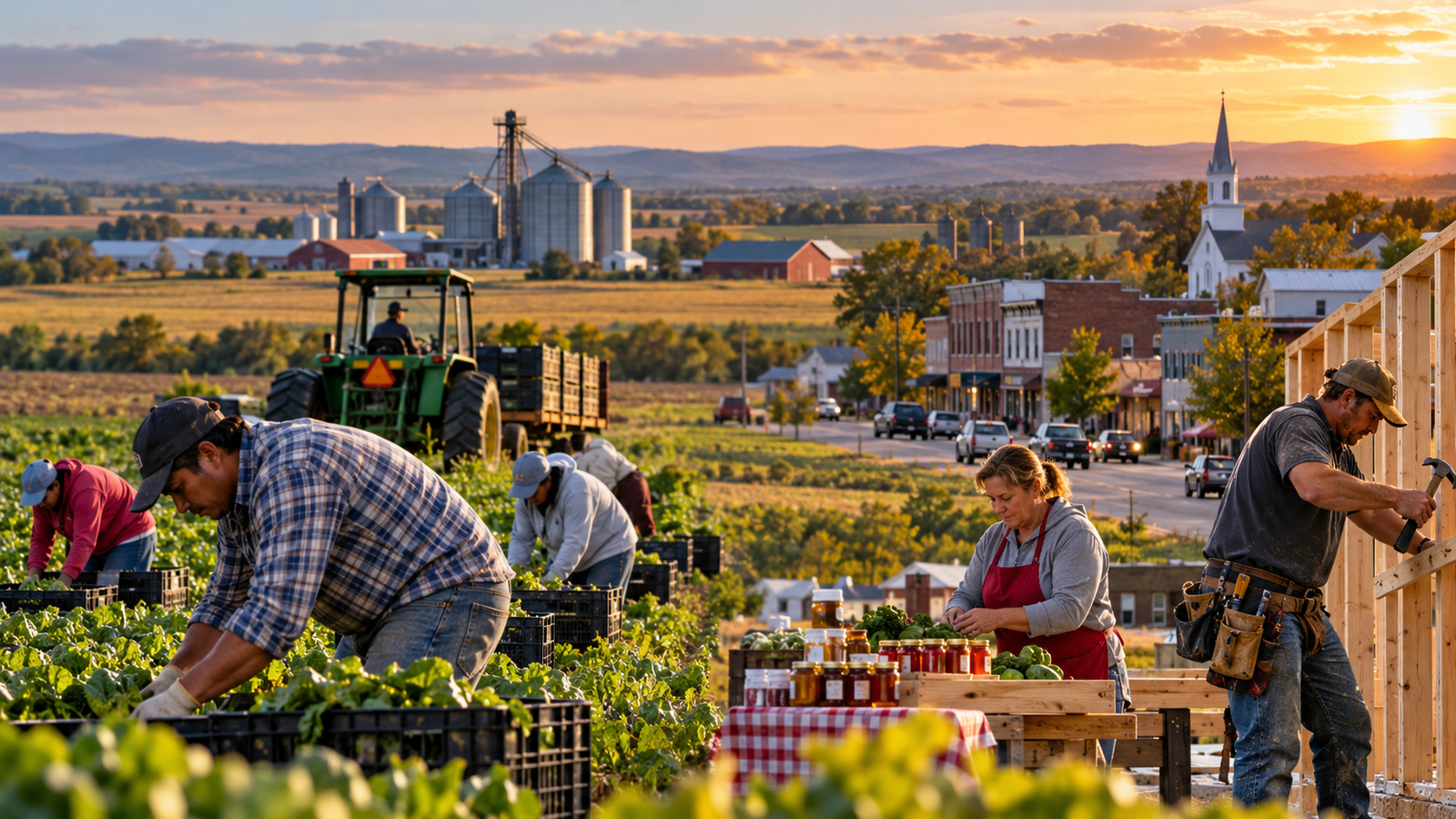
Introduction on Rural Labor Markets in America
Rural Labor Markets in America play a significant role in shaping the country’s economic development, social structure, and regional inequalities. Although the United States is often associated with large cities, advanced industries, and a technology-driven economy, rural communities remain essential to agriculture, food production, manufacturing, mining, forestry, tourism, and other economic activities. However, employment opportunities in rural areas differ considerably from those in metropolitan regions. Limited job availability, lower wages in some industries, seasonal employment, geographical isolation, and unequal access to education create distinctive challenges for rural workers.
From a sociological perspective, Rural Labor Markets in America cannot be understood simply by examining employment statistics. They must also be studied through the relationships between social class, gender, race, migration, family structure, community networks, and economic power. These factors influence who obtains employment, what kinds of work people perform, and how workers experience economic insecurity.
The informal economy is another important dimension of rural employment. It includes economic activities that operate partly or entirely outside formal employment arrangements, such as unregistered services, cash-based work, informal caregiving, and certain forms of casual agricultural labor. While these activities provide income and flexibility, they may also expose workers to low wages, insecure working conditions, and limited legal protection.
Understanding Rural Labor Markets in America therefore requires an examination of both formal employment and informal economic activity. This article explores their structure, sociological characteristics, major challenges, and implications for the future of rural communities.
Understanding Rural Labor Markets in America
Rural Labor Markets in America consist of the institutions, employers, workers, and economic relationships through which labor is exchanged outside major metropolitan centers. These markets include agricultural employment, small businesses, local government, healthcare, education, manufacturing, construction, transportation, and service industries.
Unlike large urban labor markets, rural employment systems often operate within relatively small communities. A limited number of major employers may provide a substantial share of local jobs. When a factory closes, a hospital reduces its workforce, or an agricultural enterprise experiences financial difficulties, the consequences can affect an entire community.

The structure of Rural Labor Markets in America is also influenced by geography. Long travel distances, inadequate public transportation, limited childcare facilities, and restricted access to specialized training can prevent workers from accepting available jobs. Even when vacancies exist, workers may lack the resources necessary to reach workplaces or meet employers’ requirements.
From a sociological standpoint, rural labor markets reflect the relationship between economic institutions and community life. Employment provides more than income; it shapes social identity, family responsibilities, community participation, and individual status. Consequently, changes in Rural Labor Markets in America can transform the social organization of rural society.
Historical Development of Rural Employment
Historically, rural employment in the United States was closely connected to agriculture, family farming, natural resources, and small-scale local commerce. Agricultural production employed large numbers of workers, while rural households frequently combined paid work with unpaid family labor.
Industrialization, mechanization, and technological innovation gradually transformed this arrangement. Agricultural machinery reduced the demand for certain forms of manual labor, while changes in farming methods increased productivity. At the same time, manufacturing industries created employment opportunities in some rural regions.
During the twentieth century, migration from rural communities to cities became an important feature of American social change. People moved in search of higher wages, education, industrial employment, and better living conditions. This migration altered rural age structures and reduced the working-age population in some communities.
In later decades, globalization, automation, industrial restructuring, and changes in agricultural markets created additional pressures. Some rural manufacturing communities lost stable employment as factories closed or production moved elsewhere. Meanwhile, other areas developed employment opportunities in healthcare, logistics, tourism, renewable energy, and specialized manufacturing.
These historical changes explain why Rural Labor Markets in America are highly diverse. Some rural regions benefit from growing industries and proximity to metropolitan economies, while others experience persistent unemployment, population decline, and limited economic diversification.
Agriculture and Seasonal Employment on Rural Labor Markets in America
Agriculture remains a central component of Rural Labor Markets in America, although its importance varies considerably across regions. Farms require workers for planting, harvesting, livestock management, equipment maintenance, packing, and transportation. Agricultural employment can involve family members, permanent employees, temporary workers, and seasonal laborers.
Seasonality creates a distinctive employment pattern. Workers may experience high demand during planting or harvesting periods but have fewer opportunities during other months. Their annual earnings can therefore fluctuate significantly, particularly when alternative employment is unavailable.
Agricultural workers may also face physically demanding tasks, exposure to extreme weather, long working hours, and uncertainty caused by crop failures or changing market prices. Workers employed through temporary or informal arrangements can be especially vulnerable when they lack clear contracts or reliable access to benefits.
Sociologically, agricultural labor illustrates how economic inequality is connected to ownership and control over productive resources. Farm owners and agricultural businesses may control land, equipment, and access to markets, while laborers depend on wages for their livelihoods. This unequal relationship can influence bargaining power and working conditions.
Rural Labor Markets in America must therefore be examined in relation to agricultural modernization, labor rights, immigration, and the unequal distribution of economic resources.
The Informal Economy in Rural America
The informal economy includes economic activities that are not fully registered, regulated, or protected through conventional employment arrangements. Informal work is not necessarily illegal. Instead, it describes work that operates outside some of the administrative, contractual, or social-protection systems associated with formal employment.
In rural communities, informal economic activities may include cash-paid construction, domestic services, casual farm labor, informal transportation, home-based food production, small repair services, and unregistered personal businesses. Some workers also perform occasional jobs for neighbors, relatives, and local businesses to supplement their main income.

The informal economy becomes particularly important when formal employment is scarce. Workers who cannot secure permanent jobs may rely on temporary tasks, self-employment, or community-based exchanges. These arrangements can help households meet immediate financial needs and reduce dependence on a single employer.
However, informal work often involves significant insecurity. Workers may not receive written contracts, paid leave, unemployment insurance, or employer-sponsored health benefits. Income can fluctuate, and disagreements over payment may be difficult to resolve.
The informal economy also complicates the measurement of employment. Official labor statistics may not fully capture irregular work, unpaid family contributions, or small-scale cash transactions. As a result, Rural Labor Markets in America may be more economically active than conventional employment figures suggest, while simultaneously providing less financial security than those figures imply.
From a sociological perspective, informal employment reflects both individual adaptation and structural inequality. It demonstrates how people use local networks and practical skills to survive, but it can also reveal gaps in labor protection and economic opportunity.
Social Class and Economic Inequality on Rural Labor Markets in America
Social class plays a major role in shaping opportunities within Rural Labor Markets in America. Landowners, business owners, managers, skilled professionals, wage laborers, and workers in precarious employment occupy different positions within the rural economic hierarchy.
People with property, financial savings, higher education, or professional connections generally have more options when local economic conditions deteriorate. In contrast, low-income workers may have limited access to retraining, transportation, credit, and alternative employment.
Rural poverty should not be understood only as a consequence of individual choices. It is also connected to regional investment patterns, educational opportunities, infrastructure, industrial change, and the distribution of productive assets. When well-paying jobs disappear, workers may accept lower wages or combine several part-time jobs to maintain household income.
Economic inequality can also reproduce itself across generations. Children in households with limited resources may experience restricted access to educational opportunities, digital technology, and professional networks. These disadvantages can influence their later employment prospects.
Rural Labor Markets in America therefore demonstrate how labor-market outcomes are shaped by broader social structures. Improving employment opportunities requires more than encouraging individuals to work harder; it also requires addressing the institutional conditions that restrict economic mobility.
Gender and Rural Employment on Rural Labor Markets in America
Gender relations significantly influence the organization of rural work. Men and women may participate in different occupational sectors, experience different expectations regarding family responsibilities, and have unequal access to leadership positions.
In many rural communities, women work in education, healthcare, retail, hospitality, administration, agriculture, and home-based enterprises. They also perform substantial amounts of unpaid labor, including childcare, eldercare, household management, and assistance with family businesses.
This unpaid work is economically valuable, yet it is not always recognized in conventional employment statistics. Women who manage household responsibilities may find it difficult to accept jobs involving long commutes, inflexible schedules, or irregular shifts.
The availability of childcare and eldercare services can therefore influence women’s participation in Rural Labor Markets in America. Where such services are limited or expensive, family responsibilities may restrict employment choices and reduce earning potential.
Men also face gendered expectations, particularly in communities where masculinity is strongly associated with industrial work, farming, physical labor, and the role of primary household provider. When traditional industries decline, these expectations can contribute to financial stress and changes in social identity.
A sociological understanding of rural employment must consequently consider both paid and unpaid labor, along with the gender norms that influence how work is distributed and valued.
Race, Immigration, and Labor Market Inequality
Race and immigration status can shape access to employment, workplace protection, and economic mobility in rural America. Rural communities are not socially uniform; they include people from different racial, ethnic, and national backgrounds whose employment experiences vary according to local institutions and economic conditions.
Immigrant workers contribute to agriculture, food processing, construction, hospitality, and other industries in many rural regions. Their labor supports local production and business activity, but some workers may encounter language barriers, discrimination, insecure housing, or difficulties understanding employment regulations.
Workers with uncertain immigration status may be particularly reluctant to report wage theft or unsafe conditions because they fear possible consequences. Such vulnerability can weaken their bargaining power and make informal employment arrangements more difficult to challenge.
Racial inequality can also influence access to land ownership, business financing, professional networks, and high-paying jobs. These patterns must be understood within the historical and institutional contexts of individual communities rather than treated as identical across all rural regions.
Rural Labor Markets in America illustrate how social identity and economic power interact. Policies that improve labor standards, access to education, language assistance, and fair hiring practices can help reduce inequalities and strengthen local economies.
Education, Skills, and Technological Change
Education and vocational training are increasingly important in Rural Labor Markets in America. Employers in healthcare, advanced manufacturing, information technology, logistics, and renewable energy may require specialized qualifications that are not always readily available locally.
Rural students can face barriers such as long travel distances, limited course offerings, insufficient broadband access, and the cost of moving to larger cities for higher education. These barriers can reduce access to emerging employment opportunities.
At the same time, digital technology creates new possibilities. Remote work, online entrepreneurship, digital marketing, freelance services, and e-commerce can allow some rural residents to reach customers and employers beyond their immediate communities.
However, these benefits depend on reliable internet connectivity, appropriate equipment, digital literacy, and access to suitable jobs. Remote employment is not equally available to workers in occupations requiring physical presence, such as agriculture, construction, manufacturing, and healthcare.
Automation also produces mixed effects. Machinery and digital systems can improve productivity and create demand for technical skills, but they may reduce demand for certain routine tasks. Workers who cannot access retraining may struggle to adjust.
For Rural Labor Markets in America to benefit from technological change, rural development policies must connect education, infrastructure, vocational training, and employer demand.
Migration and the Rural Brain Drain
Migration is an important force shaping rural labor supply. Young adults may leave their communities to pursue university education, professional careers, higher wages, or greater social mobility. When they do not return, rural areas can lose skilled workers and future business owners.
This process is often described as a rural brain drain. Its effects may include shortages of healthcare professionals, teachers, engineers, and skilled technicians. Population decline can also reduce demand for local businesses and place pressure on public services.
Nevertheless, migration can bring benefits through remittances, new skills, professional networks, and returning entrepreneurs. Former residents may establish businesses or invest in local projects after gaining experience elsewhere.
Rural Labor Markets in America are also influenced by commuting and regional integration. Some residents live in rural communities while working in nearby towns or metropolitan areas. Others combine local employment with remote work or seasonal migration.
The challenge is to create conditions under which people can choose to remain in rural areas without sacrificing economic opportunity. Affordable housing, reliable transportation, quality education, healthcare, and diversified employment can help rural communities retain and attract workers.
Community Networks and Informal Work
Social networks are particularly important in smaller communities. Family relationships, friendships, neighborhood connections, and local associations can help people find jobs, obtain references, exchange services, and establish small businesses.
Informal recruitment can be beneficial when formal hiring systems are limited. A worker may learn about a construction project through a relative or obtain seasonal agricultural work through a trusted community contact.
However, these networks can also reproduce inequality. People with strong local connections may access opportunities more easily than newcomers, socially isolated residents, or individuals excluded from influential community groups.
Informal work also involves forms of cooperation that are not always measured in monetary terms. Neighbors may exchange childcare, repair services, transportation, or assistance during periods of financial difficulty. These practices demonstrate that rural economies depend on social relationships as well as formal market transactions.
From a sociological perspective, Rural Labor Markets in America reveal the importance of social capital: the resources people gain through relationships, trust, and networks. Yet social capital cannot replace secure employment, adequate wages, or effective labor protections.
Government Policy and Rural Employment Development
Government policies can influence rural employment through infrastructure investment, workforce development, agricultural programs, small-business support, education, healthcare, and labor regulation.
Reliable broadband, improved roads, public transportation, and affordable childcare can make employment more accessible. Vocational education and apprenticeship programs can help workers develop skills that match local employer needs.
Support for small businesses and cooperatives may also diversify local economies. Rural entrepreneurs can create employment through food processing, tourism, renewable energy, repair services, and digital enterprises. However, business assistance should be accompanied by fair labor standards and sustainable development practices.
Labor protections are especially important for workers in informal or precarious employment. Clear wage rules, accessible complaint procedures, occupational safety measures, and information about workers’ rights can reduce exploitation.
Successful policy must recognize regional differences. A farming community, a former manufacturing center, and a rural tourism destination may require different strategies. Rural Labor Markets in America cannot be strengthened through a single national solution applied without regard to local conditions.
Instead, effective development requires cooperation among government agencies, employers, educational institutions, labor organizations, community groups, and rural residents themselves.
Future Prospects of Rural Labor Markets in America
The future of Rural Labor Markets in America will depend on how rural communities respond to technological transformation, demographic change, climate-related pressures, and shifts in national and global demand.
Healthcare and social assistance may provide growing employment opportunities in communities with aging populations. Renewable energy projects, local food systems, tourism, logistics, and advanced manufacturing may also create new jobs in particular regions.
Yet growth alone does not guarantee inclusive development. New industries may offer relatively few permanent positions, require skills unavailable locally, or produce environmental and social costs. Communities must therefore assess not only how many jobs are created but also their wages, stability, accessibility, and working conditions.
The informal economy will likely remain an important source of income for many rural households. Digital platforms and home-based businesses may expand certain forms of self-employment, although the extent of this change will depend on connectivity and market access.
A sustainable future requires a balanced approach that combines economic diversification with worker protection. Rural communities need opportunities for entrepreneurship, but they also need stable jobs, social security, affordable services, and pathways to career advancement.
Ultimately, the success of Rural Labor Markets in America should be evaluated by whether workers can earn a decent living, support their families, participate in community life, and adapt to economic change without facing persistent insecurity.
Conclusion on Rural Labor Markets in America
Rural Labor Markets in America represent a complex relationship between employment, social inequality, community networks, and economic transformation. Agriculture, manufacturing, services, public institutions, and small businesses all contribute to rural livelihoods, while informal economic activities provide additional income for households facing limited formal opportunities.
A sociological analysis shows that employment outcomes are shaped by social class, gender, race, immigration, education, geography, and access to social capital. These factors influence who obtains secure employment and who remains dependent on seasonal, casual, or poorly protected work.
The informal economy illustrates both the resourcefulness of rural residents and the limitations of existing employment systems. Although informal work can provide flexibility and immediate income, it cannot fully substitute for fair wages, safe working conditions, and adequate social protection.
Strengthening Rural Labor Markets in America requires investment in education, infrastructure, healthcare, transportation, digital connectivity, and diversified industries. It also requires policies that protect vulnerable workers and expand access to quality employment.
Ultimately, rural economic development should not be measured solely by business growth or productivity. It should also be assessed through social inclusion, economic security, and the ability of rural residents to build sustainable futures within their communities.
Frequently Asked Questions (FAQs) on Rural Labor Markets in America
1. What are Rural Labor Markets in America?
Rural Labor Markets in America are systems through which workers find employment and employers recruit labor in rural communities. They include agriculture, manufacturing, healthcare, education, construction, tourism, and local services.
2. Why are rural labor markets important?
They support food production, natural resource management, local businesses, public services, and regional economic development. They also influence migration, family income, and community stability.
3. What is the informal economy in rural America?
The informal economy consists of work that operates partly or entirely outside formal employment arrangements. Examples include casual cash-paid services, some forms of temporary agricultural labor, and unregistered small-scale businesses.
4. How does agriculture affect rural employment?
Agriculture creates jobs in farming, harvesting, livestock management, processing, and transportation. However, seasonal demand and technological change can make agricultural employment unstable.
5. What are the main challenges facing rural workers?
Major challenges include limited job availability, low wages in some sectors, seasonal employment, transportation barriers, inadequate childcare, and restricted access to training.
6. How does gender affect rural employment?
Gender influences occupational choices, wages, leadership opportunities, and the distribution of unpaid domestic and caregiving responsibilities.
7. How does education influence Rural Labor Markets in America?
Education and vocational training improve access to skilled occupations. Limited local educational resources, broadband access, and training opportunities can restrict employment mobility.
8. What is rural brain drain?
Rural brain drain refers to the departure of educated or skilled residents who move to larger towns and cities for better educational or employment opportunities.
9. How do social networks influence rural employment?
Family ties, friendships, and community relationships help workers find jobs and establish businesses. However, reliance on personal connections can disadvantage people with weaker networks.
10. How can rural employment opportunities be improved?
Investment in infrastructure, vocational education, broadband, small businesses, transportation, childcare, and worker protections can improve rural employment and economic security.
References and Further Reading
These authoritative and academic sources can strengthen the article’s factual foundation and provide further reading for your audience.
1. USDA Economic Research Service — Rural Employment and Unemployment. Recent employment trends and rural labor-force statistics.
2. USDA Economic Research Service — Farm Labor. Agricultural employment, hired farmworkers, wages, and workforce composition.
3. Jensen, L., Tickamyer, A. R., & Slack, T. (2019). Rural-urban variation in informal work activities in the United States. Journal of Rural Studies, 68, 276–284.
4. Slack, T. (2007). The contours and correlates of informal work in rural Pennsylvania. Rural Sociology, 72(1), 69–89.
5. Dumont, A. (2024). Changes in the U.S. Economy and Rural-Urban Employment Disparities. Federal Reserve.