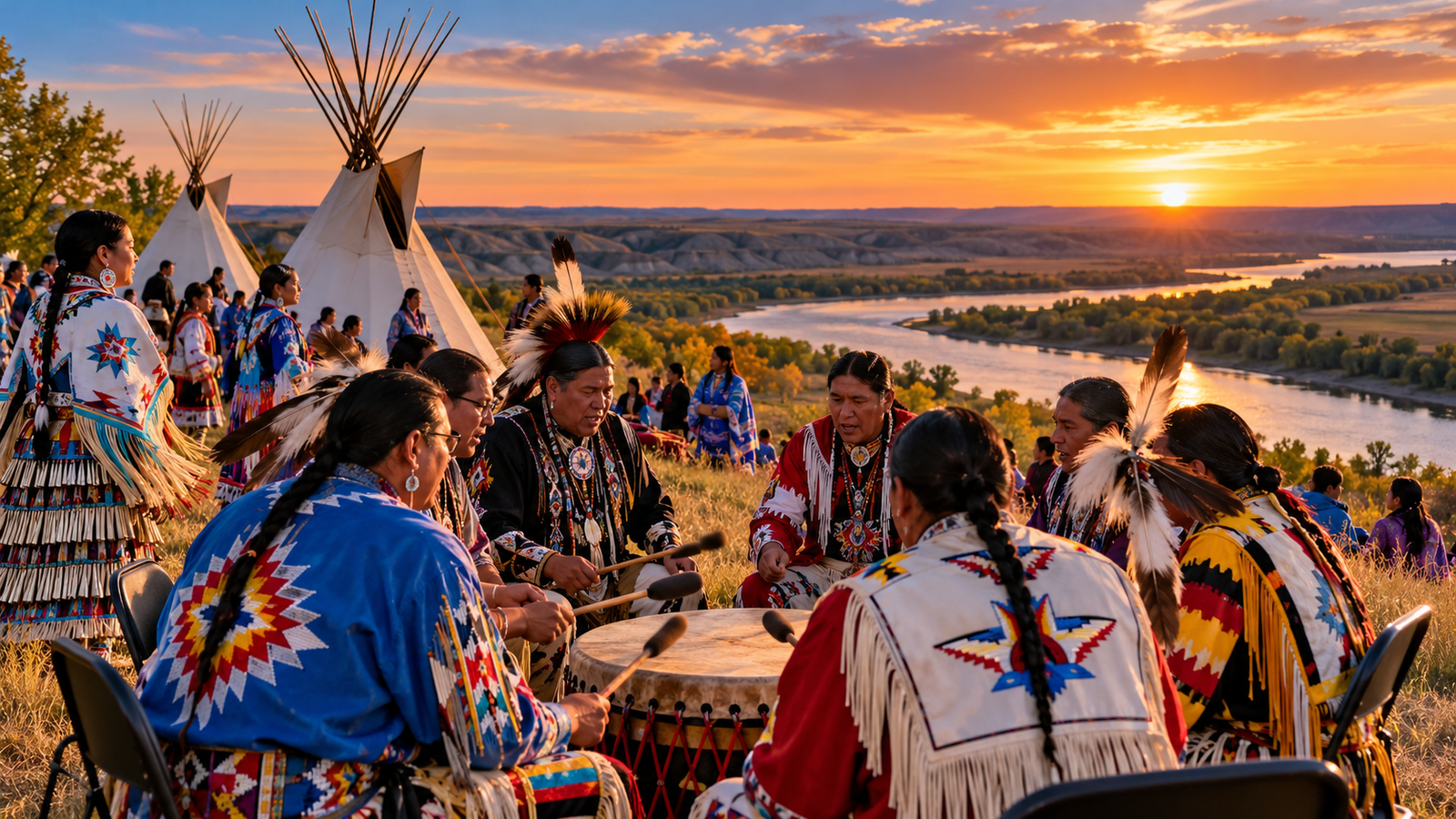
Introduction on Social Life in North Dakota
The Social Life in North Dakota is deeply connected to the history, culture, and continuing contributions of Indigenous communities. Long before North Dakota became a state in 1889, Indigenous peoples established complex societies across the Northern Great Plains. They developed systems of family organization, agriculture, hunting, trade, spiritual beliefs, leadership, and community cooperation that shaped the region’s social history.
Today, Indigenous communities remain an essential part of North Dakota’s identity. Five federally recognized Tribal Nations share geography with the state: the Mandan, Hidatsa, and Arikara Nation, also known as the Three Affiliated Tribes; Spirit Lake Nation; Standing Rock Sioux Tribe; Sisseton-Wahpeton Oyate; and Turtle Mountain Band of Chippewa Indians. The Trenton Indian Service Area is also recognized as a Native community in the state’s official overview. These communities have distinct histories, languages, traditions, and political identities.

From a sociological perspective, Social Life in North Dakota provides an important opportunity to understand the relationship between culture, social institutions, historical inequality, collective identity, and social change. Indigenous peoples are not simply part of the state’s past; they actively shape its present through tribal governance, education, cultural revitalization, economic development, artistic expression, and political participation.
Studying Indigenous communities also challenges stereotypes about Native American life. Contemporary Indigenous society includes rural and urban residents, traditional cultural practitioners, students, teachers, professionals, entrepreneurs, elected leaders, and families balancing cultural continuity with modern opportunities.
Historical Foundations of Indigenous Society
To understand the Social Life in North Dakota, it is necessary to examine the long history of Indigenous settlement and social organization. Archaeological evidence documents human occupation of the Northern Plains for thousands of years. Different communities developed ways of life adapted to the region’s grasslands, rivers, climate, and wildlife.
The Mandan, Hidatsa, and Arikara peoples historically established agricultural villages along the Missouri River. They cultivated crops such as corn, beans, squash, and sunflowers, while hunting bison and other animals. Their villages also became important centers of trade and cultural exchange. Agriculture, food storage, and cooperation supported community survival and helped establish complex social relationships.
Other Indigenous communities, including Dakota and Lakota peoples, developed social and economic practices closely connected with the wider Plains environment. Hunting, mobility, kinship, trade, and collective responsibilities influenced their social organization. The introduction of horses transformed mobility and hunting practices for several Plains peoples.
These differences demonstrate that Indigenous society was never a single, uniform system. Each community developed distinctive institutions and traditions in response to its environment, history, and cultural values.
European-American settlement brought profound changes. Epidemics, territorial expansion, warfare, treaties, land dispossession, and federal assimilation policies disrupted Indigenous communities. Reservation systems restricted access to ancestral territories, while boarding schools and other policies sought to suppress Indigenous languages and cultural practices.
The consequences continue to influence the Social Life in North Dakota today. Historical experiences shape debates about land, education, cultural preservation, economic opportunity, and the relationship between tribal governments and state or federal authorities. A sociological understanding therefore requires examining both Indigenous resilience and the structural inequalities created by colonization.
Major Indigenous Communities and Their Social Identities
Mandan, Hidatsa, and Arikara Nation
The Mandan, Hidatsa, and Arikara Nation has a significant place in the Social Life in North Dakota. These three peoples have distinct cultural histories and identities, although they share a political nation today.
Historically, their communities relied on agriculture, hunting, trade, and kinship networks. Family relationships and clan structures helped organize social responsibilities and community life. Among the Mandan and Hidatsa, kinship influenced relationships between relatives, the transmission of cultural knowledge, and the responsibilities people held toward one another.
Today, the Three Affiliated Tribes maintain cultural traditions while participating in contemporary education, government, business, and public life. Their experiences demonstrate how Indigenous communities preserve collective identity while responding to changing economic and social conditions.
Standing Rock Sioux Tribe
The Standing Rock Sioux Tribe is another important part of the Social Life in North Dakota. The Standing Rock reservation extends across North Dakota and South Dakota, connecting communities through shared histories, kinship, cultural traditions, and political relationships.
Lakota and Dakota cultural traditions emphasize relationships among people, land, community, and spiritual life. Language preservation, ceremonies, family networks, and intergenerational teaching remain important elements of cultural continuity.
Standing Rock has also become widely recognized for Indigenous activism, particularly around land, water, treaty rights, and environmental protection. These movements illustrate how collective identity can encourage political participation and social solidarity.
Spirit Lake Nation
Spirit Lake Nation contributes to the diversity of the Social Life in North Dakota through its cultural heritage, community institutions, and contemporary leadership. Located in the northeastern part of the state, the nation maintains its own political identity and community priorities.
Family connections, cultural education, tribal institutions, and community gatherings contribute to social cohesion. Like other Indigenous communities, Spirit Lake Nation faces the challenge of maintaining language and traditions while providing opportunities for younger generations.
From a sociological perspective, its experiences illustrate the importance of community-based institutions in maintaining identity and responding to social change.
Sisseton-Wahpeton Oyate
The Sisseton-Wahpeton Oyate is a Dakota nation whose members have historical and contemporary connections across the Northern Plains. Its cultural traditions and community relationships form part of the broader Social Life in North Dakota.
Dakota identity is expressed through language, kinship, storytelling, community events, and cultural practices. These institutions transmit collective memories and values between generations.
The community’s experience also highlights the importance of recognizing Indigenous nations as political communities with their own histories, priorities, and forms of self-government rather than treating Indigenous identity simply as an ethnic category.
Turtle Mountain Band of Chippewa Indians
The Turtle Mountain Band of Chippewa Indians has a distinctive history shaped by Ojibwe heritage, regional relationships, and experiences of colonial expansion. Its community life contributes to the richness of the Social Life in North Dakota.
Cultural identity, family relationships, artistic traditions, language revitalization, and community education remain important areas of social life. Tribal institutions also support public services, political representation, and economic development.
The Turtle Mountain experience demonstrates that Indigenous communities maintain continuity through adaptation. Cultural traditions can change in form while continuing to provide a sense of belonging and collective identity.
Family, Kinship, and Community Relationships
Family is a central institution in the Social Life in North Dakota, although family structures and practices vary among Indigenous nations and individual households.
In many Indigenous cultural traditions, kinship extends beyond the nuclear family. Relationships with grandparents, aunts, uncles, cousins, clan relatives, and other community members may shape responsibilities and everyday interactions. Elders can serve as important sources of historical knowledge, language, cultural teachings, and guidance.
These relationships contribute to social solidarity. Children may learn cultural values not only from parents and schools but also through storytelling, community gatherings, ceremonies, and participation in daily activities.
The sociological concept of socialization helps explain this process. Socialization is the way individuals learn the values, norms, roles, and expectations of their society. In Indigenous communities, cultural socialization can reinforce language, identity, respect for elders, and responsibilities toward relatives and the wider community.
However, it is important not to romanticize Indigenous family life or assume that all families follow the same traditional structure. Contemporary households differ in size, income, residence, religious practice, and family organization. Migration, employment, education, and historical disruptions have also influenced family relationships.
Understanding the Social Life in North Dakota therefore requires recognizing both the continuing importance of kinship and the diversity of contemporary Indigenous households.
Culture, Language, and Religious Traditions

Culture shapes the meanings people attach to their relationships, institutions, and surroundings. In the Social Life in North Dakota, Indigenous cultures provide important frameworks for identity, collective memory, and community belonging.
Oral storytelling has historically played a significant role in teaching history, transmitting values, and explaining relationships between people and the natural world. Stories can preserve community knowledge while connecting younger generations with the experiences of their ancestors.
Indigenous languages are equally important. Language carries concepts, place names, oral histories, humor, and cultural meanings that may not translate easily into English. Language revitalization initiatives, cultural classes, elder-led instruction, and educational programs can help strengthen connections between younger people and their heritage.
Ceremonies, powwows, music, dancing, beadwork, traditional foods, and artistic practices also contribute to cultural continuity. Powwows, for example, can bring together families and communities through dancing, singing, social interaction, and the sharing of cultural knowledge. Their specific meanings and protocols vary, and visitors should respect the rules established by event organizers.
Spiritual traditions are diverse as well. Some Indigenous people maintain ancestral spiritual practices, some follow Christianity, and others combine or move between different traditions. There is no single religious experience shared by every Native American person.
The North Dakota Department of Public Instruction’s Native American Essential Understandings emphasize interconnectedness, learning through storytelling, generosity, sovereignty, cultural identity, and Indigenous contributions to society. These principles provide a useful framework for understanding the Social Life in North Dakota without reducing diverse cultures to stereotypes.
Tribal Sovereignty and Political Organization
Political institutions are essential to understanding the Social Life in North Dakota. Indigenous nations possess political identities and governing traditions that predate the United States. Tribal sovereignty refers to the authority of Indigenous nations to govern their communities, establish institutions, and make decisions within the framework of applicable federal law and treaties.
Tribal governments may administer programs related to education, health, housing, economic development, public safety, cultural preservation, and community services. Their responsibilities connect political authority with everyday social welfare.
The relationship between tribal nations, state government, and the federal government is complex. Questions involving jurisdiction, treaty rights, natural resources, taxation, and public services can create disputes, but they also provide opportunities for negotiation and cooperation.
Sociologically, tribal sovereignty challenges the assumption that the nation-state is the only meaningful form of political community. Indigenous nations demonstrate how collective identity, historical continuity, and political authority can exist within a larger federal system.
The Social Life in North Dakota is consequently influenced by interactions among tribal governments, state institutions, local authorities, and federal agencies. Respectful government-to-government relationships are essential to addressing shared concerns while recognizing Indigenous self-determination.
Education and Cultural Preservation
Education is a major institution shaping the Social Life in North Dakota. Schools, tribal colleges, universities, and community education programs influence social mobility, employment opportunities, identity formation, and cultural continuity.
For Indigenous communities, education has a complicated history. Government-supported boarding schools frequently separated Native children from their families and attempted to suppress their languages and cultural practices. These experiences contributed to intergenerational harm and weakened some forms of cultural transmission.
Contemporary Indigenous education increasingly emphasizes the inclusion of tribal histories, community knowledge, Indigenous perspectives, and language learning. Educational materials developed with tribal historians, elders, and cultural experts can help students understand Indigenous societies through their own experiences and interpretations.
Education can also support economic mobility by providing access to professional training, higher education, and new employment opportunities. However, the benefits of education depend on access to appropriate resources, transportation, financial assistance, and supportive learning environments.
The Social Life in North Dakota is strengthened when educational institutions recognize Indigenous peoples as contemporary knowledge producers rather than merely subjects of historical study. Including Indigenous perspectives in curricula can also improve understanding among non-Indigenous students and reduce cultural misunderstandings.
Economic Life, Employment, and Inequality
Economic conditions strongly influence the Social Life in North Dakota. Indigenous households participate in agriculture, public administration, education, healthcare, tourism, arts, small businesses, and other sectors of the economy. Tribal governments and tribally owned enterprises can also support employment and community development.
Economic development, however, takes place within a history of land dispossession and unequal access to resources. Geographic isolation, infrastructure gaps, housing shortages, and limited access to some services can create barriers for certain communities. The extent and nature of these challenges differ between nations and households.
Sociologists use the concept of structural inequality to explain how unequal opportunities can arise from institutional arrangements rather than simply individual decisions. In the Indigenous context, historical policies and continuing differences in access to capital, infrastructure, and public services can influence economic outcomes.
At the same time, Indigenous communities are not passive recipients of external assistance. Tribal leadership, entrepreneurship, community organizations, cultural industries, and educational initiatives can create locally grounded development opportunities.
A balanced examination of the Social Life in North Dakota must therefore consider both the structural barriers Indigenous people experience and their agency in shaping economic futures. Economic progress should also be assessed in terms of community well-being, cultural continuity, environmental sustainability, and the ability of tribal nations to determine their own priorities.
Health, Housing, and Social Welfare
Health and social welfare are important dimensions of the Social Life in North Dakota. Access to healthcare, affordable housing, nutritious food, transportation, and reliable infrastructure can affect individual well-being and community development.
Some Indigenous communities experience disadvantages associated with poverty, geographic distance, shortages of healthcare professionals, and historical mistrust of institutions. These conditions should be understood in their wider social and historical context rather than attributed to Indigenous culture itself.
The concept of social determinants of health helps explain how income, education, housing, employment, and the environment shape health outcomes. Community-based services and culturally respectful healthcare can help improve access and strengthen trust.
Housing is particularly important because stable housing supports educational participation, employment, family relationships, and physical health. Overcrowding or inadequate housing can place additional pressure on households and community services.
The Social Life in North Dakota also illustrates the importance of combining public services with Indigenous leadership. Programs that involve tribal governments, community organizations, local professionals, and cultural knowledge may be better positioned to respond to local priorities.
Gender Roles, Youth, and Social Change
Gender relations and generational differences are also relevant to the Social Life in North Dakota. Indigenous communities have diverse traditions concerning gender, family responsibilities, leadership, and community participation. These traditions cannot be reduced to one universal model.
Women have played important roles in family life, cultural preservation, education, political leadership, entrepreneurship, and community organizing. The specific forms of leadership and authority differ across Indigenous nations and historical periods.
Young Indigenous people navigate multiple social environments, including family networks, schools, social media, workplaces, and tribal communities. They may participate in language revitalization, cultural events, environmental activism, and contemporary creative industries while pursuing personal educational and career goals.
Technology can connect young people with relatives and cultural resources, including those living far from their home communities. At the same time, migration for employment or higher education may create challenges in maintaining everyday cultural connections.
These developments show that the Social Life in North Dakota is dynamic rather than frozen in tradition. Cultural continuity often depends on the ability of younger generations to reinterpret and sustain meaningful practices under changing conditions.
Indigenous Activism, Land, and Environmental Justice
Land is central to many Indigenous understandings of history, identity, and community responsibility. In the Social Life in North Dakota, environmental issues are therefore also social and political issues.
Indigenous activism has drawn attention to treaty rights, sacred places, water protection, natural resources, and the effects of infrastructure and energy development. The Standing Rock protests against the Dakota Access Pipeline brought international attention to concerns about water, sovereignty, and Indigenous participation in decisions affecting ancestral territories.
From a sociological perspective, social movements develop when people organize around shared grievances, collective identities, and demands for change. Indigenous movements also demonstrate how local concerns can become part of wider discussions about environmental justice, democratic participation, and human rights.
Environmental justice involves examining how environmental risks and benefits are distributed, whose knowledge is recognized, and who has the authority to make decisions. Indigenous perspectives often emphasize responsibilities toward future generations and relationships between people, water, land, and other living beings.
The Social Life in North Dakota consequently cannot be fully understood without examining land rights, environmental governance, and the historical relationship between Indigenous nations and external political institutions.
Urbanization, Migration, and Contemporary Identity
Although many Indigenous residents have connections to reservations, Indigenous life is not limited to reservation communities. Native Americans also live in cities and towns throughout North Dakota and other parts of the United States.
Migration for education, employment, healthcare, and family reasons influences the Social Life in North Dakota. Urban residents may maintain strong connections with their home communities through visits, ceremonies, family relationships, and digital communication.
However, migration can also affect access to cultural institutions, community support, and language-learning opportunities. Urban Indigenous organizations and cultural programs can help address these challenges by creating spaces for gathering and mutual support.
Contemporary Indigenous identity may involve several overlapping affiliations, including tribal citizenship, family heritage, language, community participation, and personal experience. Tribal citizenship and belonging are not interchangeable with broad ethnic labels, and the rules governing citizenship differ among nations.
Recognizing these complexities allows sociologists to understand the Social Life in North Dakota as a changing network of relationships that crosses geographical boundaries.
Conclusion
Indigenous communities are fundamental to understanding the history and contemporary character of North Dakota. Their social institutions, cultural traditions, political systems, family networks, and community initiatives demonstrate the continuing significance of Indigenous knowledge and collective identity.
A sociological study of the Social Life in North Dakota reveals the importance of kinship, cultural socialization, tribal sovereignty, education, economic opportunity, environmental justice, and intergenerational relationships. It also demonstrates how historical dispossession and assimilation policies continue to influence present-day inequalities.
At the same time, Indigenous nations are active political and cultural communities shaping their own futures. Their contributions to education, government, arts, environmental protection, and economic development challenge outdated stereotypes and highlight the diversity of contemporary Native American experiences.
Ultimately, understanding the Social Life in North Dakota requires listening to Indigenous voices, respecting tribal sovereignty, recognizing differences among nations, and examining social problems within their historical context. Such an approach supports a more accurate understanding of Indigenous society and contributes to more informed relationships between Native and non-Native communities.
Frequently Asked Questions (FAQs)
1. What is the Social Life in North Dakota like for Indigenous communities?
The Social Life in North Dakota among Indigenous communities includes family relationships, cultural traditions, education, tribal governance, employment, community gatherings, and contemporary social participation. Experiences vary among nations and individuals.
2. Which Indigenous nations are associated with North Dakota?
Five federally recognized Tribal Nations share geography with North Dakota: the Mandan, Hidatsa, and Arikara Nation; Spirit Lake Nation; Standing Rock Sioux Tribe; Sisseton-Wahpeton Oyate; and Turtle Mountain Band of Chippewa Indians.
3. Why is kinship important in Indigenous society?
Kinship can organize family responsibilities, social relationships, cultural teaching, and intergenerational support. Its specific forms vary among Indigenous nations.
4. How does Indigenous culture influence Social Life in North Dakota?
Indigenous cultures influence language, storytelling, ceremonies, artistic expression, community gatherings, family relationships, and connections with land and history.
5. What is tribal sovereignty?
Tribal sovereignty is the authority of Indigenous nations to govern their communities and exercise political powers recognized within the United States legal framework.
6. What challenges affect Indigenous communities in North Dakota?
Challenges may include economic inequality, housing shortages, barriers to healthcare, historical trauma, language loss, and disputes concerning land and natural resources. Conditions vary across communities.
7. How do Indigenous communities preserve their languages?
Language preservation may involve elder-led teaching, immersion programs, cultural education, community classes, digital resources, and intergenerational learning.
8. How does education influence Indigenous social life?
Education can create opportunities for employment and social mobility while also supporting cultural preservation when Indigenous histories, perspectives, and languages are included.
9. What role do elders play in Indigenous communities?
Elders may transmit oral histories, cultural teachings, language knowledge, community values, and practical guidance to younger generations.
10. How does Indigenous activism affect North Dakota society?
Indigenous activism raises awareness about treaty rights, sovereignty, environmental protection, water resources, and the participation of tribal nations in decisions affecting their communities.
11. Is Indigenous life in North Dakota limited to reservations?
No. Indigenous people live in reservations, rural communities, towns, and cities. Many maintain connections with their tribal nations regardless of where they reside.
12. Why is a sociological perspective useful for studying Indigenous communities?
Sociology helps explain how institutions, historical inequalities, cultural norms, political authority, and social relationships shape Indigenous experiences and community development.
References
- North Dakota Indian Affairs Commission. North Dakota Tribal Nations and Communities. https://www.indianaffairs.nd.gov/
- State Historical Society of North Dakota. First People: Summary of North Dakota History. https://www.history.nd.gov/ndhistory/firstpeople.html
- North Dakota Department of Public Instruction. North Dakota Native American Essential Understandings. https://www.nd.gov/dpi/education-programs/indian-education/north-dakota-native-american-essential-understandings
- North Dakota Studies. The History and Culture of the Mandan, Hidatsa, and Sahnish. https://www.ndstudies.gov/
- University of North Dakota, Chester Fritz Library. North Dakota Tribal History and Culture Series. https://commons.und.edu/nd-tribal-history-series/
Suggested WordPress Tags: Indigenous Communities, Social Life in North Dakota, Native American Sociology, Tribal Sovereignty, Indigenous Culture, North Dakota Society, Social Change
Focus Keyword: Social Life in North Dakota