Introduction
Native American Rural Communities occupy a distinctive position in American society because their social organization, cultural traditions, historical experiences, and relationships with the state differ in important ways from those of many other rural populations. These communities include people belonging to hundreds of federally recognized and state-recognized Indigenous nations, as well as communities whose recognition and legal status vary. Their experiences cannot be understood through a single model because each Indigenous nation has its own history, language, political institutions, and cultural practices.
From a sociological perspective, Native American Rural Communities provide an important case study for understanding the relationship between culture, social inequality, colonialism, land ownership, collective identity, and social change. Rural life in Indigenous communities is shaped not only by geographical isolation but also by historical policies, tribal sovereignty, economic opportunities, and the continuing importance of kinship and community relationships.
Native American Rural Communities are often portrayed through stereotypes that emphasize poverty, isolation, or cultural traditions. Such representations overlook their diversity, adaptability, political activism, educational achievements, and community-led development. A sociological analysis must therefore examine both structural disadvantages and the strengths that Indigenous communities use to sustain their collective well-being.
Understanding Native American Rural Communities requires moving beyond conventional explanations of rural poverty. It involves examining how historical dispossession, unequal access to resources, federal policies, and contemporary social institutions interact with Indigenous knowledge and self-determination.
Understanding Native American Rural Communities

Native American Rural Communities are Indigenous communities situated in rural areas, including reservations, tribal trust lands, Alaska Native villages, and other places where Indigenous people maintain strong social, cultural, or political connections. However, not every Indigenous person lives on a reservation, and not every rural Indigenous community has the same legal status or institutional arrangements.
The term Native American is widely used in the United States, although many people prefer the name of their specific nation or community, such as Navajo (Diné), Cherokee, Lakota, or Hopi. The terms American Indian and Alaska Native also appear in government statistics and academic research. Respecting these distinctions is essential to sociological research because identity is closely connected to history, political sovereignty, and cultural belonging.
Native American Rural Communities are not simply geographical settlements. They are social environments in which relationships among families, elders, community leaders, tribal governments, and cultural institutions can shape everyday life. In some communities, kinship networks provide childcare, emotional support, knowledge transmission, and assistance during economic hardship.
At the same time, Native American Rural Communities differ considerably in population size, income, language use, economic activity, and access to public services. Some are located near towns and regional employment centres, while others experience significant transportation barriers and geographical isolation.
Therefore, rural Indigenous life must be understood as a diverse social reality rather than a uniform cultural category.
Historical Background: Colonialism and Land Dispossession
The historical development of Native American Rural Communities is inseparable from European colonization, territorial expansion, forced displacement, and the expansion of the United States. Indigenous nations inhabited North America long before the establishment of the modern American state, maintaining complex systems of governance, trade, agriculture, land management, and social organization.
During the nineteenth century, federal policies forced many Indigenous peoples from their ancestral territories. The Indian Removal Act of 1830 and subsequent removal campaigns contributed to the displacement of numerous nations, while military conflicts and the expansion of settler agriculture reduced Indigenous control over land.
Reservation policies confined many communities to designated territories, often disrupting established economic systems and relationships with ancestral places. These developments affected more than land ownership. They transformed access to food, employment, education, political authority, and cultural resources.
The federal allotment policy, particularly the General Allotment Act of 1887, divided many communal lands into individual allotments and enabled substantial transfers of Indigenous land into non-Indigenous ownership. These policies weakened some traditional landholding systems and contributed to long-term economic disadvantages.
Sociologically, this history illustrates how state power can restructure social institutions and produce inequalities that continue across generations. The disadvantages experienced by some Native American Rural Communities cannot be adequately explained as the result of individual choices or an absence of motivation. They must also be understood in relation to historical dispossession, unequal access to capital, and the disruption of Indigenous institutions.
Historical analysis also demonstrates Indigenous resilience. Native nations have continued to defend their territorial rights, rebuild institutions, preserve cultural practices, and pursue greater control over their economic and political futures.
Social Structure and Kinship Relationships
Social structure is a central theme in the sociological study of Native American Rural Communities. Family relationships, kinship networks, community participation, and intergenerational responsibilities often play important roles in organizing social life. However, these arrangements vary across Indigenous nations and should not be treated as universal characteristics of Native American society.
In many Native American Rural Communities, extended family relationships can provide important forms of social support. Grandparents, aunts, uncles, cousins, and other relatives may participate in childcare, cultural education, household assistance, and the transmission of community knowledge. These relationships can strengthen social solidarity and help families respond to economic difficulties.
Émile Durkheim’s concept of social solidarity provides one way to understand these relationships. Shared traditions, collective responsibilities, and community participation can strengthen a sense of belonging. In Native American Rural Communities, collective identity may be reinforced through ceremonies, community gatherings, language practices, and relationships with ancestral territories.
Nevertheless, social solidarity does not mean that communities are free from conflict or inequality. Generational differences, employment pressures, changing gender roles, migration, and disagreements over development can create tensions. Younger people may seek educational and employment opportunities outside their communities, while elders may emphasize cultural continuity and responsibilities toward the homeland.
A balanced sociological perspective recognizes that Native American Rural Communities combine continuity with change. Kinship remains significant in many settings, but family relationships also adapt to contemporary economic, educational, and technological conditions.
Tribal Identity, Culture, and Language
Cultural identity is one of the most important dimensions of Native American Rural Communities. Indigenous identity may be connected to tribal citizenship, family history, language, spirituality, collective memory, and relationships with particular territories. These connections can influence how people understand themselves and their responsibilities toward their communities.
Cultural practices are transmitted through storytelling, ceremonies, traditional ecological knowledge, artistic expression, and everyday interactions between generations. In some Native American Rural Communities, elders play an important role in teaching younger generations about community history, ethical responsibilities, traditional foods, and relationships with the natural environment.
Language is especially important because it carries historical knowledge, cultural concepts, and distinctive ways of interpreting the world. Colonial schooling policies, including boarding schools that separated many Indigenous children from their families and suppressed Indigenous languages, contributed to language loss in numerous communities.
Today, language revitalization initiatives seek to reverse these effects. Tribal schools, community language programmes, cultural centres, and intergenerational learning projects help preserve Indigenous languages and strengthen cultural identity.
From a symbolic interactionist perspective, identity develops through social interaction and the meanings people attach to symbols, language, traditions, and shared experiences. In Native American Rural Communities, cultural practices can serve as symbols of collective belonging and resistance to historical marginalization.
Importantly, cultural preservation does not require rejecting modern life. Indigenous people may combine traditional knowledge with contemporary education, digital communication, professional careers, and political participation. Cultural continuity is an active process through which communities decide what to preserve, adapt, and transmit to future generations.
Economic Inequality and Rural Poverty

Economic inequality remains a major concern in some Native American Rural Communities. Employment opportunities, household income, housing quality, transportation, infrastructure, and access to investment can differ substantially between Indigenous territories and more prosperous American regions.
The United States Department of Agriculture has documented the concentration of American Indian and Alaska Native populations in several nonmetropolitan counties experiencing persistent poverty. Its analysis of 2015–2019 Census estimates identified 34 high-poverty nonmetropolitan counties characterized by concentrations of American Indian and Alaska Native residents, where the average poverty rate for this population was 40.5%. These are historical estimates for a specific group of counties, not a current national poverty rate for all Indigenous people.
The economic difficulties experienced by Native American Rural Communities have multiple causes. Geographic remoteness can increase transportation costs and limit access to employers, financial institutions, markets, and public services. In some areas, inadequate infrastructure makes it difficult for businesses to operate efficiently or attract investment.
Historical land dispossession and restrictions on land use have also affected economic development. Some tribal lands have complex ownership arrangements, which can complicate certain transactions and development projects. In addition, limited access to capital, uneven infrastructure, and dependence on a small number of employers may constrain local economic choices.
Sociologist William Julius Wilson’s work on concentrated disadvantage offers a useful comparative perspective. His research highlights how limited employment opportunities and the geographical concentration of poverty can reinforce social exclusion. Although his work primarily addresses other populations and settings, similar structural questions can be applied carefully to Native American Rural Communities.
However, poverty should not be understood as an inevitable characteristic of Indigenous rural life. Tribal governments and enterprises have developed diverse economic activities, including agriculture, tourism, renewable energy, natural-resource management, cultural industries, and tribally owned businesses.
Gaming enterprises have generated employment and public revenue for some tribes, but their economic effects vary widely. Casinos are not available or equally profitable everywhere, and they cannot serve as a universal solution to rural poverty. Sustainable development requires locally appropriate strategies, infrastructure investment, workforce development, and respect for tribal priorities.
Education and Intergenerational Change
Education plays a significant role in shaping social mobility, cultural identity, and economic opportunities in Native American Rural Communities. Schools and colleges can provide pathways to professional employment, technological skills, and political participation. At the same time, education has a complex historical relationship with Indigenous communities.
For generations, some federal boarding schools and other assimilationist institutions attempted to replace Indigenous languages and cultural practices with dominant American norms. The separation of children from families caused profound social and cultural harm. Understanding this history is essential when examining contemporary educational experiences.
Today, educational opportunities differ considerably among Native American Rural Communities. Some students have access to tribal schools, community colleges, tribal colleges and universities, and culturally responsive educational programmes. Others encounter long travel distances, teacher shortages, limited course options, or inadequate digital infrastructure.
The Bureau of Indian Education supports educational programmes serving eligible Indigenous communities, while tribal governments and other educational institutions develop approaches suited to local needs.
Sociologically, education can be understood as both an instrument of social mobility and a site of cultural negotiation. Schools may reproduce inequality when resources are distributed unevenly or Indigenous histories are inadequately represented. Conversely, educational institutions can strengthen Native American Rural Communities when they incorporate Indigenous knowledge, local languages, and community participation.
Intergenerational change is particularly important. Young people may pursue higher education and careers in cities before returning home to work in healthcare, education, administration, technology, or tribal governance. Others maintain strong relationships with their communities while living elsewhere.
The challenge is to create educational systems that expand opportunities without requiring students to abandon their cultural identities or permanently leave their homelands.
Healthcare and Social Well-Being
Healthcare access is another important dimension of inequality in Native American Rural Communities. Distance from hospitals, shortages of healthcare professionals, transportation difficulties, and limited specialist services can make treatment difficult in remote areas.
The Indian Health Service provides healthcare services to eligible American Indian and Alaska Native people through a system that includes federal facilities and partnerships with tribal and urban Indian health organizations. The agency serves a substantial population, but eligibility rules, local service availability, and the range of treatments offered vary.
Native American Rural Communities may face additional challenges when patients need specialist treatment far from home. Travel expenses, time away from work, childcare responsibilities, and limited public transportation can discourage timely care.
Healthcare should also be examined through the sociological concept of the social determinants of health. Income, housing, education, employment, environmental conditions, and social support influence health outcomes. Consequently, improving health in Native American Rural Communities requires more than increasing the number of clinics. It also requires attention to clean water, adequate housing, nutrition, transportation, and economic security.
Culturally respectful healthcare is equally important. Providers who understand community history, language, family relationships, and Indigenous perspectives on well-being may be better positioned to build trust. Traditional healing practices may also remain important to some individuals and communities, although preferences differ.
Tribal self-governance offers opportunities to develop healthcare services around local needs. Community-led health programmes can improve accountability and encourage residents to participate in decisions affecting their well-being.
Gender, Family, and Social Change
Gender relations within Native American Rural Communities reflect both Indigenous traditions and wider social transformations. Women have held important responsibilities in the political, economic, cultural, and family lives of various Indigenous nations. Nevertheless, gender roles and authority structures differ significantly across communities.
In contemporary settings, Indigenous women may work as educators, healthcare professionals, business owners, elected officials, cultural leaders, and advocates for community rights. Their participation contributes to economic development and the preservation of cultural knowledge.
At the same time, some Native American Rural Communities experience gender-based violence, unequal economic opportunities, and barriers to accessing support services. These problems must be understood within broader structures of inequality, historical trauma, jurisdictional complexity, and uneven access to public resources rather than attributed to Indigenous culture itself.
Family structures are also changing as employment patterns, migration, education, and technology reshape everyday life. Single-parent households, multigenerational living arrangements, and families divided between rural homelands and urban destinations can all form part of contemporary Indigenous experience.
A sociological perspective therefore avoids assuming that Native American Rural Communities possess one fixed family model. Instead, it examines how gender, age, economic position, community expectations, and individual choices interact within particular historical and cultural settings.
Tribal Sovereignty and Political Participation
Tribal sovereignty is essential to understanding Native American Rural Communities. Indigenous nations are not merely cultural groups within the United States; federally recognized tribes possess a government-to-government relationship with the federal government and exercise varying forms of political authority under federal law, treaties, and their own legal systems.
Tribal governments may be responsible for areas such as education, housing, economic development, natural-resource management, public safety, and community welfare. Their powers and responsibilities differ according to legal arrangements, federal legislation, treaties, and individual tribal constitutions.
For Native American Rural Communities, self-government can create opportunities to establish policies that reflect local priorities. A tribal government may prioritize employment programmes, language revitalization, housing construction, healthcare services, or environmental protection according to community needs.
The sociological concept of self-determination is particularly relevant here. It emphasizes the ability of communities to influence decisions affecting their lives rather than depending entirely on external institutions. In Native American Rural Communities, self-determination can strengthen collective agency, political participation, and institutional accountability.
However, sovereignty does not automatically eliminate social inequality. Tribal governments may face funding constraints, jurisdictional challenges, administrative responsibilities, and disagreements over development priorities. Some communities also experience tensions between individual economic interests and collective responsibilities toward land and cultural resources.
A comprehensive understanding of Native American Rural Communities must therefore examine the relationship between political authority, available resources, and community participation. Effective governance depends not only on formal legal rights but also on the capacity to implement policies and involve community members in decision-making.
Environment, Land, and Traditional Ecological Knowledge

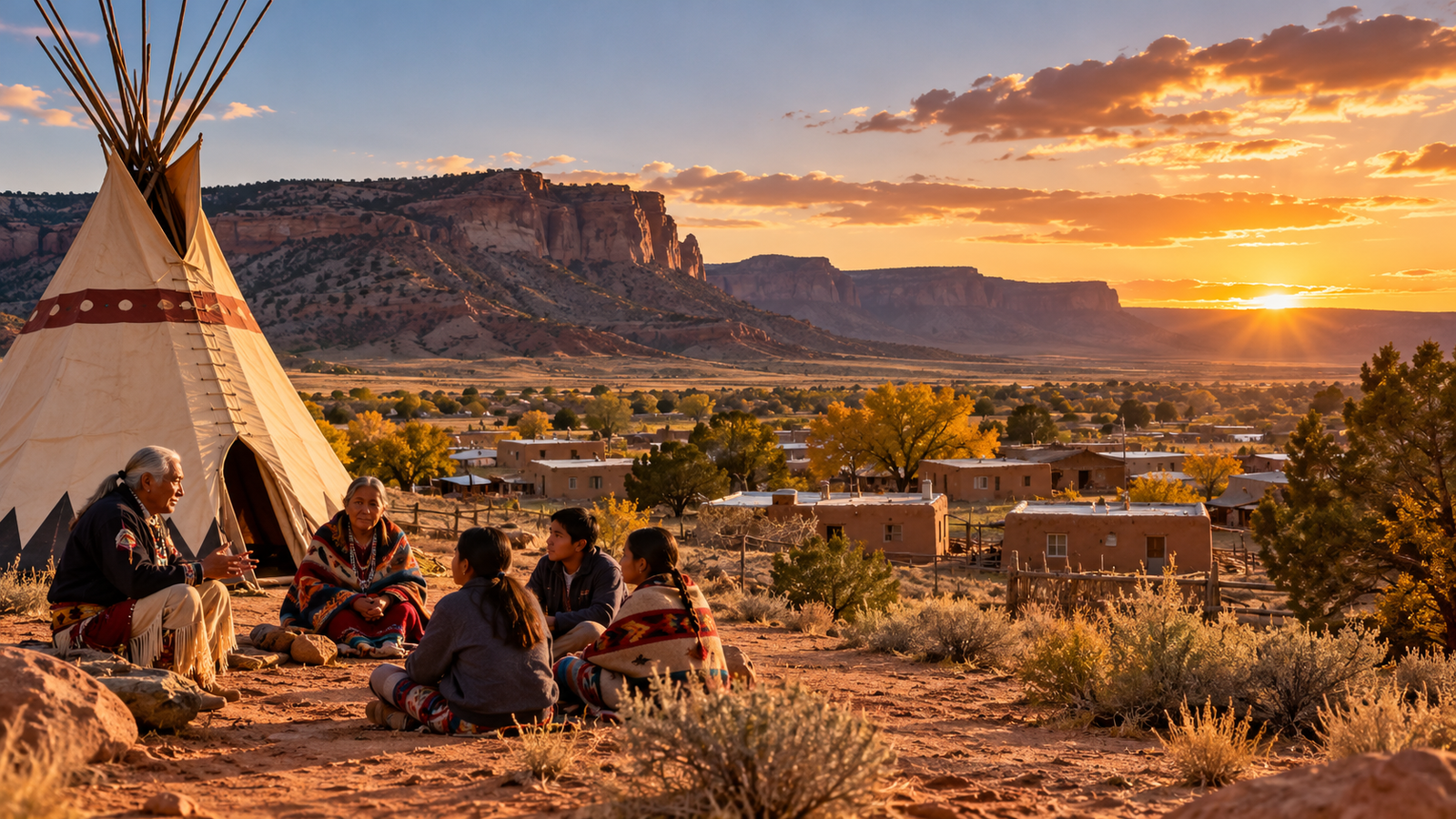
Image from labocine.com
Land holds social, economic, historical, and cultural significance in many Native American Rural Communities. Ancestral territories may be associated with collective memory, spiritual practices, food systems, community identity, and responsibilities toward future generations.
From an environmental sociology perspective, relationships with land cannot always be reduced to private property or economic production. In some Indigenous traditions, human communities are understood as having reciprocal responsibilities toward animals, plants, water, and the wider natural world.
Traditional ecological knowledge may include knowledge of local ecosystems, seasonal patterns, food cultivation, water management, controlled burning, and biodiversity. These practices vary among nations and reflect long histories of interaction with particular environments.
In Native American Rural Communities, environmental challenges can affect livelihoods and cultural continuity. Water scarcity, pollution, wildfires, climate change, and changes in land use may threaten local resources. Communities that depend on farming, fishing, grazing, or other land-based activities can be especially vulnerable to environmental disruption.
Environmental inequality is also relevant. Indigenous territories have sometimes experienced resource extraction, pollution, and development decisions in which tribal communities have had limited influence. Such cases raise sociological questions about environmental justice, political power, and the distribution of environmental risks.
At the same time, many Native American Rural Communities participate in conservation, habitat restoration, renewable energy, and tribal natural-resource management. Their knowledge can contribute to wider environmental policy when Indigenous rights and community consent are respected.
Sustainable rural development should therefore recognize Indigenous knowledge as a valuable resource while allowing individual nations to determine how their territories and cultural practices are managed.
Technology, Migration, and Modernization
Technology is changing how Native American Rural Communities participate in education, employment, healthcare, and public life. Broadband connectivity can support remote learning, telehealth, online businesses, digital cultural preservation, and communication between family members living in different locations.
However, the digital divide remains an important issue. The Bureau of Indian Affairs identifies broadband disparities as a barrier to education, healthcare, and economic opportunities in tribal communities.
Limited connectivity can reinforce existing disadvantages when students cannot reliably access online learning materials or residents cannot use digital public services. Improving broadband infrastructure can help Native American Rural Communities expand economic opportunities without requiring every resident to relocate.
Migration is another important part of social change. Some Indigenous people move to cities for higher education, employment, or healthcare, while others return to their communities to raise families, work in tribal institutions, or contribute professional skills.
Migration can produce both benefits and difficulties. Money sent home by relatives can support households, while the departure of working-age residents may reduce the local labour supply. Digital communication and frequent travel can help maintain family relationships across geographical distances.
Modernization does not necessarily mean cultural assimilation. Native American Rural Communities may use digital platforms to teach Indigenous languages, distribute cultural materials, promote local businesses, and organize political campaigns.
The central sociological question is how communities can benefit from technological change while retaining control over their cultural resources, institutions, and development priorities.
Major Sociological Theories for Understanding Native American Rural Communities
Several sociological perspectives help explain the experiences of Native American Rural Communities.
Structural functionalism examines how institutions contribute to social organization and continuity. Family networks, tribal governments, schools, and cultural institutions can support cooperation and social integration. However, this perspective must also recognize institutional failures and inequalities that disrupt community well-being.
Conflict theory focuses on power, resource distribution, and unequal relationships between social groups. It is particularly useful for examining land dispossession, economic inequality, discrimination, and conflicts over natural resources. The experiences of Native American Rural Communities illustrate how historical power relations can continue to influence access to wealth and political authority.
Symbolic interactionism explores how people develop identities and shared meanings through everyday interactions. Language, ceremonies, storytelling, and community gatherings can help maintain collective identity. This approach also highlights how Indigenous people negotiate stereotypes and represent their identities in wider society.
Postcolonial and decolonial perspectives examine the continuing effects of colonial domination on institutions, knowledge, culture, and political authority. These approaches are valuable for understanding why historical dispossession remains relevant to contemporary debates about sovereignty, education, land, and self-determination.
Social capital theory focuses on the resources available through relationships, trust, and social networks. In Native American Rural Communities, family connections, community organizations, and tribal institutions can facilitate mutual assistance and collective action. However, strong social networks cannot fully compensate for inadequate infrastructure or insufficient public investment.
Together, these perspectives demonstrate that Native American Rural Communities must be studied through the combined influence of culture, history, institutions, political power, and social relationships.
Challenges and Future Prospects
Despite their diversity and resilience, Native American Rural Communities continue to face interconnected challenges involving economic inequality, housing, healthcare, education, infrastructure, and environmental protection. Addressing these issues requires policies that recognize the historical and institutional conditions shaping rural Indigenous life.
First, investment in roads, housing, clean water, broadband, and public transportation can improve everyday living conditions. Second, locally controlled economic development can create employment while protecting cultural heritage and environmental resources. Third, education and healthcare programmes should be developed in partnership with tribal governments and community organizations.
Native American Rural Communities can also benefit from greater support for Indigenous entrepreneurs, agricultural producers, cultural industries, and renewable energy projects. These initiatives are most effective when they reflect local priorities rather than imposing a uniform development model on different nations.
Community participation is essential. Residents, elders, young people, educators, tribal officials, and local organizations can contribute different perspectives to development planning. Native American Rural Communities also need reliable data and research that accurately represent their populations, including their diversity across geography, language, income, and tribal affiliation.
Future progress will depend on recognizing Indigenous sovereignty, addressing historical injustices, and ensuring that communities have meaningful control over decisions affecting their land and resources. Native American Rural Communities should be understood not simply as recipients of public assistance but as active participants in shaping their own social and economic futures.
Conclusion
Native American Rural Communities offer important insights into the relationship between social structure, cultural identity, historical inequality, and political power. Their experiences demonstrate that rural poverty and social exclusion cannot be understood solely through individual behaviour or geographical isolation. Historical dispossession, unequal access to resources, institutional arrangements, and contemporary economic conditions all influence community outcomes.
At the same time, Native American Rural Communities demonstrate the importance of kinship, cultural continuity, tribal governance, collective action, and environmental knowledge. These strengths challenge deficit-based explanations that portray Indigenous rural populations only through their disadvantages.
A sociological understanding of Native American Rural Communities must recognize both structural barriers and Indigenous agency. Sustainable progress requires investment in public services, respect for tribal sovereignty, culturally responsive institutions, and community-led development.
Ultimately, Native American Rural Communities are not remnants of the past. They are dynamic societies whose members continue to preserve cultural knowledge, adapt to social change, and shape the future of rural America.
References and Further Reading
1. U.S. Department of Agriculture, Economic Research Service. Many American Indians and Alaska Natives Are Concentrated in High-Poverty Rural Areas.
2. Akee, R., Moreno, E., and Medford, A. B. Social and Economic Changes in American Indian Reservations: A Databook of the US Census and the American Community Survey, Third Edition, 1990–2020. Harvard Kennedy School. Read the research overview.
3. Indian Health Service. For Patients: Eligibility and Healthcare Services.
4. U.S. Bureau of Indian Affairs. The Importance of Tribal Infrastructure.
5. Mauer, K. W. (2017). “Indian Country Poverty: Place-Based Poverty on American Indian Territories, 2006–10.” Rural Sociology, 82(3), 473–498. Read the research abstract.
6. Davis, J. A. (2016). “American Indian Poverty in the Contemporary United States.” Sociological Forum. Read the research abstract.