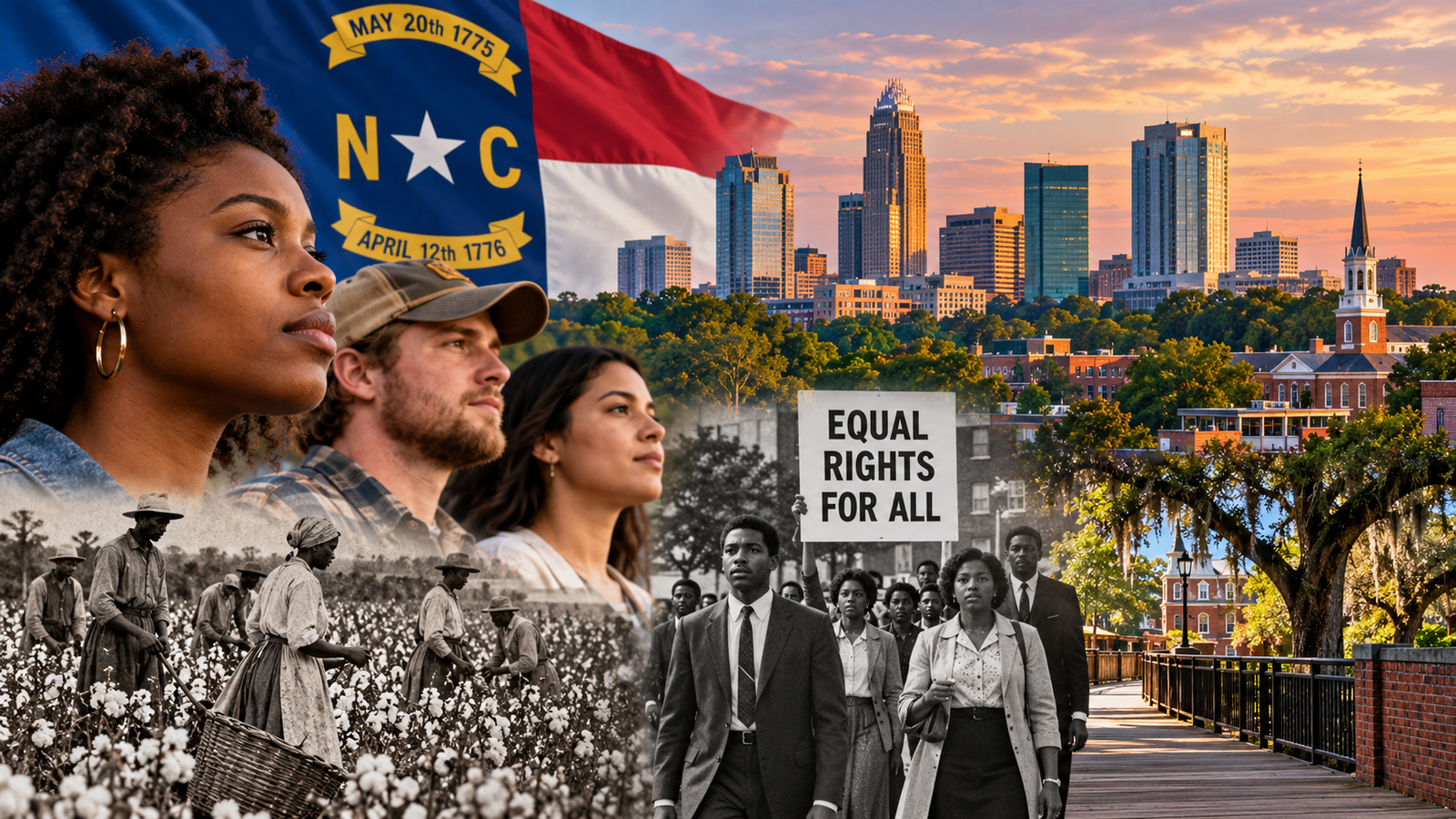
Introduction on Southern Identity in North Carolina
The American South occupies a distinctive place in the social, cultural, and political history of the United States. Its identity has been shaped by slavery, plantation agriculture, racial segregation, religious traditions, rural communities, political conflict, and the long struggle for civil rights. Within this broader regional landscape, North Carolina offers a particularly valuable case for understanding the relationship between race relations and regional identity. The state’s history reveals how cultural traditions can unite communities while also preserving social boundaries and inequalities.
The concept of Southern Identity in North Carolina refers to the shared cultural meanings, historical experiences, social practices, and regional attachments through which people understand what it means to belong to the American South. This identity is expressed through language, food, religion, family traditions, music, community life, and collective memories. However, it is not a single or universal identity. Black and white residents, Indigenous communities, immigrants, rural populations, and urban professionals may experience Southern culture in different ways.
From a sociological perspective, North Carolina demonstrates that regional identity is socially constructed and historically contested. The state’s past includes racial exploitation and institutionalized segregation, but it also includes African American resistance, multiracial civil rights activism, and changing understandings of equality and belonging. Today, economic modernization, urbanization, migration, and political polarization continue to reshape the meaning of Southern identity.

Understanding this relationship requires examining how historical institutions influence contemporary social relations, how cultural traditions reproduce group boundaries, and how communities negotiate competing interpretations of their shared past.
Table of Contents
1. Historical Foundations of Race Relations in North Carolina
To understand Southern Identity in North Carolina, it is necessary to examine the historical development of racial relationships in the state. Before European colonization, Indigenous peoples inhabited the region and maintained their own political, economic, and cultural systems. European settlement, the expansion of plantation agriculture, and the growth of slavery subsequently transformed the region’s social structure.
During the colonial period and the nineteenth century, enslaved Africans and their descendants supplied labor to agricultural and other economic activities. Slavery created a hierarchical social order in which racial classification was closely connected to legal status, economic power, and political authority. Although North Carolina’s economy differed from that of some plantation-dominated Southern states, slavery remained a fundamental institution shaping its society.
The abolition of slavery following the American Civil War in 1865 did not immediately establish racial equality. During Reconstruction, African Americans pursued education, political participation, land ownership, and greater independence. Black communities established churches, schools, civic organizations, and educational institutions that became important centers of collective life. North Carolina’s Reconstruction history therefore reveals both the possibilities of democratic inclusion and the resistance it encountered.
The end of Reconstruction and the subsequent rise of white supremacist politics weakened many of these advances. Racial identity increasingly became a mechanism for determining access to political authority, public resources, and social respectability.
A particularly important event occurred in Wilmington on November 10, 1898. White supremacists violently overthrew Wilmington’s legitimately elected local government, destroyed the office of the Black-owned Daily Record, and attacked the African American community. The violence consolidated white political power and contributed to the subsequent exclusion of Black citizens from electoral politics. The North Carolina Department of Natural and Cultural Resources identifies the Wilmington coup as a decisive turning point in the state’s racial history.
From a sociological perspective, this history demonstrates that racial inequality was not simply the result of individual prejudice. It was reinforced through institutions, political mobilization, violence, and the unequal distribution of resources. These historical structures influenced the development of Southern identity by shaping who could exercise power and whose cultural experiences received public recognition.
2. Slavery, Jim Crow, and the Construction of Southern Identity
Southern identity developed through a complex combination of shared regional traditions and unequal social relationships. Family networks, agricultural life, Protestant Christianity, local customs, and attachment to place contributed to a recognizable Southern culture. However, the meaning of these traditions was influenced by the region’s history of slavery and racial domination.
Following Reconstruction, Jim Crow segregation institutionalized racial separation in schools, transportation, public accommodations, and other areas of everyday life. Voting restrictions, including poll taxes and literacy tests, further weakened African American political participation. These policies helped preserve white political dominance and limited the ability of Black communities to challenge discriminatory institutions.
Sociologist W. E. B. Du Bois’s concept of the color line provides a useful framework for understanding this history. The color line refers to the social boundaries that divide people according to race and shape their access to opportunities, recognition, and power. In North Carolina, racial classifications influenced not only formal political rights but also everyday experiences of schooling, employment, residence, and public life.
Southern identity could consequently function in two different ways. For some white residents, it was associated with family heritage, community loyalty, historical continuity, and pride in regional traditions. Yet certain interpretations of Southern heritage also defended Confederate symbols, romanticized the plantation past, or minimized the consequences of slavery and segregation.
For African Americans, Southern identity often involved a different combination of experiences. It could include attachment to ancestral communities, religious traditions, music, food, family histories, and collective resistance. These cultural resources sustained community life despite racial discrimination.
It would therefore be inaccurate to describe Southern culture as exclusively white or to assume that every white Southerner supported segregation. The region’s identity has always been contested, and African American communities have played a central role in producing its cultural and social traditions.
The sociological significance lies in recognizing that cultural identity is shaped by power. Dominant groups can influence which histories are celebrated and which are marginalized, but excluded groups can also preserve alternative memories and challenge official narratives.
3. African American Culture and the Meaning of Southern Belonging
African American communities have profoundly shaped North Carolina’s cultural identity. Their contributions extend across music, religious life, education, literature, agriculture, business, politics, and community organizing.

Black churches historically served as more than places of worship. They provided spaces for social interaction, education, mutual assistance, leadership development, and political mobilization. Under segregation, these institutions helped create organizational networks that supported collective action and community resilience.
Historically Black colleges and universities also played an important role. Institutions such as North Carolina A&T State University in Greensboro and Shaw University in Raleigh contributed to African American education, professional development, and public leadership. These institutions helped challenge racial exclusion while strengthening community identity.
African American cultural traditions also influenced broader Southern life. Gospel music, spirituals, blues, regional foodways, storytelling, and distinctive linguistic traditions reflect generations of cultural creativity and adaptation. These practices are not merely entertainment or folklore; they are forms of cultural expression through which communities transmit memories, values, and collective experiences.
The concept of collective memory helps explain why historical events remain important to contemporary identities. Collective memory refers to the ways groups interpret and transmit accounts of their past. For African Americans in North Carolina, memories of slavery, racial violence, segregation, resistance, and achievement contribute to understandings of belonging and citizenship.
The 1898 Wilmington coup illustrates why preserving historical memory matters. If the event is remembered only as a disturbance, its political purpose and consequences may be obscured. Recognizing it as a violent overthrow of democratic government makes visible the relationship between racial domination and political power.
This process of remembering and interpreting the past influences how different communities understand Southern identity today. A more inclusive regional identity requires acknowledging African American contributions not as a separate addition to Southern culture, but as one of its foundational elements.
4. The Civil Rights Movement and Social Transformation on Southern Identity
The Civil Rights Movement transformed race relations across the American South, and North Carolina became one of its significant centers. Rather than emerging suddenly during the 1960s, the movement developed through decades of community organizing, legal challenges, student activism, and resistance to segregation.
One of the most influential events occurred on February 1, 1960, when four African American students from North Carolina A&T State University began a sit-in at the segregated lunch counter of the Woolworth store in Greensboro. Their peaceful protest challenged the exclusion of Black customers and inspired similar demonstrations across the South.
The Greensboro sit-ins illustrate several important sociological concepts. First, collective action occurs when individuals coordinate their efforts to challenge an existing social arrangement. The students transformed an everyday act—sitting down to eat—into a public demand for equal treatment.
Second, the protests demonstrate the significance of social movements in changing cultural norms. Segregation had been presented by its supporters as a normal and necessary feature of Southern society. By challenging that assumption, activists exposed the injustice underlying supposedly ordinary social practices.
Third, the movement demonstrates how young people and educational institutions can become agents of social change. Students used their networks, shared grievances, and organizational abilities to challenge established authorities.
North Carolina also participated in wider struggles for desegregation and voting rights. The civil rights campaigns of the mid-twentieth century helped undermine legal segregation and expanded the formal protections available to African Americans. The Civil Rights Act of 1964 and Voting Rights Act of 1965 were particularly important in challenging discriminatory institutions.
Nevertheless, the abolition of explicitly discriminatory laws did not eliminate every form of racial inequality. Social attitudes, residential patterns, differences in wealth, and unequal access to opportunities could persist after legal segregation ended.
From a sociological perspective, the Civil Rights Movement changed the meaning of Southern identity. It challenged the idea that regional loyalty required acceptance of inherited racial hierarchies. It also created a competing tradition of Southern identity grounded in democratic participation, interracial cooperation, and the struggle for equal citizenship.
The legacy of this movement remains important because it demonstrates that regional culture is not fixed. It can be transformed through collective action and the efforts of people who challenge established definitions of belonging.
5. Race, Class, and Economic Inequality on Southern Identity in North Carolina
Race relations in North Carolina cannot be fully understood without examining the relationship between race and social class. Although racial identity and economic position are distinct, they frequently interact to shape life chances.
Historically, slavery denied African Americans control over their labor and property. Following emancipation, discriminatory institutions and unequal access to education, credit, land, and employment restricted opportunities for many Black families. These disadvantages could accumulate across generations, affecting wealth and social mobility.
A sociological analysis must therefore distinguish between individual achievement and structural opportunity. A person’s economic position depends partly on education, occupation, skills, and personal decisions, but it is also influenced by access to resources, neighborhood conditions, family wealth, and institutional practices.
Contemporary North Carolina includes major metropolitan economies, agricultural communities, manufacturing centers, and rapidly growing technology and research sectors. This diversity creates different economic opportunities across the state. Research on Southern urbanization has shown how population growth and economic restructuring have transformed regional cities, labor markets, migration patterns, and race relations.
However, economic growth does not automatically produce equal outcomes. Residents may experience the benefits of development differently depending on income, race, educational background, and location. Rising housing costs, differences in school resources, access to healthcare, and employment insecurity can influence the degree to which people participate in economic progress.
The interaction between race and class is particularly important when considering rural communities and urban neighborhoods. A low-income rural household may experience economic disadvantage because of limited employment opportunities and public services, while a Black household in a growing metropolitan area may face different challenges associated with housing affordability, inherited wealth disparities, or residential segregation.
These experiences should not be treated as identical. Sociologists use the concept of intersectionality to examine how race, class, gender, and other social positions interact to produce distinct experiences of privilege and disadvantage.
Southern identity can sometimes obscure these differences when it emphasizes a shared regional experience without considering unequal access to economic and political resources. Conversely, a more inclusive understanding of Southern culture can recognize common traditions while acknowledging that residents do not experience those traditions under equal social conditions.
6. Religion, Family, and Community Values on Southern Identity in North Carolina
Religion and family relationships remain important elements of Southern identity, although their influence varies across individuals and communities. In North Carolina, Protestant Christian traditions have historically shaped public rituals, moral language, community organizations, and ideas about social responsibility.
Churches and religious associations have sometimes reinforced established racial hierarchies, particularly when religious authority was used to defend segregation or justify unequal social arrangements. At other times, religious beliefs inspired opposition to discrimination and supported civil rights activism.
African American churches, in particular, provided organizational resources for collective action. Religious leaders and congregations helped coordinate meetings, communicate information, raise funds, and sustain participants during periods of social conflict.
Family traditions also contribute to regional belonging. Intergenerational storytelling, shared meals, local celebrations, and community gatherings can connect people to particular places and historical experiences. These practices help reproduce cultural identity by transmitting memories and values from one generation to the next.
However, the relationship between family and racial identity is not uniform. Different communities may interpret regional traditions through distinct histories of exclusion, survival, migration, and cultural achievement. A tradition experienced as comforting and familiar by one group may carry more complicated historical associations for another.
The sociological concept of socialization explains how individuals learn cultural expectations through families, schools, religious institutions, peer groups, and media. Through these processes, people develop ideas about regional loyalty, racial difference, acceptable behavior, and community membership.
Socialization does not mean that individuals simply accept inherited values. Younger generations may reinterpret religious teachings, question racial stereotypes, and develop broader understandings of identity through education, travel, and contact with diverse communities.
Consequently, Southern identity in North Carolina should be understood as an evolving social process rather than a fixed collection of customs.
7. Urbanization, Migration, and Changing Regional Identity on Southern Identity in North Carolina

North Carolina’s economic and demographic transformation has further complicated the relationship between race and regional identity. Cities such as Charlotte, Raleigh, Durham, and Greensboro have become important centers of finance, education, technology, healthcare, and research. Their growth has attracted people from other parts of the United States and from countries around the world.
Urbanization changes social relationships by bringing together people with different cultural backgrounds, occupations, political perspectives, and experiences. It can create opportunities for interaction across racial and ethnic boundaries, while also producing new forms of residential separation and competition over public resources.
Migration has also influenced how people understand Southern identity. Long-established residents may connect regional belonging to family histories and local traditions, while newcomers may identify with North Carolina through employment, education, civic participation, and everyday community life.
These categories are not mutually exclusive. New residents can adopt regional customs, while long-established residents can change their attitudes through contact with different groups. Regional identity is continually negotiated through social interaction.
The growth of metropolitan economies also challenges stereotypes that portray the South as uniformly rural, economically traditional, or culturally homogeneous. North Carolina combines agricultural communities and historic small towns with universities, research institutions, major corporations, and diverse metropolitan populations.
Yet modernization does not automatically eliminate racial inequality. Urban growth may increase employment opportunities while simultaneously intensifying housing pressures, altering neighborhood demographics, and creating unequal access to economic advantages.
Sociologist Richard Lloyd’s review of Southern urbanization emphasizes that the region’s cities have played an important role in reshaping race relations, immigration, economic structures, and political life.
For North Carolina, this means that Southern identity can no longer be explained exclusively through rural traditions or inherited ideas about regional culture. It must also account for migration, urban life, global connections, and changing forms of community membership.
The central sociological question is not whether modernization will erase Southern identity, but how regional identity will adapt to a more mobile, diverse, and economically interconnected society.
8. Education, Historical Memory, and Racial Understanding on Southern Identity in North Carolina
Education plays a crucial role in shaping how North Carolinians understand race relations and their regional identity. Schools, universities, museums, public monuments, and historical sites influence which events are remembered and how they are interpreted.
The teaching of slavery, the Confederacy, Reconstruction, the Wilmington coup, and the Civil Rights Movement can affect how students understand the relationship between regional pride and racial inequality. If history focuses primarily on political leaders and military events, the experiences of enslaved people, African American communities, and civil rights activists may receive insufficient attention.
Conversely, an approach that examines multiple perspectives allows students to understand regional history as a complex social process involving power, resistance, cultural exchange, and institutional change.
Historical memory can also become a source of political disagreement. Debates about Confederate monuments, the naming of public buildings, and the presentation of slavery in educational curricula raise questions about who has the authority to define a community’s past.
These disagreements illustrate the sociological concept of symbolic power: the ability to influence the meanings attached to people, places, and historical events. Public symbols are not merely decorative objects; they can communicate ideas about authority, belonging, and collective identity.
For some residents, historical monuments represent family heritage or military history. For others, particularly those whose ancestors experienced slavery and racial violence, certain monuments may symbolize exclusion or the public celebration of white supremacy.
A sociological approach does not require ignoring these different interpretations. Instead, it asks how historical symbols acquired their meanings, whose experiences they represent, and how communities might discuss contested memories constructively.
Education can contribute to a more inclusive Southern identity by distinguishing cultural appreciation from the denial of historical injustice. Residents can value regional traditions while recognizing the unequal conditions under which those traditions developed.
9. Contemporary Race Relations and Political Identity
Race continues to influence debates about public policy, education, policing, voting, housing, and economic opportunity in North Carolina. Although the legal framework of segregation has been dismantled, contemporary racial relationships remain shaped by historical legacies and present-day institutional practices.
One important sociological distinction is between individual prejudice and institutional inequality. Individual prejudice involves attitudes or actions directed against people because of their racial identity. Institutional inequality concerns the ways organizational practices, policies, and established social arrangements can produce unequal outcomes.
The two may interact, but they are not identical. A society can formally reject racial discrimination while still experiencing disparities in wealth, residential opportunity, political representation, or access to services.
North Carolina’s history also demonstrates that racial equality is connected to democratic participation. The Wilmington coup of 1898 was not only an episode of racial violence; it was an attack on political representation and democratic government. The subsequent restriction of Black voting rights demonstrates how racial exclusion can weaken the political influence of entire communities.
Contemporary political debates can therefore be understood partly through competing interpretations of citizenship, fairness, historical responsibility, and regional belonging.
Some residents emphasize individual responsibility, traditional values, and continuity with the past. Others emphasize structural inequality, historical redress, and institutional reform. These perspectives do not always align neatly with racial categories, and individuals within every community hold diverse opinions.
The sociological task is to examine how political identities develop, how institutions distribute power, and how historical narratives influence public attitudes. Broad generalizations about all white or all Black North Carolinians would obscure this diversity.
A more inclusive Southern identity would allow residents to disagree about policy while recognizing equal citizenship and the historical experiences of different communities. Such an identity would not require everyone to share the same political beliefs; it would require a commitment to democratic participation and equal dignity.
10. The Future of Southern Identity in North Carolina
The future of Southern identity in North Carolina will depend on how communities negotiate the relationship between cultural continuity and social change. Regional traditions are unlikely to disappear simply because cities expand, populations diversify, or younger generations adopt different values. Instead, these changes will influence how traditions are interpreted and practiced.
Three developments are especially important.
First, historical recognition will remain central to discussions of race and belonging. Acknowledging slavery, segregation, and racial violence provides a more complete understanding of regional history. Recognition does not require rejecting every element of Southern heritage; it requires understanding that heritage honestly.
Second, inclusive institutions will influence whether cultural diversity translates into meaningful social participation. Schools, workplaces, local governments, and community organizations can help reduce barriers to opportunity and create spaces where different groups contribute to public life.
Third, intergenerational change will reshape the meanings attached to race and regional identity. Younger residents encounter Southern culture through family traditions, education, social media, migration, and relationships with people from different backgrounds. They may preserve familiar customs while rejecting inherited racial assumptions.
The future of Southern identity also depends on whether regional pride can coexist with historical accountability. A community can celebrate its music, food, literature, religious traditions, and hospitality without romanticizing slavery or overlooking the contributions of African Americans and other historically marginalized groups.
North Carolina’s experience demonstrates that identity is not simply inherited. It is continually reproduced through social interaction, political decisions, public education, and collective memory.
Ultimately, the challenge is to develop a regional identity that recognizes both shared cultural experiences and unequal historical conditions. Such an identity would treat racial justice not as a rejection of Southern culture, but as an opportunity to build a more democratic and inclusive understanding of what belonging to the South means.
Conclusion
Race relations and Southern identity in North Carolina are deeply interconnected. The state’s history of slavery, Reconstruction, white supremacist violence, Jim Crow segregation, and civil rights activism reveals how racial power influenced the formation of regional culture. At the same time, African American communities, religious institutions, educational organizations, and social movements have continually challenged exclusion and expanded the meaning of Southern belonging.
From a sociological perspective, Southern Identity in North Carolina is neither uniform nor permanent. It is shaped by historical institutions, collective memory, economic inequality, religious traditions, migration, urbanization, and political conflict. Cultural traditions can provide community solidarity, but they can also reproduce unequal social boundaries when historical injustices are ignored.
The Greensboro sit-ins demonstrate that social movements can transform established cultural norms, while the Wilmington coup illustrates the devastating consequences of racial exclusion from political power. Together, these events show why regional history must be examined through both cultural achievements and struggles over equality.
North Carolina’s future will depend partly on whether residents can reconcile regional pride with an honest recognition of the past. A more inclusive Southern identity would acknowledge the experiences of different racial and ethnic communities while strengthening equal citizenship and democratic participation.
Ultimately, understanding race relations in North Carolina offers a broader sociological lesson: regional identities are created through history, sustained through institutions, and transformed through collective action. Their meaning depends not only on the traditions people preserve, but also on the inequalities they confront and the communities they choose to build.
Frequently Asked Questions (FAQs) on Southern Identity in North Carolina
1. What is Southern Identity in North Carolina?
Southern Identity in North Carolina refers to the cultural traditions, historical experiences, social values, and regional attachments through which people understand their connection to the American South. It includes food, religion, language, family traditions, and shared historical memories.
2. How has race shaped Southern Identity in North Carolina?
Race has shaped regional identity through slavery, segregation, racial violence, political exclusion, and the civil rights struggle. African American cultural contributions and resistance movements have also played a foundational role in shaping North Carolina’s regional character.
3. What role did slavery play in North Carolina’s society?
Slavery established a racial hierarchy that connected legal status, labor, wealth, and political power. Its consequences continued after emancipation through discriminatory institutions and unequal access to resources.
4. What happened during the Wilmington coup of 1898?
On November 10, 1898, white supremacists violently overthrew Wilmington’s elected local government, destroyed a Black-owned newspaper office, and attacked the African American community. The coup marked a major turning point in North Carolina’s racial and political history.
5. How did Jim Crow laws affect African Americans in North Carolina?
Jim Crow laws enforced racial segregation in public life and restricted access to political participation, education, transportation, and other opportunities. These systems reinforced racial inequality for decades.
6. Why was the Greensboro sit-in important?
The Greensboro sit-in began on February 1, 1960, when four Black students challenged segregation at a Woolworth lunch counter. Their protest inspired similar demonstrations and became a landmark in the Civil Rights Movement.
7. How does African American culture influence Southern identity?
African American communities have shaped Southern music, religion, food, language, literature, education, and political activism. Their contributions are central to understanding the region’s cultural identity.
8. What is the relationship between race and social class in North Carolina?
Race and social class interact through differences in wealth, educational opportunity, employment, housing, and access to resources. Historical discrimination can influence economic opportunities across generations.
9. How does religion influence race relations in North Carolina?
Religious institutions have sometimes reinforced racial hierarchies, but they have also supported community solidarity and civil rights activism. African American churches were particularly important in organizing resistance to segregation.
10. How has urbanization changed Southern identity?
Urbanization has brought economic growth, migration, cultural diversity, and changing social relationships. It has expanded the meaning of Southern identity beyond traditional rural communities while creating new challenges involving housing and inequality.
11. What is collective memory in the study of Southern identity?
Collective memory refers to how groups preserve and interpret shared accounts of the past. In North Carolina, memories of slavery, racial violence, and civil rights activism influence contemporary debates about belonging and justice.
12. Does modernization eliminate racial inequality?
No. Modernization can create employment and educational opportunities, but it does not automatically eliminate structural inequalities. Historical disadvantages and institutional practices may continue to influence social outcomes.
13. How does education influence race relations?
Education influences how people understand historical injustice, racial diversity, and regional identity. Teaching multiple perspectives can encourage critical thinking and a more comprehensive understanding of North Carolina’s past.
14. Why is Southern identity considered socially constructed?
Southern identity is socially constructed because its meanings develop through historical experiences, cultural practices, institutions, and interactions. Different groups may interpret the same traditions differently, and these meanings can change over time.
15. What is the future of Southern Identity in North Carolina?
The future will depend on how communities balance regional traditions with demographic change, historical recognition, and racial equality. An inclusive regional identity can preserve cultural heritage while acknowledging historical injustices and supporting equal citizenship.