
Urban poverty in India is not merely an economic condition; it is a complex social phenomenon shaped by history, policy, culture, and the changing nature of work and cities themselves. Over recent decades millions have moved into Indian towns and cities seeking better opportunities, yet too many arrive only to find precarious livelihoods, insecure housing, and exclusion from basic services. This article unpacks the sociological causes of growing urban poverty in Indian cities, shows how structural and cultural forces interact to produce and reproduce disadvantage, and outlines policy directions grounded in sociological insight.
A short context: urbanisation without secure integration
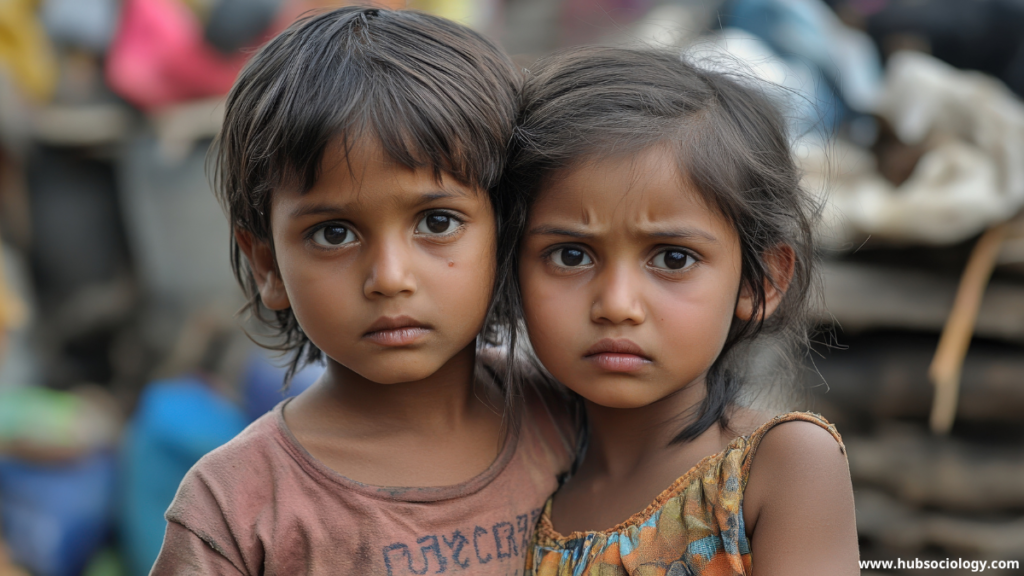
India’s urban population has expanded rapidly. Urbanisation should ideally broaden access to education, health, and higher-wage work. But when urban growth outpaces planning and social provisioning, cities become zones of concentrated vulnerability: informal settlements with poor sanitation, short-term wage labour, and tenuous legal status. Urban poverty in India therefore reflects a mismatch — large numbers of people are in cities, but many are not fully integrated into the city’s social and economic systems.
Structural economic changes and the informalisation of work
A central sociological driver is economic restructuring. Since the 1980s–90s, India’s economy shifted toward liberalisation, service-led growth, and integration with global markets. While these changes created wealth, they also produced new labour market regimes:
- Precarious employment: Growth in services, construction, small-scale manufacturing, and gig-platform jobs often produces informal, short-term, and low-paid employment. Without labour protections, many urban workers live hand-to-mouth.
- Labour segmentation: The urban labour market is deeply segmented between a core of formal, protected jobs and a vast periphery of informal workers. Sociologically, segmentation creates durable inequality: those trapped in peripheral jobs face restricted life-chances.
- Capital-intensive urban development: Cities increasingly prioritize capital flows (real estate, private infrastructure) over labour absorption. This produces construction booms that hire transient labour but do not guarantee stable jobs for residents.
These structural features create an urban economy that generates visible wealth and growth but also entrenches precariousness for a large contingent of workers.
Migration, aspiration and the rural–urban squeeze
Internal migration is often presented as a solution to rural poverty. Sociologically, migration is driven by aspirations and social networks — relatives and migrants’ associations help newcomers navigate cities. But migration also has these consequences:
- Selective migration: Many migrants are young, less-educated, and from marginalized castes or regions. They often land in low-skilled jobs and crowded living spaces.
- Urban absorptive limits: Cities have social and infrastructural limits: housing, schooling, healthcare, and registration systems that cannot expand instantly to accommodate new arrivals. This mismatch produces informal settlements and under-served areas.
- Remittance pressures: Many migrants support rural households. The obligation to remit reduces their ability to invest in urban upward mobility (training, better housing), keeping them economically vulnerable.
Thus migration is not a linear ladder to better living — it can reproduce intergenerational poverty within urban settings.
Land, housing markets and the political economy of space
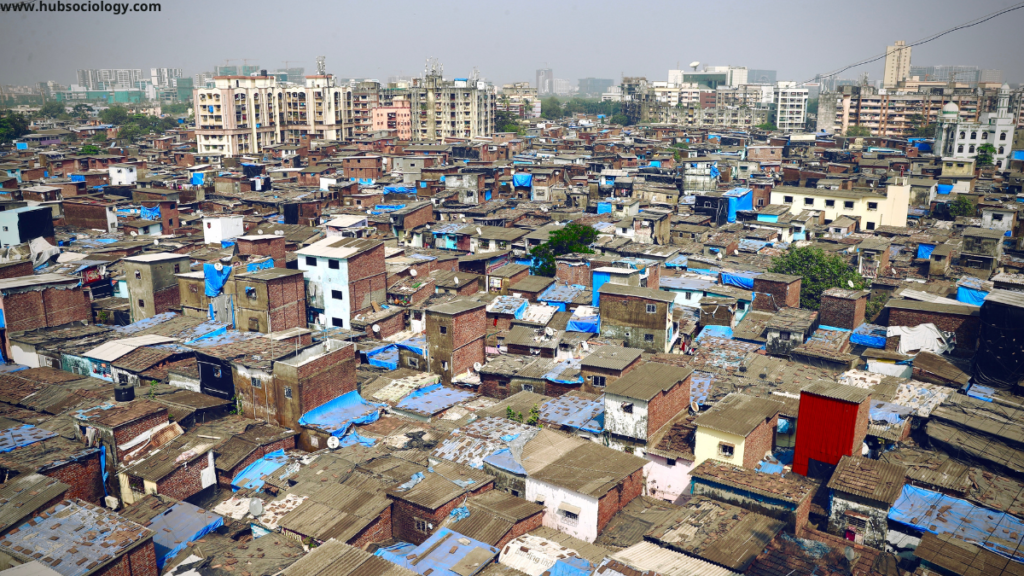
Access to secure, affordable housing is a major determinant of urban poverty. Sociological perspectives emphasise how land and housing are socially produced:
- Speculative land markets: Cities in India have seen rapid land price escalation. Developers, political patronage, and speculative investment push affordable housing out of reach for low-income households.
- Informality as survival strategy: Denied formal housing, poor households settle in informal colonies, chawls, or slums. While these provide proximity to work, they often lack tenure security and basic services.
- Spatial segregation: Low-income groups are pushed to peripheral locations lacking transport, schools, and health facilities, increasing the time and cost of access to employment and services — a form of “spatial poverty trap.”
This is not just about economics; land-use and housing are political: who gets sanctioned plots, who receives infrastructure investment, and who is evicted are questions of power and social status.
Governance failures and exclusionary urban policies
Urban poverty persists because of institutional and governance dynamics:
- Fragmented governance: Urban governance in India often involves multiple agencies — municipal corporations, state departments, parastatals — with weak coordination. This fragmentation undermines consistent delivery of services to poor localities.
- Inadequate social protection: Social safety nets have historically been rural-focused (e.g., MGNREGA). Urban social protection — for housing, food, health, and unemployment — has lagged behind, leaving many uncovered.
- Legal invisibility: Many urban poor lack formal identity proofs or address proofs, which bars them from public entitlements like ration cards, schooling, and subsidized housing.
- Policing and eviction: Informal settlements are frequently targets of eviction drives framed as “beautification” or infrastructure projects. Such policies criminalize poverty and disrupt livelihoods.
Sociologically, governance processes frequently produce exclusion through administrative rules and discretionary power.
Social exclusion: caste, gender and minorities
Urban poverty is not socially neutral. Deep-rooted social hierarchies shape who experiences poverty and why:
- Caste-based marginalisation: Dalits, Adivasis, and certain backward castes often occupy the lowest rungs of the urban labour market and live in the most precarious neighbourhoods. Caste influences access to networks, employers, and even neighbourhood mobility.
- Gendered vulnerability: Women are overrepresented in informal, low-paid care, domestic, and service work. Gender norms restrict women’s mobility and bargaining power, while safety concerns in urban spaces curtail economic participation.
- Religious and ethnic minorities: Some minorities face discrimination in housing and employment, compounding economic vulnerability.
These social divisions mean that poverty in Indian cities is intersectional: economic disadvantage overlaps with social marginality to deepen exclusion.
Urban environment, health, and infrastructure deficits
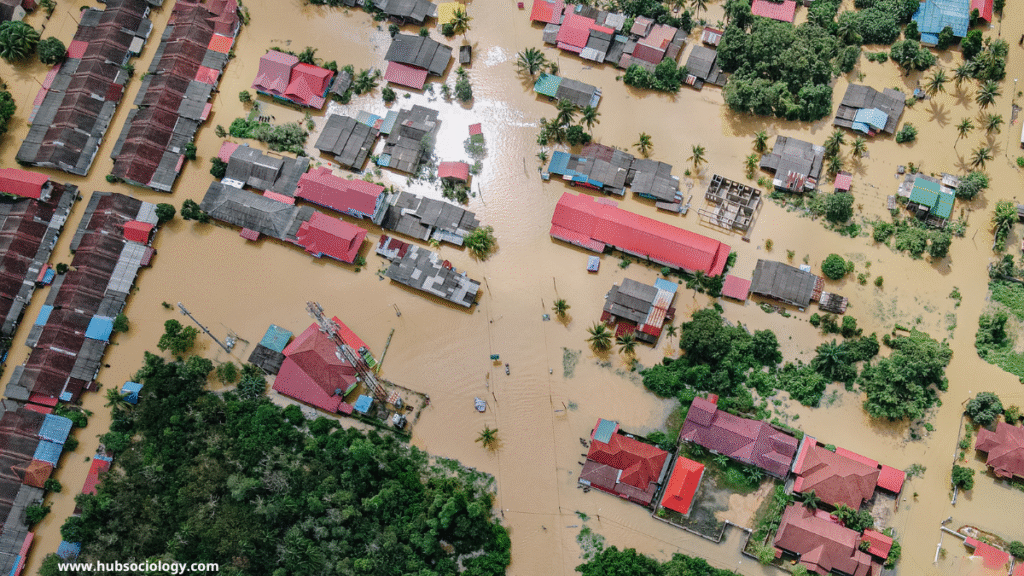
Poor urban residents disproportionately suffer from environmental and infrastructural deficits:
- Sanitation and water: Inadequate water and sanitation in informal settlements create health vulnerabilities that erode labour capacity and income.
- Air pollution and hazards: Proximity to industrial zones, dumpsites, or flood-prone areas increases health risks — a structural injustice where the poor bear environmental burdens.
- Transport deficits: Poor connectivity increases travel costs and time, limiting access to stable jobs and services.
These lived conditions reproduce poverty by constraining human capital development and health.
Measurement, invisibility and policy blindspots
How we count poverty matters. Urban poverty is often under-estimated due to measurement issues:
- Official definitions: Traditional poverty measures and surveys sometimes miss precarious, informal households, migrant groups, and those without fixed addresses.
- Temporal poverty: Many urban households move in and out of poverty seasonally or in response to shocks; static measures miss these dynamics.
- Invisible groups: Domestic workers, waste-pickers, and platform-based gig workers can be overlooked in official labour statistics.
Measurement blindspots lead to under-provisioning of urban social protection and a lack of targeted interventions.
Consequences: social fragmentation and intergenerational impacts
Rising urban poverty has broader sociological implications:
- Educational setbacks: Children in poor urban households face learning losses due to overcrowded housing, lack of after-school support, and low-quality neighbourhood schools — constraining social mobility.
- Health inequalities: Persistent morbidity and malnutrition produce long-term disadvantages.
- Social fragmentation: Spatial segregation and competition for scarce resources can fuel social tensions, informal governance structures, and sometimes crime — though criminality is itself often a response to deprivation rather than its cause.
- Intergenerational transmission: Patterns of work, residence, and social exclusion often pass across generations, making urban poverty a persistent social condition.
Policy responses informed by sociological principles
Sociological analysis points to several policy directions that address root causes rather than symptoms:
- Inclusive urban planning: Adopt people-centered planning that secures land tenure, regularizes settlements, and prioritises affordable housing close to jobs and services.
- Urban social protection: Extend cash transfers, food security, and health insurance schemes to cover informal workers and migrants; design benefits that do not require stable addresses or overly strict documentation.
- Labour formalisation and rights: Strengthen labour protections for informal workers — access to collective bargaining, minimum wages, social security portability (for migrants) and recognition of gig and platform work.
- Participatory governance: Institutionalize community participation in municipal planning so that the urban poor can claim entitlements and influence decisions about infrastructure and services.
- Targeted education and health investments: Improve schools and primary healthcare in low-income neighbourhoods, addressing the intergenerational transmission of disadvantage.
- Spatial justice: Use zoning, land use, and transit investments to reduce spatial segregation; curb speculative land practices through regulatory reform.
- Data and measurement reforms: Develop urban poverty measurements that capture temporality, informality, and marginalised groups to guide policy targeting.
These interventions require coordination between municipal bodies, state governments, civil society, and communities — in short, a politics of inclusion.
The role of social movements and civil society
Sociologically, bottom-up agency matters. Tenant movements, slum federations, waste-pickers’ unions, and women’s collectives have won rights to services, legal recognition, and better terms of engagement with the state. Strengthening civil society and urban collectives is a route toward more democratic and equitable cities.
Conclusion: beyond growth rates — social integration as the goal
The growth of urban poverty in Indian cities is not an inevitable by-product of progress; it is produced through specific economic choices, policy omissions, social hierarchies, and governance arrangements. Rapid urbanisation without social integration — that is, without legal inclusion, social protection, affordable housing, and participatory governance — will continue to deepen urban poverty and its social consequences.
A sociological approach reframes the problem: the goal is not only to increase GDP or build skyline projects, but to make cities places of secure livelihoods, dignified housing, and equal access to services. Only then will urbanisation become truly transformative for the many who come to cities with hopes for a better life.
Frequently Asked Questions
- What is urban poverty in India?
Urban poverty in India refers to the condition where city residents lack adequate income, housing, basic services, and social security, often while living in informal settlements or working in insecure jobs. - Why is urban poverty increasing despite economic growth?
Economic growth in India is uneven and largely benefits formal sectors. Many urban jobs are informal, low-paid, and insecure, which leads to rising urban poverty despite overall growth. - How does migration contribute to urban poverty?
Rural-to-urban migration brings large populations into cities faster than infrastructure and jobs can absorb them, resulting in overcrowding, informal housing, and low-wage employment. - What role does informal employment play in urban poverty?
Informal employment lacks job security, fixed wages, and social protection, making workers highly vulnerable to poverty and economic shocks. - How does housing shortage worsen urban poverty?
High land prices and speculative real estate markets force the urban poor into slums and informal settlements with poor living conditions and insecure tenure. - Is urban poverty linked to caste and social inequality?
Yes. Marginalized castes, tribal communities, and minorities often face discrimination in housing and employment, intensifying urban poverty. - How are women affected by urban poverty in Indian cities?
Women are concentrated in low-paid informal jobs, face safety concerns, and carry unpaid care burdens, making them more vulnerable to urban poverty. - What is the role of urban governance in poverty growth?
Weak municipal governance, poor policy coordination, and inadequate urban welfare schemes limit access to services for the urban poor. - Why are slums common in Indian cities?
Slums emerge due to lack of affordable housing, rapid migration, and exclusionary urban planning policies that fail to include low-income groups. - How does urban poverty affect health and education?
Poor sanitation, pollution, overcrowding, and low-quality schools lead to poor health and limited educational outcomes, reinforcing poverty cycles. - What is the difference between rural and urban poverty?
Urban poverty involves higher living costs, insecure jobs, and housing shortages, whereas rural poverty often relates to landlessness and agricultural instability. - Why is urban poverty often underreported?
Many urban poor are migrants or informal workers without documentation, making them invisible in official surveys and poverty statistics. - How does urban poverty affect children?
Children in poor urban households face malnutrition, school dropouts, child labor, and limited upward mobility. - Can urban poverty be reduced through policy intervention?
Yes. Inclusive urban planning, social protection, affordable housing, and labor reforms can significantly reduce urban poverty. - Why is a sociological approach important to understand urban poverty?
Sociology highlights how inequality, power relations, social exclusion, and institutions shape poverty, beyond income-based explanations.