Introduction
Religion has played a foundational role in shaping American society, influencing its values, institutions, political structures, and cultural practices. From the early Puritan settlements to contemporary debates over secularism, religious freedom, and pluralism, religion continues to occupy a central—though contested—place in the United States. Unlike many other modern societies, the U.S. remains highly religious despite advanced industrialization and modernization. Sociology provides essential tools to understand how religion interacts with society, particularly through the relationship between church and state and the role of religion in American culture.
This article examines religion and society in the United States from a sociological perspective, focusing on three key dimensions: the institutional relationship between church and state, the cultural influence of religion, and the social functions and conflicts associated with religious life. Drawing on classical and contemporary sociological theories, the article highlights how religion shapes identity, power, inequality, and social change in American society.
The Sociological Meaning of Religion
In sociology, religion is understood not only as a system of beliefs about the sacred but also as a social institution that organizes meaning, norms, and collective life. Émile Durkheim defined religion as a unified system of beliefs and practices related to sacred things that unite individuals into a moral community. From this perspective, religion is deeply social—it binds people together, reinforces shared values, and legitimizes social order.
Max Weber emphasized the role of religion in shaping economic behavior and social action, most notably in his analysis of the Protestant ethic and the spirit of capitalism. Karl Marx, by contrast, viewed religion as an ideological tool that can obscure social inequalities and legitimize domination. Together, these classical perspectives provide a foundation for understanding religion as both a source of social cohesion and social conflict in the U.S.
Historical Foundations of Religion in the United States
Religion has been central to American history from its earliest stages. Many early settlers, such as the Puritans, migrated to North America seeking religious freedom from persecution in Europe. However, this freedom was often limited to their own religious groups, and dissenters were sometimes marginalized.
The First Amendment to the U.S. Constitution established two crucial principles: the Establishment Clause, which prohibits the government from establishing an official religion, and the Free Exercise Clause, which protects individuals’ rights to practice their religion freely. Sociologically, this separation of church and state created a unique religious marketplace in which multiple denominations could coexist and compete, leading to religious diversity and innovation.
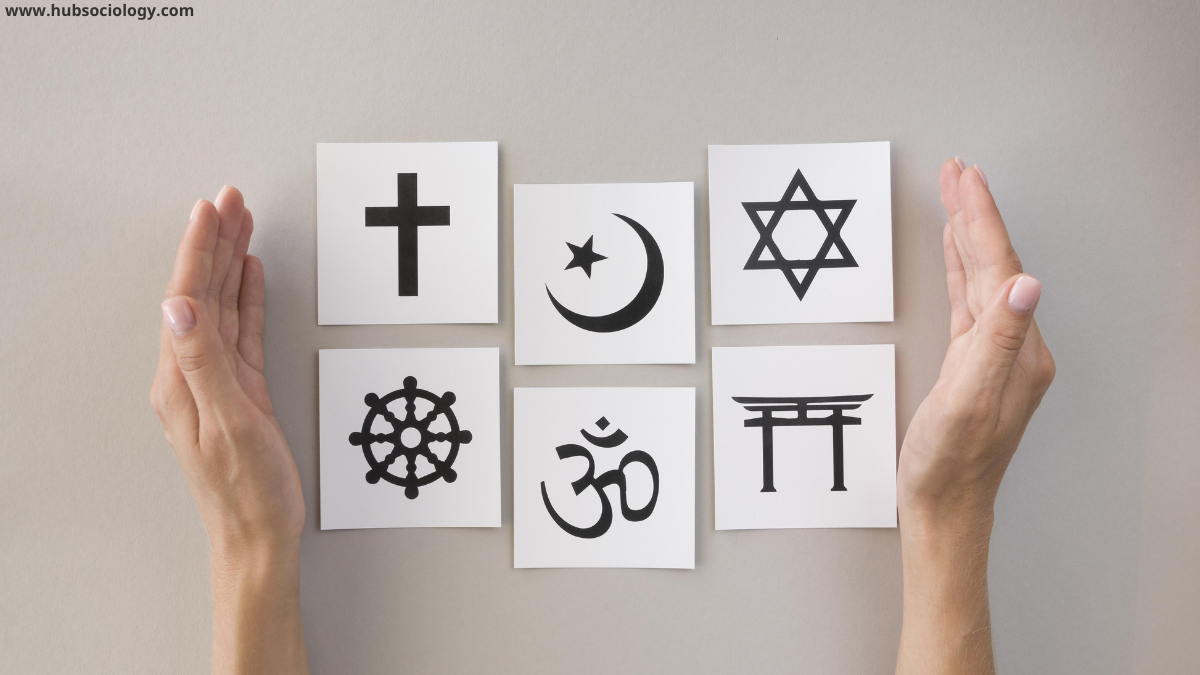
Unlike European societies where state churches dominated, American religion developed in a pluralistic and voluntary context. This contributed to high levels of religious participation and the growth of diverse religious movements, including evangelical Protestantism, Catholicism, Judaism, and later Islam, Buddhism, and Hinduism.
Church and State: A Sociological Relationship
Separation and Interaction
Although the U.S. Constitution mandates separation of church and state, sociology shows that the relationship is more complex in practice. Religion and politics frequently intersect in public life, shaping laws, policies, and political identities. The separation is institutional rather than cultural; religious values often influence political discourse and decision-making.
Debates over school prayer, abortion, same-sex marriage, and religious exemptions reveal ongoing tensions between secular governance and religious morality. Sociologists analyze these conflicts as struggles over moral authority, cultural dominance, and the boundaries of public and private life.
Civil Religion
American sociologist Robert Bellah introduced the concept of civil religion, referring to a set of beliefs, symbols, and rituals that give religious meaning to the nation itself. Examples include references to God in presidential speeches, the phrase “In God We Trust,” and national rituals such as presidential inaugurations.
Civil religion functions sociologically to promote national unity and legitimacy, blending religious symbolism with political ideology. While it transcends specific denominations, it can also marginalize non-religious citizens or religious minorities who do not share dominant cultural narratives.
Religion and American Culture
Religion as a Cultural System
Religion deeply influences American culture by shaping norms, values, and everyday practices. Concepts such as individual responsibility, moral discipline, charity, and family values have strong religious roots, particularly in Protestant Christianity. These values are reflected in cultural attitudes toward work, success, sexuality, and morality.
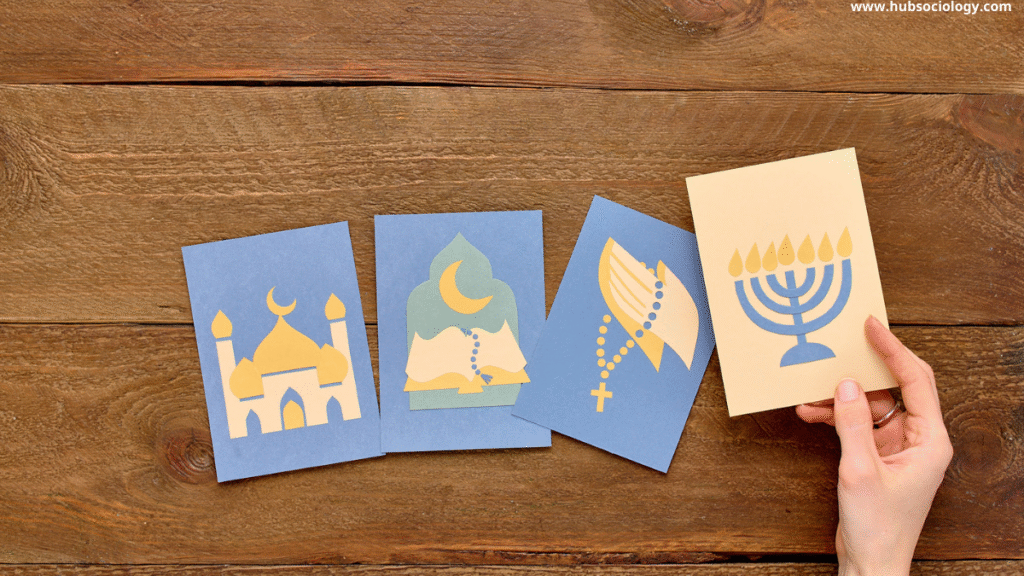
Religious holidays, rituals, and symbols are integrated into mainstream culture, often in secularized forms. Christmas, for example, functions both as a religious observance and a cultural-commercial event. Sociology examines how religious meanings are transformed as they enter popular culture.
Media and Popular Culture
Religion is also represented and contested in media and popular culture. Television, films, music, and social media portray religious themes in diverse ways—sometimes reinforcing traditional beliefs, sometimes challenging them. Televangelism and religious broadcasting illustrate how religion adapts to modern communication technologies.
At the same time, popular culture has become a site of criticism of organized religion, highlighting issues such as hypocrisy, abuse of power, and exclusion. These representations contribute to changing public perceptions of religion, especially among younger generations.
Religious Diversity and Pluralism
The United States is one of the most religiously diverse societies in the world. Immigration has played a key role in expanding religious pluralism, bringing Islam, Hinduism, Buddhism, Sikhism, and other traditions into the American religious landscape.
Sociologically, religious diversity presents both opportunities and challenges. On one hand, pluralism promotes tolerance, dialogue, and multiculturalism. On the other hand, it can generate conflict, discrimination, and social boundary-making. Muslim Americans, for example, have faced heightened scrutiny and prejudice, particularly after the events of September 11, 2001.
Religious pluralism also raises questions about national identity: Who belongs, and whose values define “American culture”? These questions are central to sociological debates on religion and society.
Religion, Power and Inequality
Religion and Social Stratification
Religion intersects with class, race, gender, and ethnicity, contributing to patterns of inequality. Historically, many religious institutions supported existing power structures, including slavery, patriarchy, and racial segregation. At the same time, religion has also inspired movements for social justice and equality.
Different religious groups occupy different social positions. Mainline Protestant denominations have traditionally been associated with political and economic elites, while evangelical and minority religious groups have often represented marginalized populations.
Gender and Religion
Gender inequality within religious institutions is a major focus of sociological analysis. Many religious traditions restrict women’s leadership roles and reinforce traditional gender norms. Feminist sociologists critique these practices as forms of symbolic and institutional domination.
However, women are often the most active participants in religious life and have used religion as a resource for empowerment, community building, and activism. This dual role highlights the complex relationship between religion and gender in American society.
Religion and Social Change
Religion as a Force for Social Reform
Religion has played a significant role in major social movements in U.S. history. The abolitionist movement, the civil rights movement, and contemporary faith-based activism for immigration reform and environmental justice all demonstrate how religious beliefs can motivate collective action.
The civil rights movement, led by figures such as Martin Luther King Jr., drew heavily on Christian theology and church-based organizing. Sociologically, this illustrates how religion can provide moral legitimacy, organizational resources, and emotional motivation for social change.
Religion and Conservatism
At the same time, religion has also been a powerful force for social conservatism. The rise of the Religious Right since the late 20th century reflects the mobilization of evangelical Christians around issues such as abortion, family values, and education.
This political engagement has reshaped American politics, contributing to polarization and debates over the role of religion in public life. Sociologists analyze these developments as part of broader struggles over cultural authority and moral boundaries.
Secularization and Contemporary Trends

Classical sociological theories predicted that modernization would lead to secularization—the decline of religion’s social influence. While some aspects of American society have become more secular, religion remains resilient.
Recent trends show declining religious affiliation, especially among younger generations, often referred to as the “nones.” However, this does not necessarily indicate a decline in spirituality; rather, it reflects changing forms of belief and practice.
Sociologists argue that the U.S. is experiencing religious transformation rather than simple decline, characterized by individualized spirituality, religious hybridization, and new forms of community.
Conclusion
Religion remains a powerful and complex force in American society. From its constitutional separation from the state to its deep integration into culture, politics, and social life, religion shapes identities, values, and conflicts in enduring ways. A sociological perspective reveals that religion is neither purely private nor purely spiritual; it is a social institution embedded in structures of power, inequality, and change.
The relationship between church, state, and culture in the United States reflects broader tensions between unity and diversity, tradition and modernity, belief and skepticism. Understanding these dynamics is essential for analyzing contemporary American society, where religion continues to influence debates over morality, citizenship, and the meaning of collective life.
In a pluralistic and rapidly changing social context, the sociology of religion helps us understand not only what Americans believe, but how those beliefs shape—and are shaped by—the society in which they live.
Do you like this this Article ? You Can follow as on :-
Facebook – https://www.facebook.com/hubsociology
WhatsApp Channel – https://whatsapp.com/channel/0029Vb6D8vGKWEKpJpu5QP0O
Gmail – hubsociology@gmail.com
FAQs
20 FAQs on Society in the United States
- What is meant by society in the United States from a sociological perspective?
Society in the United States refers to a complex social structure shaped by religion, culture, capitalism, democracy, diversity, and institutional systems. - How did religion influence the formation of society in the United States?
Religion shaped moral values, education, law, and community life during the early development of society in the United States. - Why is society in the United States considered religious despite modernization?
Unlike Europe, society in the United States developed a competitive religious environment that encouraged participation and innovation. - What role does the Constitution play in society in the United States?
The U.S. Constitution ensures religious freedom, equality, and democratic governance, forming the foundation of society in the United States. - How does the separation of church and state affect society in the United States?
It allows religious diversity while preventing state control over belief systems, maintaining pluralism in society in the United States. - What is civil religion in the context of society in the United States?
Civil religion refers to shared national symbols and beliefs that give sacred meaning to American political life. - How does religious pluralism shape society in the United States?
Religious pluralism promotes cultural diversity but also creates social tensions and identity negotiations. - What is the impact of immigration on society in the United States?
Immigration has transformed society in the United States by increasing religious, ethnic, and cultural diversity. - How does religion influence political behavior in society in the United States?
Religion shapes voting patterns, political ideologies, and public policy debates. - What is the relationship between religion and social inequality in society in the United States?
Religion can both reinforce social hierarchies and challenge inequality through reform movements. - How does gender interact with religion in society in the United States?
Religion often reinforces traditional gender roles, yet women play key leadership and activist roles. - What role did religion play in the Civil Rights Movement within society in the United States?
Religion provided moral authority, leadership, and organizational resources for social justice struggles. - How does secularization theory apply to society in the United States?
While institutional religious participation has declined, belief and spirituality remain strong in society in the United States. - Who are the “religious nones” in society in the United States?
They are individuals with no formal religious affiliation but who may still hold spiritual beliefs. - How does popular culture reflect religion in society in the United States?
Media and entertainment both normalize and critique religious beliefs and institutions. - What is the role of the Religious Right in society in the United States?
It mobilizes conservative religious groups to influence politics and social policies. - How does race intersect with religion in society in the United States?
Religion has historically shaped racial identities, segregation, and resistance movements. - Why is society in the United States described as culturally diverse?
It includes multiple ethnicities, religions, and lifestyles shaped by migration and globalization. - How does sociology help in understanding society in the United States?
Sociology analyzes institutions, power relations, inequality, and cultural patterns within society in the United States. - What is the future of religion in society in the United States?
The future points toward religious transformation, individualized spirituality, and continued cultural influence rather than complete decline.