
Introduction
For a long time, classical sociology focused primarily on social institutions such as family, religion, economy, state, and class structure, often treating the human body as a biological entity outside the core of sociological inquiry. However, contemporary sociology recognizes that the body is not merely a natural or biological object; it is deeply social, cultural, political, and symbolic. The emergence of the sociology of the body marks a significant shift in sociological thought, emphasizing that bodies are socially constructed, regulated, disciplined, represented, and experienced within specific historical and cultural contexts.
The sociology of body examines how societies shape bodily norms, meanings, practices, and identities. It explores how power, culture, gender, class, race, medicine, media, and technology influence how bodies are understood and lived. In modern societies, where body image, health, beauty, fitness, surveillance, and bodily control have become central concerns, the sociology of the body provides critical insights into everyday social life.
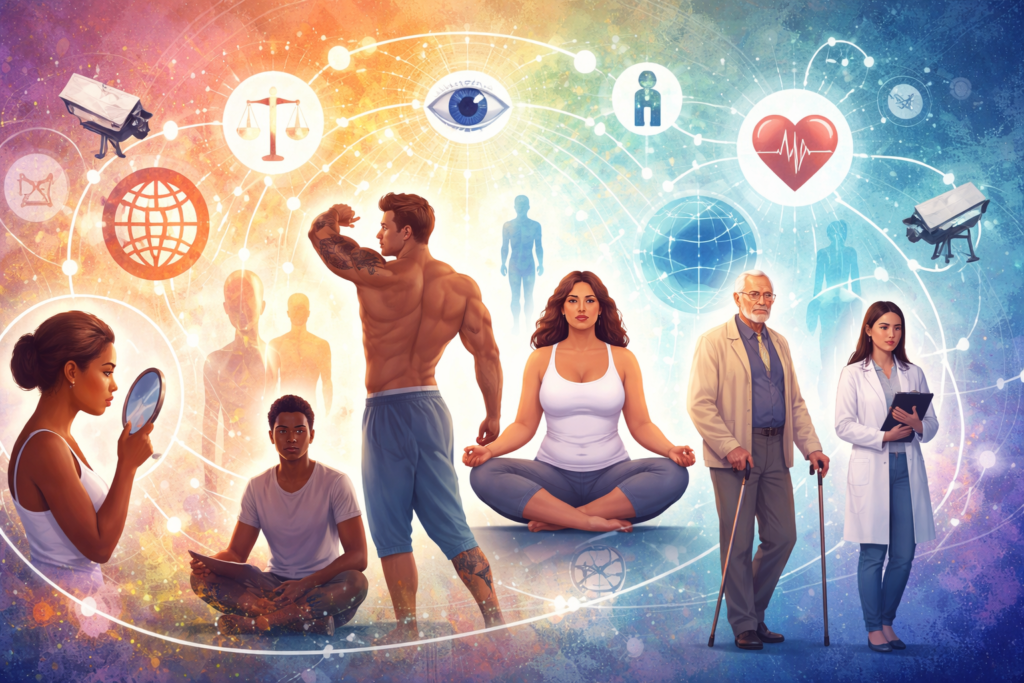
Meaning of Sociology of Body
The sociology of body is a specialized field within sociology that studies the body as a social phenomenon rather than merely a biological organism. It focuses on how bodies are shaped, interpreted, valued, and controlled through social processes. From this perspective, the body is both a product of society and a medium through which social relations are expressed.
In sociological terms, the body functions as a site where social norms, cultural values, power relations, and identities are inscribed. How individuals dress, move, eat, age, present themselves, or experience illness is not purely personal or natural; these practices are structured by social expectations and institutional forces. The sociology of the body therefore challenges the mind–body dualism traditionally found in Western thought by emphasizing the inseparability of the physical body from social life.
The field draws on insights from classical sociologists as well as contemporary theorists. Karl Marx highlighted how capitalist labor systems exploit and discipline workers’ bodies. Max Weber emphasized bodily discipline in rationalized societies, particularly through bureaucracy and religious ethics. Émile Durkheim, though indirectly, recognized the role of bodily rituals and collective representations in social cohesion. Later thinkers like Michel Foucault placed the body at the centre of power, surveillance, and discipline, profoundly shaping the sociology of the body.
Historical Development of the Sociology of Body
The sociology of body emerged more clearly in the late twentieth century as part of broader intellectual shifts within the social sciences. Feminist theory, postmodernism, medical sociology, and cultural studies played key roles in foregrounding the body as a critical area of analysis. Feminist scholars, in particular, emphasized how women’s bodies are socially regulated, objectified, and controlled through patriarchal norms. This challenged earlier sociological traditions that treated the body as neutral or irrelevant.
Michel Foucault’s work on discipline, biopower, and surveillance marked a turning point in sociological thinking about the body. He argued that modern societies exercise power not only through laws and institutions but also through the regulation of bodies. Schools, hospitals, prisons, armies, and medical systems discipline bodies by shaping posture, movement, behavior, and self-perception. This perspective highlighted how power operates at the most intimate level of bodily experience.
At the same time, sociologists began to examine how consumer culture, media representations, and globalization influence body ideals and practices. The rise of fitness culture, cosmetic surgery, dieting, and digital self-presentation made the body a central project of identity in late modern societies. As a result, the sociology of the body became an essential field for understanding contemporary social life.
Scope of Sociology of Body
The scope of the sociology of the body is broad and interdisciplinary, covering multiple dimensions of social life. It examines how bodies are shaped by social structures, cultural meanings, institutional practices, and individual experiences.
One important area within this field is the study of body and identity. The body plays a crucial role in the formation of self-identity, including gender identity, sexual identity, racial identity, and class identity. How individuals experience their bodies affects how they understand themselves and how they are perceived by others. Gender norms, for instance, dictate different expectations regarding appearance, behavior, and bodily presentation for men and women.
Another significant area is the sociology of health, illness, and medicine. Bodies are medicalized through scientific knowledge, diagnosis, and treatment. What counts as healthy or unhealthy is not purely objective but shaped by social values, institutional interests, and cultural beliefs. Medical authority often defines normal and abnormal bodies, influencing how individuals experience illness and disability.
The sociology of body also examines power and social control. Bodies are regulated through laws, moral codes, surveillance technologies, and disciplinary practices. From dress codes and beauty standards to biometric identification and digital tracking, modern societies increasingly monitor and manage bodies. This area of study highlights how power operates through bodily regulation rather than only through coercion.
Another important scope involves media, representation, and popular culture. Media images play a powerful role in shaping ideals of beauty, fitness, youth, and sexuality. These representations influence how individuals evaluate their own bodies, often leading to body dissatisfaction, anxiety, and exclusion. Sociologists analyze how media promotes particular body types while marginalizing others.
The sociology of body also includes the study of aging, disability, and bodily difference. Aging bodies challenge dominant cultural ideals of youth and productivity, often leading to marginalization and ageism. Disability studies within sociology examine how social barriers, rather than bodily impairments alone, produce disability.
Body as a Site of Power and Control
One of the central themes in the sociology of body is the relationship between the body and power. Bodies are not free from social regulation; they are shaped and controlled through institutional and cultural mechanisms. Michel Foucault’s concept of disciplinary power explains how modern societies produce “docile bodies” through continuous observation, normalization, and self-regulation.
Educational institutions regulate children’s bodies through timetables, uniforms, posture, and discipline. Workplaces regulate bodies through schedules, productivity demands, and performance monitoring. Medical institutions regulate bodies by defining norms of health and illness. Even leisure activities such as fitness and dieting involve forms of self-discipline aligned with social expectations.
Biopolitics, another Foucauldian concept, refers to the regulation of populations through policies related to health, reproduction, sexuality, and mortality. Governments and institutions manage bodies at the population level through public health campaigns, vaccination programs, reproductive laws, and surveillance systems. This demonstrates that the body is not only a personal possession but also a political and social concern.
Body, Culture, and Social Meaning
The body carries symbolic meanings that vary across cultures and historical periods. Cultural norms shape how bodies are dressed, displayed, modified, and interpreted. Practices such as tattooing, piercing, cosmetic surgery, and dieting reflect cultural values and social identities rather than purely individual choices.

Different societies assign different meanings to body size, skin color, hair, and physical ability. These meanings often intersect with power relations related to race, class, gender, and caste. For example, lighter skin tones may be socially valued in some societies, reflecting historical and colonial legacies. Such cultural meanings shape social hierarchies and everyday interactions.
Rituals and ceremonies also involve the body as a key medium of social expression. Religious rituals, rites of passage, and collective performances use bodily practices to reinforce social norms and group identity. The sociology of the body helps explain how such practices create a sense of belonging and social order.
Importance of Sociology of Body
The sociology of body is important because it reveals how deeply social forces shape even the most intimate aspects of human existence. By focusing on the body, sociology moves beyond abstract structures to examine how social power operates in everyday life. It highlights the lived experience of individuals and the ways in which social inequalities are embodied.
Understanding the sociology of the body helps in analyzing issues such as body image anxiety, eating disorders, health inequalities, gender violence, and medical ethics. It provides tools to critically examine social norms that often appear natural or inevitable. By exposing the social construction of bodily ideals, this field challenges oppressive standards and promotes greater social awareness.
The sociology of body is also crucial in contemporary societies characterized by rapid technological change. Advances in biotechnology, cosmetic medicine, digital surveillance, and artificial intelligence raise new questions about bodily autonomy, identity, and control. Sociological analysis helps assess the social implications of these developments.
Furthermore, this field contributes to policy-making and social reform by highlighting how social structures affect bodily well-being. Public health, disability rights, gender equality, and aging policies benefit from sociological insights into how bodies are shaped by social conditions rather than individual choices alone.
Conclusion
The sociology of body represents a vital and dynamic area of sociological inquiry that bridges the gap between individual experience and social structure. By treating the body as a social, cultural, and political entity, it challenges traditional assumptions about the separation of nature and society. The body emerges as a site where power, identity, culture, and inequality intersect.

In an era marked by intense focus on appearance, health, productivity, and surveillance, the sociology of the body provides critical tools for understanding how societies shape human lives at the most fundamental level. It reminds us that bodies are not merely biological objects but living expressions of social relations, cultural meanings, and historical forces. Through this perspective, sociology gains a deeper understanding of both society and the human condition itself.
FAQs on Sociology of Body
1. What is Sociology of Body?
Sociology of Body is a branch of sociology that studies the human body as a social and cultural construct shaped by norms, power relations, and institutions rather than only biology.
2. Why is Sociology of Body important in sociology?
Sociology of Body is important because it explains how social forces influence bodily experiences, identity formation, health, and social inequality.
3. How does Sociology of Body differ from biological views of the body?
Unlike biological views, Sociology of Body focuses on social meanings, cultural practices, and power structures that shape how bodies are perceived and regulated.
4. What are the key themes in Sociology of Body?
Key themes in Sociology of Body include identity, power, discipline, health, gender, sexuality, media representation, and bodily control.
5. How does Sociology of Body explain body image issues?
Sociology of Body explains body image issues as outcomes of cultural norms, media influence, and social expectations rather than individual psychological problems alone.
6. What role does power play in Sociology of Body?
In Sociology of Body, power operates through discipline, surveillance, and regulation of bodies by institutions like schools, hospitals, and the state.
7. How is Michel Foucault related to Sociology of Body?
Michel Foucault contributed significantly to Sociology of Body by explaining how modern societies discipline and control bodies through power and knowledge.
8. How does Sociology of Body analyze gender?
Sociology of Body analyzes gender by showing how male and female bodies are socially constructed, controlled, and judged differently in society.
9. What is the relationship between Sociology of Body and health?
Sociology of Body studies how definitions of health, illness, and normality are socially shaped through medical institutions and cultural beliefs.
10. How does Sociology of Body relate to media and popular culture?
Sociology of Body examines how media promotes ideal body types, influencing self-identity, consumption patterns, and social exclusion.
11. What is medicalization in Sociology of Body?
Medicalization refers to the process through which normal bodily conditions are defined and treated as medical problems within Sociology of Body.
12. How does Sociology of Body study aging?
Sociology of Body studies aging by analyzing how older bodies are socially valued or marginalized in youth-oriented societies.
13. What is the role of culture in Sociology of Body?
Culture shapes body practices such as dress, diet, beauty standards, and rituals, making it a central concern of Sociology of Body.
14. How does Sociology of Body explain disability?
Sociology of Body explains disability as a result of social barriers and exclusion rather than only physical impairment.
15. Why is Sociology of Body relevant in contemporary society?
Sociology of Body is relevant today because issues like surveillance, fitness culture, cosmetic surgery, and digital identity increasingly shape bodily experiences.
1 thought on “Sociology of Body: Meaning, Scope and Importance”