Introduction
The Black Lives Matter (BLM) movement represents one of the most significant social movements in contemporary American society. Emerging in the early twenty-first century, the movement is not merely a reaction to isolated incidents of police brutality but a broader sociological response to centuries of racial oppression, structural inequality, and institutionalized discrimination against Black Americans. From a sociological perspective, the Black Lives Matter movement can be understood as a collective struggle against systemic racism embedded within social, political, legal, and economic institutions of the United States.
The movement gained national and global visibility following high-profile cases of police violence against unarmed Black individuals, particularly the killing of Trayvon Martin in 2012 and later incidents involving Michael Brown, Eric Garner, Breonna Taylor, and George Floyd. However, sociologically, Black Lives Matter is rooted in a long historical continuum of Black resistance movements, including abolitionism, the Civil Rights Movement, and Black Power activism. This article examines the sociology of the Black Lives Matter movement in America by analyzing its origins, social context, ideological foundations, organizational structure, methods of protest, intersectionality, and its broader impact on American society.
Historical Background and Social Roots
To understand the Black Lives Matter movement sociologically, it is essential to examine the historical experiences of Black Americans. The legacy of slavery, segregation, Jim Crow laws, redlining, and racialized mass incarceration has shaped enduring patterns of inequality. Sociologists emphasize that racism in America is not only interpersonal but structural, meaning it is embedded within institutions such as policing, education, housing, healthcare, and employment.
The Civil Rights Movement of the 1950s and 1960s led to important legal reforms, including the Civil Rights Act and the Voting Rights Act. However, sociological research shows that legal equality did not eliminate racial inequality. Instead, racism evolved into more subtle and systemic forms, often referred to as “institutional racism” or “structural racism.” The Black Lives Matter movement arose within this context of unfulfilled promises of equality, particularly in relation to state violence and criminal justice.
Emergence of the Black Lives Matter Movement
The phrase “Black Lives Matter” first appeared as a hashtag on social media in 2013 after the acquittal of George Zimmerman for the killing of Trayvon Martin. What began as a digital expression of grief and outrage soon transformed into a nationwide movement. Sociologically, this highlights the role of digital media in modern social movements. Unlike earlier movements that relied heavily on formal leadership and centralized organizations, Black Lives Matter developed through decentralized networks facilitated by social media platforms.
The movement became a formal organization, Black Lives Matter, but it also functions as a broader ideological and cultural movement. From a sociological standpoint, this dual nature allows for flexibility, mass participation, and local adaptation while maintaining a shared collective identity centered on racial justice.
Structural Racism and Policing
One of the central sociological themes of the Black Lives Matter movement is its critique of policing and the criminal justice system. Numerous sociological studies demonstrate that Black Americans are disproportionately stopped, searched, arrested, and killed by police compared to White Americans. These patterns are not explained solely by individual prejudice but by institutional practices, racial profiling, and historical patterns of social control.
From a conflict theory perspective, policing can be seen as an institution that maintains existing power relations. Historically, law enforcement in the United States has played a role in enforcing racial hierarchies, from slave patrols in the South to aggressive policing in urban Black neighborhoods. The Black Lives Matter movement challenges this role by questioning the legitimacy of state violence and demanding accountability, transparency, and systemic reform.
Sociological Theories and Black Lives Matter
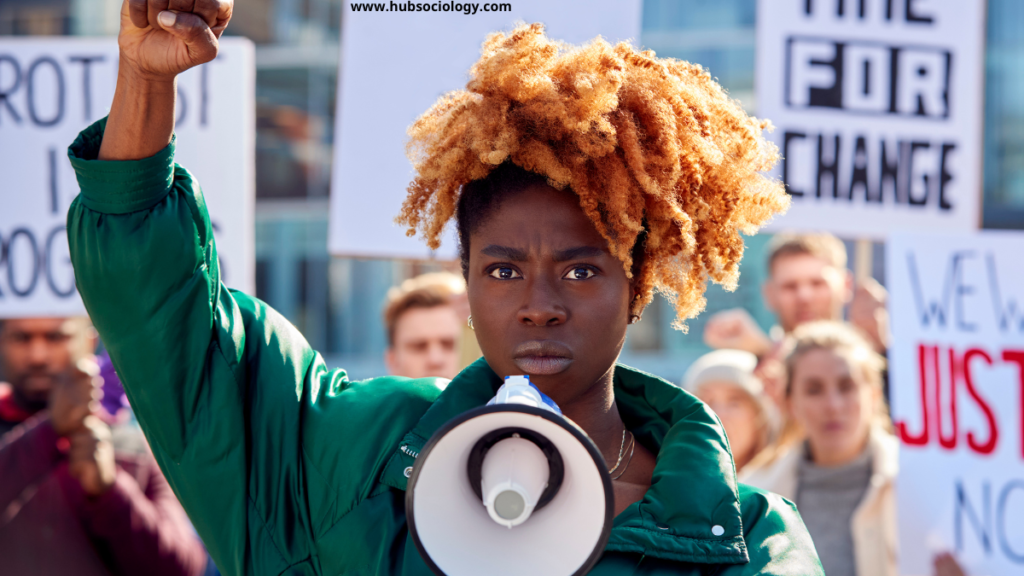
Several sociological theories help explain the emergence and significance of the Black Lives Matter movement.
Conflict theory views society as characterized by inequality and power struggles between dominant and subordinate groups. From this perspective, Black Lives Matter represents resistance by a marginalized racial group against institutions that disproportionately benefit White Americans and disadvantage Black communities.
Symbolic interactionism focuses on meaning-making and everyday interactions. The movement highlights how racial stereotypes shape police behavior, media representation, and public perception of Black individuals. The slogan “Black Lives Matter” itself is a symbolic challenge to a social order that often treats Black lives as disposable or criminal.
Structural functionalism, while less commonly applied to protest movements, can still offer insight. It suggests that social movements emerge when institutions fail to fulfill their functions. The Black Lives Matter movement points to dysfunctions within the criminal justice system, particularly its failure to ensure fairness, safety, and trust across racial groups.
Intersectionality and Inclusive Activism
A defining sociological feature of the Black Lives Matter movement is its emphasis on intersectionality. Intersectionality recognizes that individuals experience oppression in overlapping ways based on race, gender, class, sexuality, and other social identities. Unlike earlier racial justice movements that often centered heterosexual Black men, Black Lives Matter explicitly includes Black women, LGBTQ+ individuals, immigrants, and people with disabilities.
This inclusive approach reflects broader changes in social movement theory, where identity is understood as complex and multidimensional. Sociologically, this makes the movement more representative of the diversity within Black communities and challenges traditional hierarchies within activism itself.
Role of Media and Public Discourse
Media plays a crucial role in shaping public understanding of the Black Lives Matter movement. Traditional media has often framed protests in terms of violence or disorder, sometimes reinforcing negative stereotypes about Black activism. In contrast, social media has allowed activists to bypass mainstream gatekeepers, share firsthand accounts, and mobilize supporters rapidly.
From a sociological perspective, this reflects the power of framing in social movements. How an issue is presented influences whether the public views it as legitimate or threatening. The widespread circulation of videos showing police violence has been particularly significant, transforming abstract claims about racism into visible and emotionally powerful evidence.
Political and Policy Impact
The Black Lives Matter movement has had notable political consequences. It has influenced public debates on policing, mass incarceration, and racial inequality. Sociologically, this demonstrates how social movements can shift public consciousness even when policy change is slow or contested.
At the local level, some cities have implemented police reforms, revised use-of-force policies, or increased civilian oversight. Nationally, the movement has contributed to broader discussions about criminal justice reform, voting rights, and racial equity. While critics argue that change has been limited, sociologists note that cultural and ideological shifts often precede structural transformation.
Criticism and Social Polarization
The Black Lives Matter movement has also generated significant opposition, reflecting deep racial and political divisions in American society. Critics often frame the movement as anti-police or divisive, while counter-slogans such as “All Lives Matter” have emerged. Sociologically, these reactions reveal how dominant groups may resist challenges to existing power structures.
Such polarization underscores the role of race in shaping political identity in the United States. The movement exposes unresolved tensions surrounding national identity, citizenship, and belonging, making it a focal point for broader cultural conflicts.
Global Influence and Transnational Sociology
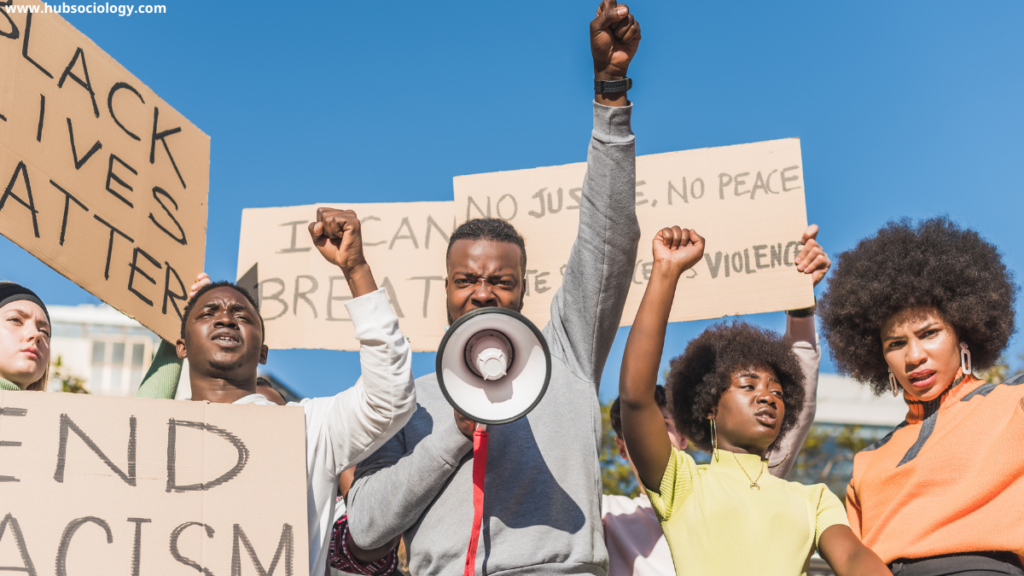
Although rooted in the American context, the Black Lives Matter movement has inspired protests and solidarity movements around the world. From a sociological perspective, this demonstrates how local struggles can become global symbols of resistance. Issues of racism, colonialism, and police violence resonate across national boundaries, allowing Black Lives Matter to function as a transnational movement.
This global diffusion highlights the interconnectedness of modern societies and the shared structural conditions that produce racial inequality in different contexts.
Conclusion
From a sociological standpoint, the Black Lives Matter movement is far more than a protest against police violence. It is a collective response to deeply embedded structures of racial inequality in American society. By challenging institutional racism, redefining collective identity, and reshaping public discourse, the movement represents a critical moment in the ongoing struggle for social justice.
The sociology of Black Lives Matter reveals how social movements emerge from historical conditions, adapt to new technological environments, and confront entrenched systems of power. Whether viewed through conflict theory, symbolic interactionism, or intersectionality, the movement underscores the continuing relevance of sociology in understanding race, resistance, and social change in contemporary America.
FAQs on Sociology of Black Lives Matter Movement in America
1. What is the Black Lives Matter movement?
The Black Lives Matter movement is a social justice movement that challenges systemic racism, police brutality, and racial inequality faced by Black Americans in the United States.
2. Why is Black Lives Matter important in sociology?
In sociology, Black Lives Matter is important because it highlights structural racism, power inequality, and institutional discrimination within American society.
3. When did the Black Lives Matter movement begin?
The movement began in 2013 following the acquittal of George Zimmerman in the killing of Trayvon Martin, marking a turning point in racial activism.
4. What sociological factors led to the Black Lives Matter movement?
Historical oppression, racial segregation, mass incarceration, police violence, and economic inequality are major sociological factors behind the movement.
5. How does Black Lives Matter relate to structural racism?
The movement emphasizes that racism is embedded in institutions such as policing, housing, education, and healthcare, not just individual attitudes.
6. Which sociological theories explain the Black Lives Matter movement?
Conflict theory, symbolic interactionism, and intersectionality are commonly used to explain the movement’s emergence and goals.
7. How does Black Lives Matter view policing in America?
From a sociological perspective, the movement critiques policing as an institution that disproportionately targets Black communities.
8. What role does social media play in the Black Lives Matter movement?
Social media enables rapid mobilization, global awareness, and decentralized leadership, making it central to modern activism.
9. What is intersectionality in the Black Lives Matter movement?
Intersectionality refers to the movement’s focus on overlapping identities such as race, gender, class, and sexuality in shaping oppression.
10. How is Black Lives Matter different from the Civil Rights Movement?
Unlike earlier movements, Black Lives Matter is decentralized, digitally driven, and explicitly inclusive of women and LGBTQ+ voices.
11. What criticisms does the Black Lives Matter movement face?
Critics argue that it is divisive or anti-police, while supporters view such criticism as resistance to racial equality and social change.
12. Has Black Lives-Matter influenced public policy?
The movement has influenced discussions on police reform, racial justice laws, and criminal justice accountability at local and national levels.
13. How has Black Lives Matter affected American society?
It has reshaped public discourse on race, exposed systemic inequality, and increased awareness of racial injustice in everyday life.
14. Is Black Lives Matter only an American movement?
While rooted in the United States, the movement has inspired global protests addressing racism and state violence worldwide.
15. What is the sociological significance of Black Lives Matter today?
Sociologically, the movement represents ongoing resistance to racial inequality and highlights the role of collective action in social change.