
Introduction on Development and Environmental Hazards
Urban development has long been celebrated as a sign of progress, modernity, and human achievement. Cities represent centers of economic growth, technological innovation, and cultural exchange. Yet, beneath this apparent advancement lies a complex reality—rapid urbanization often brings severe environmental hazards. From air and water pollution to waste management crises, climate vulnerabilities, and health risks, cities are increasingly becoming hotspots of ecological degradation. Sociologically, this tension between development and environmental hazards reflects deep-rooted inequalities, patterns of consumption, and the structural contradictions of modern industrial society. Understanding this relationship through a sociological lens allows us to see how human behavior, power structures, and institutions shape environmental outcomes in urban spaces.
Table of Contents
Urbanization and Development: The Sociological Context
Development in cities is not merely an economic process—it is a social one. It involves the transformation of social structures, lifestyles, and human relationships. According to sociologist Manuel Castells, cities are the “spatial expressions of society,” reflecting the underlying organization of production, consumption, and governance. When urban development accelerates without environmental consideration, it produces what sociologists call socially organized irresponsibility—a situation where collective progress leads to shared ecological risks.
Modern cities, particularly in developing countries, experience what Anthony Giddens terms “runaway world” development: rapid industrialization, population growth, and infrastructural expansion without proportional environmental planning. This unbalanced urban growth fosters socio-environmental crises—where marginalized communities often bear the brunt of ecological degradation caused by industrial elites and urban planners.
Sociological Theories and Environmental Hazards
1. Marxist Perspective
From a Marxist viewpoint, environmental hazards in cities are a byproduct of capitalist modes of production. Urban development prioritizes profit over sustainability, leading to overexploitation of resources and commodification of urban space. Factories, real estate projects, and consumer industries contribute to pollution and waste accumulation, while the working class often resides in environmentally hazardous zones.
David Harvey’s concept of the “spatial fix” explains how capitalism uses urban space to absorb surplus capital—through construction, infrastructure, and expansion. However, this results in ecological imbalances and social displacement, reinforcing environmental injustice. For instance, slum areas near industrial sites face higher exposure to air and water contamination.
2. Weberian Perspective
Max Weber’s theory of rationalization helps explain the bureaucratic and calculative logic behind urban planning. Cities are governed by rational systems aiming for efficiency and productivity. Yet, this rationalization often leads to the neglect of ecological ethics. Industrial zoning, vehicular expansion, and vertical housing projects are designed for economic utility rather than ecological balance. Thus, Weber’s idea of the “iron cage” becomes relevant—urban residents are trapped in systems that prioritize economic rationality over sustainable living.
3. Ulrich Beck’s Risk Society
Ulrich Beck’s Risk Society theory is particularly relevant in understanding modern environmental hazards. Beck argues that contemporary societies are preoccupied with managing risks produced by modernization itself—such as pollution, toxic waste, and climate change. Cities embody this paradox: the very development that promises better living standards creates new environmental dangers. For example, technological advancement brings convenience but also electronic waste; increased mobility leads to vehicular emissions; and high-rise construction disturbs ecological systems.
Beck’s concept of reflexive modernization suggests that society must critically assess and modify its development trajectory to mitigate self-created risks.
Forms of Environmental Hazards in Cities
1. Air Pollution
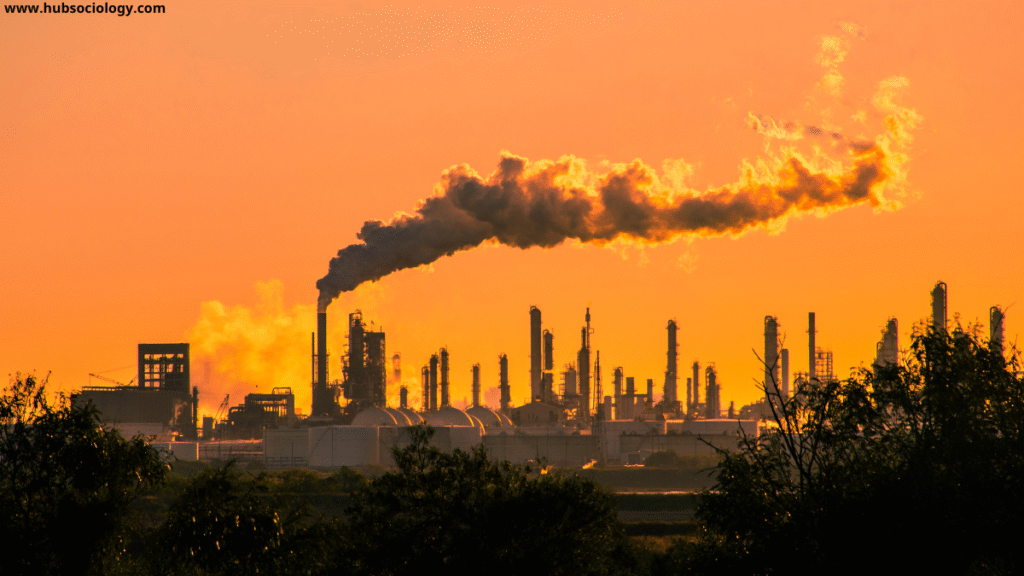
Urban air pollution is one of the most visible forms of environmental degradation. Industrial emissions, vehicular exhaust, and construction dust combine to create smog and respiratory hazards. In sociological terms, air pollution also represents environmental inequality—as poor and working-class neighborhoods are often situated closer to polluted industrial zones.
For example, cities like Delhi or Beijing experience frequent air quality crises, yet affluent populations can afford air purifiers or move to cleaner suburbs, while the poor remain exposed.
2. Water Pollution and Scarcity
Rapid urbanization leads to over-extraction of groundwater, contamination of rivers, and inadequate sewage systems. The sociological dimension here lies in the unequal access to clean water. Slum dwellers and marginalized populations often depend on unsafe sources, while elite urban residents receive treated water. This unequal distribution reflects what sociologist Robert Bullard calls environmental racism—where environmental risks disproportionately affect the powerless.
3. Waste Management Crisis
The generation of waste is a direct outcome of consumer culture in cities. From plastics to electronic waste, urban areas produce tons of non-biodegradable material daily. However, waste management systems are often inefficient or corrupt. Sociologically, this issue is tied to the capitalist ethos of disposability and consumption. Informal waste pickers, often from marginalized castes or classes, manage urban waste under hazardous conditions, symbolizing the intersection of class and environmental degradation.
4. Urban Heat Islands and Climate Change
Concrete-dominated landscapes and lack of vegetation create urban heat islands, where cities record higher temperatures than surrounding areas. Climate change exacerbates this phenomenon, leading to heat stress, floods, and health problems. Poor urban planning, excessive vehicular use, and tree cutting are sociological indicators of anthropocentric development—where human convenience overrides ecological balance.
Social Inequality and Environmental Justice on Development and Environmental Hazards
The link between development and environmental hazards in cities is deeply rooted in social inequality. The affluent benefit from urban modernization—air-conditioned offices, luxury vehicles, and clean neighborhoods—while the urban poor suffer from polluted air, poor sanitation, and inadequate housing.
Environmental justice movements challenge this inequality by demanding fair distribution of environmental benefits and burdens. Sociologists highlight the need for participatory urban governance—where citizens, especially marginalized groups, have a voice in environmental decision-making. For example, movements in cities like Mumbai, Manila, and Rio de Janeiro have resisted forced evictions and demanded sustainable housing policies.
Cultural Dimensions of Urban Environmental Crisis
Culture also shapes environmental behavior. The modern consumer culture prevalent in cities promotes excessive materialism, fast fashion, and food waste. Sociologically, this reflects what Zygmunt Bauman calls liquid modernity—a state where individuals constantly consume and discard in search of newness. Urban lifestyles, driven by advertisement and competition, create ecological footprints that are unsustainable. Changing these cultural patterns requires fostering environmental consciousness through education, media, and community initiatives.
Policy, Planning and Sustainable Urban Development
From a sociological standpoint, sustainable urban development must integrate ecological modernization—where technology and policy work in harmony with environmental ethics. Cities need green infrastructure, efficient public transport, renewable energy, and waste recycling systems. However, the success of such policies depends on social awareness, community participation, and political will.
Participatory governance models—such as citizen-led waste segregation, rooftop gardening, and eco-housing—demonstrate how collective social action can mitigate environmental hazards. Sociology, thus, provides not only a framework for analyzing urban ecological problems but also for mobilizing communities toward sustainability.
Conclusion on Development and Environmental Hazards
Development and environmental hazards in cities are two sides of the same sociological process. While urban growth symbolizes human progress, it also exposes the contradictions of modern society—inequality, consumerism, and ecological neglect. The sociological study of these dynamics reveals that environmental problems are not merely technical or scientific but deeply social in nature. Addressing them requires transforming our economic systems, cultural values, and governance models toward ecological justice.

In the end, the city must evolve from being a machine for living to a community for sustaining life. Only when development aligns with social equity and environmental responsibility can urban progress truly be called sustainable.
Do you like this Article ? You Can follow as on :-
Facebook – https://www.facebook.com/hubsociology
Whatsapp Channel – https://whatsapp.com/channel/0029Vb6D8vGKWEKpJpu5QP0O
Gmail – hubsociology@gmail.com
Topic Related Questions on Development and Environmental Hazards
5 Marks Questions on Development and Environmental Hazards (Short Answer Type)
- Define environmental hazards in the context of urban development.
- What is meant by urban environmental inequality?
- Mention two major environmental problems caused by urbanization.
- How does air pollution affect urban social life?
- Explain Ulrich Beck’s concept of Risk Society in brief.
- What is the sociological significance of waste management in cities?
- How does capitalism contribute to environmental degradation in cities?
- State two examples of environmental injustice in urban areas.
- What is meant by the term urban heat island?
- Define the concept of ecological modernization in urban sociology.
10 Marks Questions on Development and Environmental Hazards (Medium Answer Type)
- Discuss how rapid urbanization contributes to environmental hazards in modern cities.
- Examine the relationship between social inequality and environmental pollution in cities.
- Explain the Marxist perspective on urban environmental degradation.
- How does consumer culture contribute to environmental hazards in cities?
- Describe the major types of environmental hazards found in developing-country cities.
- Discuss the role of governance and planning in mitigating urban environmental problems.
- How does Weber’s theory of rationalization explain ecological neglect in urban planning?
- Analyze the sociological importance of environmental justice movements in cities.
- Discuss the impact of industrialization on the urban environment.
- What sociological measures can be taken to promote sustainable development in cities?
15 Marks Questions on Development and Environmental Hazards (Long/Essay Type)
- Critically analyze the relationship between urban development and environmental hazards from a sociological perspective.
- Explain how Ulrich Beck’s Risk Society theory helps us understand environmental problems in modern cities.
- Evaluate the role of capitalism and class structure in shaping environmental hazards in cities.
- “Urban environmental problems are not only ecological but also social.” Discuss with suitable examples.
- Examine the interconnection between globalization, urban growth, and environmental degradation in contemporary society.
- Discuss the sociological implications of waste management, pollution, and climate risks in metropolitan cities.
- Analyze how urban planning and policy failures contribute to ecological crises in modern cities.
- Discuss the concept of sustainable urban development and its relevance in addressing environmental inequalities.
- Evaluate different sociological theories—Marxist, Weberian, and Risk Society—in explaining urban environmental hazards.
- Suggest sociological strategies for balancing urban development and environmental protection in India.