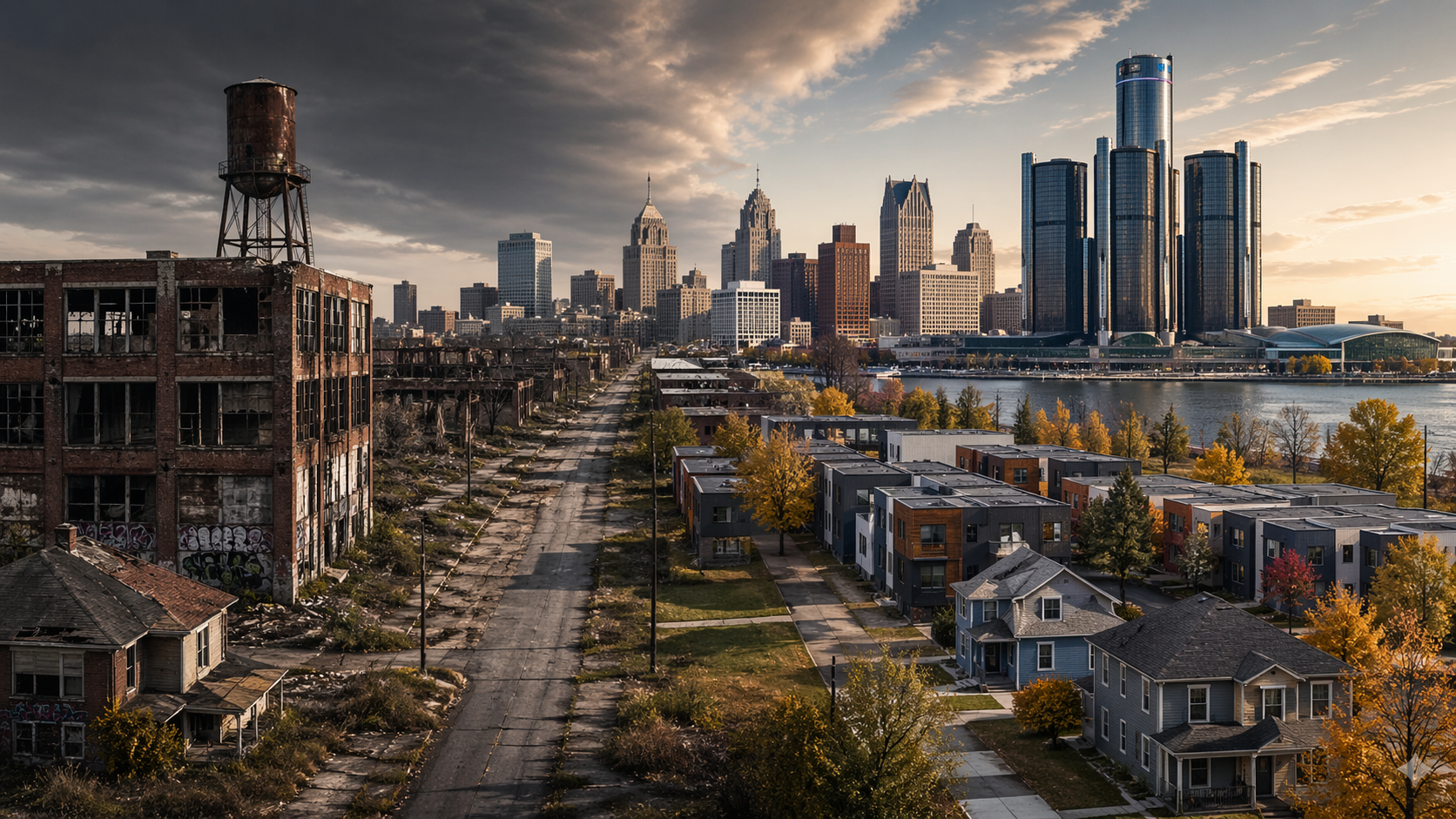
Introduction on Deindustrialization and Urban Decline in Michigan
The story of Michigan—particularly cities like Detroit—offers one of the most powerful sociological case studies of industrial rise and decline in modern history. Once celebrated as the heart of American industrial capitalism, Michigan became synonymous with prosperity, innovation, and upward mobility during the mid-20th century. However, by the late 20th century, this industrial powerhouse began to experience a dramatic transformation. The process of deindustrialization—marked by the decline of manufacturing industries—triggered profound urban decline, reshaping the social, economic, and spatial structures of cities across the state.
From a sociological perspective, deindustrialization is not merely an economic phenomenon; it is a complex social process involving class restructuring, racial inequalities, migration patterns, and institutional breakdown. Michigan’s experience reveals how industrial capitalism, when destabilized, can generate long-term urban crises. This article explores the causes, processes, and consequences of deindustrialization in Michigan, focusing particularly on Detroit as a central example, while analyzing broader sociological implications.

Historical Background: Industrialization and the Rise of Michigan
Michigan’s industrial success was largely built on the automobile industry. Cities like Detroit became global centers of automobile production, earning titles such as the “Motor City.” The rise of companies like Ford, General Motors, and Chrysler transformed Michigan into a hub of mass production and labor employment.
During the early to mid-20th century, industrialization created a strong working class, characterized by stable employment, unionization, and relatively high wages. This period also witnessed massive migration, including African Americans moving from the rural South during the Great Migration. Urban growth was rapid, and Detroit became one of the largest and wealthiest cities in the United States.
However, the very structure that enabled this growth—heavy reliance on a single industry—also laid the groundwork for future vulnerability.
Understanding Deindustrialization
Deindustrialization refers to the decline of industrial activity, particularly manufacturing, within a region or economy. In the United States, especially in the “Rust Belt,” this process began as early as the 1950s, when companies started relocating factories and adopting labor-saving technologies.
In Michigan, deindustrialization was driven by several interrelated factors:
- Automation and technological change
- Globalization and competition from foreign industries
- Relocation of industries to suburban or overseas locations
- Decline of union power and labor restructuring
The automobile industry, once the backbone of Michigan’s economy, gradually reduced its urban presence. Factories moved to suburban areas or other regions, leaving cities like Detroit economically weakened.
Detroit as a Case Study of Urban Decline
Detroit represents the most striking example of deindustrialization-induced urban decline in Michigan. During its peak, the city was a symbol of industrial prosperity. However, several structural shifts led to its deterioration.

Industrial Relocation and Job Loss
From the 1950s onward, automobile companies began decentralizing their production. Factories moved away from Detroit to reduce labor costs and avoid union pressures.
Between 1947 and 1963 alone, Detroit lost over 130,000 manufacturing jobs, illustrating the scale of economic restructuring.
This loss of employment had a ripple effect:
- Decline in household income
- Reduction in consumer spending
- Closure of local businesses
- Shrinking tax base
As industries left, the economic foundation of the city eroded rapidly.
Population Decline and “Shrinking City” Phenomenon
Detroit experienced significant population loss, declining from nearly 2 million residents in the 1950s to less than half that number in later decades.
This phenomenon aligns with the sociological concept of a “shrinking city,” where urban areas experience depopulation due to economic decline and migration.
Population decline created several challenges:
- Abandoned housing and infrastructure
- Reduced public services
- Urban blight and decay
Sociological Dimensions of Urban Decline
1. Class Restructuring and the Decline of the Working Class
One of the most significant sociological consequences of deindustrialization was the restructuring of class relations. The industrial working class, once the backbone of urban society, faced widespread unemployment and downward mobility.

Stable, well-paying manufacturing jobs were replaced by low-wage service sector employment. This shift contributed to increased economic inequality and long-term poverty.
The decline of unions further weakened workers’ bargaining power, leading to precarious employment conditions.
2. Racial Inequality and Segregation
Deindustrialization disproportionately affected African American communities in Michigan. Due to historical segregation and discriminatory housing policies, Black populations were concentrated in urban areas like Detroit.
When industries left, these communities faced:
- Higher unemployment rates
- Limited access to suburban job opportunities
- Persistent poverty
Scholars have argued that deindustrialization and systemic racism worked together to create urban crises in cities like Detroit.
“White flight”—the migration of white residents to suburbs—further intensified racial segregation and economic disparities.
3. Spatial Inequality and Suburbanization
The relocation of industries to suburban areas created spatial inequality. Jobs became geographically separated from the urban populations that needed them most.
This resulted in:
- Unequal access to employment
- Increased transportation barriers
- Concentration of poverty in inner cities
Suburbs often thrived economically while central cities declined, reinforcing socio-spatial divisions.
4. Urban Blight and Environmental Degradation
Deindustrialization left behind abandoned factories and contaminated industrial sites, commonly known as “brownfields.”
These spaces contributed to:
- Environmental hazards
- Decline in property values
- Reduced investment in urban areas
Urban blight became a visible symbol of economic decline, shaping public perceptions of cities like Detroit.
5. Social Disorganization and Crime
Economic decline often leads to social disorganization—a breakdown of community structures and institutions. In Michigan’s declining cities, this manifested in:
- Increased crime rates
- Weakening of social networks
- Reduced civic engagement
The loss of stable employment disrupted family structures and community cohesion, further exacerbating social problems.
Political and Institutional Factors
Urban decline in Michigan was not solely the result of economic forces; political decisions also played a crucial role.
Lack of Economic Diversification
Detroit’s heavy dependence on the automobile industry made it particularly vulnerable. When the industry declined, there were few alternative economic sectors to absorb displaced workers.
Urban Governance and Policy Failures
Mismanagement and ineffective policies contributed to fiscal crises. Detroit’s eventual bankruptcy in 2013 highlighted the severity of institutional failure.
Federal and Global Influences
Globalization intensified competition, while federal policies sometimes failed to support industrial transition effectively. Trade liberalization and outsourcing accelerated job losses in manufacturing sectors.
Cultural and Symbolic Dimensions
Detroit’s decline has also been interpreted through a cultural lens. The city became a symbol of industrial decay, often portrayed in media as a “ghost city” or “urban ruin.”
However, this narrative oversimplifies the reality. Sociologists argue that such representations can obscure the resilience and agency of local communities.
Urban decline is not merely a story of failure but also one of adaptation and transformation.
Resistance, Adaptation, and Urban Resilience
Despite severe challenges, Michigan cities—especially Detroit—have demonstrated resilience.
Grassroots Initiatives
Local communities have engaged in:
- Urban farming
- Community development projects
- Neighborhood revitalization
These initiatives reflect collective efforts to rebuild social and economic life.
Economic Restructuring
Detroit has attempted to transition toward a post-industrial economy, focusing on:
- Technology and innovation
- Creative industries
- Tourism and service sectors
Gentrification and New Inequalities
Recent revitalization efforts have also raised concerns about gentrification. While some areas have seen economic growth, benefits are unevenly distributed, often excluding long-term residents.
Comparative Perspective: Michigan and the Rust Belt
Michigan’s experience is part of a broader regional pattern in the Rust Belt, including cities like Cleveland, Buffalo, and Pittsburgh. These cities share common features:
- Industrial dependence
- Population decline
- Socioeconomic inequality
However, variations exist based on local policies, economic diversification, and community responses.
Theoretical Perspectives
Several sociological theories help explain deindustrialization and urban decline:
1. Political Economy Approach
This perspective emphasizes capitalism’s structural dynamics, highlighting how profit motives drive industrial relocation and labor exploitation.
2. World-Systems Theory
This theory explains how global economic shifts relocate industries from core regions (like the U.S.) to semi-peripheral or peripheral regions with cheaper labor.
3. Urban Ecology Theory
This approach examines spatial patterns of urban change, including segregation, suburbanization, and land-use transformation.
4. Social Disorganization Theory
This theory links economic decline to weakened social institutions and increased crime and disorder.
Lessons and Policy Implications
Michigan’s experience offers several important lessons:
- Economic diversification is essential for urban resilience
- Inclusive urban policies are needed to address inequality
- Investment in education and skills can help adapt to economic change
- Strong local governance is critical for managing urban transformation
Policies must address both economic and social dimensions of decline, recognizing that urban crises are deeply interconnected.
Conclusion
Deindustrialization and urban decline in Michigan represent a profound transformation of industrial society. The collapse of manufacturing not only reshaped the economy but also restructured social relations, intensified inequalities, and altered urban landscapes.
Detroit’s trajectory—from industrial powerhouse to symbol of urban decay—illustrates the complex interplay of economic, political, and social forces. While the challenges are significant, the city’s ongoing efforts at revitalization demonstrate that urban decline is not inevitable or irreversible.
From a sociological standpoint, Michigan’s experience underscores the importance of understanding cities as dynamic systems shaped by global forces, local policies, and human agency. The lessons drawn from this case are not only relevant to the United States but also to industrial regions worldwide facing similar transitions.
FAQs on Urban Decline in Michigan
- What is meant by urban decline in Michigan?
Urban decline in Michigan refers to the economic, social, and population deterioration of cities—especially industrial centers like Detroit—due to deindustrialization, job loss, and migration. - What caused urban decline in Michigan cities?
The primary causes of urban decline in Michigan include factory closures, globalization, automation, suburbanization, and the decline of the automobile industry. - How did deindustrialization contribute to urban decline in Michigan?
Deindustrialization led to massive job losses, reduced income levels, and weakened local economies, which accelerated urban decline in Michigan. - Why is Detroit often associated with urban decline in Michigan?
Detroit became a symbol of urban decline in Michigan due to its heavy dependence on the auto industry and its sharp population and economic decline after industrial relocation. - What role did migration play in urban decline in Michigan?
Migration, especially “white flight” and middle-class movement to suburbs, contributed significantly to urban decline in Michigan by reducing the urban tax base. - How did urban decline in Michigan affect employment?
Urban decline in Michigan resulted in fewer manufacturing jobs and a shift toward low-paying service sector work, increasing unemployment and underemployment. - What are the social consequences of urban decline in Michigan?
Urban decline in Michigan has led to poverty, crime, weakened community institutions, and increased social inequality. - How does racial inequality relate to urban decline in Michigan?
Urban decline in Michigan disproportionately affected African American communities due to historical segregation and limited access to suburban opportunities. - What is the “shrinking city” concept in relation to urban decline in Michigan?
It refers to cities losing population and economic vitality over time, a key feature of urban decline in Michigan. - How did suburbanization influence urban decline in Michigan?
Suburbanization shifted jobs and resources away from city centers, worsening urban decline in Michigan. - What environmental issues are linked to urban decline in Michigan?
Urban decline in Michigan created abandoned industrial sites (brownfields), pollution, and deteriorating infrastructure. - Has urban decline in Michigan affected public services?
Yes, declining tax revenues reduced funding for schools, transportation, and public safety, worsening urban conditions. - What efforts have been made to address urban decline in Michigan?
Revitalization strategies include urban redevelopment, investment in technology sectors, and community-based initiatives. - Is gentrification related to urban decline in Michigan?
Yes, recent redevelopment has led to gentrification in some areas, which may benefit economies but also displace low-income residents. - What lessons can be learned from urban decline in Michigan?
Urban decline in Michigan highlights the need for economic diversification, inclusive policies, and sustainable urban planning.
1 thought on “Deindustrialization and Urban Decline in Michigan: A Sociological Analysis”