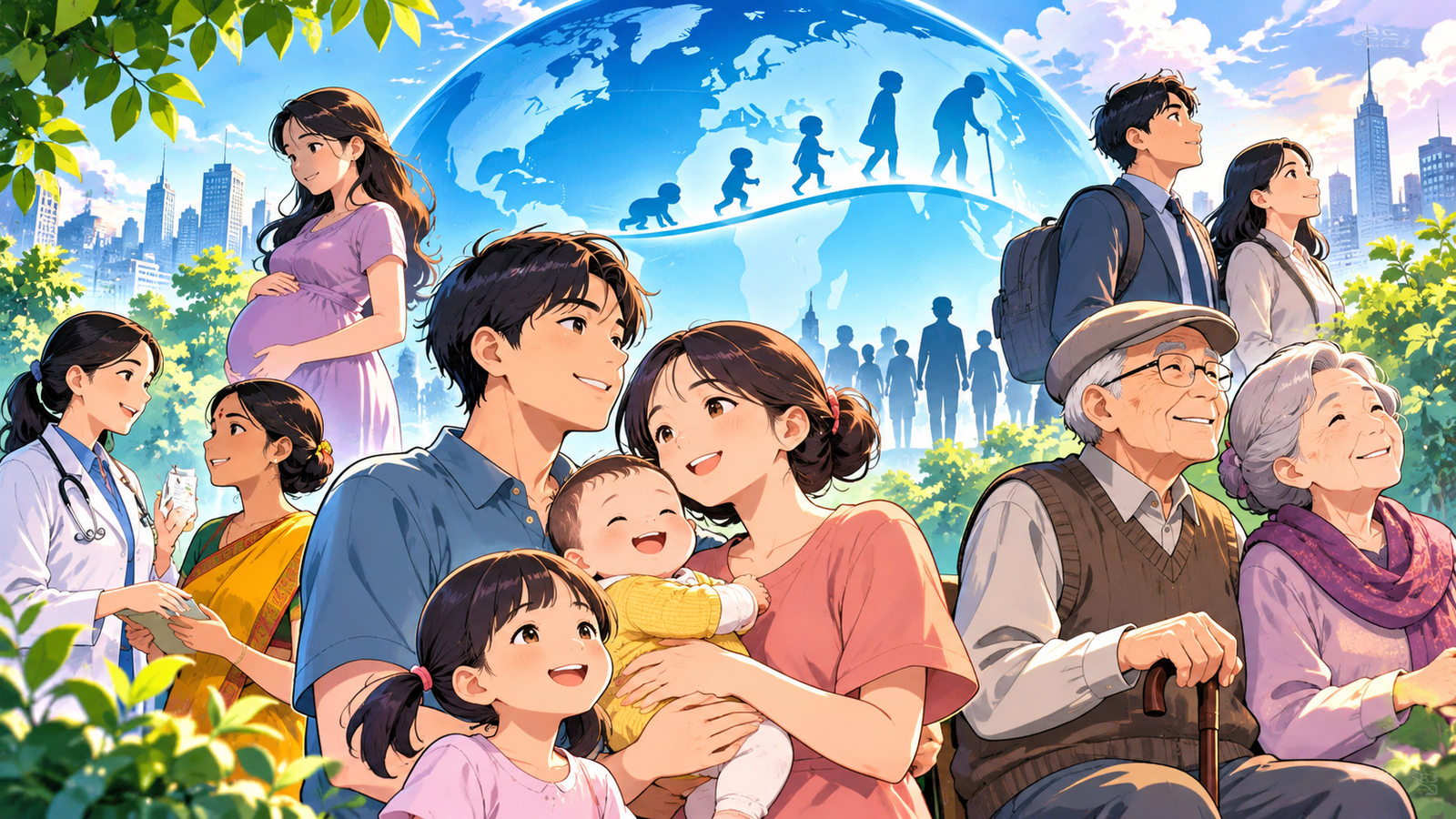
Introduction on changes in population policy
Population policy has become one of the most important areas of government intervention in contemporary society. For much of the twentieth century, many governments concentrated on controlling rapid population growth through family planning, contraception and birth-control programmes. However, demographic conditions have changed considerably during recent decades. While some developing countries continue to experience population growth, several developed nations are struggling with declining fertility rates, ageing populations and shrinking workforces. These contrasting demographic situations have encouraged significant changes in population policy across the world.
The traditional approach to population management is gradually being replaced by a broader understanding of demographic sustainability. Governments are increasingly concerned not only with the number of people but also with population composition, age structure, migration, reproductive rights, gender equality and the economic conditions of families. Countries such as China, Japan and South Korea are introducing measures to encourage childbirth, whereas countries such as India continue to emphasise voluntary family planning, reproductive healthcare and population stabilisation.

From a sociological perspective, these changes in population policy reveal the changing relationship between the state, family, economy and individual reproductive choices. Population is no longer viewed simply as a numerical issue; it is increasingly understood as a complex social phenomenon influenced by education, employment, urbanisation, gender relations and cultural transformation.
Table of Contents
1. Understanding Population Policy
Population policy refers to the deliberate actions taken by governments to influence demographic processes, including fertility, mortality, migration and population distribution. These policies are designed to address the relationship between population and social development.
Traditionally, population policies focused primarily on reducing birth rates in countries experiencing rapid population growth. Family planning programmes, contraceptive distribution, maternal healthcare and awareness campaigns were important instruments of this approach.
However, contemporary population policies have become more diversified. Some governments encourage childbirth through financial incentives, parental leave and childcare facilities. Others focus on attracting skilled migrants, improving elderly care or ensuring reproductive autonomy.
Therefore, the changes in population policy represent a transition from narrow population control towards comprehensive demographic management and social welfare.
2. Why Are Changes in Population Policy Taking Place?
Several interconnected demographic, economic and social factors explain why governments are reconsidering their population strategies.
Declining Fertility Rates
One of the most significant reasons is the decline in fertility rates across many countries. In several developed economies, women are having fewer children than previous generations. Delayed marriage, higher education, employment opportunities, urban living costs and changing family preferences have contributed to this transformation.
When fertility remains below replacement level for a prolonged period, the population may eventually experience natural decline. Consequently, governments are introducing policies to make parenthood more financially and socially manageable.
Population Ageing
Increasing life expectancy and declining fertility have accelerated population ageing in countries such as Japan, South Korea and China. A growing elderly population creates additional demand for healthcare, pensions and long-term care services.

At the same time, the proportion of working-age people may decline. This creates pressure on public finances and social security systems. These demographic challenges are encouraging changes in population policy towards active ageing, family support and labour-force sustainability.
Economic and Employment Challenges
Population structure influences economic development. A declining working-age population can create labour shortages, particularly in healthcare, manufacturing, construction and other essential sectors.
Governments increasingly recognise that demographic sustainability is connected with productivity, employment and economic competitiveness. Consequently, immigration, vocational education and policies supporting working parents have become important elements of population management.
Urbanisation and Changing Family Structures
Urbanisation has transformed family relationships and reproductive behaviour. In traditional agrarian societies, larger families often provided economic support and labour. In modern urban societies, raising children involves considerable expenses related to education, housing, healthcare and childcare.
The expansion of nuclear families, women’s employment and individual aspirations has also changed decisions regarding marriage and parenthood. These social transformations have encouraged governments to reconsider conventional population policies.
3. Global Examples of Changes in Population Policy
Different countries are adopting different strategies because their demographic situations are not identical.
China: From One-Child Policy to Pro-Natalist Measures
China represents one of the clearest examples of changing population policy. In 1979, the government introduced the one-child policy to restrict rapid population growth. Although the policy contributed to lower fertility, it also became associated with long-term demographic challenges, including population ageing and an increasingly unfavourable age structure.
Recognising these problems, China introduced the two-child policy in 2016 and subsequently allowed married couples to have three children in 2021.
The government has increasingly shifted towards encouraging childbirth through financial and social support. In 2025, China introduced a nationwide childcare subsidy of 3,600 yuan annually for each eligible child under the age of three. The programme continued into 2026.
This transformation demonstrates how changes in population policy can occur when the demographic consequences of earlier policies become significant. China has moved from restricting births towards encouraging families to have children.
Japan: Addressing the Challenges of an Ageing Society
Japan has one of the world’s most ageing populations and has experienced persistently low fertility. The declining number of births has raised concerns about labour shortages, pension sustainability and the future of rural communities.
Japanese governments have introduced various measures, including childcare assistance, parental leave, financial support for families and policies intended to improve work-life balance.
The Japanese experience demonstrates that encouraging childbirth requires more than financial incentives. Employment insecurity, housing costs, demanding working cultures and unequal domestic responsibilities also influence reproductive decisions.
South Korea: Responding to Extremely Low Fertility
South Korea faces one of the world’s most serious low-fertility challenges. The government has introduced financial assistance, childcare programmes, parental leave and housing-related support to encourage family formation.
However, economic pressures, expensive housing, employment competition and gender inequality continue to influence marriage and childbirth decisions.
South Korea illustrates the limitations of policies that focus primarily on financial incentives without adequately addressing the structural conditions that shape family life.
Germany: Immigration and Family Support
Germany faces demographic ageing and labour-market shortages. Its population strategy includes family assistance, childcare provision and immigration policies designed to attract workers from other countries.
Immigration has become an important instrument for maintaining the labour force and supporting economic activity. However, integration, housing availability and public attitudes towards migration remain significant policy challenges.
France and Hungary: Supporting Family Formation
France has historically maintained extensive family support programmes, including parental benefits, childcare services and financial assistance.
Hungary has adopted policies intended to encourage childbirth through family-related tax advantages, housing support and other financial incentives.
These examples demonstrate that countries increasingly use social welfare and economic measures to influence demographic trends.
4. Changes in Population Policy in India
India provides an important example of the transition from population control towards population stabilisation and reproductive healthcare.
India was the first country in the world to introduce an official national family planning programme in 1952. Initially, the programme focused heavily on reducing fertility and controlling rapid population growth.
The National Population Policy of 2000 introduced a broader framework. It emphasised voluntary and informed reproductive choices, maternal and child health, contraception and population stabilisation.
India’s demographic situation has also changed considerably. According to NFHS-5 (2019–21), India’s total fertility rate was 2.0, below the commonly used replacement-level benchmark of 2.1.
In its December 2024 parliamentary response, the Ministry of Health and Family Welfare reaffirmed that the National Population Policy 2000 and National Health Policy 2017 remain important policy frameworks. The government emphasised maintaining replacement-level fertility through family planning services and region-specific interventions.
Programmes such as Mission Parivar Vikas have focused on improving access to contraception and family planning services in higher-fertility areas.
The Indian experience demonstrates why changes in population policy must consider regional differences. Some states have relatively low fertility, while others continue to experience higher fertility. A uniform approach cannot adequately address all demographic conditions.
Furthermore, India must prepare for the opportunities and challenges associated with its large working-age population, including employment generation, education, healthcare and skill development.
5. Sociological Perspectives on Changes in Population Policy
The transformation of population policy can be understood through several important sociological perspectives.
Demographic Transition Theory
Demographic Transition Theory explains how societies move from high birth and death rates towards lower birth and death rates during social and economic development.
In the early stages of development, improvements in sanitation, healthcare and nutrition reduce mortality, while fertility often remains high. This produces rapid population growth.
In later stages, fertility begins to decline because of urbanisation, education, industrialisation and changing family structures.
Contemporary low-fertility countries demonstrate the later stages of this transition. Their governments increasingly focus on ageing, workforce sustainability and family support rather than simply reducing birth rates.
Functionalist Perspective
From a functionalist perspective, population structure is connected with the functioning and stability of society. Families, educational institutions, healthcare systems and labour markets perform important social functions.
A rapidly ageing population may create pressure on pension systems, healthcare institutions and the working-age population. Similarly, very rapid population growth can place pressure on educational institutions, housing and employment opportunities.
Population policies can therefore be understood as mechanisms through which governments attempt to maintain social stability and institutional balance.
Conflict Perspective
The conflict perspective examines how population policies may reflect unequal power relations between governments, economic institutions and social groups.
Historically, some population-control programmes have disproportionately affected economically disadvantaged communities and women. Coercive sterilisation, unequal access to reproductive healthcare and discriminatory population regulations raise questions about social justice and human rights.
Similarly, pro-natalist policies may place pressure on women to fulfil national demographic objectives, particularly when motherhood is presented as a civic responsibility.
This perspective highlights the importance of protecting individual autonomy while designing population policies.
Feminist Perspective
Feminist sociology emphasises the relationship between gender inequality, reproductive decisions and social institutions.
Women’s access to education, employment, healthcare and reproductive rights influences fertility patterns. However, women often continue to carry a disproportionate share of unpaid domestic work and childcare responsibilities.
Governments seeking to encourage childbirth must therefore address unequal domestic responsibilities, workplace discrimination, maternity protection and accessible childcare.
From this perspective, successful population policies should expand women’s choices rather than treat their reproductive behaviour as an instrument of state planning.
6. From Population Control to Reproductive Rights
One of the most important developments in contemporary population policy is the growing emphasis on reproductive autonomy.
The United Nations Population Fund’s 2025 State of World Population report, The Real Fertility Crisis, argues that the central issue is not simply whether countries have too many or too few children. Millions of people cannot achieve their preferred family size because of economic insecurity, inadequate healthcare, gender inequality and other social barriers.

This approach shifts attention from national fertility targets towards individual reproductive choices.
People should have the freedom and necessary resources to decide whether, when and how many children to have. Effective population policy must therefore provide access to contraception, maternal healthcare, infertility treatment, education and protection against reproductive coercion.
Such an approach makes population management more consistent with human rights and social equality.
7. Major Challenges of Contemporary Population Policies
Despite the growing diversity of population strategies, governments face several important challenges.
First, financial incentives alone cannot necessarily reverse declining fertility. Decisions about parenthood are influenced by housing costs, employment security, childcare availability and expectations about the future.
Second, rapid population growth in some regions continues to create pressure on natural resources, infrastructure and employment opportunities.
Third, international migration can help address labour shortages, but it also requires effective integration policies and protection against discrimination.
Fourth, population ageing demands sustainable pension systems, accessible healthcare and stronger long-term care institutions.
Finally, population policies must avoid coercion and discrimination. Governments should not sacrifice reproductive rights in pursuit of demographic targets.
These challenges demonstrate that changes in population policy require coordinated economic, social, educational and healthcare interventions.
8. The Future of Global Population Policy
The future of population policy will probably be shaped by demographic diversity rather than a single universal model.
Low-fertility countries are likely to expand childcare facilities, parental leave, financial assistance and immigration programmes. Countries experiencing relatively rapid population growth will continue investing in reproductive healthcare, education, women’s empowerment and employment opportunities.
At the same time, governments will need to prepare for longer life expectancy, changing family structures and the economic consequences of population ageing.
Technology, urban planning, social protection and labour-market reforms will also influence future demographic strategies.
The most sustainable approach will be one that recognises population as both a demographic and a social issue. Rather than focusing exclusively on increasing or reducing birth rates, governments should create conditions in which individuals can make informed reproductive choices and participate fully in social and economic life.
Conclusion on changes in population policy
The changes in population policy across the world reflect a fundamental transformation in how governments understand demographic development. During the twentieth century, population control was a central concern for many nations. Today, declining fertility, ageing populations, labour shortages, migration and reproductive rights have expanded the scope of population policy.
China, Japan and South Korea demonstrate the growing importance of fertility support, while Germany illustrates the role of immigration in managing demographic challenges. India represents a different situation in which regional fertility differences, reproductive healthcare and population stabilisation remain important concerns.
From a sociological perspective, these transformations reveal that population is not merely a numerical phenomenon. It is closely connected with gender relations, family structures, economic inequality, urbanisation, education and state power.
Ultimately, effective population policy should not simply pursue a particular birth rate. It should promote reproductive freedom, social equality, economic security and sustainable development. The future of demographic governance will depend on the ability of governments to balance national development objectives with the rights and aspirations of individuals.
Research sources on changes in population policy
The article’s country examples and demographic analysis draw on these authoritative sources:
- UNFPA – State of World Population 2025: Reproductive autonomy and global fertility challenges.
- China Government – Childcare Subsidies, 2026: China’s current pro-natalist measures.
- Government of India – National Population Policy, Parliamentary Answer (2024): India’s fertility and family planning framework.
- Press Information Bureau – National Population Policy: India’s policy objectives and implementation.
- United Nations – World Population Policies 2021: Historical evolution of global fertility policies.
Frequently Asked Questions (FAQs) on changes in population policy
1. What are changes in population policy?
Changes in population policy refer to the transformation of government strategies concerning fertility, mortality, migration and population distribution. These changes reflect shifting demographic conditions, such as declining birth rates, population ageing and rapid population growth.
2. Why are changes in population policy taking place across the world?
Changes in population policy are taking place because countries face different demographic challenges. Some nations experience rapid population growth, while others face declining fertility, ageing populations, labour shortages and increasing dependency ratios.
3. What are the major factors responsible for changes in population policy?
The major factors include declining fertility rates, increasing life expectancy, urbanisation, women’s education, migration, economic development, changing family structures and rising healthcare costs.
4. How has population policy changed from population control to population growth?
Earlier, many governments introduced family planning and birth-control programmes to reduce rapid population growth. Today, several countries with declining fertility are offering financial incentives, childcare facilities and parental benefits to encourage childbirth.
5. How has China’s population policy changed?
China introduced the one-child policy in 1979 to control population growth. It introduced the two-child policy in 2016 and the three-child policy in 2021. More recently, the government has introduced childcare subsidies and other family-support measures to encourage childbirth.
6. Why is Japan changing its population policy?
Japan is changing its population policy because of low fertility, population ageing and a declining working-age population. The government is expanding childcare support, parental leave and financial assistance to encourage families to have children.
7. What is the impact of changes in population policy on India?
In India, changes in population policy have shifted attention towards population stabilisation, reproductive healthcare, maternal health and voluntary family planning. Regional fertility differences remain important for planning education, employment and healthcare services.
8. What is the role of migration in modern population policy?
Migration helps countries address labour shortages and demographic decline. Several countries encourage skilled immigration to strengthen their workforce, support economic development and manage population ageing.
9. How does women’s education influence changes in population policy?
Women’s education influences fertility decisions, marriage patterns, employment opportunities and family size. Educated women generally have greater access to reproductive health information and opportunities to make informed decisions about childbirth.
10. What is the relationship between population ageing and population policy?
Population ageing increases demand for healthcare, pensions and elderly care. Consequently, governments are adopting policies that promote active ageing, retirement security, immigration and sustainable social welfare systems.