Introduction
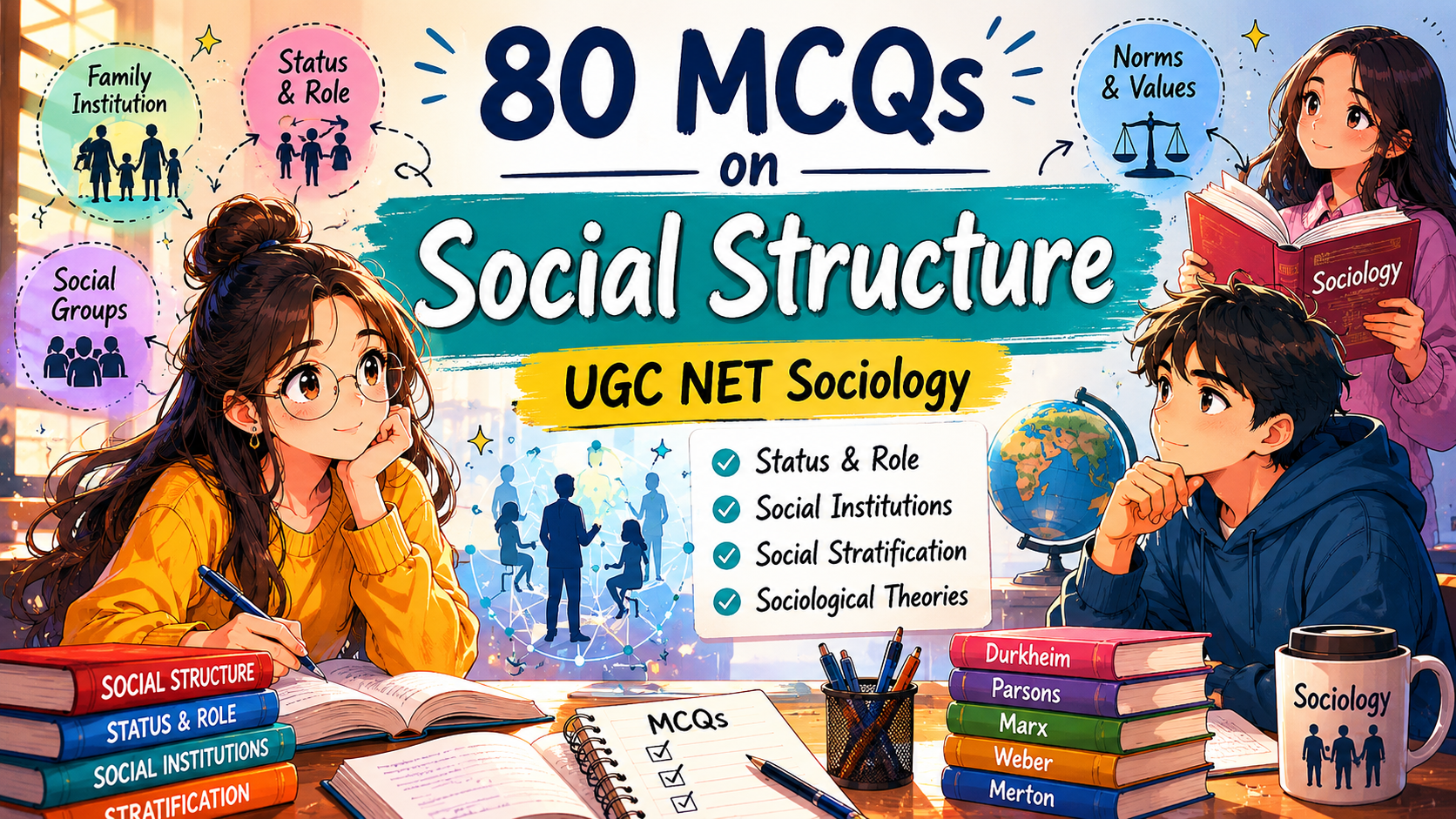
Social Structure is one of the most important concepts in sociology and frequently appears in UGC NET Sociology examinations. It refers to the organized pattern of social relationships, institutions, statuses, roles, groups, and norms that shape society. Sociologists such as Herbert Spencer, Émile Durkheim, Talcott Parsons, Robert K. Merton, A.R. Radcliffe-Brown, and S.F. Nadel have significantly contributed to the understanding of social structure.
The following 80 multiple-choice questions (MCQs) are designed according to the UGC NET Sociology syllabus and previous examination patterns. Each question includes the correct answer for quick revision and self-assessment.
MCQs on Social Structure
1. What does the concept of social structure primarily refer to?
A. Individual personality traits
B. Patterned social relationships in society
C. Economic development
D. Political ideology
Answer: B
2. Which sociologist viewed society as a system of interrelated parts?
A. Karl Marx
B. Talcott Parsons
C. Max Weber
D. George Herbert Mead
Answer: B
3. The concept of social structure is most closely associated with:
A. Structural Functionalism
B. Symbolic Interactionism
C. Phenomenology
D. Ethnomethodology
Answer: A
4. Who defined social structure as the network of actually existing social relationships?
A. A.R. Radcliffe-Brown
B. Marx
C. Weber
D. Mead
Answer: A
5. Social structure consists of:

A. Statuses and roles
B. Emotions only
C. Individual desires only
D. Biological traits only
Answer: A
6. Which of the following is an element of social structure?
A. Social institutions
B. Social roles
C. Social groups
D. All of these
Answer: D
7. Who emphasized the relationship between social structure and social function?
A. Durkheim
B. Radcliffe-Brown
C. Parsons
D. All of these
Answer: D
8. Social structure is:
A. Temporary and random
B. Organized and patterned
C. Entirely biological
D. Individualistic
Answer: B
9. Status in sociology refers to:
A. Economic wealth only
B. Social position occupied by an individual
C. Political power only
D. Educational qualification only
Answer: B
10. Role is:
A. Expected behavior associated with a status
B. Personal opinion
C. Social conflict
D. Cultural value
Answer: A
11. Which sociologist developed the AGIL model?
A. Parsons
B. Marx
C. Weber
D. Giddens
Answer: A
12. Family is an example of:
A. Social institution
B. Social movement
C. Social conflict
D. Social stratification
Answer: A
13. Which concept explains multiple statuses held by an individual?
A. Role conflict
B. Status set
C. Social mobility
D. Alienation
Answer: B
14. The term “role set” was introduced by:
A. Robert K. Merton
B. Durkheim
C. Marx
D. Parsons
Answer: A
15. Social structure contributes to:
A. Social order
B. Social stability
C. Social continuity
D. All of these
Answer: D
16. Which sociologist compared society to a biological organism?
A. Herbert Spencer
B. Marx
C. Weber
D. Mead
Answer: A
17. Social structure is generally:
A. Invisible but observable through social relationships
B. Physically visible
C. Biological in nature
D. Psychological only
Answer: A
18. Which is an ascribed status?
A. Doctor
B. Teacher
C. Daughter
D. Engineer
Answer: C
19. Which is an achieved status?
A. Son
B. Daughter
C. Student selected through examination
D. Brother
Answer: C
20. Role conflict occurs when:
A. One role has contradictory expectations
B. Multiple roles clash with each other
C. Status disappears
D. Culture changes
Answer: B
21. The concept of social structure is central to:
A. Structuralism
B. Functionalism
C. Both A and B
D. Postmodernism only
Answer: C
22. Social institutions help maintain:
A. Disorder
B. Social structure
C. Chaos
D. Isolation
Answer: B
23. Which sociologist is associated with structural-functional analysis?
A. Parsons
B. Merton
C. Both A and B
D. Marx
Answer: C
24. Social norms are:
A. Rules guiding behavior
B. Economic policies
C. Laws only
D. Political ideologies
Answer: A
25. The concept of latent function was introduced by:
A. Parsons
B. Merton
C. Durkheim
D. Weber
Answer: B
26. Manifest functions are:
A. Intended consequences
B. Unintended consequences
C. Hidden consequences
D. Dysfunctions
Answer: A
27. Social structure provides:
A. Predictability in social interaction
B. Random behavior
C. Cultural isolation
D. Social chaos
Answer: A
28. Which of the following is a primary group?

A. Family
B. Nation
C. Corporation
D. Bureaucracy
Answer: A
29. Secondary groups are:
A. Intimate and personal
B. Large and impersonal
C. Kinship-based only
D. Religious only
Answer: B
30. Social stratification is:
A. Ranking of individuals and groups
B. Social isolation
C. Cultural diffusion
D. Population growth
Answer: A
31. Karl Marx explained social structure mainly through:
A. Class relations
B. Religion
C. Language
D. Psychology
Answer: A
32. According to Marx, the economic structure is called:
A. Superstructure
B. Base
C. Institution
D. Culture
Answer: B
33. The concept of bureaucracy is associated with:
A. Durkheim
B. Marx
C. Weber
D. Parsons
Answer: C
34. Which sociologist emphasized social facts?
A. Durkheim
B. Weber
C. Mead
D. Cooley
Answer: A
35. Social facts are:
A. External and coercive
B. Personal beliefs
C. Individual emotions
D. Biological instincts
Answer: A
36. Mechanical solidarity is associated with:
A. Traditional societies
B. Modern societies
C. Industrial capitalism
D. Bureaucracy
Answer: A
37. Organic solidarity is characteristic of:
A. Traditional societies
B. Modern societies
C. Tribal societies
D. Hunting societies
Answer: B
38. Which sociologist introduced the concept of social action?
A. Marx
B. Durkheim
C. Weber
D. Parsons
Answer: C
39. Social structure influences:
A. Human behavior
B. Social interaction
C. Opportunities
D. All of these
Answer: D
40. Which is not a component of social structure?
A. Social institutions
B. Social groups
C. Individual emotions alone
D. Statuses
Answer: C
41. Kinship is a part of:

A. Social structure
B. Ecology
C. Geography
D. Psychology
Answer: A
42. The smallest unit of social structure is:
A. Role
B. Institution
C. Community
D. Nation
Answer: A
43. A collection of related roles is known as:
A. Status set
B. Role set
C. Group
D. Institution
Answer: B
44. Which sociologist discussed dysfunctions?
A. Merton
B. Parsons
C. Marx
D. Spencer
Answer: A
45. Social mobility refers to:
A. Movement within stratification systems
B. Population growth
C. Cultural change
D. Urbanization
Answer: A
46. Vertical mobility involves:
A. Change in social rank
B. Migration only
C. Cultural exchange
D. Political participation
Answer: A
47. Horizontal mobility means:
A. Change without change in rank
B. Upward mobility
C. Downward mobility
D. Class struggle
Answer: A
48. Which is a formal social institution?
A. Family
B. Education
C. Peer group
D. Friendship
Answer: B
49. Social structure is relatively:
A. Stable
B. Random
C. Temporary
D. Unorganized
Answer: A
50. The concept of structure emphasizes:
A. Pattern and arrangement
B. Chaos
C. Individual freedom only
D. Biological determinism
Answer: A
51. Social structure shapes:
A. Opportunities
B. Constraints
C. Behavior
D. All of these
Answer: D
52. Which sociological perspective emphasizes consensus?
A. Functionalism
B. Conflict Theory
C. Feminism
D. Postmodernism
Answer: A
53. Conflict theorists view social structure as:
A. Source of inequality
B. Source of harmony only
C. Irrelevant
D. Psychological
Answer: A
54. Caste is an example of:
A. Closed stratification
B. Open stratification
C. Mobility system
D. Informal group
Answer: A
55. Class system is generally:
A. Closed
B. Open
C. Fixed
D. Hereditary only
Answer: B
56. Which institution transmits culture?
A. Family
B. Education
C. Religion
D. All of these
Answer: D
57. Social structure exists:
A. Independently of individuals
B. Only in imagination
C. Only in law
D. Only in economy
Answer: A
58. Parsons viewed society as:
A. A system seeking equilibrium
B. Continuous conflict only
C. Psychological phenomenon
D. Economic institution
Answer: A
59. Which term refers to a recognized social position?
A. Role
B. Status
C. Norm
D. Value
Answer: B
60. Values are:
A. Shared standards of desirability
B. Laws only
C. Customs only
D. Sanctions only
Answer: A
61. Social control helps maintain:
A. Social structure
B. Social disorder
C. Revolution
D. Deviance
Answer: A
62. Informal social control includes:
A. Customs
B. Traditions
C. Public opinion
D. All of these
Answer: D
63. Formal social control includes:
A. Law
B. Gossip
C. Customs
D. Traditions
Answer: A
64. Which is a universal social institution?
A. Family
B. Market
C. Factory
D. Trade union
Answer: A
65. Structural differentiation increases in:
A. Modern societies
B. Primitive societies
C. Tribal societies only
D. Hunting societies only
Answer: A
66. Social structure and culture are:
A. Interrelated
B. Unrelated
C. Opposed
D. Identical
Answer: A
67. Structural functionalism focuses on:
A. Stability and order
B. Revolution
C. Alienation
D. Exploitation only
Answer: A
68. Social institutions perform:
A. Functions for society
B. Biological functions only
C. Political functions only
D. Economic functions only
Answer: A
69. Which sociologist developed the concept of anomie?
A. Durkheim
B. Marx
C. Weber
D. Spencer
Answer: A
70. Anomie refers to:
A. Normlessness
B. Social integration
C. Social mobility
D. Socialization
Answer: A
71. Which sociologist emphasized structure and agency?
A. Anthony Giddens
B. Durkheim
C. Spencer
D. Cooley
Answer: A
72. Giddens’ theory is known as:
A. Structuration Theory
B. Conflict Theory
C. Exchange Theory
D. Labeling Theory
Answer: A
73. Social structure influences life chances, a concept associated with:
A. Weber
B. Mead
C. Cooley
D. Spencer
Answer: A
74. Which of the following is not a social institution?
A. Family
B. Education
C. Religion
D. Weather
Answer: D
75. Social organization is closely related to:
A. Social structure
B. Climate
C. Geography
D. Biology
Answer: A
76. The patterned arrangement of statuses and roles forms:
A. Social structure
B. Culture only
C. Population
D. Ecology
Answer: A
77. Which perspective stresses power and inequality?
A. Conflict Theory
B. Functionalism
C. Interactionism
D. Phenomenology
Answer: A
78. Social structure is essential for:
A. Social order
B. Coordination
C. Stability
D. All of these
Answer: D
79. UGC NET Sociology frequently asks questions on:
A. Status and Role
B. Institutions
C. Social Stratification
D. All of these
Answer: D
80. Social structure can best be defined as:
A. The organized pattern of social relationships and institutions in society
B. Individual psychology
C. Economic growth only
D. Political power only
Answer: A
Conclusion
Social Structure is a foundational concept in sociology because it explains how society is organized and how individuals interact within institutional frameworks. Understanding concepts such as status, role, social institutions, stratification, norms, values, and social control is crucial for success in the UGC NET Sociology examination. Regular practice of these MCQs will help students strengthen conceptual clarity and improve examination performance.