Introduction
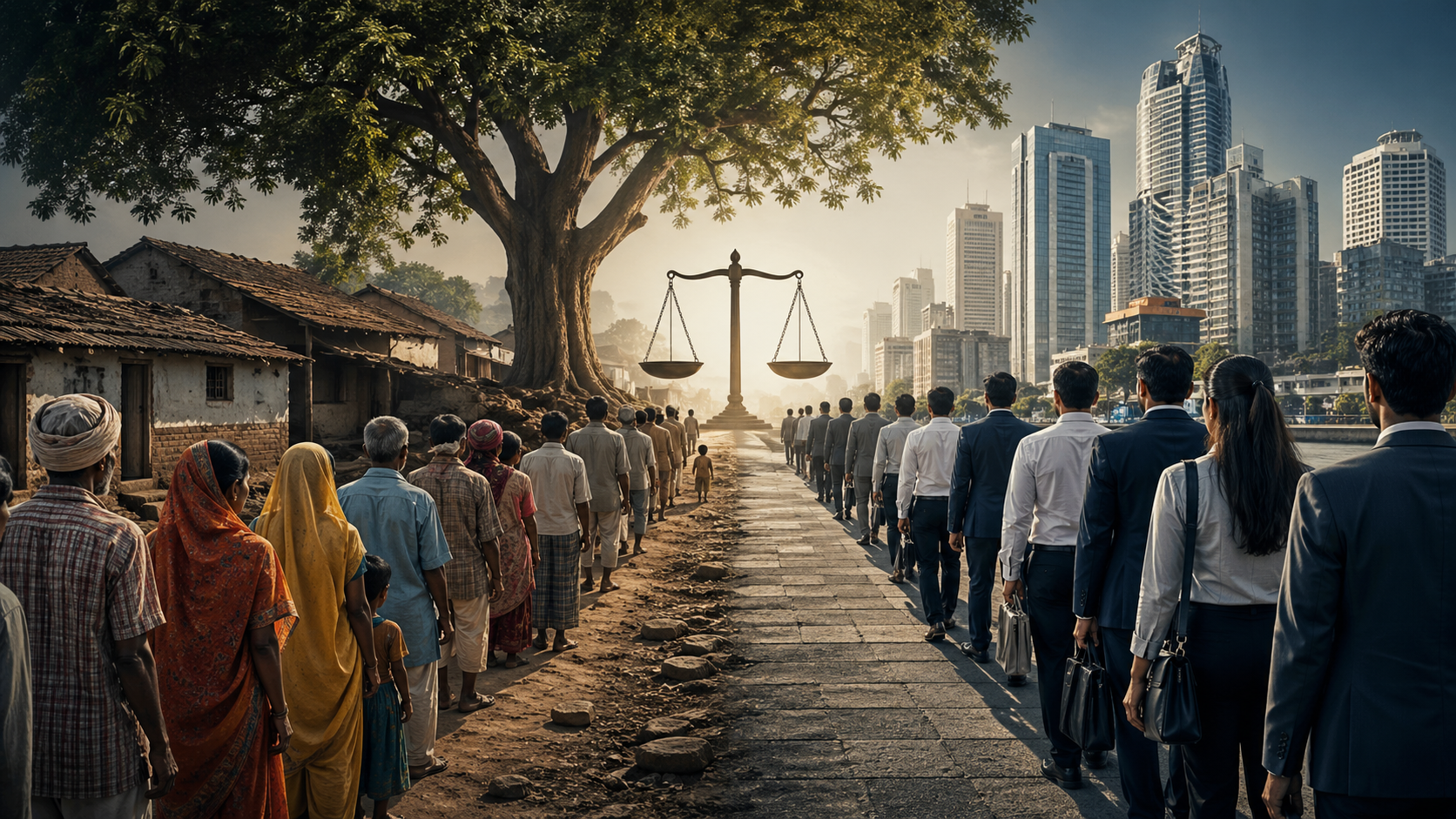
The study of Indian society has long revolved around two foundational axes of stratification: caste and class. While caste represents a historically entrenched system rooted in ritual hierarchy and hereditary status, class is a comparatively modern construct associated with economic position, occupation, and access to resources. The intersection of caste and class offers a complex framework through which inequality, mobility, power, and identity can be understood in contemporary India.
Sociologists have debated whether caste is declining and being replaced by class, or whether caste continues to shape class structures in subtle and overt ways. Scholars such as B. R. Ambedkar, M. N. Srinivas, and Andre Beteille have contributed significantly to understanding how caste and class interact rather than operate as isolated systems.
This article explores the intersection of caste and class in Indian society from a sociological perspective, examining historical foundations, theoretical debates, empirical realities, and contemporary transformations.
Understanding Caste and Class
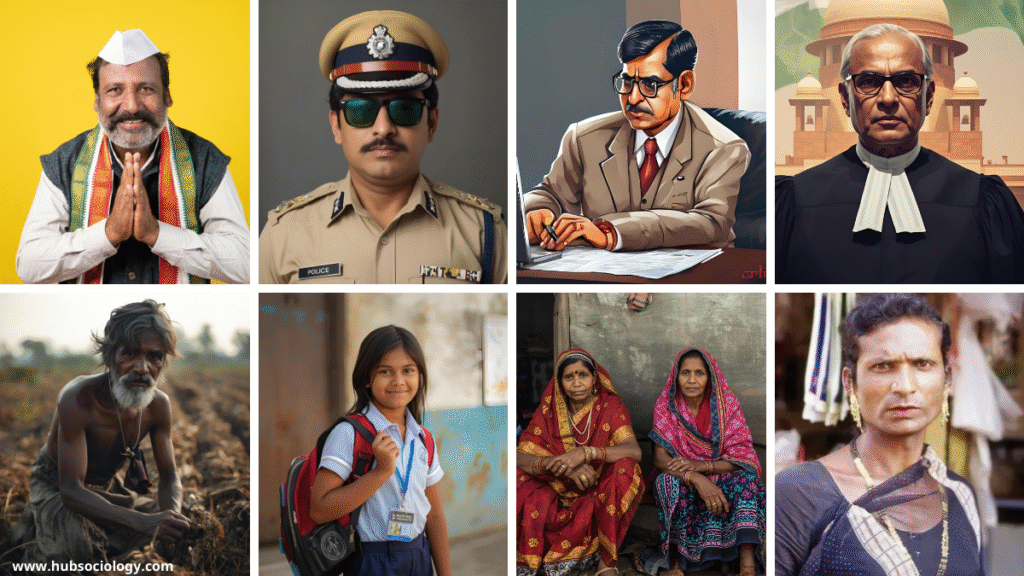
Caste: A System of Social Stratification
Caste, or jati, is a hereditary and endogamous social group characterized by:
- Occupational specialization
- Ritual hierarchy
- Restrictions on social interaction
- Social closure
The broader framework of caste is often linked to the varna system—Brahmin, Kshatriya, Vaishya, and Shudra—though in practice, thousands of jatis exist across India.
Caste is traditionally associated with notions of purity and pollution, where social status is determined by birth and maintained through rigid social norms. It is deeply embedded in cultural, religious, and social institutions.
Class: An Economic and Social Category
Class, in contrast, refers to a system based on economic differentiation. Rooted in the ideas of Karl Marx and Max Weber, class is determined by:
- Ownership of means of production
- Income and wealth
- Occupational status
- Life chances
Class is theoretically more fluid than caste, allowing for social mobility based on individual achievement.
Theoretical Perspectives on Caste-Class Intersection
Marxist Perspective
From a Marxist viewpoint, class is the primary determinant of social relations. Marxists argue that economic structures shape all forms of inequality, including caste. However, applying this framework to India reveals limitations, as caste cannot be fully reduced to class.
Indian Marxists have argued that caste often functions as a form of “pre-capitalist class structure,” but this interpretation overlooks the cultural and symbolic dimensions of caste.
Weberian Approach
Max Weber introduced a multidimensional view of stratification, distinguishing between class, status, and power. In the Indian context, caste aligns closely with “status groups,” where social honor and prestige play a crucial role.
This perspective helps explain why individuals from lower castes may experience social exclusion even if they achieve economic success.
Structural-Functionalism
Scholars like M. N. Srinivas viewed caste as a dynamic system capable of change. Concepts such as “Sanskritization” illustrate how lower castes adopt upper-caste practices to improve their status.
However, this mobility is often symbolic rather than structural, and does not necessarily translate into economic advancement.
Intersectionality
Contemporary sociology employs the concept of intersectionality to analyze how caste and class overlap with other axes such as gender, religion, and region. This approach highlights the layered nature of inequality in India.
Historical Evolution of Caste-Class Relations
Pre-Colonial Period
In pre-colonial India, caste and occupation were closely linked. Economic roles were largely determined by caste, leading to a fusion of caste and class identities. Land ownership, artisanal skills, and trade were distributed along caste lines.
Colonial Period
The colonial era introduced significant changes:
- Monetization of the economy
- Introduction of land revenue systems
- Emergence of new professions
These developments disrupted traditional caste-based occupations and created new class formations. However, caste identities persisted and adapted to changing economic conditions.
Post-Independence India
After independence in 1947, India adopted a democratic framework emphasizing equality and social justice. Policies such as:
- Reservation for Scheduled Castes and Scheduled Tribes
- Land reforms
- Expansion of education
aimed to reduce caste-based inequalities. Despite these efforts, caste continues to influence access to economic opportunities.
Empirical Realities of Caste-Class Intersection
Rural India
In rural areas, caste and class often overlap significantly. Land ownership, a key determinant of class, is still largely concentrated among upper castes.
Lower castes and Dalits are disproportionately represented among:
- Landless laborers
- Marginal farmers
- Informal workers
This overlap reinforces both economic and social inequality.
Urban India
Urbanization has introduced new dynamics:
- Occupational diversification
- Increased anonymity
- Greater opportunities for mobility
However, caste continues to influence:
- Hiring practices
- Social networks
- Residential segregation
Even in cities, upper-caste dominance is evident in elite professions such as academia, corporate leadership, and media.
Education and Mobility
Education is often seen as a pathway to class mobility. Government policies have expanded access to education for marginalized groups. However, disparities remain:

- Quality of education varies significantly
- Elite institutions are dominated by upper castes
- Social capital influences academic success
Thus, while education can facilitate class mobility, caste continues to shape educational outcomes.
Caste-Class Dynamics in the Labor Market
The labor market reflects the intersection of caste and class in multiple ways:
- Informal sector employment is dominated by lower castes
- Upper castes are overrepresented in high-paying, secure jobs
- Discrimination persists in hiring and promotion
Studies have shown that identical resumes with caste-identifiable names receive different responses, indicating ongoing caste bias.
Political Dimensions
Caste-Based Politics
Caste plays a central role in Indian politics. Political mobilization often occurs along caste lines, with parties appealing to specific caste groups.
Leaders like B. R. Ambedkar emphasized political representation as a means of empowerment for marginalized communities.
Class Politics
Class-based movements, such as labor unions and किसान आंदोलनों (farmers’ movements), also shape Indian politics. However, these movements are often fragmented by caste divisions.
Intersection in Political Mobilization
In recent decades, there has been a convergence of caste and class in political discourse. For example:
- OBC (Other Backward Classes) politics combines caste identity with economic demands
- Dalit movements emphasize both social dignity and economic rights
Globalization and Liberalization
The economic reforms of 1991 introduced liberalization, privatization, and globalization. These changes have had mixed effects:
Positive Impacts
- Expansion of middle class
- New employment opportunities
- Increased consumerism
Negative Impacts
- Growing income inequality
- Marginalization of unskilled workers
- Persistence of caste-based exclusion
Globalization has not erased caste; instead, it has reconfigured its relationship with class.
Gender, Caste, and Class
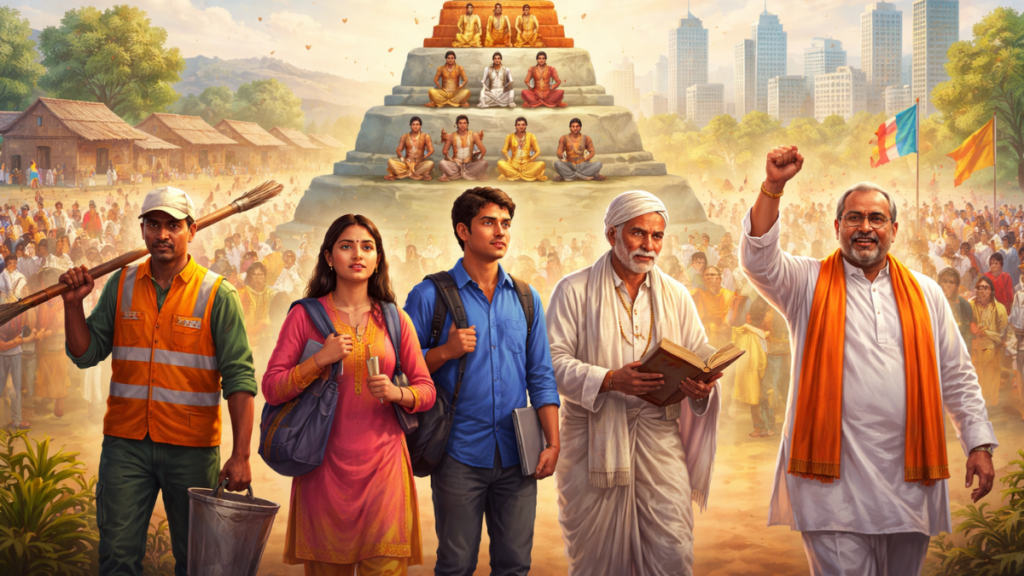
The intersection of caste and class is further complicated by gender. Dalit and lower-caste women often face triple marginalization:
- Economic exploitation
- Social discrimination
- Gender-based violence
This highlights the need for an intersectional approach to understanding inequality.
Contemporary Debates
Is Caste Declining?
Some scholars argue that caste is losing its significance in urban and modern contexts. They point to:
- Inter-caste marriages
- Occupational mobility
- Rise of individualism
However, empirical evidence suggests that caste remains a powerful force.
Is Class Replacing Caste?
Others argue that class is becoming more important than caste. While class dynamics are indeed gaining prominence, they do not operate independently of caste.
Persistence of Caste-Class Nexus
Most sociologists agree that caste and class are intertwined. Rather than replacing each other, they interact in complex ways to shape social outcomes.
Case Studies
The Rise of the Dalit Middle Class
Affirmative action and education have enabled the emergence of a Dalit middle class. This group challenges traditional caste hierarchies and asserts new forms of identity.
However, they often face:
- Social exclusion
- Tokenism
- Psychological stress
Upper-Caste Poverty
While upper castes generally enjoy advantages, there are instances of economic deprivation among them. This challenges the assumption that caste always determines class.
Media and Representation
Media plays a crucial role in shaping perceptions of caste and class:
- Underrepresentation of marginalized groups
- Stereotyping of lower castes
- Dominance of upper-caste narratives
Digital platforms, however, have opened new spaces for marginalized voices.
Policy Implications
Addressing the intersection of caste and class requires:
- Strengthening affirmative action policies
- Improving quality of education
- Ensuring equitable access to resources
- Promoting social awareness
Policies must recognize that economic inequality cannot be addressed without tackling caste-based discrimination.
Conclusion on Intersection of Caste and Class
The intersection of caste and class in Indian society is a complex and evolving phenomenon. While modernization, urbanization, and globalization have introduced new class dynamics, caste continues to shape social relations in profound ways.
Rather than viewing caste and class as competing frameworks, it is more accurate to see them as interconnected systems of stratification. Understanding their intersection is essential for addressing inequality and promoting social justice in India.
The challenge for contemporary society is not merely to reduce economic disparities but to dismantle the deep-rooted social hierarchies that perpetuate exclusion. Only by addressing both caste and class can India move towards a more equitable and inclusive future.
FAQs: Intersection of Caste and Class
1. What is the Intersection of Caste and Class?
The Intersection of Caste and Class refers to how hereditary caste hierarchies and economic class structures overlap to shape inequality, opportunities, and social mobility in Indian society.
2. Why is the Intersection of Caste and Class important in sociology?
It is important because it helps explain why economic inequality in India cannot be understood without considering caste-based social stratification.
3. How does caste influence class in India?
Caste often determines access to resources such as education, land, and jobs, which in turn shapes an individual’s class position.
4. Can class mobility eliminate caste discrimination?
No, even when individuals achieve economic mobility, caste-based discrimination may persist in social and cultural interactions.
5. How does rural India reflect the Intersection of Caste and Class?
In rural areas, land ownership and occupational roles are strongly tied to caste, making caste and class closely interconnected.
6. What is the role of education in the Intersection of Caste and Class?
Education can improve class mobility, but unequal access and social barriers rooted in caste limit its effectiveness.
7. How does urbanization affect the Intersection of Caste and Class?
Urbanization creates opportunities for class mobility, but caste continues to influence hiring, housing, and social networks.
8. What did B. R. Ambedkar say about caste and class?
He argued that caste is a fundamental social evil that must be eradicated to achieve true social and economic equality.
9. How does the Intersection of Caste and Class affect the labor market?
Lower castes are overrepresented in informal and low-paying jobs, while upper castes dominate high-income professions.
10. What is the role of reservation policies in addressing the Intersection of Caste and Class?
Reservation policies aim to reduce inequality by providing opportunities to historically disadvantaged caste groups.
11. How does globalization influence the Intersection of Caste and Class?
Globalization has created new economic opportunities but has not eliminated caste-based inequalities.
12. What is the relationship between caste, class, and gender?
Women from lower castes often face compounded disadvantages due to the combined effects of caste, class, and gender.
13. Is caste becoming less important than class in India?
While class is gaining importance, caste continues to significantly influence social and economic outcomes.
14. What is the Dalit middle class in the context of the Intersection of Caste and Class?
It refers to individuals from historically marginalized castes who have achieved economic mobility but may still face social discrimination.
15. How can India address the Intersection of Caste and Class?
Through inclusive policies, quality education, social awareness, and efforts to eliminate caste-based discrimination.