Introduction
The state of Washington has emerged as one of the most technologically advanced and economically dynamic regions in the United States. Anchored by global tech giants such as Microsoft and Amazon, Washington’s economy has undergone a profound transformation over the past three decades. Cities like Seattle and Redmond have become hubs of innovation, attracting skilled labor, investment, and global attention.
However, this rapid technological expansion has also produced significant social inequalities. While the technology sector has generated immense wealth and opportunities, it has simultaneously deepened divides across class, race, and geography. From rising housing costs to labor market polarization, the benefits of the technology economy are unevenly distributed.

This article examines the relationship between technology-driven economic growth and social inequality in Washington from a sociological perspective, focusing on structural changes, social stratification, and the lived experiences of different communities.
The Rise of the Technology Economy in Washington
The transformation of Washington’s economy into a technology powerhouse began in the late 20th century. The establishment and expansion of companies like Microsoft in Redmond and Amazon in Seattle played a pivotal role in shaping the state’s economic trajectory.
From a sociological perspective, this shift represents a transition from an industrial and resource-based economy to a knowledge-based economy. The rise of the tech sector brought high-paying jobs, innovation, and global competitiveness. It also led to the clustering of talent, capital, and infrastructure in urban centers, particularly in Seattle.
The concept of the “innovation hub” is central here. Cities like Seattle have become nodes in the global network of technological production, attracting software engineers, data scientists, and entrepreneurs from across the world. This process aligns with the theory of economic globalization, where certain regions gain prominence due to their integration into global markets.
However, this concentration of economic activity has not been evenly distributed across the state. Rural areas and smaller towns have largely been excluded from the benefits of technological growth, creating a spatial dimension of inequality.
Labor Market Transformation and Class Stratification
One of the most significant sociological impacts of the technology economy in Washington is the transformation of the labor market. The rise of high-skill, high-wage jobs in the tech sector has led to a phenomenon known as labor market polarization.
At the top of the labor hierarchy are highly educated professionals working in technology firms. These individuals enjoy high salaries, job security, and access to social and cultural capital. At the bottom are low-wage service workers, including retail employees, food service workers, and gig economy participants, who often lack job security and benefits.

This bifurcation reflects the theory of social stratification, where society is divided into hierarchical layers based on income, education, and occupation. The technology economy has intensified these divisions by rewarding specialized skills while marginalizing those without access to higher education or technical training.
Moreover, the gig economy—facilitated by platforms associated with companies like Amazon—has introduced new forms of precarious labor. Workers in delivery, warehousing, and contract-based roles often face unstable employment conditions, long hours, and limited protections.
Housing Crisis and Urban Inequality
The rapid growth of the technology sector has had profound effects on housing in Washington, particularly in Seattle. The influx of high-income professionals has driven up demand for housing, leading to skyrocketing property prices and rents.
From a sociological standpoint, this reflects the process of gentrification, where wealthier individuals move into urban neighborhoods, displacing lower-income residents. Longtime residents, including working-class families and minority communities, are often forced to relocate to more affordable areas, disrupting social networks and community cohesion.
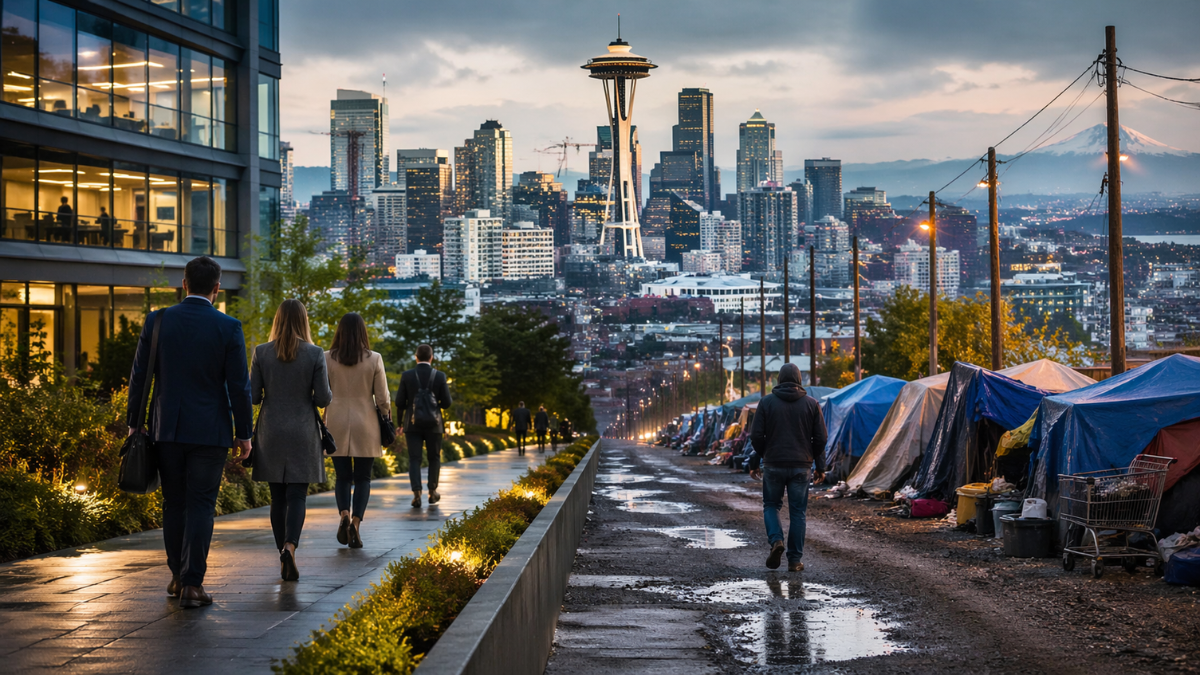
The housing crisis has also exacerbated homelessness in the state. Despite Washington’s economic prosperity, many individuals struggle to afford basic shelter. This paradox highlights the uneven distribution of wealth and the limitations of market-driven development.
Urban inequality is further reinforced by the spatial segregation of different socioeconomic groups. Affluent neighborhoods with access to quality schools, healthcare, and amenities coexist alongside marginalized communities facing limited resources and opportunities.
Racial and Ethnic Inequalities
Social inequality in Washington’s technology economy is not only economic but also racial and ethnic. While the tech sector prides itself on innovation and diversity, it remains predominantly dominated by certain demographic groups.
Racial minorities, including African Americans, Hispanic communities, and Indigenous populations, are underrepresented in high-paying tech jobs. Structural barriers such as unequal access to education, systemic discrimination, and lack of professional networks contribute to this disparity.
The concept of intersectionality is useful in understanding how race, class, and gender intersect to produce complex forms of inequality. For example, women of color in Washington face multiple layers of disadvantage in accessing opportunities within the technology sector.
Additionally, immigrant workers play a significant role in the tech economy, particularly in skilled positions. While some benefit from high-paying jobs, others face challenges related to visa restrictions, job insecurity, and social integration.
Education and the Digital Divide
Education is a key factor in determining access to opportunities in the technology economy. In Washington, disparities in educational attainment contribute to social inequality.

Schools in affluent areas often have better resources, advanced technology, and experienced teachers, preparing students for careers in STEM fields. In contrast, schools in low-income communities may lack adequate funding and infrastructure, limiting students’ access to quality education.
The digital divide further exacerbates these inequalities. Access to computers, high-speed internet, and digital literacy varies significantly across different socioeconomic groups. During events such as the COVID-19 pandemic, these disparities became particularly evident, as students from disadvantaged backgrounds struggled to participate in online learning.
From a sociological perspective, education serves as both a pathway to upward mobility and a mechanism for reproducing inequality. The unequal distribution of educational resources reinforces existing social hierarchies.
Rural-Urban Divide
The benefits of Washington’s technology economy are heavily concentrated in urban areas, particularly Seattle and its आसपास regions. Rural communities, on the other hand, have not experienced the same level of economic growth.
This rural-urban divide reflects broader patterns of regional inequality. While urban centers thrive on innovation and investment, rural areas often rely on traditional industries such as agriculture and manufacturing, which have faced decline.
Limited access to infrastructure, including broadband internet, further marginalizes rural communities. This lack of connectivity restricts participation in the digital economy and limits opportunities for economic diversification.
Sociologically, this divide highlights the uneven development of regions within a single state, raising questions about equitable growth and resource distribution.
Cultural Changes and Social Identity
The rise of the technology economy has also influenced cultural norms and social identities in Washington. The influx of highly educated professionals has transformed the cultural landscape of cities like Seattle.
New forms of consumption, lifestyle patterns, and social values have emerged, often associated with the tech industry. These include a focus on innovation, entrepreneurship, and digital connectivity.
However, these changes can create cultural tensions between different groups. Longtime residents may feel alienated by the rapid transformation of their communities, while newcomers may struggle to integrate into existing social networks.
The concept of cultural capital is relevant here. Individuals with the knowledge, skills, and behaviors valued in the tech economy are better positioned to succeed, while others may be excluded.
Policy Responses and Social Justice
Addressing social inequality in Washington requires effective policy interventions. State and local governments have implemented various measures to mitigate the negative impacts of the technology economy.
These include affordable housing initiatives, minimum wage increases, and investments in education and workforce development. Programs aimed at increasing diversity in the tech sector have also been introduced.
However, the effectiveness of these policies remains a subject of debate. Critics argue that they are insufficient to address the structural causes of inequality, while others emphasize the need for more comprehensive and inclusive approaches.
From a sociological perspective, achieving social justice requires addressing both economic and social dimensions of inequality. This includes redistributing resources, promoting equal opportunities, and challenging systemic barriers.
Theoretical Perspectives
Several sociological theories can help explain the relationship between technology and inequality in Washington.
Marxist theory highlights the role of capitalism in producing inequality, emphasizing the concentration of wealth and power in the hands of a few. The tech industry, with its immense profits and influence, exemplifies this dynamic.
Weberian theory focuses on the role of status, power, and social closure in shaping inequality. Access to education, professional networks, and credentials plays a crucial role in determining who benefits from the technology economy.
Functionalist perspectives, on the other hand, may argue that inequality is a necessary feature of society, providing incentives for innovation and productivity. However, critics contend that excessive inequality undermines social cohesion and stability.
Conclusion
The technology economy in Washington represents both opportunity and challenge. While it has driven economic growth and positioned the state as a global leader in innovation, it has also deepened social inequalities across multiple dimensions.
From labor market polarization to housing crises, racial disparities, and regional divides, the impacts of technological development are complex and multifaceted. A sociological analysis reveals that these inequalities are not merely accidental but are rooted in structural and systemic factors.
Addressing these challenges requires a holistic approach that combines economic policies with social interventions. Ensuring equitable access to education, housing, and employment opportunities is essential for creating a more inclusive and just society.
As Washington continues to evolve as a technology hub, the question remains: can it balance innovation with equity? The answer will shape not only the future of the state but also provide lessons for other regions navigating the intersection of technology and society.
FAQs: Social Inequality in Washington
- What is Social Inequality in Washington?
Social Inequality in Washington refers to the unequal distribution of income, opportunities, and resources among different social groups within the state. - How does the technology sector influence Social Inequality in Washington?
The growth of companies like Amazon and Microsoft has created high-paying jobs but also widened the gap between skilled professionals and low-wage workers, increasing Social Inequality in Washington. - Why is housing a major factor in Social Inequality in Washington?
Rising housing costs, especially in Seattle, have displaced lower-income residents, contributing significantly to Social Inequality in Washington. - How does education impact Social Inequality in Washington?
Unequal access to quality education and digital resources limits opportunities for disadvantaged groups, reinforcing Social Inequality in Washington. - What role does the gig economy play in Social Inequality in Washington?
Gig work often lacks job security and benefits, placing workers in vulnerable positions and increasing Social Inequality in Washington. - Is Social Inequality in Washington linked to race and ethnicity?
Yes, racial and ethnic minorities often face systemic barriers in employment, education, and housing, which intensify Social Inequality in Washington. - How does the rural-urban divide affect Social Inequality in Washington?
Urban areas benefit more from technological growth, while rural regions lag behind, creating geographic disparities in Social Inequality in Washington. - What is labor market polarization in the context of Social Inequality in Washington?
It refers to the division between high-paying tech jobs and low-wage service jobs, which deepens Social Inequality in Washington. - How has gentrification contributed to Social Inequality in Washington?
Gentrification has increased living costs and displaced long-term residents, worsening Social Inequality in Washington. - What is the digital divide and its role in Social Inequality in Washington?
The digital divide refers to unequal access to technology and internet services, which limits opportunities and reinforces Social Inequality in Washington. - How does immigration affect Social Inequality in Washington?
While skilled immigrants benefit from tech jobs, others face legal and economic challenges, contributing to Social Inequality in Washington. - Are women equally represented in reducing Social Inequality in Washington?
Women, especially women of color, face barriers in the tech industry, which affects efforts to reduce Social Inequality in Washington. - What policies address Social Inequality in Washington?
Policies such as affordable housing programs and education reforms aim to reduce Social Inequality in Washington, though challenges remain. - How does wealth concentration impact Social Inequality in Washington?
The concentration of wealth among tech elites increases the gap between rich and poor, intensifying Social Inequality in Washington. - Can Social Inequality in Washington be reduced?
Yes, through inclusive policies, equitable education, and fair economic practices, Social Inequality in Washington can be gradually reduced.
1 thought on “Technology Economy and Social Inequality in Washington: A Sociological Analysis”