
Introduction
Over the last four decades, social and economic inequality has become one of the most defining features of contemporary American society. While the United States is often portrayed as a land of opportunity, empirical evidence suggests that opportunities are increasingly unevenly distributed. Income gaps have widened, wealth has become concentrated in fewer hands, and social mobility has stagnated for large sections of the population. From a sociological perspective, rising inequality is not merely an economic issue; it is a structural phenomenon deeply embedded in institutions, power relations, and historical processes.
This article examines why inequality is rising in America by analyzing economic transformations, class structures, political power, race and gender dynamics, education systems, and cultural ideologies. Rather than viewing inequality as a result of individual failure or merit alone, sociology highlights how systemic forces shape unequal life chances.

Understanding Inequality in Sociological Terms
Inequality refers to the unequal distribution of valued resources such as income, wealth, education, health, and political power. Sociologists emphasize that inequality is structured, meaning it is produced and maintained by social institutions rather than random differences among individuals.
In the American context, inequality operates across multiple dimensions: class, race, gender, and geography. These dimensions intersect, creating layered disadvantages for certain social groups. The rise in inequality reflects changes not only in the economy but also in social norms, state policies, and power relations.
Economic Restructuring and the Decline of the Middle Class
One of the most significant contributors to rising inequality in America is economic restructuring since the late twentieth century. The shift from a manufacturing-based economy to a service- and finance-driven economy fundamentally altered class relations.
Manufacturing jobs once provided stable employment, decent wages, and benefits for working- and middle-class Americans, even for those without advanced education. Deindustrialization led to factory closures, job outsourcing, and automation. As a result, millions of workers experienced wage stagnation or downward mobility.
At the same time, high-paying jobs expanded in finance, technology, and professional services, sectors that require advanced skills and education. This polarization of the labor market created a growing divide between high-income professionals and low-wage service workers, hollowing out the middle class.
Wage Stagnation and the Power Imbalance in Labor Markets
Despite increases in productivity, wages for most American workers have remained relatively stagnant. Sociologists argue that this disconnect between productivity and wages reflects shifts in power rather than economic necessity.
The decline of labor unions has played a crucial role. Unions historically negotiated higher wages, better working conditions, and social protections. Their weakening reduced workers’ bargaining power, allowing employers to suppress wages while increasing profits.
Additionally, the rise of precarious employment, such as contract work, gig labor, and part-time jobs, has increased economic insecurity. These forms of employment transfer risk from employers to workers, reinforcing inequality and limiting upward mobility.
Wealth Inequality and Intergenerational Advantage
While income inequality is significant, wealth inequality is even more pronounced. Wealth includes assets such as property, savings, investments, and inheritance, which provide long-term security and power.
Sociologically, wealth inequality matters because wealth is cumulative and intergenerational. Families with wealth can invest in better education, healthcare, housing, and social networks for their children. In contrast, families without wealth remain vulnerable to economic shocks.
In America, wealth accumulation has increasingly favored the top segments of society, particularly through financial markets and real estate. Tax policies that favor capital gains over wages further accelerate wealth concentration. As a result, inequality persists across generations, challenging the ideal of equal opportunity.
Education and the Reproduction of Inequality
Education is often presented as the primary solution to inequality. However, sociology shows that education systems can also reproduce social inequality.
Access to quality education in America is strongly linked to socioeconomic status and residential location. Wealthier families can afford better schools, private tutoring, and extracurricular activities, while underfunded public schools struggle to provide equal opportunities.
Higher education, once a pathway to mobility, has become increasingly expensive. Student debt disproportionately affects lower- and middle-income students, limiting their future economic choices. Meanwhile, elite institutions remain dominated by students from privileged backgrounds, reinforcing class divisions.
Race, Ethnicity, and Structural Inequality
Rising inequality in America cannot be understood without examining race and ethnicity. Historical legacies of slavery, segregation, and discrimination have shaped present-day inequalities.
Racial minorities, particularly African Americans and Hispanic Americans, experience higher rates of poverty, unemployment, and wealth deprivation. These disparities are not simply the result of individual choices but reflect systemic barriers such as residential segregation, unequal schooling, and labor market discrimination.

Sociologically, race operates as a structural factor that intersects with class. Even middle-class racial minorities often face disadvantages compared to their white counterparts, demonstrating that inequality is multidimensional and deeply embedded.
Gender Inequality and Economic Stratification
Gender remains another crucial dimension of rising inequality. Although women’s participation in the labor force has increased, gender-based wage gaps persist.
Women are overrepresented in low-paying sectors such as caregiving, education, and service work. These occupations are often undervalued despite their social importance. Additionally, unpaid domestic labor continues to fall disproportionately on women, limiting their career advancement.
Intersectional analysis shows that women of color experience compounded disadvantages due to both gender and racial inequalities. Thus, rising inequality in America reflects not only class divisions but also gendered power relations.
Political Power, Policy, and Inequality
Sociologists emphasize that inequality is shaped by political decisions. Public policies influence taxation, welfare, education funding, labor rights, and healthcare access.
In recent decades, policy shifts have favored market-oriented approaches, deregulation, and reduced social spending. Tax cuts for the wealthy, reduced corporate regulation, and weakened welfare programs have contributed to rising inequality.
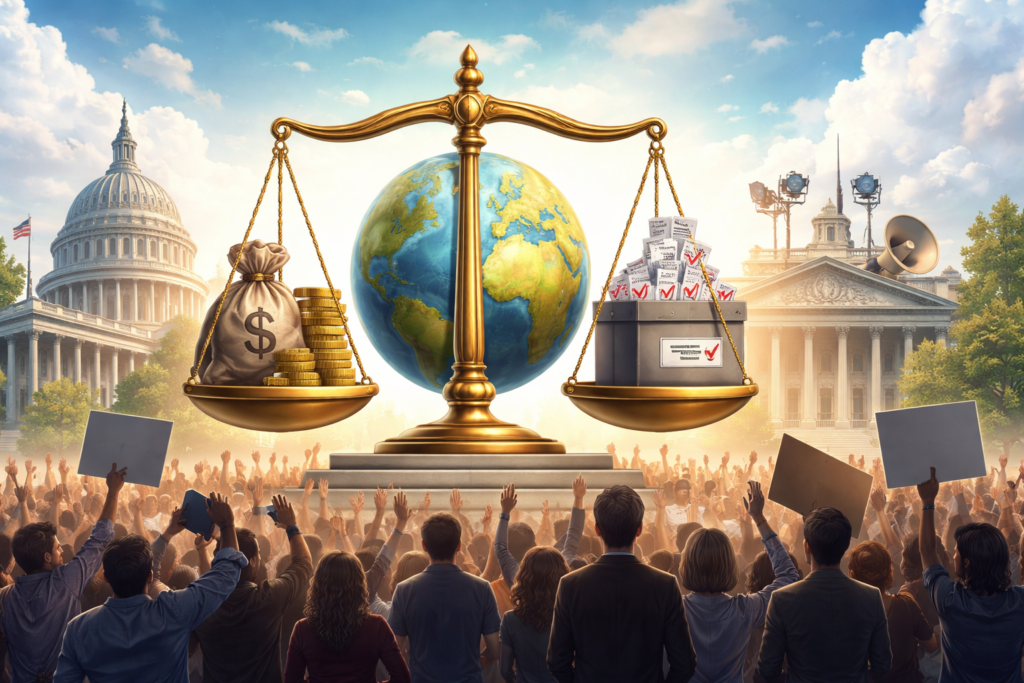
Moreover, economic inequality translates into political inequality. Wealthier individuals and corporations exert disproportionate influence over political processes through lobbying and campaign financing. This creates a feedback loop where policies increasingly reflect elite interests rather than the needs of the majority.
Cultural Ideology and the Myth of Meritocracy
American culture strongly emphasizes individualism and meritocracy—the belief that success results from hard work and talent. While these values can be motivating, sociologists argue that they also obscure structural inequalities.
By framing inequality as a consequence of individual effort, meritocratic ideology shifts attention away from systemic barriers. Those who succeed are seen as deserving, while those who struggle are often blamed for their circumstances.
This cultural narrative reduces public support for redistributive policies and social welfare programs, allowing inequality to persist with limited resistance.
Technology, Automation, and the Future of Inequality
Technological change has further intensified inequality. Automation and artificial intelligence disproportionately affect low- and middle-skilled jobs, while high-skilled workers benefit from increased demand and wages.
Digital divides in access to technology and digital skills exacerbate existing inequalities. Without inclusive policies, technological progress risks deepening social stratification rather than promoting shared prosperity.
Social Consequences of Rising Inequality
From a sociological perspective, rising inequality has profound consequences for social cohesion and democracy. High inequality is associated with reduced trust, increased crime rates, poorer health outcomes, and lower social mobility.
Communities become more segregated by class and race, weakening social bonds. Political polarization intensifies as economic insecurity fuels resentment and social conflict.
Ultimately, inequality undermines the very foundations of a democratic society by limiting equal participation and shared opportunity.
Conclusion
Rising inequality in America is not an accidental or purely economic phenomenon. It is the result of structural transformations in the economy, shifts in political power, enduring racial and gender inequalities, and cultural ideologies that legitimize unequal outcomes.
A sociological perspective reveals that addressing inequality requires more than individual effort or market solutions. It demands structural reforms in education, labor markets, taxation, and social welfare, along with a cultural shift toward recognizing inequality as a collective social issue.
Understanding why inequality is rising is the first step toward imagining a more just and inclusive American society—one where opportunity is not inherited but genuinely accessible to all.
Frequently Asked Questions (FAQs): Why Inequality Is Rising in America
1. Why inequality is rising in America despite economic growth?
Inequality is rising in America because economic growth has benefited high-income groups disproportionately, while wages for middle- and low-income workers have largely stagnated.
2. How does sociology explain why inequality is rising in America?
From a sociological perspective, inequality is rising in America due to structural factors such as class divisions, institutional bias, and unequal access to power and resources.
3. Why inequality is rising in America in terms of income distribution?
Income inequality has increased because earnings at the top have grown rapidly, while the majority of workers have experienced minimal wage growth.
4. What role does capitalism play in why inequality is rising in America?
Capitalist market systems tend to concentrate wealth among owners of capital, which explains why inequality is rising in America under market-driven policies.
5. Why inequality is rising in America even with higher education levels?
Although education levels have increased, unequal access to quality education and student debt burdens mean that education alone cannot reduce inequality.
6. How does wealth concentration explain why inequality is rising in America?
Wealth concentration allows affluent families to pass advantages across generations, reinforcing long-term inequality.
7. Why inequality is rising in America among racial groups?
Historical discrimination and ongoing structural racism have caused racial minorities to face persistent economic disadvantages.
8. How do labor market changes affect why inequality is rising in America?
The decline of unions, rise of contract work, and job insecurity have weakened workers’ bargaining power, increasing inequality.
9. Why inequality is rising in America despite welfare programs?
Limited social welfare coverage and reduced government spending have failed to adequately address structural inequality.
10. How does political influence explain why inequality is rising in America?
Economic elites exert disproportionate influence over policy decisions, shaping laws that favor wealth accumulation at the top.
11. Why inequality is rising in America in terms of gender?
Gender wage gaps and unpaid care responsibilities contribute significantly to rising inequality among women.
12. How does technology contribute to why inequality is rising in America?
Automation and digital skill gaps benefit high-skilled workers while displacing low-skilled labor.
13. Why inequality is rising in America across generations?
Intergenerational transfer of wealth and limited upward mobility trap disadvantaged families in persistent inequality.
14. How does meritocracy relate to why inequality is rising in America?
The belief in meritocracy often hides structural barriers, reducing support for policies that could reduce inequality.
15. Why inequality is rising in America and why it matters for society?
Rising inequality weakens social cohesion, limits democracy, and increases social conflict, making it a critical sociological issue.